eBook - ePub
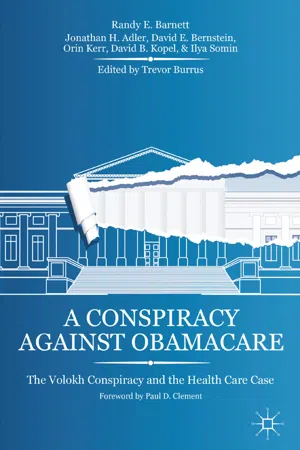
A Conspiracy Against Obamacare
The Volokh Conspiracy and the Health Care Case
- English
- ePUB (mobile friendly)
- Available on iOS & Android
eBook - ePub
A Conspiracy Against Obamacare
The Volokh Conspiracy and the Health Care Case
About this book
The Affordable Care Act debate was one of the most important and most public examinations of the Constitution in our history. At the forefront of that debate were the bloggers of the Volokh Conspiracy who, from before the law was even passed, engaged in a spirited, erudite, and accessible discussion of the legal issues involved in the case.
Information
1
In the Beginning
From the moment he took office, President Barack Obama saw health care reform as one of his administration’s top priorities. In February 2009, President Obama announced to a joint session of Congress that discussions on reforming American health care would move forward as a priority. Meetings were held with industry leaders, lobbyists, and influential senators and members of Congress over the next many months.
The discussions in this chapter occurred prior to the signing of the final version of the Affordable Care Act (ACA). As Congress, pundits, and average Americans debated health care reform, so too did the Volokh Conspiracy (VC) bloggers.
On November 7, 2009, the House of Representatives passed the “Affordable Health Care for America Act” by a 220–215 vote, with 39 Democrat votes against and 1 Republican vote in favor.
In the Senate, the road was more difficult. Senate Republicans vowed to filibuster, so any bill needed a filibuster-proof 60 votes. Having only 58 votes at the time (before Senator Al Franken (D-MN) won his recount and before Arlen Spector switched parties), Senate Democrats had to appease their more centrist colleagues. The Democrats were further stymied when, in late August, before the bill could come up for a vote, Senator Ted Kennedy (D-MA) succumbed to brain cancer.
Senate Democrats focused on getting the votes of their moderate colleagues, particularly Connecticut’s Joe Lieberman and Nebraska’s Ben Nelson. Lieberman would not support any bill that had a “public option”—that is, a government-run insurance program that competes with private insurers. In exchange for Lieberman agreeing to support the bill, Senate Majority Leader Harry Reid permanently shelved the public option provision, much to the anger of many Democrats and liberal pundits.
That left Nelson. During late-night negotiations, Reid approved several of Nelson’s “concerns,” the most famous being higher federal Medicaid payments to Nebraska, which would become known as the “Cornhusker Kickback.” Whatever name people wanted to call it, Reid got Nelson’s vote.
Early in the morning on December 24, 2009, Reid called the vote and the bill passed 60–39. All Democrats and two independents voted for; all Republicans voted against, with one abstention (Jim Bunning of Kentucky).
In January 2010, Republican Scott Brown was surprisingly elected to Ted Kennedy’s seat. Senate Democrats had lost their filibuster-proof voting bloc, but they still had the bill that was passed on Christmas Eve. It became clear that the most viable method to pass health care reform was for the House to abandon the “Affordable Health Care for America Act” and try to pass the Senate bill. Although House Majority Leader Nancy Pelosi got resistance from pro-life Democrats, on March 21, 2010, the House passed the Senate bill 219–212 despite opposition from all 178 Republicans and 34 Democrats. On March 23, 2010, President Obama signed the Patient Protection and Affordable Care Act.
The act is long and complex and, as is par for the course in modern legislation, contains many extraneous provisions. The core of the act, however, tries to expand quality health care to millions of Americans.
Insurance companies must now have a policy of “guaranteed issue,” meaning that all who want health insurance can get it regardless of preexisting medical conditions. And insurance cannot be more expensive for someone because he or she has cancer, a chronic condition, or some other expensive malady. Under the “community rating” provision insurers can only vary the price based on a few limited criteria, for example age, geographic location, and tobacco use.
To support the increased costs that will come from the guaranteed issue and community rating provisions, the law includes a constellation of subsidies, mandates, and tax credits. The most important one is the “individual mandate,” which requires essentially all Americans to purchase and maintain a qualifying health insurance plan. The mandate is backed up by a fine that is enforced by the IRS. That fact will ultimately be crucial to the outcome of this saga.
The individual mandate is a central character in this book, arguably the star. Although other aspects of the law were challenged, are being challenged, and will continue to be challenged, no challenged provision caught the public’s attention like the individual mandate. Not only is it easy to understand and directly relevant to every American’s life—“You mean I have to buy insurance even if I don’t want it?”—but it also gnaws at the limited government sensibilities that are a constant part of American political culture.
As our story begins, the individual mandate takes center stage.
* * *
Is Obamacare Constitutional?
David B. Kopel
August 17, 2009
Independence Institute Senior Fellow (and University of Montana constitutional law professor) Rob Natelson suggests not.1
Natelson puts aside the question of whether it is constitutional under originalism (for which the answer is “obviously not”), and instead points to four problems under modern constitutional doctrine:
1. It is not based on any enumerated power of Congress, not even on a very expansive reading of the power to regulate interstate commerce.
2. It relies on excessive delegation of the type held unconstitutional in Schechter Poultry Corp. v. United States.2
3. It violates substantive due process and interferes with doctor-patient medical decisions to a vastly greater extent than did the laws declared unconstitutional in Roe v. Wade.3
4. It violates the Tenth Amendment by commandeering state governments.
There are a couple caveats: It’s a blog post, not a law review article, so it just sketches out the previous points briefly. It’s obviously written in the spirit of starting a public dialogue conversation. In the spirit of constructive dialogue, we promise not to say that we “don’t want the folks who created the mess to do a lot of talking.” (By “created the mess,” I mean the people who created the legislation with little apparent consideration for constitutionality and who appear to have operated from the presumption that Congress can exercise powers that are not enumerated.)
Is Obamacare Unconstitutional?
Jonathan H. Adler
August 22, 2009
David Rivkin and Lee Casey argue that a federal mandate requiring all individuals to obtain health insurance would lie beyond the scope of Congress’s enumerated powers.4 Specifically, they argue that neither the power to “regulate commerce among the several states” nor the taxing and spending power could support such an all-encompassing mandate. Here is a taste of their argument:
Although the Supreme Court has interpreted Congress’s commerce power expansively, this type of mandate would not pass muster even under the most aggressive commerce clause cases. In Wickard v. Filburn (1942), the Court upheld a federal law regulating the national wheat markets. The law was drawn so broadly that wheat grown for consumption on individual farms also was regulated. Even though this rule reached purely local (rather than interstate) activity, the Court reasoned that the consumption of homegrown wheat by individual farms would, in the aggregate, have a substantial economic effect on interstate commerce, and so was within Congress’s reach.
The Court reaffirmed this rationale in 2005 in Gonzales v. Raich, when it validated Congress’s authority to regulate the home cultivation of marijuana for personal use. In doing so, however, the justices emphasized that—as in the wheat case—“the activities regulated by the [Controlled Substances Act] are quintessentially economic.” That simply would not be true with regard to an individual health insurance mandate.
The otherwise uninsured would be required to buy coverage, not because they were even tangentially engaged in the “production, distribution or consumption of commodities,” but for no other reason than that people without health insurance exist. The federal government does not have the power to regulate Americans simply because they are there. Significantly, in two key cases, United States v. Lopez (1995) and United States v. Morrison (2000), the Supreme Court specifically rejected the proposition that the Commerce Clause allowed Congress to regulate noneconomic activities merely because, through a chain of causal effects, they might have an economic impact. These decisions reflect judicial recognition that the Commerce Clause is not infinitely elastic and that, by enumerating its powers, the framers denied Congress the type of general police power that is freely exercised by the states.
As much as I oppose the various health care reforms promoted by the Obama administration and current congressional leadership (and as much as I would like to see a more restrictive Commerce Clause jurisprudence), I do not find this argument particularly convincing. While I agree that the recent Commerce Clause cases hold that Congress may not regulate noneconomic activity, as such, they also state that Congress may reach otherwise unregulated conduct as part of an overarching regulatory scheme, where the regulation of such conduct is necessary and proper to the success of such scheme. In this case, the overall scheme would involve the regulation of “commerce” as the Supreme Court has defined it for several decades, as it would involve the regulation of health care markets. And the success of such a regulatory scheme would depend upon requiring all to participate. (Among other things, if health care reform requires insurers to issue insurance to all comers and prohibits refusals for preexisting conditions, then a mandate is necessary to prevent opportunistic behavior by individuals who simply wait to purchase insurance until they get sick.)
Jack Balkin is similarly unconvinced.5 I generally agree with his bottom line but would question some of his argument as well. First, he chides Rivkin and Casey for making an argument that would effectively invalidate the New Deal. I am not sure this is true. While some post-1937 programs might be at risk, one might also distinguish Wickard on the grounds that it involved a commodity sold in interstate commerce (wheat), whereas health insurance is a service. One might also argue that there is a difference between seeking to control the conditions of any commodity sale (its price, quantity, etc.) and mandating that a sale take place. This line would be similar to that embraced in some New Deal Commerce Clause cases that upheld federal regulations setting conditions on the manufacture of goods sold in interstate commerce while ostensibly leaving the manufacture of goods not sold in interstate markets untouched. If I recall correctly, this line was maintained until Maryland v. Wirtz6 in 1968. So while The Rivkin-Casey argument is aggressive, I don’t think it would completely overturn the New Deal.
Balkin also chides Rivkin and Casey for citing Bailey v. Drexel Furniture,7 “a case from the Lochner Era,”8 to make their case. Well, like it or not, Bailey has never been expressly overturned, and I think there’s a good reason for that. In Bailey, the Court held that Congress could not use the taxing power to regulate behavior that would otherwise lie beyond the scope of the federal government’s other enumerated powers. This may well be true. The problem with Bailey, then, is not its view of the taxing power but rather the Bailey court’s restrained view of the federal commerce power. What makes Bailey and other cases largely irrelevant today is that there is so little that the federal government seeks to tax that it cannot otherwise regulate. I’d also note that it is not as if the Court is averse to relying upon other cases with Lochner v. New York–era pedigrees. Indeed, Meyer v. Nebraska9 and Pierce v. Society of Sisters10 are still good law, and each is closer kin to Lochner than Bailey, as they relied upon Lochner’s substantive due process rationale.
Speaking of substantive due process, there may be other constitutional problems arising from national health care reform—but not of the enumerated powers variety. While the federal government may be able to require national health insurance coverage, could it require all individuals to purchase plans that cover certain procedures? What if the guidelines for acceptable plans include contraception, abortion, and certain types of end-of-life care? Could the federal government require devout Catholics to purchase such plans for themselves? Insofar as a new feder...
Table of contents
- Title Page
- Copyright Page
- Contents
- Foreword
- Acknowledgments
- Introduction
- 1: In the Beginning
- 2: The Law Is Passed
- 3: The First Decisions
- 4: More Decisions
- 5: Moving Up the Ladder
- 6: The Big Show
- 7: Argument
- 8: Decision Time and Aftermath
- Postscript and Concluding Thoughts
- About the Contributors
Trusted by 375,005 students
Access to over 1.5 million titles for a fair monthly price.
Study more efficiently using our study tools.
Frequently asked questions
Yes, you can cancel anytime from the Subscription tab in your account settings on the Perlego website. Your subscription will stay active until the end of your current billing period. Learn how to cancel your subscription
No, books cannot be downloaded as external files, such as PDFs, for use outside of Perlego. However, you can download books within the Perlego app for offline reading on mobile or tablet. Learn how to download books offline
Perlego offers two plans: Essential and Complete
- Essential is ideal for learners and professionals who enjoy exploring a wide range of subjects. Access the Essential Library with 800,000+ trusted titles and best-sellers across business, personal growth, and the humanities. Includes unlimited reading time and Standard Read Aloud voice.
- Complete: Perfect for advanced learners and researchers needing full, unrestricted access. Unlock 1.5M+ books across hundreds of subjects, including academic and specialized titles. The Complete Plan also includes advanced features like Premium Read Aloud and Research Assistant.
We are an online textbook subscription service, where you can get access to an entire online library for less than the price of a single book per month. With over 1.5 million books across 990+ topics, we’ve got you covered! Learn about our mission
Look out for the read-aloud symbol on your next book to see if you can listen to it. The read-aloud tool reads text aloud for you, highlighting the text as it is being read. You can pause it, speed it up and slow it down. Learn more about Read Aloud
Yes! You can use the Perlego app on both iOS and Android devices to read anytime, anywhere — even offline. Perfect for commutes or when you’re on the go.
Please note we cannot support devices running on iOS 13 and Android 7 or earlier. Learn more about using the app
Please note we cannot support devices running on iOS 13 and Android 7 or earlier. Learn more about using the app
Yes, you can access A Conspiracy Against Obamacare by R. Barnett,J. Adler,D. Bernstein,O. Kerr,D. Kopel,I. Somin, T. Burrus in PDF and/or ePUB format, as well as other popular books in Politics & International Relations & Public Law. We have over 1.5 million books available in our catalogue for you to explore.