- English
- ePUB (mobile friendly)
- Available on iOS & Android
eBook - ePub
About this book
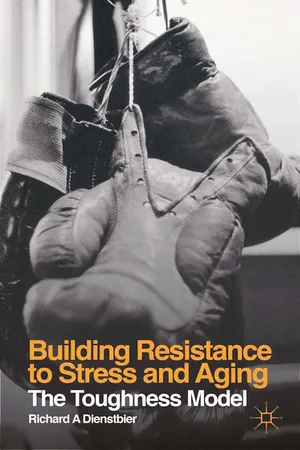
The toughness model proposed in this book incorporates psychological research and neuroscience to explain how a variety of toughening activities - ranging from confronting mental and physical challenges to meditation - sustain our brains and bodies, and ultimately build our mental and psychological capacities degenerated by stress and by aging.
Information
Part I
The Basics
1
Toughness: An Opponent Process
Although he did not name the outcome “toughness,” 125 years ago, in The principles of psychology, William James wrote a brief theory of toughness in the form of a lifestyle recommendation:
Keep the faculty of effort alive in you by a little gratuitous exercise every day. That is, be systematically heroic in little unnecessary points, do every day or two something for no other reason than its difficulty, so that, when the hour of dire need draws nigh, it may find you not unnerved or untrained to stand the test ... So with the man who had daily inured himself to habits of concentrated attention, energetic volition, and self-denial in unnecessary things. He will stand like a tower when everything rocks around him, and his softer fellow-mortals are winnowed like chaff in the blast. (James, 1890, pp. 126–7)
Although I was unaware of this remarkable passage at the time, I began thinking about toughness when I was in graduate school. Despite my being in a social psychology program, we were exposed to lots of research with animals—mostly rodents. As is true now, I was really interested in emotion, so I was fascinated by the observation that regularly handling and even mishandling young rodents toughened them. That is, as a result of those early experiences, even into their dotage those animals were smarter, more emotionally stable, and more stress-resistant than their coddled siblings. But everyone knew then and knows now that when young animals and people experience excessive stress, they usually suffer awful outcomes. Curious!
Also around that time, aerobic exercise was being recognized for its salutary impacts on cardiovascular health, and some studies were even showing similar affects on emotional stability, especially for resistance to depression. It seemed likely that the experiences that toughened the animals, and the aerobic exercise undertaken by committed joggers, were having positive impacts on both endocrine and neurological systems, and ultimately, upon mental abilities and psychological well-being. I began to think about those systems as being much like muscles—strengthened or toughened by being regularly taxed—within limits, of course. Later, with my own students I conducted research to understand toughening, and naturally, being an academic, I began to write about toughness. Since then, brain scanning, genetic analyses, and other research tools have matured, allowing us to see the minute details of the physical changes that account for toughening, and it has become apparent that other experiences and patterns of behavior lead to similar physiological modifications and mental/psychological benefits. Thus the concept of toughness matured, and thus this book.
Toughness redefined
Expanding on the mental and psychological components of toughness that were sketched out in the Introduction, gaining in mental/psychological toughness means strengthening the executive functions of planning, organizing, and appropriately focusing attention. It means that we maintain a keen ability to remember—especially to form memories of the episodes of our lives. It means having the fluid intelligence needed for solving problems and the self-control required for delaying immediate pleasures in favor of long-term goals. Even in the face of substantial stressors, it means maintaining emotional stability with resistance to anxiety and to depression. In energy-demanding situations, being tough means being able to muster higher levels of both physical and mental energy, leading to effective coping; and it even means having greater capacity to both give and receive affection.
I realize that this description of toughness sounds a bit like Pollyanna’s undergraduate honors thesis, and that I have not yet offered any research to defend my claims. Instead of offering supportive research in this chapter, I will first massage some theoretical issues and then present a theoretical structure called “opponent process theory.” Opponent process theory provides a framework for organizing much of the material of this book. By the way, Pollyanna gets some credit and a few mentions throughout, so if you are unfamiliar with her story, you can learn more about this vitally unimportant literary figure by checking out the relevant note.1
Are stress and aging really all that bad?
Perhaps we should accept that life hurls the occasional lemon at us, and accept with grace the cognitive changes that accompany our aging. However, consider this: Statistics based on American populations find that 20 percent of women and 10 percent of men will experience depression at a diagnosable level, with about 5 percent diagnosed with major depressive disorder. Moreover, although elderly depression tends to be underreported, depression rates increase with aging. The U. S. Centers for Disease Control and Prevention (CDC) estimates that 5 percent of American adults aged 65 and older who live in community settings experience major depression, with that number increasing to a whopping 25 to 40 percent for those who are hospitalized or living in nursing homes. An anxiety disorder will be experienced by 30 percent of American women and 19 percent of the men. As for declining cognitive abilities with aging, we should not dwell on that, at least until we must; but Americans are worried about it. Middle-aged Americans now fear dementia more than they fear cancer or any other disease. Unhappily, there is some basis for those fears. In America, 11 percent of the people aged 65 or older have Alzheimer’s or other dementia, as do one third of the people aged 85 or older (Alzheimer’s Association, 2013; see also Hollon et al., 2002). To compound the misery, Burton et al. (2013), note that both anxiety and depression are strongly associated with later diagnoses of dementia. As for feeling stressed, that seems to be the modern norm, with study after study in various countries showing increased feelings of stress in various occupations and life niches. Struggling economies, climate change, and international conflicts provide no help.
Similarly, it has become mundane to note that many people are way too fat. For example, two-thirds of American adults are either overweight or obese. But obesity is now a worldwide problem. As a result, Type II diabetes is spreading through most developed countries, and even to many developing nations. For a variety of reasons discussed below in an entire chapter, overweight people are less likely to be as tough as they would be if they maintained a lower weight. Beyond the direct physiological links between excess body fat, especially abdominal fat, and low toughness, being overweight is also likely to lead to changes in lifestyles—changes that decrease toughness. Fortunately though, at any point in our lives most of us can significantly increase our toughness, and we can do it through activities that actually add to our quality of life.
Mind and body
The basic premise of neuroscience is that the mind is simply a reflection of neural processes within the brain. Nevertheless, although on the one hand we should accept this one-to-one correspondence between underlying neural activity and mental events, on the other hand a couple of important caveats apply. The first is that at this point we have no “satisfying” ideas as to how those physiological events become the mental events that we experience; that mystery is complete. The second caveat is that even as we remain within the realms of science, at various interesting levels of analysis it is sometimes appropriate and useful to separate mind from brain or, more generically, mind from body. I explain below.
There is a vast and growing science of “mind and body,” but when mind-body linkages are considered, the emphasis is usually on how the mind influences the body. There is, for example, a significant amount of research literature on how emotions affect arousal within the body, and all that goes with that, from blood sugar regulation (hereafter “blood glucose”) by both insulin and adrenaline, to impacts on heart rate and blood pressure. In addition, in the past two to three decades psychologists have learned much about how moods and emotions affect the immune system. Knowing those paths from mind to body, we understand why some of our students will get a cold or the flu after finals week, and why my hostile Type-A neighbor is courting an early coronary. On the positive side, research shows that meditation, caring for a pet, being married, and even prayer can have calming impacts on the mind, with subsequent positive impacts on the body. That mind-to-body emphasis is natural given that we understand much about how the brain activates and controls various systems in the body, even activating and deactivating genetic processes.
However, my consideration of toughness leads to an equal emphasis on the rest of the causal loop between mind and body—that is, how the body influences the brain and the mind. For example, our concern will often be on how the physiological aspects of toughness lead to mental/psychological toughness. Much of that information is new because regulation from body to brain and on to mind is far less obvious than the other part of that cycle, but at least as much intellectual fun. For example, as I mentioned above, learning the many ways that both exercise and being well nurtured affect our neurochemistry and the structures of our brain is fascinating—especially because modern neuroscience allows us to understand how those aspects of physiological toughening subsequently affect mental/psychological toughness. Another example of bodily impacts on the mind relates to how fetal hormonal balances modify brain structures that in turn influence our adult sexual orientations (i.e., whether we become heterosexual or homosexual individuals). Although that topic is awfully interesting, it is really not directly relevant to the main theme of this book; thus, I have relegated a few summary paragraphs to a note on this topic.2 But for now, as promised above, I consider that organizing theoretical structure called opponent process theory.
Opponent process theory
As his third law of motion, Isaac Newton told us that, “for every action, there is an equal and opposite reaction.” He was apparently not thinking about physiological processes, but through opponent process theory, I will. Opponent process theory is a theory of homeostatic balance developed five decades ago by Solomon and Corbit (1974, 1980). Because it provides a theoretical flood light that illuminates toughness, I discuss it in some detail here.
Homeostasis actually implies, of course, that our various physiological systems should fluctuate only within limited and healthy ranges. As implied by that definition, every system has some way of being regulated—of being returned to within its normal range when something pushes it out of its acceptable range. Opponent process theory provides a valuable elaboration of that idea. Although originally a highly influential theory, in recent years it has lost some of its pizzazz merely by virtue of its successes. Today researchers are typically more interested in the details of individual opponent process systems than in the more abstract overarching theory.
Nevertheless, here I overarch. Just about everything in the body can get out of homeostatic balance. Solomon and Corbit noted that the mechanism for restoring balance to an out-of-balance system is some form of negative feedback loop. The metaphor that is typically used to describe negative feedback is the house-heating thermostat. Simple heating thermostats are merely supposed to tell the furnace to go on when it is too cool, and then the heat itself “negates” that process, causing the thermostat to shut off the heat when the room warms up.
Blood glucose upregulation
Because an appropriate balance of blood glucose is a recurrent issue as I consider toughness, I use blood glucose regulation to illustrate some opponent processes. Blood glucose is the only fuel that the brain can use, and so a balanced amount of blood glucose is as vital as a balanced amount of oxygen. Depletion of either will cause brain damage and death. During normal activities, the brain uses an astonishing 75 percent of the blood glucose that is consumed by the body. That percentage even increases during episodes of energy-demanding mental effort.
Consider first how blood glucose levels become restored when you become hypoglycemic after skipping lunch. Various receptors in your liver and elsewhere send neural messages about the glucose shortfall to your hypothalamus. Within the brain, the hypothalamus forwards its own concerned messages about the crisis to the pancreas. The pancreas then releases the pancreatic hormone glucagon—a dull hormone that shall receive scant further attention. After flowing through the circulation system to the liver, the glucagon asks the liver to release more blood glucose.
If the need for more blood glucose results from an impending crisis, the opponent processes to the anticipated hypoglycemia are somewhat different: adrenaline gets involved. Anticipating an extreme energy requirement, some previously loafing neurons in the brain, especially in the hypothalamus, send desperate neural messages to the adrenal glands. The subsequently released adrenaline then stimulates the pancreas to release the dull hormone glucagon, and both the glucagon and the adrenalin coerce the liver to release additional blood glucose (note that throughout the book, I use the British terms adrenaline and noradrenaline rather than the more pretentious U. S. terms epinephrine and norepinephrine).
Glucose downregulation
Consider the opposite condition—hyperglycemia. That condition in a nondiabetic person leads to insulin secretion by islet cells in the pancreas. Acting as an opponent process, the insulin facilitates removal of the excess glucose from the blood and then the storage and use of the glucose in various body cells. Sometimes that opponent process overshoots, resulting in hypoglycemia, with too much blood glucose removed. When that happens, people sometimes feel light-headed or depressed a half-hour or so after consuming sugar snacks.
Alternatively, a short bout of exercise (10 minutes of brisk walking) has been found to stimulate longer lasting energy. Opponent process theory allows us to understand that greater energy benefit from the walking. Note first that many opponent processes outlast the conditions that evoked them. With that in mind, consider that insulin—the main opponent process to the excess sugar from candy—reduces blood glucose. Thus it is easy to understand why some people experience hypoglycemia after scarfing down sugar. On the other hand, after blood glucose is reduced by the energy demands of the brisk walk, adrenaline and glucagon—the opponent processes to that depletion—will stimulate the release of blood glucose. Thus the exercise usually has longer lasting positive impacts than the sugar snack (for details, see Thayer, 2001).
Opponent processes in the long run
For this next example, first, a few words about the busy neurons in your brain. You may know that the synapses are the places where small gaps exist between neurons and that when a sending neuron discharges or “fires” it releases chemicals called neurotransmitters into its “downstream” synapses. When those neurotransmitters are detected by receptors on the “upstream” ends of a receiving neuron, the probability increases that the receiving neuron will fire. Enough background for now.
Solomon and Corbit theorized that with repeated exposure to an unbala...
Table of contents
- Cover
- Title
- Introduction
- Part I The Basics
- Part II Arousal and the Elements of Weakness
- Part III Toughening (At Last)
- Part IV Applications of Toughness
- Glossary
- Notes
- References
- Index
Trusted by 375,005 students
Access to over 1.5 million titles for a fair monthly price.
Study more efficiently using our study tools.
Frequently asked questions
Yes, you can cancel anytime from the Subscription tab in your account settings on the Perlego website. Your subscription will stay active until the end of your current billing period. Learn how to cancel your subscription
No, books cannot be downloaded as external files, such as PDFs, for use outside of Perlego. However, you can download books within the Perlego app for offline reading on mobile or tablet. Learn how to download books offline
Perlego offers two plans: Essential and Complete
- Essential is ideal for learners and professionals who enjoy exploring a wide range of subjects. Access the Essential Library with 800,000+ trusted titles and best-sellers across business, personal growth, and the humanities. Includes unlimited reading time and Standard Read Aloud voice.
- Complete: Perfect for advanced learners and researchers needing full, unrestricted access. Unlock 1.5M+ books across hundreds of subjects, including academic and specialized titles. The Complete Plan also includes advanced features like Premium Read Aloud and Research Assistant.
We are an online textbook subscription service, where you can get access to an entire online library for less than the price of a single book per month. With over 1.5 million books across 990+ topics, we’ve got you covered! Learn about our mission
Look out for the read-aloud symbol on your next book to see if you can listen to it. The read-aloud tool reads text aloud for you, highlighting the text as it is being read. You can pause it, speed it up and slow it down. Learn more about Read Aloud
Yes! You can use the Perlego app on both iOS and Android devices to read anytime, anywhere — even offline. Perfect for commutes or when you’re on the go.
Please note we cannot support devices running on iOS 13 and Android 7 or earlier. Learn more about using the app
Please note we cannot support devices running on iOS 13 and Android 7 or earlier. Learn more about using the app
Yes, you can access Building Resistance to Stress and Aging by R. Dienstbier in PDF and/or ePUB format, as well as other popular books in Psychology & Clinical Psychology. We have over 1.5 million books available in our catalogue for you to explore.