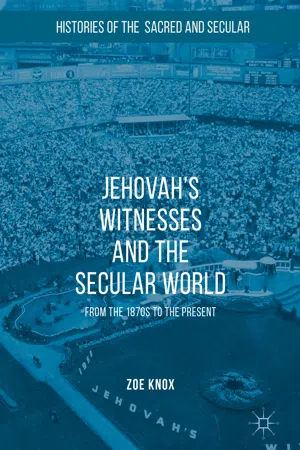
Zoe KnoxJehovah's Witnesses and the Secular WorldHistories of the Sacred and Secular, 1700-2000https://doi.org/10.1057/978-1-137-39605-1_1
Begin Abstract
1. Introduction
Zoe Knox1
(1)
School of History, Politics & International Relations, University of Leicester, Leicester, UK
End Abstract
Jehovah’s Witnesses have their origins in the tremendous religious ferment of nineteenth-century America. The writer Ralph Waldo Emerson captured the energy and fervour of the faithful and the intellectual and spiritual mood of the times in his description of those assembled to discuss the topic of priesthood at the Chardon Street Chapel in Boston, Massachusetts in November 1841. ‘The composition of the assembly was rich and various’, Emerson observed. It drew together,
…from all parts of New England, and also from the Middle States, men of every shade of opinion from the straitest orthodoxy to the wildest heresy, and many persons whose church was a church of one member only. A great variety of dialect and of costume was noticed; a great deal of confusion, eccentricity, and freak appeared, as well as of zeal and enthusiasm. If the assembly was disorderly, it was picturesque. Madmen, madwomen, men with beards, Dunkers, Muggletonians, Come-outers, Groaners, Agrarians, Seventh-day-Baptists, Quakers, Abolitionists, Calvinists, Unitarians and Philosophers—all came successively to the top, and seized their moment, if not their hour, wherein to chide, or pray, or preach, or protest.1
The early part of the century had seen a revival within Protestantism and, alongside this, a rise in premillennialism, the belief that Jesus Christ would return to the earth and take the righteous up to heaven, thus marking the start of the thousand-year epoch before the final judgment. A wide interest in premillennialism was further fuelled by the prophecies of William Miller, a Baptist preacher born in Massachusetts and raised in upstate New York. Miller predicted that the second coming would occur ‘about the year 1843’.2 When the year passed uneventfully, the Millerites, as his followers were known, were not discouraged. On the contrary, they identified a precise date for the second coming: 22 October 1844. In Miller’s own estimation, some 50,000 Millerites eagerly awaited the return of Christ.3 The day elapsed without incident. Hiram Edson, a Methodist preacher and dedicated Millerite, wrote vividly of their despair: ‘Our fondest hopes and expectations were blasted, and such a spirit of weeping came over us as I never experienced before. It seemed that the loss of all earthly friends could have been no comparison. We wept, and wept, until the day dawn’.4
While the failure of Millerite prophecy gave many cause for disillusionment, for others it served to reinvigorate their study of biblical chronology. The major denominations that emerged under the broad umbrella of the Adventist movement essentially arose from the varied responses to what became known as the ‘Great Disappointment’. Edson was a prominent figure in the early history of the Seventh-day Adventist Church, for example, along with other former Millerites, among them Ellen G. White. The search to identify the precise date of Christ’s return also animated Charles Taze Russell, a haberdasher from Allegheny City, now a part of Pittsburgh, Pennsylvania. It is in his quest for clarity on biblical chronology that the origins of the Watch Tower organisation can be found. Small groups of men gathered in what they called ‘ecclesias’ to discuss scripture, guided by Russell’s own tracts. These study circles prompted the men, eventually known as Bible Students, to forge an identity that marked them apart from the established Christian churches. Russell’s differences from key Adventist figures amounted to no greater a deviation than many of the Second Adventist (sometimes called First-day Adventist) offshoots, but, in due course, the distinctiveness of their interpretations became more apparent and they developed an independent identity.
Thus, from their humble origins as small, loose-knit groups of Bible Students, Russell and his followers laid the foundations of a highly visible, and frequently controversial, worldwide religious organisation, known since 1931 as Jehovah’s Witnesses. The growth and spread of the faith was remarkable, even by the standards of the day, when spiritual ferment in fin de siècle United States, Great Britain, and Germany led to the emergence of a great number of new religious communities. Since the 1940s, the Watch Tower Bible and Tract Society of Pennsylvania,5 the corporate body of Witnesses, has become genuinely international, using its distinctive doorstep ministry to spread its teachings (‘the Truth’) around the world. There are congregations of Jehovah’s Witnesses in 240 countries, from Albania to Zimbabwe. Most Witnesses reside outside of the United States, giving the organisation a greater global presence than any other ‘American original’, to use the American historian Paul K. Conkin’s term for ‘homemade varieties of Christianity’.6 Of the 8,220,105 active Witnesses worldwide in 2015, only 1,231,867 were in the United States.7 For this reason, a study of the history of the organisation must look beyond its birthplace and to its global community (Image 1.1).
The number of Jehovah’s Witnesses worldwide is small compared to the major Christian churches. The Vatican counts 1.2 billion Catholics; there are 105 million adherents of Baptist churches; and 125 million Russian Orthodox believers. Despite its modest membership, the Watch Tower Society has historically been at the forefront of debates about a remarkably wide range of issues related to religious toleration. Throughout their history, Witnesses’ unique interpretation of the Bible has repeatedly brought them into conflict with state authorities, in both democratic and authoritarian settings. This continues in the twenty-first century. In 2015, for example, hundreds of Witnesses were imprisoned around the world, the majority of them for refusing to perform military service, organising Bible study sessions in private homes, or evangelising. One Brussels-based human rights group documented 555 Witnesses serving terms in South Korea for refusing to perform military service. It also recorded cases of Witnesses imprisoned for their beliefs in Azerbaijan, Eritrea, Singapore, and Turkmenistan.8 Historically, religious identities have often been forged through shared persecution (the Protestant tradition in England is one such example). In the twentieth century, there were few religious communities that so clearly forged collective identities through oppression, and on such a large scale. This has strengthened their group identity and cohesion. The persecution of ordinary Witnesses around the world is a major theme in the Society’s literature to the present day.
Far from being passive in the face of opposition, the Society has brought cases before the highest courts and won landmark legal decisions. Mark McGarvie, a historian of American law, argued that Witnesses were contemptuous of American values: ‘Professing their acceptance of God’s true laws, they [Jehovah’s Witnesses] expressed disdain for many of the legal and cultural values of the United States’.9 By casting Witnesses as opponents of American values we miss the extent to which they have defined and upheld these values, particularly when it comes to legal culture. In addition to its many historic victories, the Society secured a major win in the United States Supreme Court in 2002. The decision in Watchtower Society v. Village of Stratton overturned an ordinance in Stratton, Ohio which required would-be canvassers to obtain a permit from the mayor’s office by completing a registration form. The decision was important for the organisation because it allowed Witnesses to access private residential property without first securing a permit. It benefited other itinerant evangelists in the same way. More broadly, the decision protected free speech, one of the bedrocks of the First Amendment. It declared unlawful the requirement that anonymity be lifted through a registration process before canvassing, thus protecting the right of every American to engage in anonymous speech.10 They have had a defining influence on rights legislation beyond the American context, too: the European Court of Human Rights has made multiple rulings in the Society’s favour, overturning decisions by state authorities particularly in Greece and the former Soviet Union.11 The impact of Witnesses on modern conceptions of religious freedom is far out of proportion to their numbers and cannot be dismissed as merely a product of their hostility towards the secular world.
The determined effort to remain aloof from the world has, paradoxically, drawn the Watch Tower organisation into a remarkably wide range of issues. Some of these are historically linked with religious minorities, such as conscientious objection, and others not so obviously connected with belief, such as medical treatment. M. James Penton, a historian, former Witness and fierce critic of the Society, has argued that Witnesses have provoked a harsh response from governmental authorities because of their interactions with the world and their persistent proselytism. He observed: ‘Most societies can and will tolerate a small, uncooperative religious minority which submits to a ghetto-like existence. But when such a group refuses to be isolated and attempts to make converts by the millions, then in the eyes of many political leaders it becomes a socially disturbing force which should be curbed or outlawed’.12
The Watch Tower Society’s interpretation of biblical verse has led to fundamental challenges to the traditional jurisdictions of modern governments, such as inculcating patriotism and conscripting armies, and to more modern mandates, such as facilitating harmony in inter-denominational relations. Coupled with the intransigence of Jehovah’s Witnesses in the face of obstacles to their meetings and ministry, this has meant that Witnesses have suffered for their convictions and have been subjected to both legal and extra-legal persecution in a wide range of geographical contexts. These experiences have, in turn, shaped the culture of this religious community.13 Sustained opposition can entrench, rather than overturn, marginal positions. The persecution of Witnesses has reinforced their conviction of the righteousness of their cause. The Society frequently raises the Nazi Party’s repression of Witnesses in Germany in articles on the challenges that Witnesses must face as the only true Christians. It likens the persecution of the early Christians for their message to the persecution of Witnesses in the modern world.14
This book examines how Jehovah’s Witnesses have challenged the jurisdictions of modern states and influenced understandings of religious tolerance and freedom of worship worldwide. Their influence is all the more remarkable given that they aim to remain aloof from the world. This detachment differs markedly from many other religious organisations, including those derived from Adventist roots. For example, the Seventh-day Adventist Church lobbies for religious freedom around the world through its Department of Public Affairs and Religious Liberty (PARL), which is based in the Church’s headquarters in the United States. PARL reaches beyond the Seventh-day Adventist community to lobby national governments and international organisations as well as to cooperate with other faith communities on a range of policy issues, from health care to prisoners’ rights. In contrast, the Watch Tower Society is remarkably insular. Whilst it engages with the secular state through courts of law, this is to a narrow end, namely opposing attempts to inhibit the public ministry of Witnesses. They have unintentionally championed the rights of a wide range of other religious ...
Table of contents
Cover
Front Matter
1. Introduction
2. Watch Tower, Witnesses, and the World
3. Politics
4. Ministry
5. Blood
6. Religion
7. Opposition
8. Conclusion
Back Matter
Trusted by 375,005 students
Access to over 1.5 million titles for a fair monthly price.
Study more efficiently using our study tools.
Frequently asked questions
Yes, you can cancel anytime from the Subscription tab in your account settings on the Perlego website. Your subscription will stay active until the end of your current billing period. Learn how to cancel your subscription
No, books cannot be downloaded as external files, such as PDFs, for use outside of Perlego. However, you can download books within the Perlego app for offline reading on mobile or tablet. Learn how to download books offline
Perlego offers two plans: Essential and Complete
Essential is ideal for learners and professionals who enjoy exploring a wide range of subjects. Access the Essential Library with 800,000+ trusted titles and best-sellers across business, personal growth, and the humanities. Includes unlimited reading time and Standard Read Aloud voice.
Complete: Perfect for advanced learners and researchers needing full, unrestricted access. Unlock 1.5M+ books across hundreds of subjects, including academic and specialized titles. The Complete Plan also includes advanced features like Premium Read Aloud and Research Assistant.
Both plans are available with monthly, semester, or annual billing cycles.
We are an online textbook subscription service, where you can get access to an entire online library for less than the price of a single book per month. With over 1.5 million books across 990+ topics, we’ve got you covered! Learn about our mission
Look out for the read-aloud symbol on your next book to see if you can listen to it. The read-aloud tool reads text aloud for you, highlighting the text as it is being read. You can pause it, speed it up and slow it down. Learn more about Read Aloud
Yes! You can use the Perlego app on both iOS and Android devices to read anytime, anywhere — even offline. Perfect for commutes or when you’re on the go. Please note we cannot support devices running on iOS 13 and Android 7 or earlier. Learn more about using the app
Yes, you can access Jehovah's Witnesses and the Secular World by Zoe Knox in PDF and/or ePUB format, as well as other popular books in History & Social History. We have over 1.5 million books available in our catalogue for you to explore.