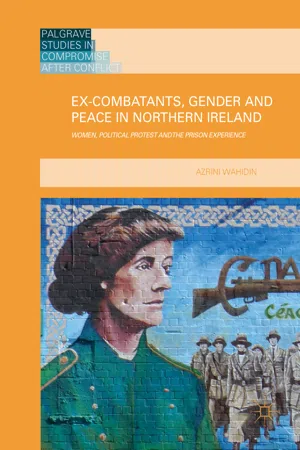
This book explores the contours of women's involvement in the Irish Republican Army, political protest and the prison experience in Northern Ireland. Through the voices of female and male combatants, it demonstrates that women remained marginal in the examination of imprisonment during the Conflict and in the negotiated peace process. However, the book shows that women performed a number of roles in war and peace that placed constructions of femininity in dissent.
eBook - ePub
Ex-Combatants, Gender and Peace in Northern Ireland
Women, Political Protest and the Prison Experience
- English
- ePUB (mobile friendly)
- Available on iOS & Android
eBook - ePub
Ex-Combatants, Gender and Peace in Northern Ireland
Women, Political Protest and the Prison Experience
About this book
Information
© The Editor(s) (if applicable) and The Author(s) 2016
Azrini WahidinEx-Combatants, Gender and Peace in Northern IrelandPalgrave Studies in Compromise after Conflict10.1057/978-1-137-36330-5_11. Introduction
Azrini Wahidin1
(1)
Nottingham Trent University, Nottingham, UK
Irish women are every bit as revolutionary as Irish men and their resistance is every bit as fierce, be they IRA, Sinn Féin activists or campaign organisers and protesters. (An Glór Gafa /The Captive Voice 1990)
The aim of this chapter is to contextualise by way of background the ghostly shadow of the past through examining political protest, discriminatory prison policy, and how both female and male Volunteers in the Irish Republican Army found ways of resisting the brutality of the state forces (see Punch 2012). What this chapter clearly shows is the complexity of the political situation in Northern Ireland1 and how this has impacted on the lives of female ex-combatants.
This chapter sets out the method used to access the experiences of the ex-combatants. The subsequent chapters focus on particular aspects of women’s experience as activists, as combatants, as prisoners and as participants in the peace process, in order to build an account of the significant but under-explored role of the construction and experience of gender under conditions of struggle.
Researching Political Imprisonment
This research was a personal and political journey where the questions were reformulated over time through formal and informal discussions with former politically motivated prisoners/ex-combatants. This research started off with a question, which was fluid and open to contestation. As Taylor states, ‘we shall find that its terms are transformed, so that in the end we will answer a question which we could not properly conceive at the beginning’. The initial question was to disrupt the silence surrounding women’s involvement in the IRA and their experiences of political protest, struggle and imprisonment. The subject and nature of the study was one that was about struggle and, hence, it was important to reflect the voices of the women and interrupt the silence surrounding their involvement as Volunteers/soldiers in an Army. This book is about their experience of political protest and the role they, as women, played in configuring the pathway to peace.
Community activists and ex-prisoner groups provided contacts on the basis of which a snowballing approach was used to locate further interviewees. The main ex-combatant group had a database of contacts for former male politically motivated prisoners but there was no equivalent for women. In the process of gaining access, I was in contact with Voices: Republican Women Ex-prisoners Group, Tar Anall and Coiste na nIachmí. The latter responded in a positive way but felt that it would be difficult to find women who would speak about their experience. It was through the other two organisations and with the support of three particular women that access was facilitated to female and male former ex-combatants/Volunteers who would otherwise be difficult to reach. The 28 women and 20 men interviewed in the course of this research came from across Ireland; some came from cities and others came from rural areas. Some had spent time in British prisons and others had served time in the Republic of Ireland or in the North of Ireland. Many had experienced being on the run and all attested to levels of brutality at the hands of the state. Focus groups were held with female and male ex-combatants, who had the opportunity to read, amend and comment on the process. They were provided with the questions and an envelope beforehand, and were asked to make changes and incorporate areas that they thought were missing. They were also given the opportunity to read the transcripts and make changes. They were given the chapter content to comment on, and also the draft manuscript. The aim was to create a participatory process that involved cooperation and collaboration, thereby transgressing traditional power relationships between those who are researched and those conducting the research. It allowed ex-combatants as much ownership as possible of the material, so that ‘the issue of what [was to] be disclosed [remained] under the control of the interviewee’ (Jamieson and Grounds 2002, p. 10). It enabled a priori assumptions to be challenged reflecting the participants’ experiences, rather than an imposition of my own preconceptions as to what would emerge as significant. Full and informed consent was given and participation was voluntary: it was stressed to participants that they were free to withdraw at any time during the study. Such an approach was important with regard to validating the nature of the research with a group that was hard to reach (Grounds and Jamieson 2003).
This study applied a life-course approach to the involvement of women in the Irish Republican Army and examines the experiences of being criminalised from arrest to imprisonment and life almost twenty years later. The youngest participant was in her 40s at the time of interview and the oldest was 80.
The participants represented different ethnicities and sexualities; some were widowed, some were grandparents and some had remained single. A number of the participants had doctorates, some were Members of the Legislative Assembly (MLAs), some were community workers, writers or film directors, and all had at one time been involved at various levels of the Irish Republican Army structure both inside and outside of prison. Their stories are testimonies of the pain they endured as politically motivated, as mothers, daughters, partners, sisters, fathers, brothers and soldiers. Their stories are illustrative of the violence the state used to maintain a system of inequality. Both women and men had been subjected to prolonged periods of interrogation and degrading treatment, and had faced uncertain lengths of imprisonment, possible loss of life, divorce, penury, lone parenthood and, in some cases, having their children taken into care. These are just some examples of the impact the Conflict2 had on the lives of the women and men in this study. But what this research clearly shows through the narratives of the women and men which form the focus of this book is their resilience, resistance and political transformation in the face of war and terror. The voices in this book disturb and interrupt the silence surrounding their experiences as former politically motivated prisoners and question the impunity of the British state in the transition from conflict to peace.
In this book, all the names of the ex-combatants and any identifying variables have been changed in agreement with the participants of the study unless they have chosen otherwise.
The remainder of the Introduction provides an outline of the book, indicating the focus of each of the following chapters as they chart the journey of women’s involvement and examine how they took the struggle from the home and the streets to beyond the wire: the prison.
Overview
The book examines the gendered experiences of imprisonment, how the women Volunteers placed femininity in dissent, by drawing out the ways in which (contested) conceptions of gender were brought into play in the course of the struggle and, at times, became a site and focus of punishment and of resistance. It is only by interrogating how femininity was inscribed on the body of the female ex-combatant that one begins to tease out the contradictions that emerged not only through the attitudes of fellow comrades, but also through the way the state forces responded to women’s involvement in political protest in Northern Ireland.
It is by listening to the voices of women and male Volunteers that their experiences of being part of a wider struggle that continues to sustain the momentum of the peace process comes to the fore in spite of attempts made by groups (ie. Unionists, Dissident Republicans) who wish to derail the journey of change. The overall aim of this book is to address the lacuna surrounding the role women played in the IRA and their experience of the criminal justice system, and to question why women remain marginal in a society that is transitioning from war to peace. In this movement of transition, new spaces are being created that have the potential to develop new possibilities for a different type of society.
The book is therefore innovative on several levels. It challenges the cultural stereotypes by recognising the combatant role played by women, a stereotype that pervades cultural perspectives of women as ‘natural peace-makers’ and which seriously neglects the role they have played in war. It builds on the extensive literature on ex-combatants in post-conflict societies (for example, McMullin 2013) by taking a gendered approach in order to bring voice to female ex-combatants who are usually overlooked in what is a dominant focus on male ex-prisoners. It also builds on the growing literature in Northern Ireland on ex-combatants’ contribution to the peace process (for example, Shirlow et al. 2010) by showing that the imprimatur of women prisoners was also important, inside and outside of prison. In this respect, it directly engages with the women’s attitude towards the Good Friday Agreement and their involvement in post-conflict politics. Finally, it explores the same transition made by ex-combatants from a military to a political strategy in Northern Ireland addressed by Brewer et al. (2013), but brings a gender perspective by considerably expanding on the number of female ex-combatant respondents whose narratives of transition are analysed and addressed. We hear the stories of women directly involved in war and peace—and, largely, for the first time.
Chapter 2 explores the debates surrounding peace, war and gender. The chapter will begin by contextualising the discussion with reference to some of the literature on peace and war. It will then place the discussion within a feminist framework to facilitate the deconstruction of masculinity and femininity and, in particular, examine the role of gender constructs during times of war.
Chapter 3 explores the landscape of Conflict in Northern Ireland and provides the context of key moments of political action; that is, women taking to the streets and challenging the authority of the state. The chapter contextualises and examines the turning points in penal policy and prison resistance. It then discusses the gendered nature of warfare and how women’s bodies became a tool in the weaponry of the British state.
Chapter 4 examines the rise of women’s involvement in relation to direct action. This chapter focuses on how and why women became involved in the Irish Republican Army (IRA). The chapter demonstrates how women organised themselves to counteract military power on their street, in their homes and in their communities, by organising bin lid patrols as an effective warning system that alerted members of the IRA of the presence of the British Army.
Chapter 5 explores the historical development of women’s involvement in the IRA by focusing on the rise and fall of the women’s Republican organisation Cumann na mBan. It charts the growing involvement of women and the challenges women faced in demanding to be treated as equals in the IRA. It is argued that, throughout the twentieth century, women have played crucial roles operationally, behind the scenes and on the front line. The second part of this chapter focuses on the motivations for, and experiences of, becoming an active Volunteer, and how gender and the constructions of femininity either facilitated or presented obstacles to women’s involvement within the IRA.
Chapter 6 focuses primarily on women’s experiences of Armagh prison, charting the initial reactions of the women to Armagh prison: the reception process; their reactions to their cells, and how political prisoners were organised within the confines of the prison walls.
Chapter 7 contextualises and illustrates techniques of resistance utilised by the women political prisoners by drawing on a key moment for the women in prison—The Great Escape. By using this act of resistance as a case study, the chapter illustrates agency and resistance, the modalities of prison power and the power to punish. In their attempt to destabilise the authority of the prison the women, demonstrated the continued struggle that occurred behind the prison walls.
Chapter 8 examines the events of 7 February 1980 in Armagh Prison (also known as Black February). The chapter explores the subjective experiences of the women on the no wash protest and how the act of defilement created new spaces and new ways of controlling the prison gaze. This chapter also details how the women placed their femininity in dissent by challenging expectations around cleanliness of the female body and how the gendered body was used by the prison authorities to increase feelings of vulnerability that were fuelled by the prospect of further violence towards the women.
Chapter 9 examines the policy and practice of strip searching of the women of Armagh and the events leading to the mass strip search at HMP Maghaberry. The chapter examines how the women responded and experienced this particular type of gendered punishment. It demonstrates that the role of strip searching was primarily to control, punish, humiliate and discipline the bodies of politically motivated prisoners and thus calls into question the government’s claim that strip searching was necessary for the purpose of security.
Chapter 10 explores the nature of the negotiated peace process and details the transition from war to a post-conflict society. The chapter provides an account of the need to move from a situation of conflict to a situation of peace—albeit a fragile one. It discusses the far-reaching consequences of the failure to offer full amnesty to prisoners under the Good Friday Agreement. An air of silence still surrounds the accounts of those who were directly involved in political protest, who experienced imprisonment and who are still living with the trauma and pain of the Conflict—for many, their voices remain unheard.
Chapter 11 explores the complexities of disarmament, demobilisation and reintegration (DDR) in Northern Ireland. This chapter examines not only the salient role ex-combatants ...
Table of contents
- Cover
- Frontmatter
- 1. Introduction
- 2. Women, War and Peace
- 3. An Cogadh Fada: The Legacy of Conflict in Northern Ireland
- 4. Mná sa Streachailt: The Role of the Accidental Activist*
- 5. From Footnote Soldiers to Front-Line Soldiers
- 6. Sites of Confinement: The Stories of Armagh and Maghaberry Prison
- 7. Nor Meekly Serve My Time: ‘A’ Company Armagh
- 8. Parthas Caillte: The Politics of Resistance and the Role of the Gendered Incarcerated Body
- 9. The ‘Norms of Our Conflict’: The Use of Strip Searching as Gendered Punishment
- 10. There Is No Glory in Any War
- 11. Conclusion: Compromise After Conflict—Making Peace with the Past
- Backmatter
Trusted by 375,005 students
Access to over 1.5 million titles for a fair monthly price.
Study more efficiently using our study tools.
Frequently asked questions
Yes, you can cancel anytime from the Subscription tab in your account settings on the Perlego website. Your subscription will stay active until the end of your current billing period. Learn how to cancel your subscription
No, books cannot be downloaded as external files, such as PDFs, for use outside of Perlego. However, you can download books within the Perlego app for offline reading on mobile or tablet. Learn how to download books offline
Perlego offers two plans: Essential and Complete
- Essential is ideal for learners and professionals who enjoy exploring a wide range of subjects. Access the Essential Library with 800,000+ trusted titles and best-sellers across business, personal growth, and the humanities. Includes unlimited reading time and Standard Read Aloud voice.
- Complete: Perfect for advanced learners and researchers needing full, unrestricted access. Unlock 1.5M+ books across hundreds of subjects, including academic and specialized titles. The Complete Plan also includes advanced features like Premium Read Aloud and Research Assistant.
We are an online textbook subscription service, where you can get access to an entire online library for less than the price of a single book per month. With over 1.5 million books across 990+ topics, we’ve got you covered! Learn about our mission
Look out for the read-aloud symbol on your next book to see if you can listen to it. The read-aloud tool reads text aloud for you, highlighting the text as it is being read. You can pause it, speed it up and slow it down. Learn more about Read Aloud
Yes! You can use the Perlego app on both iOS and Android devices to read anytime, anywhere — even offline. Perfect for commutes or when you’re on the go.
Please note we cannot support devices running on iOS 13 and Android 7 or earlier. Learn more about using the app
Please note we cannot support devices running on iOS 13 and Android 7 or earlier. Learn more about using the app
Yes, you can access Ex-Combatants, Gender and Peace in Northern Ireland by Azrini Wahidin in PDF and/or ePUB format, as well as other popular books in Social Sciences & Peace & Global Development. We have over 1.5 million books available in our catalogue for you to explore.