- English
- ePUB (mobile friendly)
- Available on iOS & Android
eBook - ePub
About this book
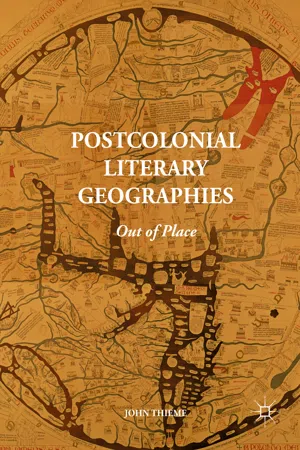
This book examines how ideas about place and space have been transformed in recent decades. It offers a unique understanding of the ways in which postcolonial writers have contested views of place as fixed and unchanging and are remapping conceptions of world geography, with chapters on cartography, botany and gardens, spice, ecologies, animals and zoos, and cities, as well as reference to the importance of archaeology and travel in such debates. Writers whose work receives detailed attention include Amitav Ghosh, Derek Walcott, Jamaica Kincaid, Salman Rushdie, Michael Ondaatje and Robert Kroetsch. Challenging both older colonial and more recent global constructions of place, the book argues for an environmental politics that is attentive to the concerns of disadvantaged peoples, animal rights and ecological issues. Its range and insights make it essential reading for anyone interested in the changing physical and human geography of the contemporary world.
Information
© The Editor(s) (if applicable) and The Author(s) 2016
John ThiemePostcolonial Literary Geographies10.1057/978-1-137-45687-8_11. Introduction: Exploring Space, Excavating Place
John Thieme1
(1)
University of East Anglia, Norwich, UK
The Heraclitean aphorism that one can never step into the same river twice, because other waters are always flowing, dates back two and a half millennia and it is both a truism of Western philosophical commentary on humanity’s perception of the natural world and a commonplace of everyday experience. Returning to the scene of our childhood, we visit another place because of its metamorphosis through time. Buildings may have been demolished, arable land may now be used for grazing, neighbours may have moved away, but even when physical changes are minimal or indiscernible, the epistemological landscape has altered. On a macro-political level, seismic changes such as the French and Russian Revolutions, the collapse of Communism in Eastern Europe and the Arab Spring effect major transformations in the identities of nations, but seemingly more settled societies are also subject to the dynamics of the ever-flowing river. Switzerland is a land of traffic jams and multicultural encounters as well as cuckoo clocks, alpenhorns and chocolate. The alpine snow remains, but climate change means that it falls differently from year to year, from minute to minute, and again the epistemological landscape alters along with the physical. Everything is in flux and the identity of places is constantly in motion. So it goes without saying that the Heraclitean aphorism holds true? Except that in post-Enlightenment Western thinking there is a contrary impulse which has tried to transfix place as static and unchanging, an impulse which gathered force and was prevalent during the centuries when Western European empires were expanding and flourishing. Despite the proliferation of cross-cultural encounters that occurred as a consequence of the hitherto unparalleled movements that occurred during this era of exploration, trade, conquest and missionary activity, imperialist practices and more recently neo-colonial forms of globalization have habitually promoted fixed conceptions of place, while redrawing borders, dispossessing peoples and despoiling landscapes for commercial gain.
This study mainly examines responses to such practices from the non-Western side of the colonial divide, considering a number of pivotal topoi in postcolonial texts in the context of a range of commentary on the construction of place and space, especially work in the field of cultural geography, but also referring to literary and social theorists and recent ecocriticism. It aims to demonstrate that postcolonial writing characteristically sees space as heterogeneous and malleable and, through a series of case-studies, to examine the ramifications that this view has in writing that interrogates the Western constructions of place that were predominant during the period when European imperial hegemonies were at their height and in the subsequent era of American-led globalization. It suggests that the identity politics, implicit or explicit, in postcolonial writing offer a particular challenge to discourses that see place as a stable entity. This position is not, of course, peculiar to postcolonial responses to place. As the geographer Doreen Massey puts it in a contemporary reworking of the Heraclitean aphorism, ‘social relations are never still; they are inherently dynamic’ and so it is necessary to ‘move beyond a view of place as bounded, as in various ways a site of authenticity, as singular, fixed and unproblematic in its identity’ (1994, p. 2). However, such a view has added resonance for societies that have suffered, in varying forms and to various degrees, from the imposition of the essentialist discourses of culture and geography that have characterized colonial and neo-colonial power axes.
The book engages with writing from societies that have experienced various forms of colonization, settlement and globalization, with a particular, though not an exclusive, focus on texts from India, the Caribbean and Canada. As a former settler/invader colony, Canada may seem remote from countries that have more obviously experienced the destructive aspects of colonization, but my Canadian sections mainly concern themselves with the displacement of Indigenous peoples, regional marginalization and texts on the outer verges of the Canadian mosaic, while also arguing that transplantation from Old World environments engenders a heightened sensitivity to spatial issues in Canadian writing more generally. My subtitle, Out of Place, is taken from the geographer Tim Cresswell (1996),1and postcolonial geographies are fashioned out of place in two senses: they emanate from ever-evolving topographies and they stem from situations where people have been displaced, either by physical movement or by the disruption of their home environment by colonial intervention.
This opening chapter introduces the theoretical commentary on place and space that underpins the book’s subsequent trajectory. As a preface to what follows, it concludes with a discussion of two texts by Robert Kroetsch, ‘Stone Hammer Poem’ (1976) and Badlands (1975), both of which undermine fixed conceptions of place and space by problematizing the possibility of finding originary moments of departure. ‘Stone Hammer Poem’ excavates the traces present in Canadian Prairie notions of history and landscape, by probing the layers (prehistoric, Aboriginal, settler, etc.) to be found in a single domestic object, a paperweight, the eponymous stone hammer. Badlands juxtaposes an account of a 1916 expedition to find dinosaur bones with a narrative of a 1972 journey by the daughter of the expedition’s leader, doing so in a manner that disturbs both textual stability and the possibility of a unitary response to place, in this case a primeval landscape that appears to have been almost untouched by human intervention. The discussion of these two texts is brought into dialogue with Kroetsch’s theoretical comments on the importance of using an archaeological method to excavate the nature of place. On one level these comments are a distinctive outcrop of the Prairie environment, but they also demonstrate an indebtedness to the work of Michel Foucault.
Issues relating to the ownership and management of space have, then, particular importance in societies where colonizing powers have seen it as their prerogative to impose artificial boundaries and to misappropriate the pre-existing identities of places through onomastic practices that erased earlier iterations of place. At its most extreme this has taken the form of claims that the occupied space has hitherto been non-existent, such as the British assertion that Australia was terra nullius (an empty land and therefore exempt from the normal laws of ownership), a doctrine that supposedly legitimized the expropriation of Indigenous Australian space.2 Elsewhere, practices such as the colonial naming of what is now known as Zimbabwe after the expansionist imperialist Cecil Rhodes afford similar instances of the misappropriation of place by superimposing an extraneous identity. Such practices reached their height during the late nineteenth-century heyday of European imperialism, particularly in the Scramble for Africa that ensued when the Berlin Conference3 allocated European powers particular spheres of influence in Africa and in so doing provided both a spurious legitimization for the European invasion of African territory and a framework for the further partitioning of the continent, with the consequence that by 1914 most of Africa was under European control. From around this time, in British colonies around the world, the export of English cultural values was an integral part of the imperial project and unsurprisingly, given that a historiographical metanarrative held sway in the British imaginary at this time, colonial territories were subjected to a discourse of post-Enlightenment social and cultural progress that privileged the historical. Such discourses were at their height in the nineteenth and early twentieth centuries, but they have a longer provenance and particular sections of this book see sites that were seminal in promulgating a sense of imperial ascendancy, such as the map, the garden and the zoo, as part of a longer history of ideologically encoded geography.
In his influential study Postmodern Geographies, Edward Soja commented that ‘The nineteenth-century obsession with history did not die in the fin de siècle.’ Soja took the view that the ‘the critical consciousness of modern social theory’ continued to be pervaded by the ‘historical imagination’ (1989, p. 10). However, by the time he was writing a sea change was under way and the hegemony of what the St Lucian Nobel prize-winning poet Derek Walcott has called ‘The Muse of History’ (1976) was being interrogated in various quarters. Postmodernism and poststructuralist theory were contributing towards the shift in emphasis that is summarized in the subtitle of Soja’s book, The Reassertion of Space in Critical Social Theory, and the book itself, which took its departure point from Foucauldian theory, was instrumental in taking this shift further. In the same decade, a significant movement towards the study of non-Western writing, which had hitherto generally been marginalized in Anglophone literary canons, and the development of a set of practices that have most commonly been referred to as ‘postcolonial’ redirected cultural analyses towards earlier commentary on place and space and their relationship with time. The work of Michel Foucault and Mikhail Bakhtin, along with that of Gaston Bachelard, Henri Lefebvre and Soja, became touchstones for literary critics commenting on the ‘re assertion of space’ (italics added) and a growing proliferation of cross-cultural and cross-disciplinary approaches also moved attention away from the privileging of the temporal. Additionally, the changing political economies of decolonization and late twentieth-century globalization unsettled the earlier naturalizing of the historiographical approach, which had been at the heart of that aspect of the imperial project whose purported mission was to ‘civilize’ colonized territories.
Soja quoted Foucault’s comment that ‘Space was treated as the dead, the fixed, the undialectical, the immobile. Time, on the contrary was richness, fecundity, life, dialectic’ (Foucault 1980, p. 70; qtd. Soja, p. 10) as part of an epigraph for his opening chapter and more generally Foucault’s work, some of which had been comparatively neglected for twenty years, asserted the mobility of space and its intersection with time. In a 1980 interview, where he talked about the relationship between space and power, Foucault recalled a 1960s response to his work on heterotopias, which he sees as singular spaces whose functions are different or even the opposite of others, by a Sartrean psychologist, who had taken the view that space was reactionary, while history was revolutionary, commenting that this such a view was not unusual (Foucault 1991, p.252) at the time of its utterance. However, it is of course mistaken to see space and time as binary opposites. New waters are always flowing in the river and Bakhtin’s use of the term ‘chronotope’ to describe ‘the intrinsic connectedness of temporal and spatial relationships’ (1981, p. 84) foregrounds the dynamic interconnectedness of time and space in the formation of social relations. Again this is particularly pertinent in postcolonial societies, responding to colonial geographies that characteristically denied the fecund potential of space by superimposing a closed, essentialist version of place—to the exclusion of all the other possibilities latent or nascent in an environment. The present book follows Yi-Fu Tuan’s classic distinction between place and space, ‘undifferentiated space becomes place as we get to know it better and endow it with value’ (1977, p. 6), and in colonial environments such endowment usually took the form of inflicting a non-dialectical Eurocentric—and more recently a Western-led globalized—version of place on the dialectical multiplicity of the ‘other’ space. While mobile subaltern forms continued to exist and the colonial encounter itself was inevitably informed by kinetic pluralism and creolization, the official discourse of the colonial superstructure promoted fixed conceptions of alterity, imported, usually with some distortions, from the perceived national imaginary of the colonizing power. In response to this, the identity politics, implicit or explicit, in postcolonial writing usually offer a challenge to discourses that see place as fixed and immobile. This position is developed in this study through chapters devoted to topoi which illustrate ways in which postcolonial writers have fashioned chronotopes that dispute or disrupt colonial geographies. The individual chapters discuss maps, botany and gardens, spice, ecologies, animals and the spaces they inhabit, and cities, contextualizing them through reference to shifts in perceptions of how they have been viewed. Thus cartography, horticulture and zookeeping are seen as mobile practices which assumed particular culturally encoded significances at the height of the colonial era, but which have had very different associations in non-Western and pre- and post-Enlightenment European thinking. The Coda, with which the book concludes, substantiates its central premise that the identities of places are always in transit by outlining the significance of the journey as a trope for a mobile postcolonial geography and foregrounding the extent to which the texts considered promote the case for an egalitarian and ecologically sensitive politics of place.
Foucault’s view of space is a clear influence on Robert Kroetsch’s ‘Stone Hammer Poem’ and Badlands, but at the same time both texts articulate a poetics specific to the Canadian Prairies. This regionalism involves a distinctively postcolonial response to place and distances Western Canadian conceptions of the environment from the national metanarrative promoted by Eastern Canadian historiography. In an essay entitled ‘The Moment of the Discovery of America Continues’, Kroetsch both acknowledges his debt to Foucault and suggests the need to turn to draw on an intertextual bricolage of local ‘deposits’ in order to realize a sense of Prairie place:
The central image of ‘Stone Hammer Poem’ embodies the multiple identities inherent in a single displaced object, identities which co-exist in the present moment of the poem. The object is first referred to as a stone, shaped like a child’s skull, which has become a hammer, but it quickly becomes clear that is now a paperweight on the poet’s desk. It has been found in a wheatfield and cut to serve its present purpose. From here its provenance becomes increasingly un...I am aware that it is the great French historian Michel Foucault who has formalized our understanding of the appropriateness of the archaeological method. But the prairie writer understands that appropriateness in terms of the particulars of place: newspaper files, place names, shoe boxes full of old photographs, tall tales, diaries, journals, tipi rings, weather reports, business ledgers, voting records—even the wrong-headed histories written by eastern historians become, rather than narratives of the past, archaeological deposits. (1989b, p. 7)
Table of contents
- Cover
- Frontmatter
- 1. Introduction: Exploring Space, Excavating Place
- 2. Postcolonial Mappae Mundi
- 3. After the Bounty: Botany and Botanical Tropes
- 4. ‘Lucent Syrops, Tinct with Cinnamon’: Romantic Spice, Postcolonial Spice
- 5. Borrowing the Earth: Postcolonial Ecologies
- 6. Paper Tigers and Other Therianthropes
- 7. Urban Chronotopes: London and Bombay
- 8. Travelling Places: A Coda
- Backmatter
Trusted by 375,005 students
Access to over 1.5 million titles for a fair monthly price.
Study more efficiently using our study tools.
Frequently asked questions
Yes, you can cancel anytime from the Subscription tab in your account settings on the Perlego website. Your subscription will stay active until the end of your current billing period. Learn how to cancel your subscription
No, books cannot be downloaded as external files, such as PDFs, for use outside of Perlego. However, you can download books within the Perlego app for offline reading on mobile or tablet. Learn how to download books offline
Perlego offers two plans: Essential and Complete
- Essential is ideal for learners and professionals who enjoy exploring a wide range of subjects. Access the Essential Library with 800,000+ trusted titles and best-sellers across business, personal growth, and the humanities. Includes unlimited reading time and Standard Read Aloud voice.
- Complete: Perfect for advanced learners and researchers needing full, unrestricted access. Unlock 1.5M+ books across hundreds of subjects, including academic and specialized titles. The Complete Plan also includes advanced features like Premium Read Aloud and Research Assistant.
We are an online textbook subscription service, where you can get access to an entire online library for less than the price of a single book per month. With over 1.5 million books across 990+ topics, we’ve got you covered! Learn about our mission
Look out for the read-aloud symbol on your next book to see if you can listen to it. The read-aloud tool reads text aloud for you, highlighting the text as it is being read. You can pause it, speed it up and slow it down. Learn more about Read Aloud
Yes! You can use the Perlego app on both iOS and Android devices to read anytime, anywhere — even offline. Perfect for commutes or when you’re on the go.
Please note we cannot support devices running on iOS 13 and Android 7 or earlier. Learn more about using the app
Please note we cannot support devices running on iOS 13 and Android 7 or earlier. Learn more about using the app
Yes, you can access Postcolonial Literary Geographies by John Thieme in PDF and/or ePUB format, as well as other popular books in Literature & Literature General. We have over 1.5 million books available in our catalogue for you to explore.