eBook - ePub
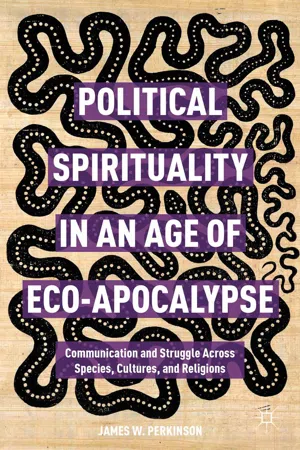
Political Spirituality in an Age of Eco-Apocalypse
Communication and Struggle Across Species, Cultures, and Religions
- English
- ePUB (mobile friendly)
- Available on iOS & Android
eBook - ePub
Political Spirituality in an Age of Eco-Apocalypse
Communication and Struggle Across Species, Cultures, and Religions
About this book
This book 'hunts and gathers' across different historical epochs and situations, juxtaposing biblical materials and hip-hop, Christian colonialism and vodou, personal experience and racial politics, poetics and high theory, in order to challenge the current crisis of sustainability from the perspective indigenous communities and deep ancestry.
Information
CHAPTER 1

FROM SYCAMORE TREES TO HUMAN DESTINY: READING THE WILD AT THE CROSSROADS OF GLOBALIZATION AND APOCALYPSE
Thenceforth natural things are not only themselves but a speaking.
—Paul Shepard, Nature and Madness
The only way to begin this writing is with a form of confession. The planet is in trouble. It is not a time simply to “do theory.” The signals are unmistakable for anyone willing to look. An interlocking quaternary of apocalyptic forces—peak oil, climate change, species extinction, and population overshoot—ride in upon us relentlessly like horsemen from the end times. M. King Hubbard’s modeling of the peak production of modernity’s primary energy resource accurately predicted the decline of U.S. oil production in the mid-1970s and served notice that such a global peak was in the offing (no matter how ferocious the attempts to enter Faustian bargains of self-delusion with our zooplankton and algae ancestors whose viscous bodies are the lifeblood of industrial civilization). There were only so many trillion trillion deaths in the planet’s oceans over the millions of years leading up to this one, and the supply of “black gold,” however tweaked by new technologies of extraction, is limited. But, as climate change denier Richard Muller (2012) has acknowledged, even if that peak is pushed out a few decades hence by tar sands fever, it will not much matter at today’s rates of CO2 emissions. Political gridlock, corporate constitution in the imperative of growth, and all the reigning idolatries of short-term gain interlocked with take-no-prisoners advertising and its consumer culture offspring, translate into a depressing scenario. The recasting of human interaction as cyborg in social media fora—granting “full metal jacket” forms of isolated connectivity devoid of organic modes of vulnerability and measurably eroding our evident capacity for empathy and self-limitation—only compounds the issue. All of this coalesces into an accelerating rush toward the tipping point of unstoppable warming that does not seem remediable in our current possibilities of self-editing. Peak oil concerns may well be eclipsed in short order by peak air and peak water realities.
PLANETARY EXTINCTION?
Meanwhile, in the last century we have altered a long-standing balance between species extinction and new species incubation rates, which has us plundering the biosphere’s generative capacity—and shredding its ecodiversity—with rapacity. As one commentator now argues—it is like constructing an ever-ascending tower to house our species ever closer to technocracy’s vision of a high-rise heaven by ever-more furiously pulling out the bricks lower down to build with ever-increasing alacrity the next layer above (Quinn, 2007). The future of such an enterprise will remain “bullish” until the brick that is one too many is finally pried loose. And, slum cities of multiple millions cropping up almost overnight across the planet’s global south, skyrocketing total population numbers toward nine billion (or more)—only deepens the thickening gloom! National governments make common cause with transnational finance and privatized militance—creating ceaselessly revolving doors between boardrooms, west wings, pentagons, and bedrooms, and erecting insurmountable lifestyle buffers between policy deciders and the effects of their decisions on those slum-dwelling denizens. The entire ruling apparatus appears increasingly as one cartel, under the dollar, invisibly ensconced behind state-of-the-art security and ruthlessly secessionist on a planetary scale—until the wrong technology falls into the wrong hand of rage and a nuclear winter or biotoxic horror is visited upon everyone.
In the face of such a dilemma, how might one say anything meaningful about “communication” that was not sheer twaddle? I do not pretend to know how to answer such a charge, except to say that the problem of secession identified here as promulgated by ruling class elites vis-à-vis everyone else, is even more radically the problem between modern humanity writ large and the rest of the biosphere. The question on the table of academic deliberation at least—if, indeed, not of every other area of human endeavor—is simply this: What does it mean to be human? We have evolved a form of knowledge production that resembles a hive of worker bees tending feverishly to their respective honey holes without a clue that the entire comb has been cut loose from the tree and fallen into a north-flowing river just south of Niagara Falls, New York. The interlocking crises should push us to stop in our tracks and recognize that continuing to do the same thing over and over again in expectation of a different result is indeed, as Einstein opined, the practical definition of insanity.
The logic of expansionist civilization inherited from a 10,000-year-old turn toward monocrop agriculture, driven by imperial demand for ever-greater technologies of control and ever-larger citadels of accumulation and unleashed on a planet of finite resources, simply cannot be sustained.1 And as one scholar writing on these issues offers: “What can’t be sustained . . . can’t be sustained” (Jensen, 2008). We keep dodging the feedback from the biosphere in hopes that the social structures we have cantilevered over the limit of the planet’s carrying capacity (Heinberg, 2014) will somehow find new support from some unforeseen technological innovation. And thus we will not really have to stop and do something different. I have no crystal ball and so cannot infallibly gainsay that hope. I can only say that for me—and a growing host of others who are trying to look reality in the eye without blinking—the ecological blowback is stark and demands radical rethinking of our entire career on the planet as a species. It means stripping down to the pith, reimagining the root, asking the unanswerable questions all over again: Why are we here? What does it mean to be alive?
“HUMAN” COMMUNICATION
Communication is everywhere—a grand phenomenon of nature taking place at every level of the cosmos: from bacteria sending out chemical “shouts” to their environments in search of return signatures indicating like-configured bacterial explorers in the same neighborhood to quasars and microwave hum from the primordial event of big bang yet sounding across the expanding bubble of the macrospace we naively call the uni-verse. Our own particular frequency of exchange within that grand cacophony is immensely narrow and tiny, embedded within an implicate order of ever-recalibrating waves of information and energy that makes Pythagoras’s music of the spheres but a minute intuition of the whole. And yet something as human and vernacular as black church’s call-and-response or Inupiat throat singing turns out to be a rough imitation of the ultimate conversation, both a riff upon and a model of what is going on intergalactically. Perhaps more to the point, we need to attend to the researches of E. T. Hall and William Condon from early in the history of the discipline of communication studies to the effect that the call and the response are actually happening simultaneously with each other, as the ever-emergent phenomenon of entrainment, and not as a cause-effect progression of linear events, threaded onto a line of time like beads on an abacus (Leonard, 1978, 14–22). There is indeed a temporal priority that invigorates our own genesis on the planet. But it is one in which we are the dependent beneficiaries of the grand concert of life forms who have distilled tested and true survival strategies in syncopated interactions with local ecologies for a millennial millennia of centuries before we arrived, late and now lost, on the many-layered scene. As a recent twist in the shape and thrust of spiraling strands of DNA coating the planet in strobing signals of photon exchanges and electromagnetic pulsations, we are “bathed” in communication. We find ourselves awaking on a stage not only set for, but composed by and of, an unfathomable quadrillion of others, whose very existence is lived literally through us, as indeed we live through them. The fundamental structure of what “is”—and the primordial communication echoing forth from and as that structure—is the metabolism of everything by and with everything else.
It is “eating and being eaten” all the way up and down the phylum. It is our destiny to become food for other life forms and our vocation to compost other life forms into the peculiar beauty and singular significance we mysteriously embody. But our mystery is no more than that of any other composite of this writhing codification of information called life. And that seems to be the great forgotten import that our strange eco-autistic affliction of self-reflection has somehow effaced from our otherwise quite formidable consciousness. We have incarcerated ourselves in the markings of our minds and the languages of our lips—like some huge Alcatraz of the imagination fogged in with words upon words upon words—forgetting that we are far more than a mere ocular substrate for the products of Maybelline and its parent corporation or the advertising orgasm that finds its most coveted stimulation in that part of our anatomy. Indeed, the 65 to 92 percent of our “being” that is communicating other than through our voice box is coparticipant in a nuanced and throbbing dance at every level. These range from the atomic and molecular inside our own bodies, where we ricochet around as minorities in the ecodiversity of bacteria living there, to the balletic stages of New York City and the robotic streets of South Central, whence we turn for relief and healing from our automaton-existence inside the corporate state, on out to the moon tides and sun flares that choreograph our blood beats and punctuate our body rhythm with novelty. Just where we should be directing our attention, inside this living vibraphone of communication as a species priding itself on some measure of self-consciousness, is no mean question.
I would argue for something quite prosaic and yet disturbingly profound in what I take to be an apocalyptic situation. Journalism scholar Robert Jensen suggests that we are today a species “out of place,” trying to occupy a niche for which we are ill-equipped genetically (Jensen, 2008). Thus far relatively “hard-wired” by our Pleistocene inheritance to value morally and pay attention emotionally to what is about 100 yards around us in any direction, and bearing a cranial size capable of dealing with fewer than 150 relationships socially with any kind of complexity and nuance (what anthropologists are now calling the “rule of 150”; Wells, 2010, 118–119; 205), we are in trouble. Our wet dream of representative democracy among 300 million political actors in this country alone, or equitable living and sustainable dwelling among seven billion co-tenants of a militantly globalized economy, seems patently delusional in its ceaseless projections of progressive attainment. If we just try a bit harder. Run a little faster. Consume more rampantly. Kill a bit more efficiently. Grow more exponentially—we’ll get there! Technology will indeed save us!?
DIALECTICAL IDENTIFICATION
Maybe. But I find my deepest responses evoked by a range of voices insisting the only way forward is by taking deep stock of where we have already been—and that by way of radical apprenticeship to where we still remain: as one animal species among millions of species of other life forms. We are not yet able to eat our computers or drink our motor oil. And the research continues to indicate that our mental health declines in inverse proportion to the layers of machine we introduce between our bodies and those of our photosynthetic cousins outside our windows, whose green-producing miracles as the lone “self-feeders” (“autotrophs”) of the planet—creating living matter out of hard rock and sunlight—literally creates the envelope of oxygen and animation upon which we all depend (Rasmussen, 214). (Seeing living plants outside one’s window has measurable effects on health beyond that of observing a Screensaver depiction of foliage, according to recent research; Williams, 2012). All flesh is finally grass, as the Hebrew prophet Isaiah once raged, and thus it is no great wonder that for indigenous cultures the globe over, “grass” itself is the great primal godess to which all the rest of the pantheon offers homage.
And thus begins to re-emerge a perhaps strange suggestion in the face of collapse. Learn the language of an animal. Talk to a plant. Recover a sense of one’s destiny as irretrievably intertwined with other life forms, whose communication and commensality is the very material and meaning of “being” alive. If I were “God,” I’m not sure I would have arranged it that way. Warped as I am by my schooling in industrial culture, my lifestyle trajectory is more that of the “Borg” of Star Trek fame than the blue-skinned hunter-gatherer creatures Avatar names as “Na’vi.” At least that would have to be the assessment if one judged by how and where I actually live, as compared with how I might fantasize or speak. But the returns today on industrial culture and its agricultural fore-parent are so far dismal. “Civilization,” in spite of its vaunted achievements, has never not been built on coerced labor and violent exploitation, and has almost nowhere proven durable on the face of the planet in a 10,000-year career (Rasmussen, 1995, 41). The environmental “communication” of our time—really a compound form of feedback from . . . fish, and fungi—is at the very least the word, “Stop!” Ventrioloquized through a human imagination such as mine it sounds thus: “Halt and listen! You are not the only being present here. We have something to say. Indeed, we have been talking all the way along the time line and you used to be able to hear. In fact, you cannot be you if you cannot hear us. If our very pheromones are to your anemic postmodern nostrils only so much stench, as Agent Smith snorted over the sweating head of Morpheus, then indeed Matrix is right. You have already become merely a Smithclone; your organic metabolism of other organic bodies merely the fat and grease and calories of the great corporate machine whose algorithms have effectively ‘eaten’ you.”
If human identity is fundamentally dialectical, gradually constructing itself in a crucible of negotiation with its quintessential others, then we could track human development as having “progressed” over its time on the planet through three gradually shifting moments:
1.a primordial indigenous identity as living animal worked out in our varied ecologies of origin (African savannah, Gobi desert, Amazonian rainforest, etc.) in languages populated by immense vocabularies of the flora and fauna regularly encountered and known in reciprocal modes of exchange in those ecologies;
2.a recent (10,000-year-old) agricultural experiment in which identity is increasingly fabricated by elites, sequestered away from plant and animal encounters in moat-protected “castles,” as an ideological bribe and hollow palliative foisted on their laboring populations who create the wealth they hoard and consume, in which violent contact with other human cultures, encountered in the relentless project of expansion, becomes dialectically decisive for one’s own sense of self, offering images of the despised and racialized “stranger” as the negative foil for identification, the savage sign of what one supposedly is not;
3.our current fetishization of the machine, emerging as the second and third and fourth skin of the human organism, the hardened carapace of urban concrete and suburban steel whose belly we inhabit like futuristic Jonahs without a beach in sight, the plastic and glass and vinyl cocoons in which we eat and sleep and watch our manifold screens, the molded alloys we drive, the silicon and plasma through which we communicate, the titanium and chemistry we splice into our ailing bodies, the GMO foods we wittingly or not eat, the whole spectral mass of re-engineered biosphere now rising up before us as messianic cyborg whose indestructibility is sold as a secret religion to our children through their wide-eyed consumption of “Transformer” toys and “Terminator” stars, against whose overwhelming engulfment we can barely find momentary escapist relief in recreation with a re-engineered “goofy” called a “pet” or visitation with an enslaved anomaly in a “zoo.” I increasingly encounter students now who confess to closing their blinds at home because they are actually afraid of trees and grass. The cyborg is here. The question now is where is the human?
PERSONAL INTIMATION
My own life trajectory has been one of continuous pilgrimage into deep encounters with cultures and people different from myself. I am a white male middle class heterosexual by background and conditioning who has lived the majority of his life in the inner city—mostly in Detroit. Without question my most profound educational formation has been “ghetto” street life over the course of four decades. There, low-income neighbors checked, challenged, embraced, rebuffed, and taught me, in what has amounted to an ongoing rite of initiation into another way of being a body, under protocols of rhythm and percussion, signifying and rhyme-spitting, dozens-playing and “jiving,” that broke down the codes of bourgeois morality and presuppositions of supremacy I had internalized growing up, and opened a way to experiment with being “something else.” The process continues today. Most of my academic work has entailed theorizing in both religious studies and communication studies discourses about race and racism animated by that personal trek across the boundaries separating black from white. And then late in the day, I married a Filipina and found myself confronted all over again with the need to undergo yet another regime of border crossing. This time it was into a culture structured in what one Filipino ethnomusicologist called a curvilinear tonality of communicating—both strangely similar to and yet confoundingly different from the percussive sensibility I had slowly internalized in inner-city Detroit. And yet again I have had to embrace a recurrent experience of awkward failure and apologetic chag...
Table of contents
- Cover
- Title
- Copyright
- Dedication
- Contents
- Acknowledgments
- Introduction: The Politics and Eco-Logics of “Spiritual” Communication
- 1. From Sycamore Trees to Human Destiny: Reading the Wild at the Crossroads of Globalization and Apocalypse
- Part I: The Question in the Biblical Tradition: Communication and Resistance
- Part II: The Question and the Christian Tradition: Communication and Empire
- Part III: The Question in Modernity: Communication Among the Subordinated
- Part IV: The Question in Post-Modernity: Communication and Globalization
- Part V: Personal Conclusion: Communication and Spirituality in Post-Colonial Partnership
- Notes
- Bibliography
- Index
Trusted by 375,005 students
Access to over 1.5 million titles for a fair monthly price.
Study more efficiently using our study tools.
Frequently asked questions
Yes, you can cancel anytime from the Subscription tab in your account settings on the Perlego website. Your subscription will stay active until the end of your current billing period. Learn how to cancel your subscription
No, books cannot be downloaded as external files, such as PDFs, for use outside of Perlego. However, you can download books within the Perlego app for offline reading on mobile or tablet. Learn how to download books offline
Perlego offers two plans: Essential and Complete
- Essential is ideal for learners and professionals who enjoy exploring a wide range of subjects. Access the Essential Library with 800,000+ trusted titles and best-sellers across business, personal growth, and the humanities. Includes unlimited reading time and Standard Read Aloud voice.
- Complete: Perfect for advanced learners and researchers needing full, unrestricted access. Unlock 1.5M+ books across hundreds of subjects, including academic and specialized titles. The Complete Plan also includes advanced features like Premium Read Aloud and Research Assistant.
We are an online textbook subscription service, where you can get access to an entire online library for less than the price of a single book per month. With over 1.5 million books across 990+ topics, we’ve got you covered! Learn about our mission
Look out for the read-aloud symbol on your next book to see if you can listen to it. The read-aloud tool reads text aloud for you, highlighting the text as it is being read. You can pause it, speed it up and slow it down. Learn more about Read Aloud
Yes! You can use the Perlego app on both iOS and Android devices to read anytime, anywhere — even offline. Perfect for commutes or when you’re on the go.
Please note we cannot support devices running on iOS 13 and Android 7 or earlier. Learn more about using the app
Please note we cannot support devices running on iOS 13 and Android 7 or earlier. Learn more about using the app
Yes, you can access Political Spirituality in an Age of Eco-Apocalypse by James W. Perkinson in PDF and/or ePUB format, as well as other popular books in Social Sciences & Sociology of Religion. We have over 1.5 million books available in our catalogue for you to explore.