Kinship, Love, and Life Cycle in Contemporary Havana, Cuba is an ethnographic analysis of gender, kinship, and love in contemporary Cuba. The book documents how low-income Havana residents negotiate their social relations through gendered caring practices over the life cycle from birth to death.
eBook - ePub
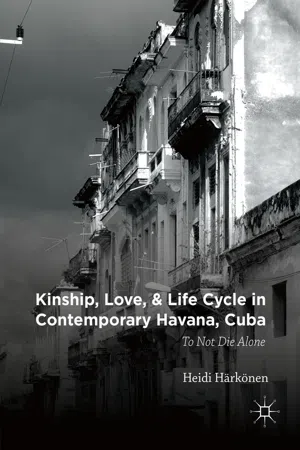
Kinship, Love, and Life Cycle in Contemporary Havana, Cuba
To Not Die Alone
- English
- ePUB (mobile friendly)
- Available on iOS & Android
eBook - ePub
About this book
Information
© The Editor(s) (if applicable) and The Author(s) 2016
Heidi HärkönenKinship, Love, and Life Cycle in Contemporary Havana, Cuba10.1057/978-1-137-58076-4_11. Introduction: Bodies, Love, and Life in Urban Havana
Heidi Härkönen1
(1)
Helsinki, Finland
Everyday life in Cuba is strongly gendered. Gender creates a significant difference both in individuals’ intimate experiences of love, desire, and sexuality and in how the state seeks to reorganize relationships in a socialist society.1 Gender mediates Cubans’ experiences of their personal relationships and of larger structures and changes.
Marilyn Strathern (1988: x) argues that gender can be understood only as a difference: men and women need to be examined in relation to each other. Since we cannot automatically assume gender—or any other categorization—to occupy an organizing position in how social relations are lived, enacted, and experienced, attention must be paid to the ways in which people present sociality: how relationships are construed through categories such as gender and the principles on which these categorizations are based.
Categorizations are not only culturally contingent, but their meanings and emphasis shift over time. As people move across specific situations and relationships over their life course, state policies and historical changes simultaneously shape gender, kinship, and love.
This chapter explores the pervasively gendered nature of Cuban society by concentrating on love, sexuality, and domestic life in the context of both the island’s revolutionary history and the contemporary post-Soviet era. Jennifer Cole and Lynn M. Thomas (2009: 3) emphasize that it is important to pay attention to the emotional aspect of social relations, to love as historically and culturally contingent and enabling particular kinds of personhood and relationships. Cole and Thomas (2009: 2) define love as “the sentiments of attachment and affiliation that bind people to one another.” Their view of love is useful for understanding gender relations in contemporary Cuba since it includes both love toward one’s kin and diverse forms of sexual passion.
In today’s Havana, love, sexuality, and domestic life are shaped by meanings and practices related to kinship, care, materiality, space, the body, agency, and emotion/affect.2 As love, sexuality, and ideas of gender have also played a significant role in state politics since the 1959 revolution (Hamilton 2012), they provide an introduction into many of the complexities in Cubans’ everyday life.
Socialist Efforts to Modernize Family, Gender, and Sexuality
The 1959 Cuban revolution represented a modernization project aimed at creating a new industrial, scientific, and egalitarian society without religion, discrimination, or unemployment. Efforts to create the socialist New Man focused on the abandon of egoistic selfishness, vanity, and materialism, seen as bourgeois vices (Guevara 2005 [1965]). The New Man, as conceptualized by Che Guevara (2005), was to be hardworking, morally pure, responsible, truthful, self-sacrificing, oriented toward physical labor, guided by a humanistic spirit and proletarian internationalism, and indifferent to amusements, material incentives, or external beauty. As in other socialist states (cf. Verdery 1996: 24–25; Gal and Kligman 2000a: 5, b: 5; Cohen 2005: 86–149; Friedman 2005), a further aim was to undermine diverse mediating structures (such as religious institutions) to generate a direct relationship between the state and the individual (see also Hamilton 2012: 31). The purpose was to create a revolution “outside of which there is no life” (Guevara 2005: 30).
A part of this endeavor was to move nurturing work from non-state actors to the state to allow women’s participation in wage labor (Castro Ruz 2006: 79–86; Safa 2005: 323–325). Elise Andaya (2007: 53) even argues that Cuba’s New Man was actually a New Woman, considering that women’s productive and reproductive lives became such an inherent part of revolutionary views of the new society. In the 1960s, kindergartens were opened, schools kept children busy during the day, hospitals and polyclinics offered free health care, and state care homes were founded for the elderly (Bell et al. 2007; Castro Ruz 2006; Mesa-Lago and Vidal-Alejandro 2011). With the help of the Cuban Women’s Federation (Federación de Mujeres Cubanas, FMC), women’s engagement in wage labor was supposed to eradicate machismo and create full gender equality (Rosendahl 1997: 51–77; Safa 2005: 324–328), in an “Engelsian” (2004 [1884]) spirit.
However, several researchers have pointed out the strongly gendered character of socialist state policies (Verdery 1996: 64–65; Gal and Kligman 2000a, b). Due to women’s widespread participation in the labor force, relatively easy access to abortion (except in Romania), liberal divorce laws, generous maternity leaves, and state-provided child care, socialist policies have been considered to empower women (Verdery 1996: 64–69; Safa 2005). At the same time, authors have shown that socialist policies are unable to eliminate machismo (Rosendahl 1997). They have also disfavored women by interfering in their reproductive lives (Kligman 1998) while leaving intact their domestic responsibilities, thus creating the “triple burden” (Verdery 1996: 65) of wage labor, political activism, and mothering combined with heavy housework (Verdery 1996: 44–50, 61–69). At the same time, Cuban policies on gender, sexuality, and domestic life contain several ambiguities and have varied over the years of the revolution.
Jafari Allen (2011: 58) argues that sexuality in particular “stands at the nexus of ideas of culture, nationhood, and race in Cuba.” During its first years, the revolution sought to reform sexuality in numerous ways. In the early 1960s, Cubans who were labeled as prostitutes or homosexuals were placed in the notorious Military Units for the Aid of Production (UMAP, Unidades Militares para la Ayuda de Producción) camps to turn them into “proper” socialist citizens (Lumsden 1996: 65–70; Allen 2011: 67–73). Physical labor was conceived as rehabilitating and educative and as a way to avoid bourgeois-style intellectualism (Pettavino and Brenner 1999; Allen 2011: 69). The efforts to promote gender egalitarianism in diverse fields of life were accompanied by a preoccupation with the “correct” gender difference. For instance, a man’s appearance judged to be “effeminate” (i.e. a man who had long hair or whose trousers were “too tight”) could be a reason for a police arrest and detention into the UMAP camps (Allen 2011: 70; see also Lumsden 1996: 6, 71–72). Such practices emphasize connections between the socialist state and gender, sexuality, and bodily appearance. They highlight the importance of a gendering that is clearly inscribed in a person’s body to Cuban society.
As a part of its efforts to reform local gender relations, the state promoted egalitarian marital relations (cf. Verdery 1996: 61–82). The state encouraged intermarriage across divisions of race, age, wealth, and geographical origin as a part of a policy aimed to erase social differences (Díaz Tenorio 1993; Fernandez 2010: 4–5). Through a campaign of collective weddings in the 1960s (“Operación Matrimonio,” Blanco 1960; Cabrera 1960; Martinez-Alier 1974: vii, 140–141), through state incentives to newlyweds, and through subsequent other policies that allowed all Cubans to marry with the luxury of a bourgeois wedding ceremony, the government sought to promote greater stability in the informal marital relations of the poor. This effort can be linked to the revolution’s endeavor to modernize Cuban society. For modernization theory, the existence of nuclear families based on legal marriage was an important indication that modernization was taking place (Cole and Thomas 2009: 10). Like the early revolutionary stand on sexuality, such practices highlight the regulatory, disciplinary aspects of Cuban state power, with family policies aimed at increasing state rule over its citizens (cf. Cole and Thomas 2009: 5–9).
However, in the Caribbean, researchers have for a long time described marital relations as fragile and unstable, with people entering into legal marriages in lower numbers than in many other parts of the world (Clarke 1974 [1957]; Smith 1988, 1996a). Since the colonial era, state efforts to curtail Caribbean sexuality have been frequent across the region (Barrow 1996; Smith 1996a: 81–100, 1996c), so that in this regard socialist Cuba is no exception. However, in 1975, Cuba officially eased up its policy to promote legal marriage by granting long-term consensual unions the same legal status as marriage. This change also gave full legal rights in terms of inheritance to the offspring of nonlegalized unions (see Código de Familia de la República de Cuba).
Helen Safa (2005) argues that the revolution has emphasized the role of matrifocality because it has increased women’s independence and the amount of female-headed families. My ethnographic data conforms to Safa’s view in the sense that my interlocutors’ gender and kinship relations correspond with many aspects of Caribbean matrifocality. The strong emphasis that Cubans give to the mother–child bond, the central position of women in the family and in the household, and the relative marginality of men as husband–fathers correspond with Caribbean matrifocality (cf. Clarke 1974; Barrow 1996: 73; Smith 1996a, b).
However, in other aspects contemporary Habaneros’ family relations differ from the traditional views on Caribbean matrifocality. My interlocutors did not regard wedding as a particularly important life-cycle ritual (cf. Clarke 1974: 76–77; Smith 1996a: 149). They made no difference between legal marriage and nonlegal unions (cf. Rosendahl 1997: 56) and consequently, no differentiation between “illegitimate” and “legitimate” children (cf. Clarke 1974: 74–76; Smith 1996a: 29, 75, 149; Barrow 1996: 50, 77, 435). Legal ma...
Table of contents
- Cover
- Frontmatter
- 1. Introduction: Bodies, Love, and Life in Urban Havana
- 2. Kinship as an Idiom for Social Relations
- 3. Fertility and Reproduction: Having a Child Is Worth the Trouble
- 4. Becoming a Woman: Quince as a Moment of Female Sexuality
- 5. Love, Sexuality, and Adult Gender Relations: Nobody Likes Sleeping Alone
- 6. Old Age, Funerals, and Death: Reciprocating Care
- 7. The State as Family
- 8. Conclusion: Time, Care, and Kinship
- Backmatter
Trusted by 375,005 students
Access to over 1.5 million titles for a fair monthly price.
Study more efficiently using our study tools.
Frequently asked questions
Yes, you can cancel anytime from the Subscription tab in your account settings on the Perlego website. Your subscription will stay active until the end of your current billing period. Learn how to cancel your subscription
No, books cannot be downloaded as external files, such as PDFs, for use outside of Perlego. However, you can download books within the Perlego app for offline reading on mobile or tablet. Learn how to download books offline
Perlego offers two plans: Essential and Complete
- Essential is ideal for learners and professionals who enjoy exploring a wide range of subjects. Access the Essential Library with 800,000+ trusted titles and best-sellers across business, personal growth, and the humanities. Includes unlimited reading time and Standard Read Aloud voice.
- Complete: Perfect for advanced learners and researchers needing full, unrestricted access. Unlock 1.5M+ books across hundreds of subjects, including academic and specialized titles. The Complete Plan also includes advanced features like Premium Read Aloud and Research Assistant.
We are an online textbook subscription service, where you can get access to an entire online library for less than the price of a single book per month. With over 1.5 million books across 990+ topics, we’ve got you covered! Learn about our mission
Look out for the read-aloud symbol on your next book to see if you can listen to it. The read-aloud tool reads text aloud for you, highlighting the text as it is being read. You can pause it, speed it up and slow it down. Learn more about Read Aloud
Yes! You can use the Perlego app on both iOS and Android devices to read anytime, anywhere — even offline. Perfect for commutes or when you’re on the go.
Please note we cannot support devices running on iOS 13 and Android 7 or earlier. Learn more about using the app
Please note we cannot support devices running on iOS 13 and Android 7 or earlier. Learn more about using the app
Yes, you can access Kinship, Love, and Life Cycle in Contemporary Havana, Cuba by Heidi Härkönen in PDF and/or ePUB format, as well as other popular books in Social Sciences & Cultural & Social Anthropology. We have over 1.5 million books available in our catalogue for you to explore.