eBook - ePub
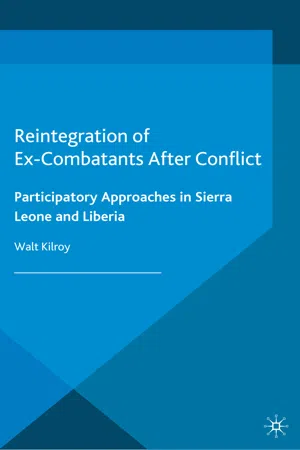
Reintegration of Ex-Combatants After Conflict
Participatory Approaches in Sierra Leone and Liberia
- English
- ePUB (mobile friendly)
- Available on iOS & Android
eBook - ePub
Reintegration of Ex-Combatants After Conflict
Participatory Approaches in Sierra Leone and Liberia
About this book
Reintegration programmes for ex-combatants are supposed to support the wider peace process. This study, based on detailed fieldwork, looks at the way they were carried out in Sierra Leone and Liberia and assesses the degree to which they were conducted in a participatory way.
Information
1
Does It Matter How Ex-Combatants are Reintegrated After War?
Programmes for the Disarmament, Demobilisation and Reintegration (DDR) of ex-combatants have become an important part of the package of measures carried out under the heading of ‘peacebuilding’. They deal with a wide variety of aims in support of a peace process, from security concerns, stabilisation, and management of spoilers, to social and economic recovery of the country involved. If anything, they have been a victim of their own success, in the sense that they can be seen as something to be applied in most situations, although many voices warn that each DDR programme must relate to its particular context and conflict (for example, Stockholm Initiative on DDR 2006: pp. 41–45; Integrated DDR Standards 2006). The lessons learned have led to a discussion of ‘second generation DDR’, which proposes a wider range of options, so that programmes can be more flexible and responsive to the local context and to input from the communities involved (Specht 2010; Colletta and Muggah 2009; UN Department of Peacekeeping Operations 2010).
The results of DDR have also been mixed. Some studies show real benefits for those ex-combatants who took part in reintegration programmes, in terms of their social and economic well-being (Pugel 2007). Others have failed to measure any significant benefit (Humphreys and Weinstein 2004), or have highlighted significant difficulties in trying to bring about social and economic reintegration (Jennings 2007), especially for women. One of the difficulties with reintegration programmes is that they interact with a wide range of issues, from security sector reform (Nathan 2007) and transitional justice (Cutter Patel 2009), to political and economic reconstruction. Sometimes the boundaries and lines of responsibility are not clear. The need for a holistic, integrated approach has long been recognised (Berdal 1996; Muggah 2005; Integrated DDR Standards 2006), but putting this into practice remains a challenge.
The conceptualisation and practice of DDR has evolved since the early 1990s, as it increasingly became accepted as a standard programme to be included in comprehensive peace agreements. While there may still be lingering perception that it is a ‘cash for guns’ deal, DDR has become a sophisticated and multi-faceted operation, often involving a dozen or more agencies.
The accepted definition of DDR within the UN system is:
Disarmament is the collection, documentation, control and disposal of small arms, ammunition, explosives and light and heavy weapons of combatants and often also of the civilian population. Disarmament also includes the development of responsible arms management programmes.
Demobilization is the formal and controlled discharge of active combatants from armed forces or other armed groups. The first stage of demobilization may extend from the processing of individual combatants in temporary centres to the massing of troops in camps designated for this purpose (cantonment sites, encampments, assembly areas or barracks). The second stage of demobilization encompasses the support package provided to the demobilized, which is called reinsertion. …
Reintegration is the process by which ex-combatants acquire civilian status and gain sustainable employment and income. Reintegration is essentially a social and economic process with an open time frame, primarily taking place in communities at the local level. It is part of the general development of a country and a national responsibility, and often necessitates long-term external assistance.
UN Secretary-General (2006a: p. 8)
The context in which DDR is supposed to take place can include destroyed infrastructure, economic disruption, population movement, trauma, and loss of social capital, amounting to a fragile or barely-existent state. Positive outcomes clearly will be difficult to achieve and many factors will interact with each other to provide both good and bad outcomes, not to mention disputes about whether any particular outcome is indeed ‘good’ or ‘bad’. Nonetheless there have now been over 20 such schemes organised in the post-Cold War period, most of them with international involvement. The literature has highlighted the inadequacies of early schemes and the need for holistic planning and operations, with broadly participatory approaches. It is fair to expect therefore that later schemes should have been informed by these earlier assessments: participation ought to be visible and its impacts should be capable of assessment. This research seeks to make such an assessment in the case of Liberia and Sierra Leone.
Since post-conflict reconstruction and recovery is the context, the framework used for this study is taken from the discourse within development: namely, a participatory approach to designing and implementing programmes. The term ‘participation’ in this study is taken from the development context, as explained by Robert Chambers (1997, 1998), and as promoted by those agencies committed to a partnership approach to development work through nationally-based nongovernmental organisations (NGOs). This requires, among other things, that the intended beneficiaries of a development programme are genuinely involved in, consulted on, and make input to, the main stages of its planning, implementation, monitoring and evaluation. This study considers the difficulties and shortfalls in implementing DDR, and asks to what extent a participatory approach was taken in the case study countries (Liberia and Sierra Leone). It also asks whether those ex-combatants who experienced a more participatory approach during reintegration have had better outcomes in social and economic terms.1
This book explores the DDR schemes in two cases which share some important characteristics – they are both small post-conflict West African states and the schemes took place in a similar timeframe (1999 to 2002 in Sierra Leone and 2003 to 2009 in Liberia). It is based on fieldwork, including interviews, surveys and focus groups carried out with ex-combatants, people in communities in which ex-combatants sought reintegration, and those involved in running the DDR schemes. The research seeks to analyse the extent to which the DDR programmes were participatory, the type, level and context of participation, and the effects of participation on programme outcomes in those places where participatory approaches were found.
Chapter 1 contextualises this work within the existing literature on DDR, it explores the concept of participation in a development and post-conflict context, and explores a typology, based on the work of Pretty (1995) through which levels of participation might be analysed. Chapter 2 discusses the methodological approach. Chapters 3 to 6 set out and discuss the evidence gathered in fieldwork. Chapter 3 explores the way in which information about DDR was passed to ex-combatants, the amount of information, and its accuracy or quality. Chapter 4 analyses the two-way information flow: the extent to which the views of ex-combatants were passed on, sought, or considered by those designing and running the programmes. Chapter 5 considers the effects of a participatory approach (such as it existed) on programme outcomes, based on quantitative data. Chapter 6 considers the same question, based on the qualitative data. Finally, the Conclusions (Chapter 7) seek to both evaluate the evidence in this particular study, and also draw broader conclusions about the way in which DDR interacts with the peace process, which can be generalised to the wider debates.
How DDR emerged
An annual overview of all DDR processes currently underway has been produced since 2006 at the Escola de Cultura de Pau at Barcelona Autonomous University (Caramés et al 2006; Escola de Cultura de Pau 2007 and 2008; Caramés and Sanz 2009). The 2008 version compares 19 different programmes, using a very broad definition of DDR which includes schemes which are not generally active (such as Chad or Côte d’Ivoire), or which deal with just one participant in the conflict (such as the AUC militia in Colombia). Of these 19 cases, three were in Asia (Nepal, Indonesia, and Afghanistan); two in the Americas (Colombia and Haiti); and the rest in Africa. The review estimates that these programmes involved 1.1 million ex-combatants at some stage in the processes, although not all in that particular year. The total cost of these programmes over their lifetimes is estimated at US$1.599 billion.
The importance of a holistic approach for DDR was recognised as early as the mid-90s, at the level of planning, funding, and ensuring that there is effective transition from demobilisation to reintegration (for example, by Colletta et al 1996). However, the reality is that while a holistic approach has often been advocated, putting this into practice involves considerable challenges. The difficulties include the short timeframes demanded for starting DDR when an agreement is imminent; the large number of actors involved, often with different organisational cultures and agendas; and the fact that funding is more likely to be available for dealing with the hardware (disarmament), rather than for the longer-term work of reintegration.
DDR is best viewed as an integrated set of processes, which are themselves a part of the wider peace process. It has the capacity to provide positive or negative feedback into the peace process. The possible feedbacks arise from confidence building between parties, opening lines of communication, addressing interests, and providing incentives at a number of levels. It can also bring tensions to the surface, especially when resources or jobs are to be divided up, or where local commanders’ interests diverge from those of their leaders or the combatants. Clearly, the relationship between ex-combatants and the communities where they settle can also be a difficult one.
Berdal describes ‘an interplay, a subtle interaction, between the dynamics of a peace process’ and how DDR is implemented (1996: p. 73). DDR cannot bring political agreement on its own, and a peace process which collapses will leave a DDR programme in an untenable position, as seen in the failure of the first DDR programme in Angola (Gomes Porto and Parsons 2003). Kingma (1997) says that DDR can contribute to peacebuilding and human security – and indeed had been ‘critical in making the peace hold’ in Mozambique (Kingma 2000: p. 241). He is among several authors to emphasise that demobilisation on its own cannot guarantee the success of a peace process. It is a political enterprise, and ultimately depends on the political will to reach and implement a settlement.
Peacebuilding goes beyond the narrow conception of DDR in a number of respects: it considers what constituencies are supporting the implementation of a peace agreement, as well as those who oppose it. Underlying causes are also considered, and the role of issues besides DDR such as security sector reform (SSR), and rule of law is acknowledged. These related areas are in fact considered also by the broader, holistic, integrated conceptions of DDR which a number of authors have called for.
Some of the challenges faced by a peacebuilding approach parallel those faced by integrated DDR: the agenda is broader, but is consequently more diffuse. Also, because a wider range of actors is involved, engagement with a highly diverse group of organisations and constituencies is implied. In addition, longer timeframes are called for, even though attention spans and funding cycles may be relatively short, in supporting the implementation of an agreement (rather than just deploying peacekeepers to monitor a ceasefire). This is a parallel of the way that sustainable economic and social reintegration is a longer-term process which merges into reconstruction and development. Finally, peacebuilding, human security and DDR all have a fundamental relationship with development, and its role in underpinning a peace process. It is not just a matter of adding one more ingredient to the mix: policy coherence and interaction effects mean that DDR must not only be approached in a holistic way. Its real contribution is the ‘interplay’ between DDR implementation and the peace process referred to by Berdal (1996: p. 73).
DDR is generally credited with positive interactions with the peace process, and possible handling of potential spoilers and interest groups. It is seen as a way of building confidence, when it runs well. On the question of reducing the number of guns in circulation, there is no assumption that all the weapons used in a conflict can be gathered in a DDR process. However, tens of thousands of weapons are typically taken in, and an apparent reduction in weapons circulating has been noted, for example, in Sierra Leone (Berman and Labonte 2006).
On the other hand, a number of recurrent shortcomings have been identified. These problems include the exclusion and marginalisation of women and of girls, who have had different experiences than male fighters, generally suffer more abuse, and who can face greater problems when it comes to reintegrating. In Sierra Leone – one of the countries which is often cited as a more successful DDR programme – women were under-represented among those demobilising. There are several reasons for this, including stigma and fear of being identified as an ex-combatant; being excluded from the programme by commanders who wanted others to benefit instead from registering as an ex-combatant; and not qualifying for the programme, as they did not have a weapon to hand in. There can be real difficulties in setting the ‘entry price’ to a DDR programme – the amount of hardware to be handed in. Setting it too low (as happened in Liberia) means the system has to cater for many who were not in fact ex-combatants, while setting the type or amount of arms at too high a level excludes those who did not have access to these at the time of disarmament. In Liberia’s final programme, 28,314 weapons were surrendered, although this gives a ratio of just 0.26 when compared with the 107,000 supposed ex-combatants who demobilised. In Sierra Leone, the ratio was higher, at 0.58, based on 42,300 weapons for 72,500 ex-combatants by 2002 (Caramés et al 2006: p. 22).
Besides the growing recognition of the importance of an integrated approach, DDR’s essential link with recovery programming and development is also more widely acknowledged now. The UNDP (2005a: p. 5) describes it as ‘a complex process, with political, military, security, humanitarian and socioeconomic dimensions’, and says that while much of the programme focuses on ex-combatants, ‘the main beneficiaries of the programme should ultimately be the wider community’ (2005a: p. 11). DDR must therefore be ‘conceptualized, designed, planned and implemented within a wider recovery and development framework’ (2005a: p. 6). The real challenge, as mentioned already, remains the problem of economic reintegration, in a situation where the labour market offers few opportunities for those who have been trained as part of DDR. Many ex-combatants will judge the entire programme on the basis of whether they can find a livelihood after they have handed in their guns, or end up without work and living in desperate poverty. The evaluation and design of DDR programmes is therefore not just a technical matter of the removal of guns, rather it is central to the entire peacebuilding project.
The evolution of DDR literatures
As the practice of DDR has developed in the field, so too has the policy literature which reflects and facilitates this process of exploration. Berdal (1996) was among the early writers on DDR, drawing on the small number of cases underway at the time. He comes to definite conclusions about the best way to approach DDR: that it should be agreed during the main peace talks; that an integrated, holistic approach to the various elements of DDR is needed; that local capacity and credibility must be built; and that reintegration is linked with the development of the local economy and capacities. It is interesting to note how early on in the experience of DDR the need for a holistic approach to DDR was recognised.
Best practice and assessment
A growing body of guidelines, manuals, and best practice on DDR has been developed in recent years, which attempt to set out the ‘lessons learned’. They generally recognise the importance of considering relations with stakeholders, and the sense of inclusion in the process by the community and ex-combatants. Again, participation may not necessarily be explicitly mentioned, but this in essence is what is being referred to, for example in the UNDP’s Practice Note (2005a), and the Final Report (2006) of the Stockholm Initiative on DDR (SIDDR). The UN’s Integrated DDR Standards (IDDRS) (2006) says that the involvement of ex-combatants, communities, and other stakeholders in DDR is implicit in the guiding principles of the IDDRS. Its associated Operational Guide (2006: p. 26) says that the process should be: people-centred; flexible, transparent and accountable; nationally-owned; integrated; and well planned.
Most of the reviews of DDR programmes have been largely qualitative in nature, in the attempt to tease out causal mechanisms and assess their impact. A more explicitly quantitative approach has also emerged, mainly using two large datasets. These relate to Sierra Leone, where more than 70,000 ex-combatants eventually went through DDR up to 2004, and for neighbouring Liberia, whose main DDR programme started in 2003. Humphreys and Weinstein (2005, 2007 and 2009) based their work on a survey of 1,043 ex-combatants conducted in 2003, shortly after Sierra Leone’s 11-year war had ended, while rein-tegration was still underway. In a finding they describe as surprising, the regression analysis showed no evidence that ex-combatants who took part in DDR fared any better, compared to those who did not go through the programme. They note that these results should be treated with caution (2007: p. 563), and acknowledge that the longer-term effects of DDR are not explored in the study (2009: p. 67).
It is also important to note that even though 87 per cent of the respondents had entered ...
Table of contents
- Cover
- Title
- Copyright
- Contents
- List of Figures and Tables
- Acknowledgements
- List of Abbreviations
- Chapter 1 Does It Matter How Ex-Combatants are Reintegrated After War?
- Chapter 2 The Context in Sierra Leone and Liberia
- Chapter 3 Learning Your Fate: What Ex-Combatants Knew about the Reintegration Process
- Chapter 4 Having a Say in the Reintegration Process and Shared Decision-Making
- Chapter 5 The Effects of a More Participatory Approach: Quantitative Measures
- Chapter 6 The Effects of a More Participatory Approach: Qualitative Measures
- Chapter 7 Conclusion: Why Does a Participatory Approach Matter?
- Appendix I: Translation of Survey Questions into Variables
- Notes
- Bibliography
- Dates and Locations of Focus Group Discussions
- Index
Trusted by 375,005 students
Access to over 1.5 million titles for a fair monthly price.
Study more efficiently using our study tools.
Frequently asked questions
Yes, you can cancel anytime from the Subscription tab in your account settings on the Perlego website. Your subscription will stay active until the end of your current billing period. Learn how to cancel your subscription
No, books cannot be downloaded as external files, such as PDFs, for use outside of Perlego. However, you can download books within the Perlego app for offline reading on mobile or tablet. Learn how to download books offline
Perlego offers two plans: Essential and Complete
- Essential is ideal for learners and professionals who enjoy exploring a wide range of subjects. Access the Essential Library with 800,000+ trusted titles and best-sellers across business, personal growth, and the humanities. Includes unlimited reading time and Standard Read Aloud voice.
- Complete: Perfect for advanced learners and researchers needing full, unrestricted access. Unlock 1.5M+ books across hundreds of subjects, including academic and specialized titles. The Complete Plan also includes advanced features like Premium Read Aloud and Research Assistant.
We are an online textbook subscription service, where you can get access to an entire online library for less than the price of a single book per month. With over 1.5 million books across 990+ topics, we’ve got you covered! Learn about our mission
Look out for the read-aloud symbol on your next book to see if you can listen to it. The read-aloud tool reads text aloud for you, highlighting the text as it is being read. You can pause it, speed it up and slow it down. Learn more about Read Aloud
Yes! You can use the Perlego app on both iOS and Android devices to read anytime, anywhere — even offline. Perfect for commutes or when you’re on the go.
Please note we cannot support devices running on iOS 13 and Android 7 or earlier. Learn more about using the app
Please note we cannot support devices running on iOS 13 and Android 7 or earlier. Learn more about using the app
Yes, you can access Reintegration of Ex-Combatants After Conflict by W. Kilroy in PDF and/or ePUB format, as well as other popular books in Politics & International Relations & African Politics. We have over 1.5 million books available in our catalogue for you to explore.