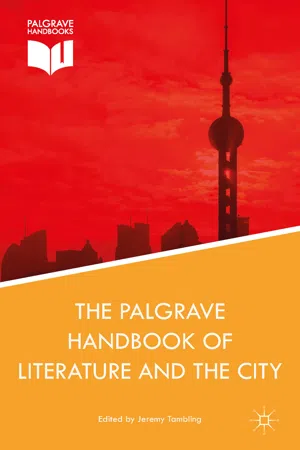
This book is about the impact of literature upon cities world-wide, and cities upon literature. It examines why the city matters so much to contemporary critical theory, and why it has inspired so many forms of writing which have attempted to deal with its challenges to think about it and to represent it. Gathering together 40 contributors who look at different modes of writing and film-making in throughout the world, this handbook asks how the modern city has engendered so much theoretical consideration, and looks at cities and their literature from China to Peru, from New York to Paris, from London to Kinshasa. It looks at some of the ways in which modern cities – whether capitals, shanty-towns, industrial or 'rust-belt' – have forced themselves on people's ways of thinking and writing.
- English
- ePUB (mobile friendly)
- Available on iOS & Android
eBook - ePub
The Palgrave Handbook of Literature and the City
About this book
Trusted by 375,005 students
Access to over 1.5 million titles for a fair monthly price.
Study more efficiently using our study tools.
Information
The City in Theory
Introduction
Cities—which include ‘global cities’ since Saskia Sassen popularised the term in the 1990s: she meant New York, London, and Tokyo, largely on account of their place in international finance—begin to be actively theorised in the nineteenth century. Indeed, poetry, novels, and theoretical writings began to lose their difference and became part of each other with the sense of how much of a challenge the city in modernity was proving to be. Early writers on the city—the subject of Jason Finch’s chapter which follows—include Georg Simmel in Berlin and Patrick Geddes, who developed the word ‘conurbation’ to think how cities mass together to make a single space, and the Chicago School of urban sociologists, such as Louis Wirth. They respond to the different modes of city planning current after Haussmann’s redesigning of Paris: the City Beautiful, the Garden City, the Radiant City, for instance. They respond, too, to the new ways in which the city becomes the active topic of such writers as Parent-Duchatelet, Chadwick, Dickens, Baudelaire, and Zola, and, in the twentieth century, the surrealist writer Louis Aragon, in Paris Peasant (1926), thinking of the disappearance of the nineteenth-century Paris arcades, seeing them—and therefore the city—as ‘true sanctuaries of a cult of the ephemeral’. This indicates several areas of interest: first, the city as always renewing itself in terms of its fashion, so that it gives a new sense of beauty, as itself ephemeral and changing, the ‘marvellous suffusing everyday appearance’, as Aragon says, a phrase which anticipates Carpentier’s definition in his novel The Kingdom of this World of what is now called ‘magic realism’. That changefulness exists despite the sense of the city as the permanent, the unchanging.
The theme passes from Baudelaire to Aragon to Walter Benjamin, whose Arcades Project, given a chapter in Part I, considers nineteenth-century Paris as a heap of fragments which are still there to be read, and to be reclaimed, and concludes his analysis of ‘Paris—the Capital of the Nineteenth-Century’ by thinking of Balzac (1799–1850), the great writer of Paris before Haussmann, referring, just as the bourgeoisie are making their piles of wealth, to ‘the ruins of the bourgeoisie’, and saying that ‘we begin to recognise the monuments of the bourgeoisie as ruins even before they have crumbled’. The meaning of this can be glossed from Marvin Trachtenberg’s book on the Renaissance architect Alberti (1404–1472), Building in Time: From Giotto to Alberti and Modern Oblivion (Yale 2010). Alberti believed in the ideal city, intact, and humanist in inspiration, and observable from a single perspective. Before Alberti, Gothic architects had built slowly, so that no building was ever complete; always in process, different moments overlaid on each other: Trachtenberg calls this ‘building in time’; it corresponds to the idea that a building shows duration. Alberti was the first city planner to want a whole synchronic display of styles at one moment: building outside time, time excluded. The ideal city appears the work of a moment, absolute, commanded into existence, and excluding the idea of ruins. The postmodern building, Robert Venturi’s extension to the National Gallery in London (1991), presents itself as in an ‘ideal’, not real time, as is the case with pastiche. Benjamin’s argument is that the ruin appears despite such an attempt at evading time as an essential within architecture, and the city, whose commodity structure, exhibited in its downtown (display windows, as Benjamin points out in ‘Central Park’ no. 38 (1938), have become part of building facades). Benjamin says that ‘allegorical emblems return as commodities’, meaning that signs of ruin (like the allegorical skull in Renaissance/Baroque paintings) are now the gleaming icons of capitalist modernity, but which are equally, signs of ruin (‘Central Park’, 32a). The city is always incomplete, always in ruins, and that double perception requires, for Benjamin, a focus on ‘the dialectical image’. We remember that in Baudelaire’s ‘The Swan’, discussed in the previous chapter, everything becomes allegory.
In Britain, in the 1960s, an early theorist of the city was H.J. Dyos, whose compilation of chapters The Victorian City (1973), with Michael Wolff, set a standard for empirical readings of what cities are and have been. Here, the attention was both on suburbs, and on industrial cities, and on the new urban poor that had been created by the city and by capitalist industrialisation. Dickens, Elizabeth Gaskell, Disraeli, Kingsley, Henry Mayhew, William Booth, founder of the Salvation Army—a vital theme for writers about the working class, including Shaw, and of course Brecht—and Charles Booth, with his surveys of urban poverty in the 1890s, have all given impetus to consideration of what the city means, and entails: much here arises out of Marxist analysis, and the work of Engels. The slums, a nineteenth-century concept, were early defined by the journalist John Hollingshead, writing Ragged London in 1861. Marxist theory about the city has moved from considering its industrial basis, and the concealed and unconcealed poverty which the realist novel opened up, towards thinking, as with Benjamin, of the city as the site of consumption, of commodity fetishism, and of the ‘phantasmagoria’; this makes the city so much an ideological product, preventing people from seeing things as they are, certainly providing a fantasy world, perception of which induces melancholia, or delirium: the city being indeed a delirious space, as with the postmodern architect Rem Koolhaas’s history of Manhattan, Delirious New York (1978). ‘Postmodern’ here exploits the sense that the city has no one entity, nor one history, and abolishes all thought of there being a stable origin to anything: the city is what is made of it, and its ‘bigness’, as Koolhaas describes this in SMLXL (1995), means the defeat of architecture and even town planning as a way of controlling or stabilising people’s lives. The work of Foucault, influential on Richard Sennett, and Henri Lefebvre and Michel de Certeau sees a contest between urban policing surveillance and policing and the construction of ‘space’, and the way that ‘the everyday’ may contest this, or else conform with it. The chapters in this part all look at cities in the light of these different ways of trying to conceptualise what may, after all, not be mapped, not be described nor fully encompassed.
All these, and more topics, are discussed in the chapters which follow: Jason Finch and J. A. Smith giving between them an account of 100 years of urban theory, Smith focussing on Venturi, architect of a kitsch Las Vegas (see also David Spurr’s chapter, later). Ben Moore writes on Benjamin, who is vital for many of the chapters of the book, and Alfie Bown following with an account of the city and everyday life. Both Moore and Bown take Paris as a primary focus, and Paris, as the Introduction has already noted, takes the prime place for defining the city—even if it is not quite a global city in Saskia Sassen’s original sense of that term. Yet it has, uniquely, continued to engender debates, which is one reason why the city, including its capital status in relation to so many French colonies, weaves in and out of many of the chapters ahead.
© The Author(s) 2016
Jeremy Tambling (ed.)The Palgrave Handbook of Literature and the City10.1057/978-1-137-54911-2_2Modern Urban Theory and the Study of Literature
Jason Finch1
(1)
http://www.palgrave.com/us/book/9781137549105
Jason Finch
is a Lecturer in English Literature at Åbo Akademi University in Turku, Finland. He is the author of E.M. Forster and English Place: A Literary Topography (Turku, 2011), and Deep Locational Criticism: Imaginative Place in Literary Research and Teaching (Amsterdam, 2016), as well as the co-editor of a number of collections, most recently Literature and the Peripheral City (Palgrave 2015). At present, he is working on the London slums as concept and reality between 1820 and 1970.
In the twentieth century, the city was theorized as never before. Thinking about cities became professionalized. This happened at the intersection of theoretical and applied thinking, between sociological research and architectural practice, which was known as planning. This was when, in many parts of the world, the growth of cities seemed an uncontrollable and even a dangerous phenomenon. While multiple urban traditions, for example that of the Arab world, continued (qualified by imperialism and colonialism), the changes that were visualized and written about in cities such as Paris and New York had enormous impacts on large and small cities in many countries.
This chapter considers what literary scholars in the twenty-first century could do with the models and theories which emerged under the general headings of planning and urban studies between the mid-nineteenth and the later twentieth centuries. Accounts of the city which were produced to describe and shape actual practice and policy in the new, sprawling urban zones could become fresh approaches to the reading of literature. Conversely, as works produced from the 1970s onwards in sociology, architecture and design, and human geography taking a cultural turn recognize (Lefebvre [1974] 1991; Sennett 1977, 1994; Pinder 2005; Campkin 2013), literature and other forms of cultural production contribute to the discussion. The texts at the centre of this chapter were shaped with different purposes in mind from those of literary scholars. The outcome of such purposes in the actual building and planning decisions of nineteenth- and twentieth-century cities in Europe, North America and elsewhere is neither utopia nor dystopia but the messiness of life. Such messiness is rendered best not by plans but by certain literary forms, notably the realist novel and creative non-fiction.
Until the ‘spatial turn’ of the 2000s and 2010s, literary scholarship paid little attention to urban theory. Even now, the reception of contemporary spatial theory by Andrew Thacker (2003), Anna Snaith and Michael Whitworth (2007) and others, like the mapping-based approach of Franco Moretti (1998, 2005), the ‘geocriticism’ proposed by Bertrand Westphal ([2007] 2011) and his disciple Robert T. Tally Jr. (2013) and even the postmodern geographies of Edward Soja (1989) rather emphasized narratives of the modern, within which the urban dominates, proposed in France between the 1960s and the 1990s by Pierre Bourdieu et al. 1999, Michel Foucault ([1967] 1998), Guy Debord ([1967] 1994), Gilles Deleuze, Henri Lefebvre ([1974] 1991), George Perec ([1974] 1997), Michel de Certeau ([1974] 2000) and Marc Augé ([1992] 1995). Such narratives see the modern and postmodern urban as essentially the site of contests of power between varied ideological forces with individual ‘users’ occasionally developing the ability to subvert the system via creative and irrational practices of walking and art production. But a much broader range of theorizations of and responses to the urban, produced in the nineteenth and twentieth centuries, have still largely been overlooked by literary scholars. Work from specifically German and Anglo-American traditions which coalesced as urban studies is at the centre of this chapter.
Specifically, this chapter moves from fairly fresh responses to the rapidly urbanizing city in the nineteenth century and at the beginning of the twentieth by the likes of Friedrich Engels ([1845] 1987), John Ruskin ([1884] 2006), Charles Booth ([1886–1903] 2002), Ferdinand Tönnies ([1887] 2001), Frederick Law Olmsted ([1870] 2003) and William Morris ([1890] 2007) to the wholesale rejection of the urban embodied most clearly in the work of Ebenezer Howard ([1898] 2003) and Patrick Geddes (1915) and developed into a massive orthodoxy in the USA by Lewis Mumford ([1938] 1940, 1961) and in the UK by Patrick Abercrombie (1945) in the mid-twentieth century. This is followed by efforts to reshape the urban via revolutionary transformations, again focused on the era between the two world wars and emerging most clearly in the work of Le Corbusier ([1929] 2003) and Albert Speer (1970; see Hall 1988, pp. 198–200).
Running alongside such efforts was a slow and penetrating effort to get to grips with the details and landscape of the modern urban beginning, with the refocusing on the individual in Georg Simmel ([1903] 2010), progressing through the Chicago School sociological studies produced between the 1920s and the 1960s and taking a vital turn with the neo-urbanism of Jane Jacobs (1961) and the work on gentrification and urban revival of Ruth Glass (1964), Marshall Berman ([1982] 1983) and Neil Smith (1996) between the 1960s and the 1990s. This work tested the hypotheses about the unique nature of the modern urban social experience proposed by Tönnies and others, becoming itself the foundation for twenty-first century work in cultural geography (Pinder 2005) and sociological ethnography (Hall 2015).
Nineteenth-Century Fear of the City
The historian of urban planning, Peter Hall (1988, p. 14) entitles his chapter on late nineteenth-century ‘[r]eactions to […] the Slum City’, ‘City of Dreadful Night’. In doing so, he borrows the title of a literary text, the Victorian poem of the same name by James ‘B.V.’ Thomson, which describes a city as dark and bleak, its inhabitants isolated. Characteristic nineteenth-century accounts of the new, sprawling metropolis were acts of demonization. For Engels (1820–95), the meaning of the city was found in many individuals living in close physical proximity to one another, which he held to be necessarily a dehumanizing experience:
The brutal indifference, the unfeeling isolation of each in his private interest, be...
Table of contents
- Cover
- Frontmatter
- Prologue: City-Theory and Writing, in Paris and Chicago: Space, Gender, Ethnicity
- 1. The City in Theory
- 2. European Cities
- 3. North American Cities
- 4. Latin American Cities
- 5. African Cities
- 6. Asian Cities
- 7. Urban Themes
- Backmatter
Frequently asked questions
Yes, you can cancel anytime from the Subscription tab in your account settings on the Perlego website. Your subscription will stay active until the end of your current billing period. Learn how to cancel your subscription
No, books cannot be downloaded as external files, such as PDFs, for use outside of Perlego. However, you can download books within the Perlego app for offline reading on mobile or tablet. Learn how to download books offline
Perlego offers two plans: Essential and Complete
- Essential is ideal for learners and professionals who enjoy exploring a wide range of subjects. Access the Essential Library with 800,000+ trusted titles and best-sellers across business, personal growth, and the humanities. Includes unlimited reading time and Standard Read Aloud voice.
- Complete: Perfect for advanced learners and researchers needing full, unrestricted access. Unlock 1.5M+ books across hundreds of subjects, including academic and specialized titles. The Complete Plan also includes advanced features like Premium Read Aloud and Research Assistant.
We are an online textbook subscription service, where you can get access to an entire online library for less than the price of a single book per month. With over 1.5 million books across 990+ topics, we’ve got you covered! Learn about our mission
Look out for the read-aloud symbol on your next book to see if you can listen to it. The read-aloud tool reads text aloud for you, highlighting the text as it is being read. You can pause it, speed it up and slow it down. Learn more about Read Aloud
Yes! You can use the Perlego app on both iOS and Android devices to read anytime, anywhere — even offline. Perfect for commutes or when you’re on the go.
Please note we cannot support devices running on iOS 13 and Android 7 or earlier. Learn more about using the app
Please note we cannot support devices running on iOS 13 and Android 7 or earlier. Learn more about using the app
Yes, you can access The Palgrave Handbook of Literature and the City by Jeremy Tambling in PDF and/or ePUB format, as well as other popular books in Literature & Social History. We have over 1.5 million books available in our catalogue for you to explore.