eBook - ePub
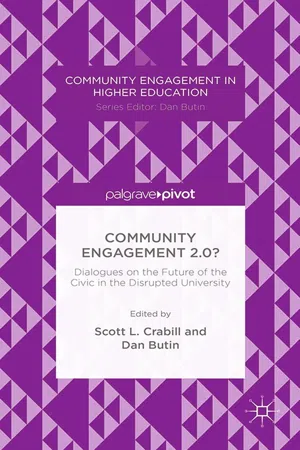
Community Engagement 2.0?: Dialogues on the Future of the Civic in the Disrupted University
Dialogues on the Future of the Civic in the Disrupted University
- English
- ePUB (mobile friendly)
- Available on iOS & Android
eBook - ePub
Community Engagement 2.0?: Dialogues on the Future of the Civic in the Disrupted University
Dialogues on the Future of the Civic in the Disrupted University
About this book
As higher education is disrupted by technology and takes place less and less on campus, what does meaningful community engagement look like? How can it continue to enrich learning? In Community Engagement 2.0? , Crabill and Butin convene a dialogue: five writers set out theoretical and practical considerations, five more discuss the issues raised.
Information
Topic
EducationSubtopic
Comparative Education1
Provocation: On the Future of the Civic in the Disrupted University
Dan Butin
Abstract: This chapter examines the ongoing “disruption” of higher education to suggest that we reframe how we think about civic engagement in higher education. As digital learning technologies force us to rethink the foundations of traditional models of teaching and learning, civic learning offers a means to revisit education as transformation rather than transmission. The chapter serves as a provocation for the community and civic engagement fields to embrace and integrate such technological disruptions in order to enhance civic engagement as a high impact practice.
Crabill, Scott L. and Dan Butin, eds. Community Engagement 2.0? Dialogues on the Future of the Civic in the Disrupted University. New York: Palgrave Macmillan, 2014.
DOI: 10.1057/9781137441065.0004.
DOI: 10.1057/9781137441065.0004.
We are today witnessing a fundamental reorientation of what it means to teach and learn at colleges and universities. This technological disruption will, trust me, change higher education. (OK, don’t trust me. For the sake of provocation, this chapter operates at the level of broad brush strokes. Nevertheless, the reference list offers a sampling of the recent research that drives this introductory chapter; see also Butin, 2014a, 2014b.)
This chapter is thus an attempt to think about the future of community engagement in an increasingly online world. I want to suggest that as learning moves further and further into the “cloud,” it may actually be that civic learning—those feet on the ground—that offers a coherent vision for the future of higher education.
For whether we like it or not, the value proposition of postsecondary education has been fundamentally questioned and the monopoly of place-based institutions shattered. Demographic changes, market pressures, and technological advancements have eroded and disrupted any singular notion of what constitutes a college education. Students today take a dizzying array of pathways towards a bachelor’s degree, and it becomes ever more difficult to qualify or quantify whether and to what extent a “traditional” education differs—in process or product—from the emerging options and opportunities that digital learning technologies have begun to make available.
I am not simply talking about MOOCs (massive open online courses) enrolling millions upon millions of students, or online institutions such as the University of Phoenix with enrollments dwarfing even the largest state institutions, or the online “open badges” movement and the federal government’s parallel endorsement of competency-based education rather than the historically sacrosanct credit hour, or even about the fact that one in three college students has taken an online course. Nor is this about the cost or quality or access of higher education. This is about what it means to be educated. And, concomitantly, the future of place-based learning as online education becomes ever-more accepted as one among multiple modes by which students learn and move through the credentialing process known as higher education.
Don’t get me wrong. Higher education as a “place” will not disappear. Postsecondary education serves a multiplicity of functions to a wide variety of constituencies. Above and beyond the traditional functions of knowledge production and dissemination, postsecondary institutions act as mechanisms of stratification, modes of socialization, drivers of economic activity, and hubs for institutional collaboration. Put otherwise, postsecondary institutions do much more than just educate and credential students. A large number of place-based colleges and universities will thus continue to make a substantial impact in their local communities, support the development of new research and knowledge, develop meaningful university-industry partnerships, and serve as proxies for distinguishing and differentiating who we consider to be “elite.” Yet I want to suggest that all bets are off in the realm of teaching and learning. I want to suggest that current and developing digital learning technologies will, in the next decade, force us to reconsider just about every aspect of what we used to think about as the traditional model of education.
To be clear, there are a few major caveats. The depth and breadth of such disruption will of course be stratified, as different institutions embrace and embed such technology in fundamentally distinct ways. Given the diverse and distinct segments of the postsecondary landscape (e.g., nonprofit, for-profit, public and private two- and four-year institutions), implementation and integration of such technologies will substantially vary. Moreover, technologically driven developments are still all too often at the “beta” phase of development and thus may function more as supplements to traditional models of teaching and learning rather than as their replacements.
Yet irrespective of such postsecondary differentiation, the political and financial pressures are too great, the technological opportunities too available, and the storyline of college as the “life of the mind” just too tattered. The questions about the future of civic and community engagement in the “disrupted university” are thus acute and potentially dire: Does online learning undermine the raison d’être of community-based models of teaching, learning, and research? How does civic learning as a deeply labor-intensive, faculty-driven practice continue to have resonance in an automated, machine-driven pedagogical environment? What happens to service-learning as a critical, justice-oriented, and disruptive pedagogical practice?
To begin to answer such questions, we must be clear about two interrelated points: that most traditional modes of teaching and learning (let’s call this the “transmission model of education”) do a pretty poor job of educating a large percentage of postsecondary students, and that technological platforms are increasingly demonstrating their capacity at meeting or exceeding student outcomes in comparison to traditional face-to-face instruction (see, e.g., Bowen et al., 2013; Lack, 2013; Mazoué, 2012).
One can cite a litany of statistics and research that suggests that a vast majority of students are being poorly served by our system of higher education, from abysmal graduation rates outside of the elite institutions to the opportunity and outcome gaps across racial, ethnic, and socioeconomic student populations to the low-level curriculum delivered by contingent instructors that is misaligned to high school preparation as well as future employer expectations (Arum & Roksa, 2010; Mullen, 2010). At the heart of this problem—at least from the framework of enhancing teaching and learning—is the outmoded notion that education is solely or simply the delivery of specific content knowledge: as if we could just transfer knowledge from instructors to students.
But until recently such a transmission model of education was all we had and all we could hope for outside of the artisanal endeavors of individual faculty. We might rail against the so-called banking model of education (i.e., depositing information into passive and empty students), but, as we have all learned, some banks are just too big to fail. This chalk-and-talk model, however imperfect, was all we had.
Until now. The rise of MOOCs—with their capacity to freely enroll millions upon millions of students from anywhere, anytime—is but the most obvious manifestation of the forthcoming technologically driven disruption. For MOOCs are just platforms for the efficient delivery of content knowledge (Sarma & Chuang, 2013). And such online, massively networked, data-driven, and automated systems are fundamentally changing how content gets delivered. “Adaptive” modules, for example, change in difficulty according to responses, and automated “stealth assessments” provide instantaneous feedback and helpful prompts that are based on mining “big data” through sophisticated learning analytic algorithms.
The research by now is in fact clear that such online and computer-driven instruction is just as effective, and oftentimes even more so, than traditional face-to-face settings. From a recent US Department of Education meta-analysis to highly specific analyses of intelligent tutoring systems, the basic story is that we can no longer presume that any particular form of instruction—face-to-face, hybrid, or fully online—is the default mode by which any particular student learns best (Bowen, 2013; Carey & Trick, 2013; Sarma et al., 2013; Means et al., 2010).
To be clear, I am not suggesting that the quintessential seminar—with its intimate small group dynamics of guiding professor and inquisitive students—is somehow in jeopardy of losing out to a MOOC. But remember, just one in four college students today fits into the “traditional” category we have long associated with recent high school graduates going straight into a four-year undergraduate degree. Community colleges, for example, educate close to half of the 18 million students in postsecondary education. To be blunt, less than five percent of all college students will ever experience an upper-level seminar as I have just idyllically described. Most students, instead, will be stuck in a lecture hall watching a PowerPoint presentation. That is the transmission model of education.
In that light, when we are thus faced with the pragmatic, fiscal, and policy dilemmas of, for example, half a million community college students in California who cannot get access to in-seat courses necessary for their majors (as happened just last year), technological solutions become, by necessity, a part of the policy discussion. Online instruction becomes an obvious opportunity to provide “good enough” instruction to a large number of students at minimal cost. We cannot hide from these realities. If this is thus the future of the “disrupted university,” where does that leave place-based learning, much less community engagement? What do we have to offer?
I want to suggest that we in fact have much to offer. For in this technological disruption lies the seed of the answer of the value and necessity of place-based civic engagement. The key is the realization that, above all else, MOOCs and online education more broadly demonstrate that we can more or less solve the question of how to efficiently and effectively deliver specific forms of content knowledge. Put otherwise, MOOCs can inform, but they cannot educate (Butin, 2014a).
I am here referencing the distinction between closed- and open-ended learning, or what learning theorists have alternatively described as shallow versus deep learning, first- and second-loop learning, or transmissional and transformational education. This distinction—which, I acknowledge, may be all too binary and all too neat—offers a productive means by which to realize the limits of this forthcoming technological disruption and the potential for a renewed vision for engaged learning.
To that end, I want to dwell for a moment on Gregory Bateson’s (2000) distinctions of three levels of learning, or what he terms “zero learning,” “learning I,” and “learning II.” Zero learning for Bateson was any system (whether human or computer-based) that simply reprocessed a signal with minimal modification in its actions. Electronic circuits, genetically pre-programmed actions, habituated responses and any other action “not subject to correction by trial and error” all constitute a minimal degree of learning. In contrast, “learning I” is the ability to learn exactly through trial and error. A system does things differently at time “X+1” because it has learned from both the content and context of what happened at time “X.” It is different, I come to learn, when someone yells “fire” from the back of a theater rather than on the stage. Such contextual markers of specific content are key to the ability to learn.
As such, Bateson theorized that “learning II” occurs when I am able to understand the context of contexts. Bateson termed this “deutero-learning,” and cognitive scientists and psychologists refer to this as metacognition, or colloquially as the ability to learn to learn. The point is that a system (again, whether human or computer-based) must be able to “jump” a level and reflect back upon itself (through a process of self-monitoring, self-reflection, or meta-cognition) about the initial level it was just at. In so doing, it is able to see the system within which it had been operating and, ideally, modify the pattern of behavior based upon this new-found higher-order perspective.
John Dewey (1910), in How We Think, poetically described this as a “moment of doubt.” This “forked-road situation,” Dewey suggested, is what fosters true thinking as it creates “a situation which is ambiguous, which presents a dilemma, which proposes alternatives,” and as such forces us to pause and “metaphorically climb a tree; we try to find some standpoint from which we may survey additional facts and, getting a more commanding view of the situation, may decide how the facts stand related to one another” (p. 11).
Such a moment of uncertainty forces us to rethink and reorient our notions of the normal through a reconsideration of these taken-for-granted assumptions to potentially reveal alternative perspectives and pathways. So it is here that we come to find the limits of MOOCs and any and all digital learning technologies like it. Namely, computer-based systems are incredibly efficient at achieving a specific defined task within a closed-loop system. They can transmit specific content knowledge in a multiplicity of ways, assess students’ comprehension in real-time and with immediate feedback, and offer a highly calibrated set of next steps that adapts to an individual’s particular background knowledge, level of comprehension, and learning preferences. This is learning analytics at its best, offering true “learning I” instruction.
But, to be clear, there are very prescribed limits to such a model of education. Namely, the content knowledge that is delivered must be stable, singular, and solvable (VanLehn, 2011). Put otherwise, there must be a right and a wrong answer. So long as one can atomize a body of knowledge and delimit the parameters of responses (which, sadly for dialogue and debate, research has shown constitutes the vast majority of classroom-based interactions), an automated system will excel at such a task. Yet the moment one attempts to step outside of such a system, to jump a level of awareness in order to survey the context and assumptions and implications of the system (what “learning II” is all about), the “brittleness” of even the best closed-ended systems is revealed.
Brittleness refers to a system’s inability to handle ambiguous or unexpected developments. For while even the most complex closed-ended domain (e.g., chess) is mappable, even basic open-ended domains create the problematic of an infinite regress; that is, a system that attempts to map the combinametrics of even basic linkages will quickly collapse. This is oftentimes glossed as “the map is not the territory,” in that any representation of “reality” cannot duplicate that very reality. A map is useful insofar as it offers a coherent representation—across a specific set of variables—of a far more jumbled and complex world. As soon as additional variables are added to a map, adding so-called accuracy, the map at some point takes on the very size and complexity it was meant to code for and thus no longer serves its purpose.
What place-based civic education thus offers is exactly those moments of stepping outside of the normal, of “boundary crossing” into a moment that cannot be fully prescribed or coded for. Engaged learning—the type that happens outside of textbook covers and beyond the four walls of the classroom—offers a chance to make learning come alive and bridge theory and practice exactly by fostering and forcing the “moments of doubt” and reflection. Whether one refers to it as service-learning, community-based research, or civic engagement, such practices are—by their very nature of engaging with the complex realities of our day-to-day lives—inherently complex and disruptive of our taken-for-granted notions of the world (Butin, 2010).
This, ultimately, is the notion of education as transformation rather than as transmission. And this is the power and promise of community engagement in higher education: ...
Table of contents
- Cover
- Title
- 1 Provocation: On the Future of the Civic in the Disrupted University
- Part I Theoretical and Practical Considerations
- Part II Responses and Dialogues
- Index
Trusted by 375,005 students
Access to over 1.5 million titles for a fair monthly price.
Study more efficiently using our study tools.
Frequently asked questions
Yes, you can cancel anytime from the Subscription tab in your account settings on the Perlego website. Your subscription will stay active until the end of your current billing period. Learn how to cancel your subscription
No, books cannot be downloaded as external files, such as PDFs, for use outside of Perlego. However, you can download books within the Perlego app for offline reading on mobile or tablet. Learn how to download books offline
Perlego offers two plans: Essential and Complete
- Essential is ideal for learners and professionals who enjoy exploring a wide range of subjects. Access the Essential Library with 800,000+ trusted titles and best-sellers across business, personal growth, and the humanities. Includes unlimited reading time and Standard Read Aloud voice.
- Complete: Perfect for advanced learners and researchers needing full, unrestricted access. Unlock 1.5M+ books across hundreds of subjects, including academic and specialized titles. The Complete Plan also includes advanced features like Premium Read Aloud and Research Assistant.
We are an online textbook subscription service, where you can get access to an entire online library for less than the price of a single book per month. With over 1.5 million books across 990+ topics, we’ve got you covered! Learn about our mission
Look out for the read-aloud symbol on your next book to see if you can listen to it. The read-aloud tool reads text aloud for you, highlighting the text as it is being read. You can pause it, speed it up and slow it down. Learn more about Read Aloud
Yes! You can use the Perlego app on both iOS and Android devices to read anytime, anywhere — even offline. Perfect for commutes or when you’re on the go.
Please note we cannot support devices running on iOS 13 and Android 7 or earlier. Learn more about using the app
Please note we cannot support devices running on iOS 13 and Android 7 or earlier. Learn more about using the app
Yes, you can access Community Engagement 2.0?: Dialogues on the Future of the Civic in the Disrupted University by Scott L. Crabill, D. Butin in PDF and/or ePUB format, as well as other popular books in Education & Comparative Education. We have over 1.5 million books available in our catalogue for you to explore.