eBook - ePub
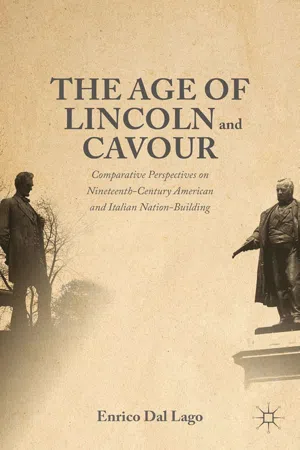
The Age of Lincoln and Cavour
Comparative Perspectives on 19th-Century American and Italian Nation-Building
- English
- ePUB (mobile friendly)
- Available on iOS & Android
eBook - ePub
The Age of Lincoln and Cavour
Comparative Perspectives on 19th-Century American and Italian Nation-Building
About this book
In the 19th century, both Italy and the US were young countries pursuing liberal nationalism even as unity was threatened by a recalcitrant southern population. This nuanced analysis of abolitionism and Italian democratic nationalism, Lincoln and Cavour, and the nation's two civil wars provides powerful new insights into their histories.
Information
Notes
Introduction
1. The “transnational turn” in American history and Risorgimento history is well represented by the following works: for the United States, see Thomas Bender, Nation among Nations: America’s Place in World History (New York: Hill & Wang, 2006), and Ian Tyrrell, Transnational Nation: United States History in Global Perspective since 1789 (New York: Palgrave, 2007); for Italy, see Maurizio Isabella, Risorgimento in Exile: Italian Emigrés and the Liberal International in the Post-Napoleonic Era (Oxford: Oxford University Press, 2009); and Silvana Patriarca and Lucy Riall, eds. The Risorgimento Revisited: Nationalism and Culture in Nineteenth-Century Italy (New York: Palgrave, 2012).
2. W. Caleb McDaniel and Bethany L. Johnson, “New Approaches to Internationalizing the History of the Civil War Era,” Journal of the Civil War Era 2:2 (2012), 146. See also Michael E. Woods, “What Twenty-First Century Historians Have Said about the Causes of Disunion: A Civil War Sesquicentennial of the Recent Literature,” Journal of American History 99:2 (2012), 415–439; and Don H. Doyle, “The Global Civil War,” in Aaron Sheehan-Dean, ed., A Companion to the U.S. Civil War (Oxford: Blackwell, 2014), 1103–1120.
3. Maurizio Isabella, “Review Article: Rethinking Italy’s Nation-Building 150 Years Afterwards: The New Risorgimento Historiography,” Past & Present 217 (2012), 267. See also Maurizio Isabella, “Nationality before Liberty? Risorgimento Political Thought in Transnational Context,” Journal of Modern Italian Studies 17:5 (2012), 507–515; and Oliver Janz and Lucy Riall, “Special Issue: The Italian Risorgimento: Transnational Perspectives: Introduction,” Modern Italy 19:1 (2014), 1–4.
4. See David Potter, “Civil War,” in C. Van Woodward, ed., The Comparative Approach to American History (New York: Oxford University Press, 1968), 138–143. Previously, in 1962, Potter had mentioned some of the comparative themes he would elaborate on in the following years; see David Potter, “The Historian’s Use of Nationalism and Vice Versa,” American Historical Review 67 (1962), 924–950.
5. Even though he never published a comparative historical monograph, in his acclaimed study on the origins of the American Civil War, The Impending Crisis, Potter hinted at the importance of a wider perspective including contemporaneous events in Europe; see David Potter, The Impending Crisis, 1848–1861 (New York: Harper & Row, 1976), especially 1–17.
6. For an overview of the historiography of American exceptionalism and comparative history’s contribution to its dismantlement, see George Fredrickson, “From Exceptionalism to Variability: Recent Developments in Cross-National Comparative History,” Journal of American History 82 (1995), 587–604; and Rick Halpern and Jonathan Morris, eds., American Exceptionalism: U.S. Working Class Formation in an International Context (New York: St. Martin’s Press, 1997).
7. See Barrington Moore, Jr., Social Origins of Dictatorship and Democracy: Landlord and Peasant in the Making of the Modern World (Boston: Beacon Press, 1966); and Raimondo Luraghi, Storia della Guerra Civile americana (Turin: Enaudi, 1966). See also Raimondo Luraghi, “The Civil War and Modernization of American Society: Social Structure and Industrial Revolution in the Old South before and during the War,” Civil War History 18 (1972), 230–267; and, more recently, Raimondo Luraghi, “Il significato storico della Guerra Civile americana centoquarant’anni dopo,” TuttoStoria 2001, 24–31, in which the author claims once more that “the Civil War took its rightful place among the nineteenth-century national revolutions” (p. 25).
8. Eric J. Hobsbawm, “The Invention of Tradition,” in Eric J. Hobsbawm and Terence N. Ranger, eds., The Invention of Traditions (Cambridge: Cambridge University Press, 1983), 1–14. See also Ernest Gellner, Nations and Nationalism (Oxford: Blackwell, 1983); Benedict Anderson, Imagined Communities (London: Verso, 1983); and Eric J. Hobsbawm, Nations and Nationalism since 1780 (Cambridge: Cambridge University Press, 1990).
9. See especially Peter Kolchin, Unfree Labor: American Slavery and Russian Serfdom (Cambridge, MA: Belknap Press, 1987); Peter Kolchin, A Sphinx on the American Land: The Nineteenth-Century South in Comparative Perspective (Baton Rouge: Louisiana State University Press, 2003); Shearer Davis Bowman, Masters and Lords: Mid-19th-Century U.S. Planters and Prussian Junkers (New York: Oxford University Press, 1993); and Enrico Dal Lago, Agrarian Elites: American Slaveholders and Southern Italian Landowners, 1815–1861 (Baton Rouge: Louisiana State University Press, 2005).
10. See Drew Faust, The Creation of Confederate Nationalism: Ideology and Identity in the Civil War South (Baton Rouge: Louisiana State University Press, 1988); Susan-Mary Grant, North Over South: Northern Nationalism and American Identity in the Civil War Era (Lawrence: University of Kansas Press, 2000); Melinda Lawson, Patriot Fires: Ideology and National Identity in the Civil War North (Lawrence: University of Kansas Press, 2002); Stephanie McCurry, Confederate Reckoning: Power and Politics in the Civil War South (Cambridge, MA: Harvard University Press, 2010); Paul Quigley, Shifting Grounds: Nationalism and the American South, 1...
Table of contents
- Cover
- Title
- Copyright
- Contents
- Acknowledgments
- Introduction: Nation-Building in the Age of Lincoln and Cavour: Comparative Themes and Dimensions
- I Nineteenth-Century American Abolitionism and Italian Democratic Nationalism
- II Lincoln, Cavour, and Progressive Nationalism
- III Secession, Civil War, and Nation-Building in the United States and Italy
- Conclusion
- Notes
- Index
Trusted by 375,005 students
Access to over 1.5 million titles for a fair monthly price.
Study more efficiently using our study tools.
Frequently asked questions
Yes, you can cancel anytime from the Subscription tab in your account settings on the Perlego website. Your subscription will stay active until the end of your current billing period. Learn how to cancel your subscription
No, books cannot be downloaded as external files, such as PDFs, for use outside of Perlego. However, you can download books within the Perlego app for offline reading on mobile or tablet. Learn how to download books offline
We are an online textbook subscription service, where you can get access to an entire online library for less than the price of a single book per month. With over 1.5 million books across 990+ topics, we’ve got you covered! Learn about our mission
Look out for the read-aloud symbol on your next book to see if you can listen to it. The read-aloud tool reads text aloud for you, highlighting the text as it is being read. You can pause it, speed it up and slow it down. Learn more about Read Aloud
Yes! You can use the Perlego app on both iOS and Android devices to read anytime, anywhere — even offline. Perfect for commutes or when you’re on the go.
Please note we cannot support devices running on iOS 13 and Android 7 or earlier. Learn more about using the app
Please note we cannot support devices running on iOS 13 and Android 7 or earlier. Learn more about using the app
Yes, you can access The Age of Lincoln and Cavour by Enrico Dal Lago in PDF and/or ePUB format, as well as other popular books in History & European History. We have over 1.5 million books available in our catalogue for you to explore.