This book presents post-Marxist theoretical approaches towards social critique and offers discourse analytical tools for critical research. How is a normative critique possible? The author, working at the crossroads of sociological discourse analysis and social philosophy, answers this question and others to show how empirical discourse research can be used to develop normative critique of societies. Divided into three major sections, Herzog introduces the reader to the theoretical approaches to critique, provides tools for normative evaluations of social structures, and finally offers practical examples of theoretical concepts. The book will be of interest to those working in the fields and subfields of discourse analysis, poststructuralism, hegemony theory, cultural political economy and critical theory, with an interdisciplinary orientation.
eBook - ePub
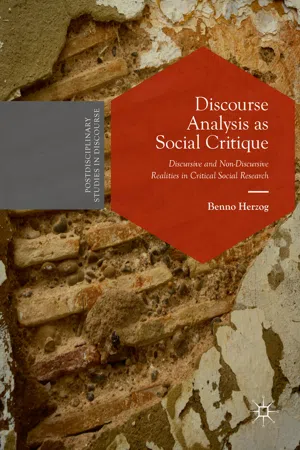
Discourse Analysis as Social Critique
Discursive and Non-Discursive Realities in Critical Social Research
- English
- ePUB (mobile friendly)
- Available on iOS & Android
eBook - ePub
Discourse Analysis as Social Critique
Discursive and Non-Discursive Realities in Critical Social Research
About this book
Information
© The Author(s) 2016
Benno HerzogDiscourse Analysis as Social CritiquePostdisciplinary Studies in Discourse10.1057/978-1-137-56908-0_11. Theoretical Approaches to Critique
Benno Herzog1
(1)
Dept of Sociology & Social Anthropology, University of Valencia, Valencia, Spain
1.1 Critique as Social Practice
When beginning to study subjects in social sciences or humanities, we often hear that we have to be “critical”. We should “read critically” or write a “critical commentary” about particular issues treated in class. Entering deeper into our fields of study, we become familiar with theories, approaches, or methods that call themselves critical, such as critical sociology, Critical Discourse Analysis (CDA), critical theory (in lower-case letters), or Critical Theory (in upper-case letters). In this flood of imperatives, to be critical, it might appear that social science and humanities are critical per se. What else should they be? If the alternative to being critical is being uncritical, then of course everybody wants to be critical.
However, what exactly does being critical mean? What is critique? Certainly there are many important and interesting definitions. However, the point that I want to make attempts to lead to the very core of all of these definitions of critique. Everybody who claims to be critical refers ultimately to a bundle of critical norms or critical methods. One good first entry point into the analysis of critique can be the explicit definition of Michel Foucault, the French post-structuralist thinker. He describes critique as the “art of not being governed or better, the art of not being governed like that” (Foucault 2007: 44). Later, he describes this position as “insubordination” or “desubjugation” (ibid.: 47).
It seems that at the beginning of critique, Foucault envisions an act of will. Where, however, does this act of will come from? Why does Foucault not want to be governed in that manner? These questions ultimately refer to the normative basis of Foucault’s notion of critique. All critique refers to some type of prescriptive statement. Something should or should not be like this. My daughter should tidy up her room, my neighbour should turn his music lower, or the government should reduce taxes. When making these kinds of critical statements, we always refer to some norms—such as order, in the case of my daughter’s room, or consideration in the case of my neighbour’s music. In the case of tax reduction, the underlying normative basis perhaps is less obvious. Depending on why and which taxes we want to be lowered and for whom, the normative basis of this argument probably is related to equality, distributive justice, or liberty.
So let us have a look at the normative basis of Foucault’s argument. Throughout his work, Foucault was quite critical of norms in general and hegemonic norms in particular. He was quite aware that norms are used as techniques of subjugation. Even unsuspicious norms, such as autonomy, liberty, or solidarity can turn into impositions. So, for example, the imperative of autonomy can be used to justify cuts in the welfare state to foster individuals’ autonomy and responsibility. The same could even be said of solidarity. Reductions in social care for the needy can be justified by appealing to individual solidarity and solidarity through charity.1 David Harvey resumes the contradiction that for Foucault (and for other thinkers) is inherent in the notion of freedom and liberty:
For what classical liberal political economy proposes was not only some sort of utopian model for a universalized capitalism but a certain vision of individual liberty and freedom that ultimately came to underpin, as the French philosopher Michel Foucault acutely notes, a self-regulatory structure of governance that placed limits on the arbitrariness of stat power at the same time as it led and enabled individuals to regulate their own conduct according to the rules of a market society. (Harvey 2014: 204)
However, even though Foucault was critical of all of the norms that he analysed, there is still a normative basis in both his writings and his political activities. In Foucault’s work, we can find many reasons for his attitudes that could serve as a normative basis. Foucault discussed the consequences of a very wide range of techniques of power or governmentality as the dispositif of sexuality (Foucault 1979), techniques of surveillance and punishment in the judicial system, educational system and factory (Foucault 1975), and in treating mental “illnesses” (Foucault 2006). Although Foucault does not list the positive bundle of norms to which he refers, we can deduce these norms from his work. In all of Foucault’s writings, he shows how social order, power relations, and subjugation are produced by humans’ social actions and transformed into a relatively stable social structure. Individuals are usually unaware of the whole range of actions described by Foucault. When engaging in practices of discourse production, surveillance, or punishment, people think of those practices as “normal” or “natural” and do not acknowledge the violence present in the fact that specific discourses or practices are predominant in our society. Foucault himself described a series of these mechanisms in his inaugural lecture (Foucault 1981), showing the diverse mechanisms of exclusion necessary to create the existing order of discourse. From his series of writings, we can understand that Foucault implicitly defends norms related to autonomy or liberty, especially those related to the possibility of making free and conscious decisions. Ultimately, these are the norms of illustration. No wonder Foucault’s definition of critique was first published in response to Emanuel Kant’s question, “What is Enlightenment?”
We can say that there are plenty of reasons to criticize society, for “not being governed like that”. All of these reasons ultimately refer to some norms. However, we must ask whether these reasons or norms are exclusive to Foucault and some of his followers. Perhaps other people have other reasons and other norms for why they refuse a specific type of government. And probably, there are many people who are quite happy with the existing social order. Now, if there are different stances towards the existing social order and even a different critical stance, which criteria do we have to want for a particular critique to be effective? What is the reason that the normative basis and argument of person A must be taken more seriously than those of person B?
This reasoning leads us to yet another characteristic of social critique: social critique must be universal—or at least widely shared by society—if it does not want to result in an imposition of norms by a particular social group. To be effective, social critique must be able to give a second-order reason that we want a critique. We can imagine a second-order reason or the corresponding second-order norm in analogy to Harry Frankfurt’s second-order volitions (Frankfurt 1971). Following Frankfurt, the free will that differentiates persons from animals is essentially based on the capacity of having second-order volitions. I can have the first-order volition to eat the juicy and enchanting steak in front of me. However, at the same time, I can have the second-order volition of not wanting to eat meat. I do not want my first-order volition to become effective. I want to be a vegetarian and I do not want to be the type of person who eats animals. For Harry Frankfurt, non-human animals lack the capacity of having a volition over their first-order volitions. A cat cannot decide whether it wants to be the type of animal that eats mice. Although the cat can have other first-order volitions, which make not chasing a mouse at a particular moment like wanting to play or wanting to chase a bird, and so on, the cat cannot decide that it does not want his first-order volition to become effective.
In the same way, we can refer to second-order norms when realizing social critique. We do not want to be governed like that, but we understand that if most people prefer to be governed like that, we do not want to impose a change upon them. Too often in humanity’s history, a particular social group has mistaken its particular situation, interests, and norms with those of the rest of society. The bourgeois class speaks in the name of the whole nation, or the communist party speaks in the name of society as a whole or—as is more subtle but more accepted today—a group of mainly male, mainly white, and mainly upper-class politicians speaks in the name of a national population. In other words, the norms to which social critique refers must be either universal norms or (at least) widely accepted social norms.
When criticizing, however, we do not follow only explicit or implicit normative assumptions. Apart from the often-unconscious or inexplicit normative basis of critique, there is another presupposition: When we criticize something or someone, we suppose that the status quo is suitable to change. In other words, we make an ontological statement about the object of critique, saying that it can be influenced by human behaviour. We can complain about the weather or lament the demise of a close relative, but both events are not subject to critique. What we can criticize is human behaviour and human-made circumstances. Critique is not about good wishes but about believing in the possibility of change. So when I criticize myself for not having brought an umbrella despite the cloudy sky announcing rain, I am believing that I could have acted differently and that next time in a similar situation, I should take an umbrella with me.
We will return to the point of the object of critique in the next chapter. Now, we want to take a deeper look at the questions around the problems of social change. Insofar as social critique expresses universal or socially accepted norms, it not only wants to evaluate or judge reality but also wants to contribute to change. Critique wants to change the criticized, that is, the persons, groups, or complex social structures being critiqued. A short glance at social reality shows that cognitive conviction is important in the process of change. Individual, groups, or societies must accept certain arguments and behave differently. However, we know from ourselves that this is not merely a matter of who has the better argument. We accept all of the reasons that we should not smoke, eat healthier food, or exercise more often. We want these reasons to be effective. However, we continue to behave in the criticized way. Are we not persons as described by Harry Frankfurt? Yes, we are; we want our unhealthy lifestyle to be ineffective. However, we often seem unable to make the change. Often there are practical or material impediments: the physical feeling of stress after a few hours without smoking, the mouth-watering pasta prepared by our mother-in-law, or the simple lack of time or money to enrol at a gym.
Therefore, critique is always more than a philosophical enterprise. Of course, although it must be fed by good reasons, it must also consider the real, practical, or material situation. It was exactly that point that caused Karl Marx to break with philosophy. The writing that best expresses Marx’s move from philosophy to critique is perhaps his “Thesis on Feuerbach”, in which Marx notes in his first thesis the need for a “‘practical-critical’ activity” (Marx 1970). Here, critique is a practice, an activity that changes both reality and the people involved in critique. For Marx, the role of practice and the material world is threefold:
First, material reality and practice are the starting points of critique. Critique is always practical. Second, critique must prove its truth both in relation to material reality and in practical activity. Thus, critique is not (only) about logical, cognitive consistency. Marx writes in his second thesis as follows:
The question whether objective truth can be attributed to human thinking is not a question of theory but is a practical question. Man must prove the truth— i.e., the reality and power, the this-sidedness of his thinking in practice. The dispute over the reality or non-reality of thinking that is isolated from practice is a purely scholastic question. (Marx 1970: 121)
With the expression “this-sidedness” (Diesseitigkeit), Marx seeks to distance himself from what he criticizes in both religion and philosophy: theoretical thinking without it is not grounded in the existing social reality and has no impact on reality. Finally, in Marx’s last, well-known eleventh thesis, he names the third and perhaps most important role of practice and reality for critique. “The philosophers have only interpreted the world, in various ways; the point is to change it” (ibid.: 123) Here, practice and reality are the objectives of critique. This quotation differs slightly from the better-known quote published in 1888 by Marx’s friend, Friedrich Engels. In the more popular version published by Engels, the second part of the thesis states, “the point, however (aber in the original German version), is to change it.” This “however” seems to open a space for contradiction between interpreting and changing the world, as if interpretation and change were two different activities. Nevertheless, for Marx, as we have seen in the first theses, interpretation and change come together in a practical-critical activity.
We have seen that the practical-material world is the starting point of critique, the criteria to prove the truth of critique and the end of the critical activity. However, the reverse of these theses does not mean that all change is the result of critique. There are several diverse reasons for change, such as natural development or development of a social system according to its own laws. Here, we could name the multiple processes of social differentiation in social systems, for example, the growing amount of laws, amendments, and law-like rules created to react in the logic of the juridical system to the challenges of reality. Nevertheless, critique is one very important method of change. It is important insofar as it is not only practical but also conscious. Critique is a conscious, self-reflexive method of change.
These considerations lead directly to questions related to critique as a method. What exactly is this critical method? What differentiates the specific practice of critique from other practices? We probably would avoid saying that a mechanic who changes the tires of my car is engaging in a critical practice, although undoubtedly, he is performing a conscious practical and material act aimed at changing the object of his acts. Or, if we prefer to remain with social objects of practice, traffic policemen whose practices aim at changing the flows of people at rush hour are engaged in a practice based on social reality and aim consciously at its change. Perhaps a short glance at the text of Max Horkheimer, the German post-Marxist, director of the Institute of Social Research in Frankfurt, and author of the famous 1937 essay “Traditional and Critical Theory”, could help us further understand the difference between critical and non-critical activities. In the above-mentioned essay, Horkheimer states “that there is a human activity which has society itself for its object” (Horkheimer 1975: 206). In a footnote, he clarifies that he is referring to critique: “In the following pages this activity is called ‘critical...
Table of contents
- Cover
- Frontmatter
- 1. Theoretical Approaches to Critique
- 2. Analytical Tools
- 3. Practical Examples
- 4. Conclusions
- Backmatter
Trusted by 375,005 students
Access to over 1.5 million titles for a fair monthly price.
Study more efficiently using our study tools.
Frequently asked questions
Yes, you can cancel anytime from the Subscription tab in your account settings on the Perlego website. Your subscription will stay active until the end of your current billing period. Learn how to cancel your subscription
No, books cannot be downloaded as external files, such as PDFs, for use outside of Perlego. However, you can download books within the Perlego app for offline reading on mobile or tablet. Learn how to download books offline
Perlego offers two plans: Essential and Complete
- Essential is ideal for learners and professionals who enjoy exploring a wide range of subjects. Access the Essential Library with 800,000+ trusted titles and best-sellers across business, personal growth, and the humanities. Includes unlimited reading time and Standard Read Aloud voice.
- Complete: Perfect for advanced learners and researchers needing full, unrestricted access. Unlock 1.5M+ books across hundreds of subjects, including academic and specialized titles. The Complete Plan also includes advanced features like Premium Read Aloud and Research Assistant.
We are an online textbook subscription service, where you can get access to an entire online library for less than the price of a single book per month. With over 1.5 million books across 990+ topics, we’ve got you covered! Learn about our mission
Look out for the read-aloud symbol on your next book to see if you can listen to it. The read-aloud tool reads text aloud for you, highlighting the text as it is being read. You can pause it, speed it up and slow it down. Learn more about Read Aloud
Yes! You can use the Perlego app on both iOS and Android devices to read anytime, anywhere — even offline. Perfect for commutes or when you’re on the go.
Please note we cannot support devices running on iOS 13 and Android 7 or earlier. Learn more about using the app
Please note we cannot support devices running on iOS 13 and Android 7 or earlier. Learn more about using the app
Yes, you can access Discourse Analysis as Social Critique by Benno Herzog in PDF and/or ePUB format, as well as other popular books in Languages & Linguistics & Linguistics. We have over 1.5 million books available in our catalogue for you to explore.