- English
- ePUB (mobile friendly)
- Available on iOS & Android
eBook - ePub
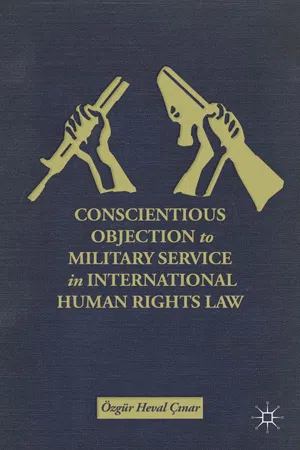
Conscientious Objection to Military Service in International Human Rights Law
About this book
This book examines the right to conscientious objection in international human rights law. It begins with an exploration of the concept of conscience and its evolution. Ozgur Heval o inar analyzes human rights law at both the international and regional level, considering UN, European, and inter-American mechanisms.
Information
Topic
DirittoPART I
Conscience, Freedom of Conscience, and Conscientious Objection to Military Service
The essence of the right to conscientious objection is the concept of conscience itself. Thus, in order to comprehend the scope and meaning of the right to conscientious objection, it is first necessary to undertake a detailed examination of the origins and development of the concept of conscience and of freedom of conscience in chapter 1. Such an analysis will also ensure a better understanding of the subsequent legal analysis of the right to conscientious objection.
The development of conscientious objection in parallel with the aforementioned evaluation of the concept of conscience and freedom of conscience will also be examined in chapter 2. In this respect, the evolution of the concept of conscientious objection will become clear within this study.
Finally, in the light of the evolution of the concept of conscientious objection, chapter 3 will examine how various types of conscientious objectors have arisen. It will describe the different categories into which conscientious objectors can be divided, explain the differences between these categories, and investigate how these differences are interpreted at national and international levels.
CHAPTER 1
Conscience and Freedom of Conscience
The word “conscience” derives from the Latin word “conscientia.” In its linguistic origins, the term “conscience” signified shared (con) knowledge (science).1 According to the Longman Contemporary English Dictionary, the conscience is “the part of your mind that tells you whether what you are doing is morally right or wrong.”2 Eide and Mubanya-Chipoya, in their report to the United Nations, interpret the meaning of conscience thus: “genuine ethical convictions, which may be of religious or humanist inspiration, and supported by a variety of sources.”3
In the travaux préparatoires of the International Covenant on Civil and Political Rights (ICCPR), delegates took account of the fact that conscience can be attributed to both philosophical and scientific concepts that, in themselves, amount to belief, in contrast to religious ideas that are based on faith. Thus, the drafters accepted equality between religioun and conscience deriving it from an individual’s personal moral canons founded in his/her distinction of right from wrong.4
It is evident from these interpretations that a central role is assigned to the individual in determining the substance of one’s conscience, allowing for the fact that any understanding of the concepts of good and bad varies from person to person and even from incident to incident. In this respect, there are several fundamental factors that affect a person’s conscience such as religious, moral, ethical, philosophical, humanitarian, or similar convictions.5
A Brief History of the Recognition of the Concept of Conscience and Freedom of Conscience
The subjective and secular character of the concept of conscience is a result of its evolution through a historical timeframe. A retrospective over “three periods”6 will explain how conscience and freedom of conscience have been gradually disentangled from a religious framework to become more secular and to be recognized as independent categories of freedom. The point has now been reached whereby similarity in the wording of relevant articles in international and regional human rights documents safeguards both freedom of conscience and freedom of religion, thereby demonstrating the strong relationship between these two independent freedoms.7
The First Period: Up Until the End of the Middle Ages
The origins of the current individual, subjective, and secular aspect of freedom of conscience can be found in the historical acceptance of minority religious groups.8 This chapter will therefore address the relationship between the concepts of religious tolerance and freedom of conscience both before and after the acceptance of Christianity as a state religion.9 Special attention will be paid to their development in Europe because the majority of the struggles for freedom of religion and conscience have taken place in Europe.10
To understand the role of religious tolerance before the acceptance of Christianity as a state religion it will be instructive to look at the third-century works of Tertullian, a Christian scholar. Here, one encounters texts propounding the idea that no one should be forced to hold any particular belief. Tertullian presents the case for freedom of belief, ergo, the freedom to believe in Christ as a precondition of Christianity. He claims that in this religion people are advised to love one another, adding that belief in Christianity cannot be attained by force.11 While, in this period, religious tolerance was emphasized, the concept of conscience was expressed solely within a religious framework.12
Having suffered constant persecution in the early days, Christians were initially in favor of religious tolerance. In the Edict of Milan, proclaimed by the Roman Emperor Constantine in 313 AD, the emperor called for tolerance to be shown to “the Christian Church and all other religions.”13
However, after the adoption of Christianity as the state religion under Constantine, Christianity spread rapidly over Europe and once the Christian Church was established, despite being in total contradiction to “the teachings of Christ,”14 persecution of people holding other beliefs commenced.15 Persecution increased under subsequent emperors, the Church eventually becoming a sort of department of religious affairs in an imperial, theocratic church-state.16 During the Middle Ages there was constant friction between church and state as regards their relative powers, and it is apparent that the Church was determined to limit the authority of the state in religious affairs.17
Concurrently, in countries outside Europe where Christianity was not predominant, there was little or no tolerance shown to minority religious groups. In Japan, for instance, after the acceptance of Buddhism as the state religion in the sixth century, followers of other religions were treated harshly.18
Overall, after the acceptance of Christianity as the state religion in Europe, the influence of the Church grew to the extent that, at least until the twelveth century, the power of the Church restricted the authority of the state. Consequently, intolerance of non-Christian societies became increasingly prevalent. The widespread influence of the Church meant that the concept of conscience was defined solely within a religious framework.
Nevertheless, in the twelveth century Abelard, a French scholar, stated that it was always wrong for a person to act against his/her conscience.19 In the thirteenth century, Thomas Aquinas, Italian priest and theologian, said that people did not have to comply with the orders of a lower authority when it contradicted that of the supreme power, God.20 These commentators believed that God created man, and therefore gave man a sense of good and evil.21 Being founded on Graeco-Roman and Christian traditions, this idea of conscience admits the existence of a supernatural force. In the Bible’s Epistle to the Romans (2:15) it is said that God wrote his law in our hearts, to which our conscience bears witness, meaning that conscience as related to an individual’s sense of good and evil was based on religious conviction.22
It is apparent from the above dictum that in examining the concept of conscience within the context of theology, scholars have emphasized that the concept should not be predetermined by institutions such as the Church or the state. In fact, at that time, Abelard and Aquinas were considered social rebels.23
In conclusion, the word “conscience” itself gained currency during this period, albeit restricted to the theological context. Thinkers commonly maintained that “moral actions” originate from the “objective law of God”; not until the beginning of the rise of humanism was there any change in this tendency.24
The Second Period: From the Renaissance and Reformation to the Nineteenth Century
With the Renaissance period (the fifteenth and sixteenth centuries) views on morality began to change. During this period, thinkers such as Erasmus focused on the humanitarian aspects of religion thereby ensuring that future scholars would evaluate the concept of conscience outside the theological context. However, while moral views began to undergo a change, the concept of conscience was still considered within a religious framework.25
From the beginning of the Reformation (the sixteenth century), the authority of the Church began to be questioned. In particular, the “mediator function of priests and sacraments” came to be somewhat rejected.26 However, while it became accepted that a person’s conscience formed part of a p...
Table of contents
- Cover
- Title
- Introduction
- Part I Conscience, Freedom of Conscience, and Conscientious Objection to Military Service
- Part II Conscientious Objection to Military Service as a Human Right
- Conclusion
- List of Cases
- List of Treaties and Other International Instruments
- List of International Official Documents
- Notes
- Bibliography
- Index
Trusted by 375,005 students
Access to over 1.5 million titles for a fair monthly price.
Study more efficiently using our study tools.
Frequently asked questions
Yes, you can cancel anytime from the Subscription tab in your account settings on the Perlego website. Your subscription will stay active until the end of your current billing period. Learn how to cancel your subscription
No, books cannot be downloaded as external files, such as PDFs, for use outside of Perlego. However, you can download books within the Perlego app for offline reading on mobile or tablet. Learn how to download books offline
Perlego offers two plans: Essential and Complete
- Essential is ideal for learners and professionals who enjoy exploring a wide range of subjects. Access the Essential Library with 800,000+ trusted titles and best-sellers across business, personal growth, and the humanities. Includes unlimited reading time and Standard Read Aloud voice.
- Complete: Perfect for advanced learners and researchers needing full, unrestricted access. Unlock 1.5M+ books across hundreds of subjects, including academic and specialized titles. The Complete Plan also includes advanced features like Premium Read Aloud and Research Assistant.
We are an online textbook subscription service, where you can get access to an entire online library for less than the price of a single book per month. With over 1.5 million books across 990+ topics, we’ve got you covered! Learn about our mission
Look out for the read-aloud symbol on your next book to see if you can listen to it. The read-aloud tool reads text aloud for you, highlighting the text as it is being read. You can pause it, speed it up and slow it down. Learn more about Read Aloud
Yes! You can use the Perlego app on both iOS and Android devices to read anytime, anywhere — even offline. Perfect for commutes or when you’re on the go.
Please note we cannot support devices running on iOS 13 and Android 7 or earlier. Learn more about using the app
Please note we cannot support devices running on iOS 13 and Android 7 or earlier. Learn more about using the app
Yes, you can access Conscientious Objection to Military Service in International Human Rights Law by Ö. Ç?nar in PDF and/or ePUB format, as well as other popular books in Diritto & Diritti civili in ambito legislativo. We have over 1.5 million books available in our catalogue for you to explore.