- English
- ePUB (mobile friendly)
- Available on iOS & Android
eBook - ePub
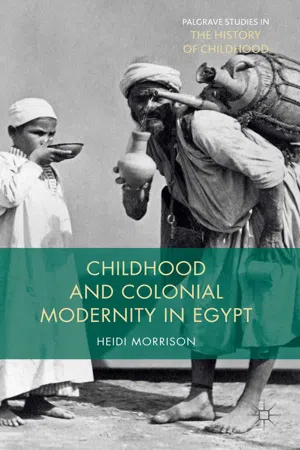
Childhood and Colonial Modernity in Egypt
About this book
This book examines the transformations of Egyptian childhoods that occurred across gender, class, and rural/urban divides. It also questions the role of nostalgia and representation of childhood in illuminating key underlying political, social, and cultural developments in Egypt.
Information
1
Reforming Childhood in the Context of Colonialism

Figure 1.1 Studio portrait
Source: Alban, Cairo/Egypt, 1945–1950.
Collection AIF/Georges Family Mikaelian
Copyright Arab Image Foundation
A 1940s photo by one of Egypt’s most important studio portraitists, Aram Alban, who went by the name of Alban,1 depicts a father dressed in Egyptian peasant attire sitting steadfast in front of his son dressed in semi-European attire. On their heads are two different symbols: the father wears an imama (traditional head wrap) and the son a tarboosh (felt, cone-shaped hat worn by the educated upper/middle-class Egyptian elite). The father’s eyes look away, the son’s look to the camera. The diverted eyes of the father, in comparison to the son’s, point to a tension between old and new.
The headgear on the father and son in this photo are both symbols of resistance. The father seems to represent an authentic Egyptian tradition, while the son represents the effendi (middle-class) child that will be discussed further in Chapter 2. Fused together father and son embody the nationalist message of early twentieth-century Egypt, a country searching for a national identity after years of British occupation. Resisting imperialism meant becoming a nation as modern as its occupiers, yet grounded in authentic, Egyptian roots. Many Egyptians saw children as a surrogate for the nation and hence represented resistance through them. In Egypt, clothing expressed tensions about European imperialism and the struggle to stay true to oneself while current with modern times.2
Europe developed new ideas about childhood during the nineteenth and early twentieth centuries that coincided with its growing global influence. While Europe may have exported some new ideas about childhood to its empires, this did not translate into wholesale adoption in places like Egypt. The chapter refrains from reducing the history of childhood in Egypt to a comparative one that holds the modern western standards of childhood as the model. Modernity was not a force emanating from the West and replicated by Egypt.3 Egyptians carved out an identity that accepted, rejected, and modified various aspects of modern European ideas.
Egyptian reforms on childhood came in large part from a resistance to imperialism, specifically the colonial gaze. (Other chapters in this book explore how childhood changed, thanks to new ideas about the nation, gender, and class.) The colonial gaze sought to keep Egyptians in subordinate positions to their British rulers by denigrating Egyptian culture and deeming it inferior to western. The colonial gaze embodied aspects of the white man’s burden. Ashis Nandy claims that in colonial situations, psychological domination impacts the inner life of the colonized.4 One impact is that the colonized fight the oppression. Historians of modern Egypt, such as Lisa Pollard, Beth Baron, Omnia El Shakry, Michael Gasper, and Wilson Jacob, have studied how tensions with imperialism manifested in Egyptian discourses on gender, sexuality, peasants, and the social sciences. However, no scholar has looked at how this tension manifested itself in Egyptian ideas about childhood.
Late nineteenth- and early twentieth-century Egyptian intellectuals’ responses to western imperialism changed child-rearing in three ways. First, Egyptian justifications and motivations for reforming childhood in Egypt emerged from resistance to imperialism, which translated into Islamic heritage playing a role in shaping new ideas toward childhood. Second, Egyptian intellectuals’ concern in reforming childhood focused on providing a moral education. Intellectuals equated the future of Egypt with personal behavior taught in childhood. Third, intellectuals in Egypt, unlike their contemporaries in Europe, articulated the actualization of the child’s self (or, in other words, the fulfillment of the child’s potential) as a rebirth for the whole community, more so than the individual.
In order to understand how some Egyptian intellectuals sought to refute the colonial gaze through discourses on child-rearing, this chapter begins by looking at the way many Europeans depicted Egyptian children in the imperial imagination. This depiction is explored through representations of the Egyptian child laborer.
Child labor in Egypt
We cannot discuss how the British imperial gaze manifests itself in ideas about child laborers without first situating that discourse in the economic and institutional framework that kept Egyptian children in exploitative conditions. Muhammad ʿAli, regarded as the founder of modern Egypt, tried decades prior to the British protectorate to turn Egypt into a state-run farm for his profit, leading some peasant families to lose their status as self-sufficient producers. Land passed to large landowners through land seizures, conscription, and heavy taxation.5 The system of Capitulations, which contained privileges for foreign merchants under the pretext that foreign business in Egypt was in the country’s best interest, also helped to ensure that peasant children remained locked in their spot as laborers in the global market. The cotton produced in Egypt fed the factories of the industrial revolution in Europe. Historians of childhood in the West argue that children in Europe reinvigorated modern European economic growth, were the glue that held it together, and should not be overlooked.6 These historians fall short of acknowledging that in the same era Egyptian children also footed the bill of Europe’s industrial wealth. It was not until the 1952 Revolutionary government of Nasser that the structure of the Egyptian economic system changed; that is, redistribution of land and adoption of import-substitution, and the patterns of child labor really began to change.
In Egypt’s rental system, the tenant family used their children for labor. If the family did not hire outside labor, then they only paid land usage (which cost between half and four-fifths of the crop). Rented farms were far from lucrative for families, even if they used their own children, and the families were far from being their own masters since the owner retained control of the water and fixed crop rotation and harvesting dates. The large landowners were primarily British and local elites.
Families depended on all members to work, even if it meant sending children off to neighboring villages for seasonal work through the tarh.īla system. In this system, the employer usually paid a certain sum to the contractors who distributed the amount earned among the workers. Contractors directed children in cotton and sugar cane harvesting, picking and eliminating insect infestations, ginning factories, digging canals, and repairing roads. At crop processing plants in the Nile Delta and in Middle Egypt, it was common to find up to 300 peasants from nearby villages (half of them children) feeding gins and sorting raw cotton.7 There are accounts as early as 1932 that refer to the practice in ginning factories whereby girl employees were recruited by an officer who received the total of wages earned and who, in paying them to the girls, frequently retained a portion of their small earnings.8
While children in Egypt have always worked in the fields with their families, the pattern of exploiting children to work for the benefit of people not related to them began under Muhammad ʿAli at the start of the nineteenth century. ʿAli transformed the Egyptian economy and army to establish his own hereditary rule independent of the Ottoman Empire. ʿAli’s reorganization of the Egyptian economy around long-staple cotton as a cash crop allowed him to secure a monopoly that locked peasant children into working for the state. ʿAli prohibited family migration to the cities, conscripted child laborers, and ordered Egyptian peasant families to cultivate cotton to the exclusion of all other crops, which he bought and then sold to British textile manufactures at a higher price. The successors of ʿAli and the Egyptian landed elite continued his policies.
Child labor also existed because there was little recourse for child laborers through unions. The first trade union organization was set up at the beginning of the twentieth century and by 1911 there were 11 unions with 7000 members. In 1919, the government officially recognized labor unions by setting up a central committee of conciliation, and in 1942 the government recognized freedom of association in trade unions. Despite the legal recognition of trade unions, the laws did not cover agricultural workers, and the minimum age for joining trade unions was 15 years.
There was little protection for child laborers in the law. The earliest protective legislation, enacted in 1909 and prohibiting the employment of children below the age of nine in certain industries, was widely acknowledged to be completely ineffective.9 Regarding the 1909 legislation, the Labor Research Department in London reported in 1928:
Its provisions were a dead letter from the first, because there was nobody to see that they were enforced and the penalties were limited to a fine not exceeding L1 for the first offence and for the second imprisonment up to seven days. Child labor continued to be employed and is still employed for very long hours, both in cotton picking and in ginneries.10
The first Labor Office was set up in Egypt in 1930, but its main function was formulation of legislation and settlement of disputes in matters relating to the trade union movement, and not to children. After an ILO mission to Egypt in 1932, a law was promulgated in 1933 to regulate the employment of children. The ILO report observes boys and girls under the age of ten being paid low wages in traditional handicraft workshops and factories.11 The 1933 law established 12 years as the minimum age for employment, but children over nine years of age could work in certain industries (including textiles, carpet weaving, and furniture) upon production of a certificate of physical fitness. This was the first law regulating child work enacted since 1909, but it fell short of necessary protection.12 The law was largely ignored and inadequately enforced, as the Labor Office employed only three inspectors, two inspectresses, and one clerk to cover all of Egypt.
The explanation for child labor in Egypt’s cotton industry relates to the cheapness of their wages, as well as their abundance in supply. Political scientist Ellis Goldberg claims that Egyptian cotton was produced as a labor-intensive good in an economy with abundant labor, as opposed to a capital-intensive good in an economy with abundant capital that could invest in mechanization of production. Britain was the most advanced industrial power, had more cotton spindles, mechanical looms, and capital invested in textile production than any other country in the world. Goldberg writes, “It is thus no won-der that powerful England easily subordinated Egyptian interests to its own and exploited the Nile Valley to provide the Lancashire mills with raw cotton harvested by children.”13 As Peter Stearns says, the Industrial Revolution was a global process, though an uneven one.14
The capitalist economic system to which Egypt was tied kept Egyptian children out of school and in the labor force, as did minimal legal protection for children and a lack of financial investment in education. Racialized notions of childhood in the imperial imagination played a significant role as well.
Colonial representations of Egyptian child workers
During the nineteenth century and first half of the twentieth century, Europeans employed Orientalist stereotypes in their discourse on Egyptian race, gender, and sexuality. The stereotypes included representing Egyptians as inferior, degenerate, and feminine and Europe as active, civilized, and virile. Europeans used such stereotypes for various reasons, including justifying imperial rule, selling commercial products, disciplining subjects, and building the field of anthropology. Wilson Jacob argues that England idealized imperial masculinity to cause changes in conceptions of gender in England and maintain a paternalistic attitude toward the colonies.15 Lisa Pollard argues that England legitimized colonial control in Egypt’s public realm because of polygamy, extended families, and bizarre sexual habits.16
Egyptian children did not escape the colonial gaze. British depicti...
Table of contents
- Cover
- Title Page
- Copyright
- Contents
- List of Figures
- Acknowledgments
- Note on Transliteration and Translation
- Introduction
- 1. Reforming Childhood in the Context of Colonialism
- 2. Nation-Building and the Redefinition of the Child
- 3. Child-Rearing and Class
- 4. Girls and the Building of Modern Egypt
- 5. Constructing National Identity through Autobiographical Memory of Childhood
- Conclusion
- Glossary
- Notes
- Bibliography
- Index
Trusted by 375,005 students
Access to over 1.5 million titles for a fair monthly price.
Study more efficiently using our study tools.
Frequently asked questions
Yes, you can cancel anytime from the Subscription tab in your account settings on the Perlego website. Your subscription will stay active until the end of your current billing period. Learn how to cancel your subscription
No, books cannot be downloaded as external files, such as PDFs, for use outside of Perlego. However, you can download books within the Perlego app for offline reading on mobile or tablet. Learn how to download books offline
Perlego offers two plans: Essential and Complete
- Essential is ideal for learners and professionals who enjoy exploring a wide range of subjects. Access the Essential Library with 800,000+ trusted titles and best-sellers across business, personal growth, and the humanities. Includes unlimited reading time and Standard Read Aloud voice.
- Complete: Perfect for advanced learners and researchers needing full, unrestricted access. Unlock 1.5M+ books across hundreds of subjects, including academic and specialized titles. The Complete Plan also includes advanced features like Premium Read Aloud and Research Assistant.
We are an online textbook subscription service, where you can get access to an entire online library for less than the price of a single book per month. With over 1.5 million books across 990+ topics, we’ve got you covered! Learn about our mission
Look out for the read-aloud symbol on your next book to see if you can listen to it. The read-aloud tool reads text aloud for you, highlighting the text as it is being read. You can pause it, speed it up and slow it down. Learn more about Read Aloud
Yes! You can use the Perlego app on both iOS and Android devices to read anytime, anywhere — even offline. Perfect for commutes or when you’re on the go.
Please note we cannot support devices running on iOS 13 and Android 7 or earlier. Learn more about using the app
Please note we cannot support devices running on iOS 13 and Android 7 or earlier. Learn more about using the app
Yes, you can access Childhood and Colonial Modernity in Egypt by Heidi Morrison in PDF and/or ePUB format, as well as other popular books in History & African History. We have over 1.5 million books available in our catalogue for you to explore.