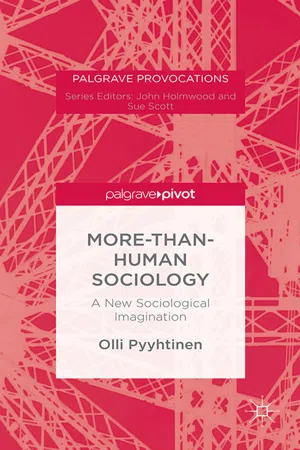
- English
- ePUB (mobile friendly)
- Available on iOS & Android
eBook - ePub
About this book
Information
1
Introduction: Bringing Imagination Back In
Abstract: This chapter outlines the topic, main objectives, and structure of the book. It identifies the pathologies distorting the traditional virtues and calling of sociology, and suggests how the sociological imagination needs to be restructured. To render sociology responsive to the ever-more complicated world, the chapter argues that it is important, first, to take seriously the share of objects and materials in the constitution of our living together; second, to liberate sociological thought from the reifying mode of thought by beginning from relations, alloys, and assemblages; and, third, to refute the micro–macro model and attend to the multiplicity of scales on which things exist.
Keywords: matter; Mills; relations; scale; the sociological imagination
Pyyhtinen, Olli. More-than-Human Sociology: A New Sociological Imagination. Basingstoke: Palgrave Macmillan, 2016. DOI: 10.1057/9781137531841.0003.
The book at hand is a call for a bolder, more creative sociology. The prevailing sociological modes of speaking and thinking are not particularly imaginative. Sociology has by and large gotten stuck in a reactionary anthropocentric ontology and remains trapped in reifying, substantialist thought that closes entities upon themselves. Also, when trying to make sense of the world that is ever more complicated, much of sociological scholarship still relies on a largely pre-given vertical hierarchy which fixes things on just two scales, with micro-level phenomena on the bottom and large macro-scale forces and structures at the top. Sociological thought is thereby in need of restructuring. This book aspires to bring sociological imagination back to life as an adventure of ideas and experimental creation of concepts and to thus move the discipline of sociology forward into the 21st century.
Obviously, I’m immensely inspired by the critical ethos of C. Wright Mills’ The Sociological Imagination (2000 [1959]). Challenging the dominant schools of sociology of the time, which he accused of distorting the old virtues and calling of the discipline, Mills’ work presents an incitement to a radical sociology. One manifestation of the pathological distortions resulting from disciplinary closure, fine specialization and moral indifference was for Mills what he calls ‘Grand Theory’. Its practitioners operate on such a high level of generality and formalism that they are unable to get down from the highest generalities to making sense of everyday experience. Mills regarded the work of Talcott Parsons as the exemplar par excellence of grand theories in American sociology. The other pathology of sociology mentioned by Mills is what he termed ‘abstracted empiricism’. Parallel to the fetishism of concepts that is characteristic of grand theory, abstracted empiricism fetishizes the methods of inquiry. It reduces the practice of doing research to technicalities, and the problems it treats are largely dictated by the methodology employed. According to Mills, this approach leads to a severe ‘methodological inhibition’ (p. 50), by which he means that ‘the kinds of problems that will be taken up and the way in which they are formulated are quite severely limited by The Scientific Method’ (p. 57).1
I feel that Mills’ diagnosis of the distorted nature of sociology still holds water today, though the pathologies may now have slightly different manifestations. Today, the dominant schools of sociology are no longer grand theory and abstracted empiricism but, as Thomas Kemple and Renisa Mawani (2009, p. 235) suggest, it would perhaps be more apt to call them ‘abstracted theoreticism’ and ‘grand empiricism’: whereas the first tends to strip theory down ‘to operationalizable concepts and hypotheses’, for the latter method amounts to ‘quantifiable and correlatable variables’. The result nevertheless remains the same. Sociologists have turned into disciplinary specialists who are able to talk only to other sociologists and social scientists. In Mills’ vision, by contrast, sociology should contribute to resolving the most significant and urgent questions of our time. It should be of relevance to both public issues and to personal troubles and experiences. It should convey its ideas to a broader audience outside the academy and, to succeed in this task, one should avoid the ‘turgid and polysyllabic prose’ that in his view prevailed in the social sciences at the time and instead present one’s work ‘in as clear and simple language as your subject and your thought about it permit’ (Mills, 2000 [1959] p. 217).
Consequently, Mills stresses the public and moral mission of social scientific studies. For him, the political task of the social scientist is ‘continually to translate personal troubles into public issues, and public issues into the terms of their human meaning for a variety of individuals’ (p. 187). Mills’ view of the post–World War II American society and his contemporaries was ‘rather bleak’ (Treviño, 2012, p. 25). It was especially the new middle class of specialists, managers and bookkeepers of which he was highly critical. Mills found the new middle class to be apathetic and indifferent. Not only did they not know their place in history and society, but they also did not even care about such matters. This gave Mills reason to describe them scornfully as ‘cheerful robot[s]’ (Mills, 2000 [1959], p. 171). According to him, in their everyday lives people are often ‘bounded by their private orbits in which they live’, and therefore they are incapable of looking at their experiences and personal troubles beyond ‘the close-up scenes of job, family, neighborhood’, in relation to and from the perspective of the big picture of society (p. 3). However, Mills argues that the life-chances of individuals are always interlinked with wider social circumstances. The experiences and fates of the individual are tied to the historical era in which one lives, and one’s possibilities of getting along in life depend not solely on oneself, but on others as well. For Mills, the sociological imagination has radical intellectual and political potential in that it can enable people to acquire a lucid understanding of what is going on in the world and how that relates to and affects their own lives. It has the ability to help people not only to better understand their place in their epoch but also to take their lives into their own hands and become active participants in the making of history.
Accordingly, the theoretical backbone of Mills’ book is the idea that the individual and society cannot be understood apart from each other. On the one hand, the individual is an upshot of society and its historical dynamics. And, on the other hand, with their lives and actions individuals also affect – to a lesser or greater extent – the making of society and the course of its history. In other words, then, for Mills the sociological imagination connects biography and history. It is ‘the capacity to shift from one perspective to another’ (Mills, 2000 [1959], p. 7), from the individual to the social and back. Mills maintains that the sociological imagination makes it possible to understand broad historical changes from the perspective of what they mean to the lives, fates and experiences of individuals, and what the individuals could do about the prevailing state of affairs.
In stark contrast to the then prevailing idea of a highly specialized profession, Mills portrays sociology as craftsmanship – something with which I greatly sympathize. He proposes that sociology is to be conceived and conducted as the practice of a craft. What I find wonderful about this idea is that it turns attention from the results of sociological research and from crystallized ideas and theories to the practices of doing sociology. It thereby proposes a turn from sociology as a dogma to sociology as a craft or practice. It emphasizes the importance of cultivating one’s skill to the full and working towards the perfection of the fruits of one’s thought. Thus, besides intellectual curiosity, a social scientist must possess professional pride to ‘do a job well for its own sake’, as Richard Sennett (2008, p. 9) defines craftsmanship.2 And, instead of endorsing rigid methodological procedures and a specialization based on the technical skills of using particular methods or theories (in terms of which sociological craftsmanship seems to be widely understood today), according to Mills it is more important to stimulate and develop the sociological imagination. This is because for him imagination precedes technicalities. ‘[T]echnical understanding develops through the powers of imagination’, as Sennett (2008, p. 10) puts it.3 In other words, to prevent them from becoming a straitjacket, methods and theories should in Mills’ suggestion be employed in a manner to set the sociological imagination free. They should increase our sensibilities; create new possibilities for thinking, acting and being; and create a break with the given. A ‘new idea introduces a new alternative’, as philosopher Alfred North Whitehead (1978 [1929], p. 11) suggests. And time is ripe for new ideas. We not only need to counter the aforementioned pathologies of abstracted theoreticism and grand empiricism, but also to reconsider the sociological imagination. In short, the sociological imagination needs to be revised, in relation to the transformations of life and the human condition.
Imagining matter, relations and scale differently
In recent years, there’s been a widespread engagement with reassessing the sociological imagination. Besides the many articles and books engaging directly with Mills (e.g., Fraser, 2009; Kemple & Mawani, 2009; Gane & Back, 2012; Treviño, 2012; Scott & Nilsen, 2013), there are also several scholars committed to developing new ways of doing sociology so that the discipline would better respond to life in the 21st century. The key outputs include, for example, The New Sociological Imagination (2006) by Steve Fuller, Live Methods (2013) edited by Les Back and Nirmal Puwar, David Beer’s Punk Sociology (2014), Reassembling the Social (2005) by Bruno Latour, Manuel DeLanda’s A New Philosophy of Society (2006) and A Different Society Altogether: What Sociology Can Learn from Deleuze, Guattari, and Latour by Roar Høstaker (2014).
My own book comes close to these titles in that it shares with them the aim to restructure the sociological imagination. Fuller’s The New Sociological Imagination obviously announces this ambition the most explicitly. However, as it centres especially on the entanglement of biological and sociological themes and discusses issues like socialism, religion and the challenge of naturalism, Fuller’s book has an entirely different focus than mine. What is more, it is not accidental or just for the sake of drawing a fine line between the two books that I use the indefinite article ‘a’ instead of the definite article ‘the’ in the subtitle. The present book is intended as a kind of manifesto for a new sociological imagination, not for the new sociological imagination. While I am admittedly trying to set out something like a programme here, the book is at the same time also an exploration into what and how we could think. It has not been my aim to write a new Rules of Sociological Method, but the purpose of the book is to stimulate and enrich the sociological imagination and set it free.
This ethos is what I share with Back and Puwar’s (2013) edited volume and the punk attitude of Beer (2014). However, while Back and Puwar’s Live Methods and Beer’s Punk Sociology concentrate more on the ways of doing sociology and on the nature of sociological knowledge, mine is what you would call a ‘theory book’ in that it tends to focus on substantial themes and concepts.
Perhaps the closest point of comparison can be found in Latour’s Reassembling the Social (2005), which the present book to some extent even takes as a model or paragon of some sort. With it, the book shares the effort of rethinking the social and developing an alternative social theory.4 I am also very sympathetic to Latour’s work and take up several of its themes and insights. However, the two books differ in their substantial and analytical aims and focus. While Latour does stand as one of my most significant sources of inspiration and information, unlike Latour’s the present book is not a plea for actor-network theory (ANT). Rather, it draws on a wider variety of sources and approaches, such as the work of Gilles Deleuze, Michel Serres and Georg Simmel.5
The insistence on the relevance of Latour and Deleuze for sociological inquiry connects the book to the works of DeLanda (2006) and Høstaker (2014), of which the first draws especially on Deleuze while the latter tries to demonstrate the relevance of Latour, Deleuze and Félix Guattari for sociological theory. However, unlike them I engage explicitly with the concept of the sociological imagination.
In this book, my main argument is that to render the sociological imagination responsive to life in the 21st century it needs to be revised in three respects:
First, we need to reassess the being, status and scope of relations. Our lives are marked by unprecedented connectivity, extending well beyond by our niche. By our consumption, for example, we are likely to be connected to producers, suppliers, shopkeepers and marketing campaigns; we may take part in the working conditions of workers in a sweatshop in China, in the creation or loss of jobs in a factory in Germany and in the fluctuation of prices in the global stock market; the availability of products may be affected by hot weather damaging wheat crops in the U.S. Great Plains or by international sanctions against certain countries; and, by throwing things away we contribute to the mounting masses of waste resulting from overconsumption and waste of resources on a societal scale. Prevailing sociological thinking, however, is not very well equipped to get a handle on these webs of interconnections. This is because sociological concepts tend to be reifying. As I already suggested above, the prevalent sociological imagination is substantialist in nature: for it, the social world consists of entities of various sorts, from individuals, groups, institutions and social systems all the way to society itself. And while Mills insists on connecting the individual and society, like so many others he, too, takes them as given units of analysis. Instead of starting from individuals and their actions or from society and its structures, this book sets out to ‘liberate’ sociological thought from the reifying mode of thought by beginning from relations, associations, alloys and assemblages. While relations have of course been paid some attention in the tradition of sociology, it is only with few exceptions that they have been considered in relational terms. On the contrary, relations are typically understood primarily on the basis of beings, for example as something...
Table of contents
- Cover
- Title
- 1 Introduction: Bringing Imagination Back In
- 2 Turn to Relations
- 3 Matters of Scale
- 4 More-than-Human
- 5 Conclusion: The Promise of Sociology?
- Bibliography
- Index
Trusted by 375,005 students
Access to over 1.5 million titles for a fair monthly price.
Study more efficiently using our study tools.
Frequently asked questions
Yes, you can cancel anytime from the Subscription tab in your account settings on the Perlego website. Your subscription will stay active until the end of your current billing period. Learn how to cancel your subscription
No, books cannot be downloaded as external files, such as PDFs, for use outside of Perlego. However, you can download books within the Perlego app for offline reading on mobile or tablet. Learn how to download books offline
We are an online textbook subscription service, where you can get access to an entire online library for less than the price of a single book per month. With over 1.5 million books across 990+ topics, we’ve got you covered! Learn about our mission
Look out for the read-aloud symbol on your next book to see if you can listen to it. The read-aloud tool reads text aloud for you, highlighting the text as it is being read. You can pause it, speed it up and slow it down. Learn more about Read Aloud
Yes! You can use the Perlego app on both iOS and Android devices to read anytime, anywhere — even offline. Perfect for commutes or when you’re on the go.
Please note we cannot support devices running on iOS 13 and Android 7 or earlier. Learn more about using the app
Please note we cannot support devices running on iOS 13 and Android 7 or earlier. Learn more about using the app
Yes, you can access More-than-Human Sociology by O. Pyyhtinen in PDF and/or ePUB format, as well as other popular books in Social Sciences & World History. We have over 1.5 million books available in our catalogue for you to explore.