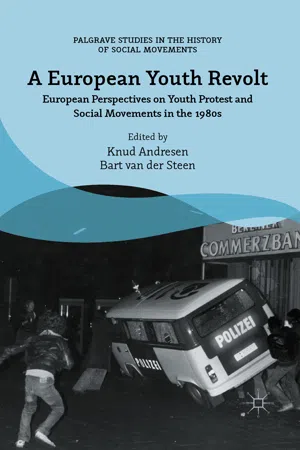
During the early 1980s, large parts of Europe were swept with riots and youth revolts. Radicalised young people occupied buildings and clashed with the police in cities such as Zurich, Berlin and Amsterdam, while in Great Britain and France, 'migrant' youths protested fiercely against their underprivileged position and police brutality. Was there a link between the youth revolts in different European cities, and if so, how were they connected and how did they influence each other? These questions are central in this volume.
This book covers case studies from countries in both Eastern and Western Europe and focuses not only on political movements such as squatting, but also on political subcultures such as punk, as well as the interaction between them. In doing so, it is the first historical collection with a transnational and interdisciplinary perspective on youth, youth revolts and social movements in the 1980s.
eBook - ePub
A European Youth Revolt
European Perspectives on Youth Protest and Social Movements in the 1980s
- English
- ePUB (mobile friendly)
- Available on iOS & Android
eBook - ePub
A European Youth Revolt
European Perspectives on Youth Protest and Social Movements in the 1980s
About this book
Information
Topic
Scienze socialiSubtopic
Storia europeaPart I
Concepts and Debates
1
Unrest or Social Movement? Some Conceptual Clarifications
Sebastian Haunss
When in 1980 and 1981 protesters in Zurich, Amsterdam, Berlin and many other cities clashed with the police and disturbed these cities’ urban routines, contemporary commentators were surprised by the intensity of the conflicts, by the number of participants and by the level of violence they often involved. Politicians, journalists and social scientists alike have been quick to label the wave of protest that emerged in several European countries, and most forcefully in the Netherlands, Switzerland and Germany, as a ‘youth movement’,1 ‘youth protest’,2 ‘youth unrest’,3 ‘youth rebellion’4 or ‘youth revolt’.5 Usually these terms were not defined, and often authors used them interchangeably, yet always with the prefix ‘youth’. Others have precisely questioned this prefix, arguing that the issues addressed in the protest were not necessarily youth-specific, and that a significant number of the participants were too old to be labelled as youth.6
In this chapter I would like to take these terms, which are still used to describe the series of mostly urban protests in 1980 and 1981, as a starting point to reflect upon the implications and assumptions that accompany these concepts. The aim is to situate these concepts within the broader literature about protest and social movements and to discuss the implications of these labels. In doing so, I do not claim that the phenomena of the time should not be identified as youth movements, youth protests or whichever labels were chosen. Instead of trying to find the ‘correct’ label – a task that is bound to fail, because the labels always reflect analytical concepts and do not directly represent the empirical reality – I would rather like to add a layer of self-reflection to the study of these phenomena by discussing the epistemological presumptions that are ingrained in the labels used to describe them.
The dominant notion – that the two most notable aspects of the urban protests in 1980–81 were the youthfulness of their protagonists and the violence of their interaction with the authorities – implicitly suggests two perspectives in order to understand these protests: a generational perspective and a focus on repertoires of action.
At first glance the reference to youth states merely that the rebellious protagonists – or at least most of them – are below a certain age. Yet the term not only provides a description but also offers an explanation for the social phenomenon. Those authors who explicitly label the contentious episode as youth protest, youth movement or youth revolt are thereby claiming that the unifying element among the protagonists is their age or, more precisely, the fact that they belong to the same age cohort. An explanation for their actions should thus either reference the specific historical experiences this age cohort shares exclusively with those of the same age (and not with older generations), or the reference to youth may point to a conflict between two generations, most likely between the generations of the activists and their parents.
On the other hand, the focus on violence – a focus that is so dominant in contemporary studies – suggests that somehow an analysis of the forms and repertoires of action might help to understand the protests and their dynamics. This phenomenological perspective highlights the similarities between instances of contention with regard to their forms of action. It characterizes the social phenomenon by its outer form, more specifically by the fact that the forms of action breach the confines of generally accepted and institutionalized forms of participation. This phenomenological perspective links the various events, mobilizations and other forms of social interaction through their shared means and/or repertoires of action.
In addition to these two perspectives the terms unrest, protest, movement, rebellion and revolt also suggest, to different degrees, a certain embeddedness of the concrete contentious events within broader, more or less aggregated, episodes of collective action or processes of social change.
In this chapter I situate the generational and phenomenological perspectives in the larger body of social-movement research and discuss their usefulness for understanding the protests in 1980–81. I argue that the episodes of protest should be interpreted as being related to each other and embedded in structures and dynamics of social conflict that stretch, in time and scope, beyond the single episodes themselves.
Youth – the generational perspective
The reference to youth can imply both a strong and a weak generational perspective. A strong version of a generational perspective would explain the protests of 1980–81 with the historically specific experiences of one generation or a manifest conflict between the specific young generation and their parents, or with a combination of both. Such a strong version of a generational perspective was present in the contemporary psychological interpretation that the protests in 1980–81 were result of an incomplete break by the young protesters from their parents.7 This view can be found in other research about social movements and conflict as well, but usually with a critical reflection on the appropriateness of the term ‘generation’ to define protesters.8 The problem of this strong generational model is that it proposes a general rift between two generations at one point in time. But while protesters may come from one generation it is never a whole generation that protests. Those engaged in contentious interactions are always only a minority of the age cohort as a whole. A strong generational model is therefore not well suited to explain protest because it would always have to explain the lack of protest in the majority of persons belonging to one generation.
Other studies using the generational concept do not usually refer to an age cohort but to a notion of activist generations, characterized by shared experiences and not primarily by shared age. In her book about the development of the radical women’s movement in the United States, for example, Nancy Whittier uses the term ‘feminist generations’ to refer to groups of activists, who have participated in the women’s movement at the same time.9 A generation of activists, as such, does not share the same age but the same period of engagement. They are political, not age, cohorts. The concept of generations is then not used to explain the emergence of a movement but to analyse its development over time.
More common is another, much weaker, generational concept that builds on the general idea that a person’s age might have a strong influence on his or her propensity to participate in protests and/or social movements. This reflects the idea that youth (however this is defined) would be a biographical phase in which people are more likely to participate in protests. This interpretation is quite common in several studies about the protests in 1980–81. In his study of the protests in Zurich, Hanspeter Kriesi argues that youth should be understood as a transitional phase of emancipation from the confines of the family and before full integration into the labour market with its own strict set of rules.10 This transitional phase offers the potential for a relatively high level of personal freedom but is also characterized by the instability of status passages.11 Several authors also argue that younger people are more sensitive than older people to the problems of their societies.12 One might therefore assume that younger people above a certain age should show greater biographical proclivity to protest because they have less work and family obligations and, therefore fewer reasons, which might hinder their engagement.
The problem with this assumption is that, in a similar way to the strong generational concept, the notion that the particularities of this transitional phase between childhood and adulthood would explain the protest of 1980–81 has to address the issue of differential participation in protests by persons from the same age group. Only a minority of each age group takes to the streets, while the conditions of greater biographical proclivity should be relevant for all young people. Moreover such a perspective would also have to explain why the youth-specific factors affecting persons of a certain age have created fertile conditions for protest only at a specific point in time. Did the conditions of socialization for young people change significantly between 1975 and 1980?
The problem with both the strong and the weak generational perspectives is that they attempt to explain activities of a specific minority of young people at one point in time, with general claims about general conditions of socialization for all – or at least the majority of – people of a certain age group. A generational claim (‘We are speaking in the name of a whole generation!’) may be a legitimate political empowerment strategy, but as an analytical category it can never work. Generational or age-related conditions of socialization can only ever be one factor among others that comprise a more complex explanation.
Moreover, the notion of youth protests in the early 1980s may be superficially plausible but rests on weak empirical evidence. Unfortunately, information about the demographics of protesters in general, and about protesters at that time specifically, is rather limited and usually rests on police records of persons detained during particularly violent events.13 While general surveys often show the propensity to protest as declining with age, this assumption has not been generally confirmed in those cases in which research has produced reliable information about the age of participants in protests or social movements. Existing studies do not give a clear indication of youth (or old age) as either a propagating or an inhibiting factor for participation in social movements.
For example, in his study about the participants in the ‘freedom summer’ mobilization of the US civil rights movement in 1964, Doug McAdam has shown that there was no linear relationship between age and participation in this form of high-risk activism. Participation rose among ‘freedom summer’ activists between the age of 18 and 21, then dropped and then rose again with age.14 Studies that have looked at the age of participants in protests in Germany consistently show the age group of 40–64 to be overrepresented compared to their proportion of the overall population, whereas those under 25 are generally underrepresented, and those between 25 and 39 are overrepresented only in peace protests.15 A comparative study of the worldwide anti Iraq war protest on 15 February 2003 shows the youngest age cohort of 15–25 year olds as overrepresented in some countries (Italy, Germany, Sweden) and underrepresented in others (United States, Spain).16
Overall, therefore, research on social movements has so far not produced evidence supporting either the strong or the weak generational perspective. This does not mean that such a perspective may not be quite fruitful in some instances. But it should remind us that the generational hypothesis is demanding if its claim goes beyond the simple observation that many young people have participated in a given protest. For example, such a demanding claim would be that a specific social condition, one which enabled certain forms of protest in the early 1980s, would have influenced only people from a distinct age cohort.
But even if the notion of generational or age cohorts may not be that helpful for the analysis of protest dynamics in the early 1980s, the generational perspective can point to the importance of biographies to understand movement participation by accounting for individual and sometimes collectively shared pre-histories of movement engagemen...
Table of contents
- Cover
- Title
- Introduction: The Last Insurrection? Youth, Revolts and Social Movements in the 1980s
- Part I Concepts and Debates
- Part II Squatters and Autonomist Movements
- Part III Transforming Radical Movements
- Part IV New Social Movements and Youth Protest
- Part V Punk and Protest
- Part VI Expert Debates
- Index
Trusted by 375,005 students
Access to over 1.5 million titles for a fair monthly price.
Study more efficiently using our study tools.
Frequently asked questions
Yes, you can cancel anytime from the Subscription tab in your account settings on the Perlego website. Your subscription will stay active until the end of your current billing period. Learn how to cancel your subscription
No, books cannot be downloaded as external files, such as PDFs, for use outside of Perlego. However, you can download books within the Perlego app for offline reading on mobile or tablet. Learn how to download books offline
Perlego offers two plans: Essential and Complete
- Essential is ideal for learners and professionals who enjoy exploring a wide range of subjects. Access the Essential Library with 800,000+ trusted titles and best-sellers across business, personal growth, and the humanities. Includes unlimited reading time and Standard Read Aloud voice.
- Complete: Perfect for advanced learners and researchers needing full, unrestricted access. Unlock 1.5M+ books across hundreds of subjects, including academic and specialized titles. The Complete Plan also includes advanced features like Premium Read Aloud and Research Assistant.
We are an online textbook subscription service, where you can get access to an entire online library for less than the price of a single book per month. With over 1.5 million books across 990+ topics, we’ve got you covered! Learn about our mission
Look out for the read-aloud symbol on your next book to see if you can listen to it. The read-aloud tool reads text aloud for you, highlighting the text as it is being read. You can pause it, speed it up and slow it down. Learn more about Read Aloud
Yes! You can use the Perlego app on both iOS and Android devices to read anytime, anywhere — even offline. Perfect for commutes or when you’re on the go.
Please note we cannot support devices running on iOS 13 and Android 7 or earlier. Learn more about using the app
Please note we cannot support devices running on iOS 13 and Android 7 or earlier. Learn more about using the app
Yes, you can access A European Youth Revolt by Bart van der Steen, Knud Andresen in PDF and/or ePUB format, as well as other popular books in Scienze sociali & Storia europea. We have over 1.5 million books available in our catalogue for you to explore.