- English
- ePUB (mobile friendly)
- Available on iOS & Android
eBook - ePub
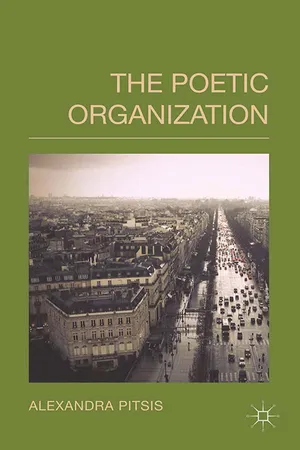
The Poetic Organization
About this book
The Poetic Organization explores the inherent aspects of organization that revolve around poetic processes. This book is a commentary on poetic elements in organization that are critical to developmental areas of organizations, yet poetics are rarely given the attention deserved.
Information
Part I
Conceptual Framework
1
Introduction
1.1 Central issues
The Poetic Organization is concerned with how poetics emerges across organizational contexts. The term ‘poetics’ is not a static one, and refers to an intricate mix of subjective interiorized and exteriorized aspects dealing with the way organizational members become ‘present’ to themselves and others through their expressions, their practices, passions, interests and eloquence as connected to a fictive mode. The research for this book entailed identifying poetic elements in organizational coaching, which were explored through discussions with coaches as to how they perceived poetics in their personal and professional practices. Organizational coaching is a form of coaching that takes into account systematic aspects of processes and activities taking place across a whole organizational context. The research was undertaken by entering into engagement with nine organizational coaches about the notion of poetics and involved conducting lengthy semi-structured interviews with each coach, including embedded workshops on storytelling and automatic writing.
In order to address the elusive poetic elements, a ‘ficto-analytical’ methodology was developed to undertake the research in a fluid manner – this can be described as a methodology that perceives research material as essentially connected to the fictive. Drawing from narrative methodologies with theoretical traces that link to the humanities, philosophy and sociology, this research methodology rendered the research subjects a collision of factual and fictive aspects. The fictive avenue was explored in order to articulate the premise that organizations entail an essentially poetic process.
Poetics elements are inherent in organizational existence, and this book ponders how poetics practices are often what sustain the ways in which organizations can usefully maintain their viability. Significantly, poetics aspects are the main component by which the construction of professional identities are established. The organizational coaches elucidated poetics through various modes and reflections and revealed some of the intangible poetics examined in this book. These reflections implicitly centred on their influences, musical tastes and reminiscences from their individual and collective experiences and how these shaped their coaching processes and relationships towards their work and profession.
The Poetic Organization envisages a different way of exploring organization studies and takes a step towards the larger project of actively poeticizing organization. The research included a presentation of an active version of the poeticized organization through the study of one coaching organization, which demonstrated that these elements at work are creative and usually unstated, but crucial in maintaining representations of organizations. However elusive the poetic element is to delineate, it manages to flow through organizational spaces in material and nonmaterial ways. This book articulates specific ways in which this surfaces, and delves into detailing some of the poetic elements encountered in organizational life. It is important to note that the research does not propose that poetics in organizations is lacking. On the contrary, there are a number of organizations that are open and incorporate poetics enthusiastically (though there could always be more). The research throws a focus on organizational practices and, in turn, how these can influence organizational existence in a subtle manner.
1.2 Poetics in organizational context
Poetics is an inherent part of organization, and the issue of poetics within organization works on multiple levels, from theoretical to more functionalist aspects. At the heart of this issue is the process of distinguishing various levels of what is deemed poetic and how this has been implicated in organization studies. The Poetic Organization takes into account the following questions: What is poetics in an organizational context? How is poetics manifested in organization? How is poetics explored in terms of an organizational context? The aim of this book was to follow the trajectory of these questions, carving a path that ultimately shaped this book in an emergent manner.
Poetics is typically defined in terms of its literary basis, where it is seen as ‘The theory and practice of poetry, concerning itself with such fundamental questions as what poetry is, what it does, and how it should be written ... is known as poetics’ (Crystal, 1990: 954). Such a definition positions poetics as a term that originates from the literary field and as specifically relating to a set of poetic devices such as metaphor, metonymy, rhetoric, irony, simile, assonance and a myriad of other terms used to describe literary aspects of a ‘text’. The other element to the definition is it traces back to the original ancient Greek word ‘poiein’ which means ‘to make’ (Crystal, 1990: 954) referring to an active element. The word ‘poetic’ is quietly powerful as it refers to a level of transformation, evoking a sense of creation.
The standard understanding of poetics focuses on the written aspect of poetics, but the manner in which I use the term takes into account that poetic attributes can also be elucidated through exposition. My trajectory into what poetics is in organizations draws from a way of looking at poetics in terms of its relationship to the phenomena of the world, not only by its technical relationship to texts or systems of communication. It relates to a creative ability that we all share in common and participate in whether consciously or unwittingly.
I delve into this in the research by looking at the workings of a series of poetic explorations as they unfolded with the organizational coach engagements. Such a perspective centred on my personal recognition of poetics, and is connected to my intrinsic understanding of this term. The notion of the ‘writerly’ is also embedded in this understanding with Barthes’ (1974) idea of the text as a multiplicitous site, brought into play through infinite readings, is an implied platform for this research. Barthes’ philosophy connects with the reading of organizations in a manner that draws on the infinite sense of ‘being’ through textual processes.
At a deeper level, and at the basis of my understanding of poetics, lies a profound way of comprehending poetics. Gaston Bachelard (1884–1962) espoused a subtle view of poetics, incorporating a phenomenological view in which poetic aspects of literature and life in general had a vitality which could be referred to as a ‘direct ontology’ (Bachelard, 1969: xii).
The subject of this ontology was explored in The Poetics of Space, in which the poetic element is connected to phenomenology by studying how it ‘emerges into consciousness as a direct product of the heart, soul and being of man, apprehended in his actuality’ (Bachelard, 1969: xiv). To embrace what this means and incorporate it into organizational practices with a subtle awareness activates what poetics is in an organizational context.
Such an approach drew me to sources on how poetics was received in organization studies and how it emerged within this context (Case, 2003; Rhodes, 2001; Westwood and Linstead, 2001). A focus on poetics and how it manifests in organizations leads to the conceptualization of organizations as poetic entities. This is significant, as considering poetics accentuates what a poeticized organization is and how it is made up of multiple levels of practices, nuances and unstated or silenced activities.
In terms of poetics within the field of organization studies, there are a number of ways in which poetics becomes apparent. These relate to unresolvable issues about the relationship of organization studies to other disciplines such as humanities (Inns, 2002). This also includes organization studies’ relationship to literature, cultural, philosophical and scientific studies. In this scenario, poetics is aligned with phenomenological and prospective ways of being and is synonymous with an ephemeral and abstract understanding of the term. It is through these possibilities and the workings of poetic representations that entities such as organizations come into existence.
Poetics, particularly the way in which it relates to organizations, is often negotiated through the use of terms such as ‘metaphor’ (Inns 2002; Inns and Jones, 1996). The reason for the dominance of metaphor relates to a group of organization scholars who saw the analysis of metaphor as providing a useful technical function in assessing processes within organizations (Grant and Oswick, 1996a; Morgan, 1986). The way this term is used within the research for this book takes into account some of these literary aspects, but centres on poetics as a broad term used to describe a resonance of various experiences or conceptualizations specific to a subjective understanding of how this works in the research. Consequently, poetics in the context of this book takes on an added complexity.
In terms of poetics and its significance to the organization, it is the focus on this subjective space that activates the poeticized organization. The theoretical aspects centre on the ambiguous way in which poetics has been taken up and also explore poetics in an abstract sense. Poetics is not prescriptive or functional, nor is it a science that can be applied or analysed in a logical sense. There is something missing from the definitions of this term, and it will always perpetuate an absence, a disruption or discontinuity that relates to the research in a direct manner and that influenced the contours it took. The underlying implicit premise is that poetics is a schema of the discontinuous aspects of existence, as understood through fractured essences of narrative and story tied to lived experience:
The narrative scheme serves as lens through which the apparently independent and disconnected elements of existence are seen as related parts of a whole ... narrative shows the interconnectedness and significance of seemingly random activities. (Polkinghorne, 1988: 36)
The discontinuity of poetics is an active characteristic of making sense of what happens in organizational space. The idea of language as belonging to a disjointed stream is vital in looking at the spaces between language and organization. Leach raised this notion in looking at how we make sense of the world, indicating that we somehow indoctrinate our awareness to suture the gaps, where we, ‘arrive at semantically distinct verbal concepts if we repress the boundary percepts that lie between them’ (Leach, 1972: 39).
The poetic engagements with the organizational coaches occurred in these ‘discontinuous’ ways in organizations, making organizational space a rich convergence of these fractured poetic elements. Ortony (1975) saw this discontinuous facet of expression from another perspective and emphasized the ‘inexpressibility factor of language ’ and the use of metaphor, where:
Language and logic are discrete symbol systems. Thus, the task we have to perform in communication is to convey what is usually some kind of continuum by using discrete symbols. It would not be surprising if a discrete symbol system were incapable of literally capturing every conceivable aspect of an object, event or experience that one might wish to describe ... this deficiency is filled by metaphor. (Ortony, 1975: 46)
What emerged was a context for viewing organizations through a valuable lens of metaphoric explorations. Such a perspective continued to view organizations through a functional drive, galvanizing an era of pragmatism via poetics. At the same time, this perspective was centred on more ephemeral aspects of the way ontological issues were absorbed into organization. Consequently, a sentiment was played out in alignment with perspectives on viewing organizations through an aesthetic element, as a way of expression beyond its utilitarian aspects, centring on language and its mystery (Linstead and Höpfl, 2000; Westwood and Linstead, 2001). What followed was a perspective on organization, seeing it as an expression of the unknown and unknowable aspects, focusing on the inexpressible and multiplicitous elements contained within organization (Case, 2003; Rhodes, 2001; Westwood and Linstead, 2001).
1.3 Methods of eliciting organizational poetics
In order to put the research into play and question how poetics works within an organizational framework, The Poetic Organization centres on how one particular coaching organization used poetics in contextualized ways. Such a position inherently focuses on other, more metaphysical aspects of organizational existence. I have called this organizational coaching company Rock and Roll (R & R) Coaching, a fabricated name for the purposes of the research. At the helm of R & R Coaching was the head coach, Jack, who provided leadership and direction to the other eight coaches who engaged in the research for this book. These eight coaches were the main R & R organizational coaches, and were invited to participate in the research because of their status as ‘main coaches’; this meant there was continuity and coherence with the aims of the research.
The methods used to elicit poetics within this research included a preliminary questionnaire, followed up with an extended semi-structured interview with two embedded workshop activities that focused on storytelling and automatic writing. The storytelling activity included a random element using a selection of ‘prompts’ to evoke a story, whether fictional, anecdotal or actual. The automatic writing exercise drew impetus from Surrealist activities, where the coach was asked to write ‘without thinking’ about what they were writing.
A semi-structured approach for the interviews was selected that aligned with the consideration of the issues in the interview phase, which allowed ‘follow up questions and exploration of topics unanticipated by the interviewer’ (Mabry, 2008: 218) and the unknown element to be honoured in research interactions.
In order to understand the way the data is approached, it is vital to look at how the research revolved around the development of methods related to fictional/research processes. The ficto-analytical method is developed and applied in the research for The Poetic Organization, and it can be defined as an ephemeral research method that delves into poetic schemas within organizations. This method included the development and use of poetic conceptual paraphernalia to navigate the research and the development of unique key descriptors for analysing the ‘data’, such as Poetic Profiles, Poetic fragments, Key Poetic Fragments and Conversation Strings. The culmination of this research was constituted through the development of these key descriptors, and was done through focusing on major poetic doctrines embedded within the organization. It is important to understand that the ficto-analytical method applied here is a delicate template rather than a quantifiable or direct results approach such as might be expected within academia. It is presented here as a type of challenge to the customary way of viewing organizations and related research methods.
These key terms are defined in this chapter in an introductory manner, and will be presented in more depth with their operational use in Chapter 4. In general, these key descriptors allowed for a focus on poetic schemas embedded in the R & R Coaching organization. The coaches’ Poetic Profiles were drawn from their experiences in the coaching profession and in life, and in some cases the profiles emerged as a significant part of the way in which the organization functioned.
These poetic elements related to the head coach’s passion for rock music and also to other fragmentary aspects that emerged in the course of the research. In addition to the data material which formed a rich platform in which to explore poetics, I also looked at the ‘scripts’, both literal and implied, discussed in the interviews. These explicit and implicit scripts formed a significant part of what poetics is for the coaching organization in this study. The concept of ‘script’ in organization studies has been defined as ‘a cognitive framework that underlies an organizational story, the skeleton of a story that remains after the nonessential details have been stripped away’ (Martin, 2002: 74). The use of the concept of script in this section reflects the material ways the scripts have been taken up in a pragmatic manner, but also more loosely refers to underlying, more tacit elements of script engagements and processing. What took shape was a number of related organizational elements, including the development and origins of a ‘Foundational script’, which is a set of stories at the core of the organization. A major proposition in this book is that all organizations have a foundational poetic script that is integrated into the core functions of the business. R & R Coaching has such a script, which is explored in detail and which conveys the heart of the poetic element of the coaching organization.
The data obtained formed a platform on which poetics could be e...
Table of contents
- Cover
- Title
- Part I Conceptual Framework
- Part II Exploring the Poetic in Coach Engagements
- Part III Discussion and the Path Taken
- References
- Index
Trusted by 375,005 students
Access to over 1.5 million titles for a fair monthly price.
Study more efficiently using our study tools.
Frequently asked questions
Yes, you can cancel anytime from the Subscription tab in your account settings on the Perlego website. Your subscription will stay active until the end of your current billing period. Learn how to cancel your subscription
No, books cannot be downloaded as external files, such as PDFs, for use outside of Perlego. However, you can download books within the Perlego app for offline reading on mobile or tablet. Learn how to download books offline
Perlego offers two plans: Essential and Complete
- Essential is ideal for learners and professionals who enjoy exploring a wide range of subjects. Access the Essential Library with 800,000+ trusted titles and best-sellers across business, personal growth, and the humanities. Includes unlimited reading time and Standard Read Aloud voice.
- Complete: Perfect for advanced learners and researchers needing full, unrestricted access. Unlock 1.5M+ books across hundreds of subjects, including academic and specialized titles. The Complete Plan also includes advanced features like Premium Read Aloud and Research Assistant.
We are an online textbook subscription service, where you can get access to an entire online library for less than the price of a single book per month. With over 1.5 million books across 990+ topics, we’ve got you covered! Learn about our mission
Look out for the read-aloud symbol on your next book to see if you can listen to it. The read-aloud tool reads text aloud for you, highlighting the text as it is being read. You can pause it, speed it up and slow it down. Learn more about Read Aloud
Yes! You can use the Perlego app on both iOS and Android devices to read anytime, anywhere — even offline. Perfect for commutes or when you’re on the go.
Please note we cannot support devices running on iOS 13 and Android 7 or earlier. Learn more about using the app
Please note we cannot support devices running on iOS 13 and Android 7 or earlier. Learn more about using the app
Yes, you can access The Poetic Organization by A. Pitsis in PDF and/or ePUB format, as well as other popular books in Business & Business Strategy. We have over 1.5 million books available in our catalogue for you to explore.