eBook - ePub
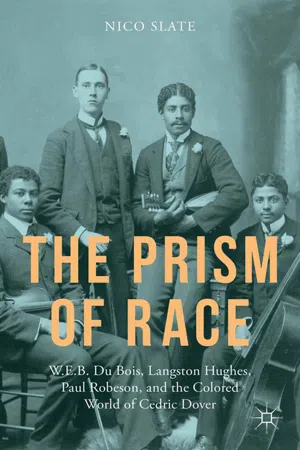
The Prism of Race
W.E.B. Du Bois, Langston Hughes, Paul Robeson, and the Colored World of Cedric Dover
- English
- ePUB (mobile friendly)
- Available on iOS & Android
eBook - ePub
The Prism of Race
W.E.B. Du Bois, Langston Hughes, Paul Robeson, and the Colored World of Cedric Dover
About this book
A scholar of race and a leader in the Afro-Asian solidarity movement, Cedric Dover embodied the 20th-century cosmopolitan redefinition of racial identity. Tracing Dover's evolution through his relationships with W.E.B. Du Bois, Langston Hughes, and Paul Robeson, this book tracks racial identity in the twentieth century.
Information
1
Cedric Dover’s Colored Cosmopolitanism
Today, all men are mongrels; all races are mixed races, which means that they are not races at all.
—Cedric Dover, “What Is a Race Riot?”1
By the time Dover was born in April 1904, the “Eurasian” or “Anglo-Indian” community, a population composed of the progeny of British and Indian sexual unions, had grown large and relatively self-contained. With a significant presence in old colonial cities such as Madras and Calcutta, Eurasians occupied an intermediate position between the British and their many Indian subjects. Like mixed-race communities in many parts of the world, Eurasians suffered discrimination on account of the widespread antipathy felt toward “miscegenation.” Dover liked to quote a novel that defined “the Eurasian” as “the half part of a nigger; but not the twentieth part of a man.” He considered entitling his autobiography “One Khaki” after a derogatory limerick:
There once was a person called Starkie
Who had an affair with a darkie;
The result of his sins
Was quadruplets, not twins,
One black, one white, and two khaki.
While some Eurasians avoided categorizing their community as racially mixed and emphasized their white roots, Dover embraced his hybrid ancestry. He was proud to be khaki.2
This book is a biography, but not a traditional biography. I explore Dover’s scholarly work and the intellectual, often academic conversations that Dover shared with others. A future biographer will focus more on the story of Dover’s life. But in the many years I spent researching this book, trying to understand Dover the thinker and writer, I also came to know Dover the man. I came to recognize Dover’s handwriting and the unique style of his typed letters, many of which, I later learned, were typed by his wife, Maureen Alexander-Sinclair. I came to recognize that, like all writers and intellectuals, Dover’s work cannot be separated entirely from his life. Indeed, throughout his life, Dover’s writing reflected his evolving identity, especially his racial identity.
Dover preferred the term “Eurasian” to “Anglo-Indian.” As a Eurasian, there was less risk of being confused with the white British residents of India. As a Eurasian, Dover could define his community to include mixed-race people throughout Asia. Dover’s ambitions extended even further. Although he never abandoned his Eurasian identity, Dover sought allies among mixed-race people throughout the world. In the 1920s and 1930s, his preferred nomenclature shifted to accommodate his increasingly expansive identity. Dover came to see himself as a “half-caste” in a world full of half-castes. He came to believe that “all men are mongrels” and “all races are mixed races.” He did not, however, disavow racial identity. Rather, Dover’s recognition of the artificiality of race only clarified for him the overriding importance of racial divisions and particularly hierarchies of color. Dover learned to see himself as a colored man in a world in which the color line, although socially constructed and historically determined, defined who had power and who did not.
Dover’s world was divided by more than a single color line. Growing up in Calcutta, Dover encountered a society fractured along multiple lines. Of his education, Dover wrote, “I was schooled in a Roman Catholic institution for the ‘sons of gentlemen,’ where the sons of the poor (who, of course, are not gentlemen) were sometimes admitted.” Class difference, Dover realized early in life, mapped onto color. In India, as in many countries, color was more a spectrum than a line—a spectrum that intersected with hierarchies of class, caste, religion, language, gender, and other forms of difference.
British imperialists used the diversity of India to argue for the necessity of empire. Divisions of religion and caste rendered India, in the words of Winston Churchill, merely “a geographical term.” India, he deemed, “no more a united nation than the Equator.” Long before he was the enemy of the Nazis, Churchill was the champion of empire. The specter of disunity and disorganization offered a useful justification for British rule. It was the British, the argument went, that stabilized Indian society. Without the British, India would fracture along a thousand lines.3
Indian nationalists countered by using the colonial experience to unify Indians. Although different in many ways, all Indians were oppressed as colonial subjects. Dover learned from Indian nationalists how to craft unity in diversity. Dover recognized the advantages of respecting diversity while pursuing larger solidarities. His awareness of multiplicity did not hinder his ability to envision grand unities. But like the Indian nation, Dover’s project also risked overlooking other solidarities. For most of his adult life, Dover pursued the unity of the colored world, a world defined by the single global color line so forcefully articulated by Du Bois. The tension between singularity and multiplicity would stay with Dover throughout his life.4
Dover’s relationship with the colored world grew out of his relationship to India. While many Eurasians distinguished themselves from “the natives” and curried favor with the colonial state, Dover aligned himself with the growing anticolonial movement led by the Indian National Congress. In March 1925, Dover and his first wife, Mercia Haynes-Wood, started a journal, The New Outlook, that aimed to speak for the Eurasian community. “Our policy,” Dover and Wood wrote, “will be one of loyalty to the Government and of friendliness towards the Indians—our brothers of the soil.” Dover later described himself as “the first Eurasian to ally himself wholly with the struggle for Indian independence.” Dover forgot to mention his wife. Similarly neglecting Mercia Haynes-Wood, the Times of India validated Dover’s assessment of his unique significance. In 1951, the Times called Dover the first Eurasian “to support the Congress whole-heartedly and to lead the younger generation towards identifying themselves with Indian aspirations.”5
The eclipse of Mercia Haynes-Wood is revealing—revealing not only of Dover’s relationship to the women in his life, but also of the way in which racial leadership was consistently defined as male. A highly educated scientist, Haynes-Wood, worked side-by-side with Dover to craft a new identity for Eurasians. But like many women of that generation, her contributions were marginalized at the time, and largely forgotten by history. Like most of his colleagues, Dover focused on attacking racism and imperialism, without sufficiently recognizing their intersection with gender inequality. This is more surprising given that throughout his life Dover would work closely with women—most prominently his wives.
Together, Dover and Haynes-Wood encouraged Eurasians to embrace simultaneously their hybridity and their identities as Indians, a difficult task given the significant social and economic divisions between Eurasians and other Indians. Eurasians often operated as colonial intermediaries, almost a distinct caste, pushing for special privileges from the government. Dover avoided such a narrow identity politics by bridging his Eurasian and Indian identities within an inclusive colored solidarity.
Dover blended his radical orientation toward Indian politics with an equally radical approach to Eurasian racial identity. As a young man, Dover confronted a world in which most authorities, scientific and otherwise, agreed that racial mixture led to personal and social degradation. Fictional accounts of the typical mixed-race individual portrayed, in Dover’s words, “an undersized, scheming and entirely degenerate bastard.” “His father is a blackguard, his mother a whore,” Dover continued, “he is a potential menace to Western Civilisation, to everything that is White and Sacred.” In the face of such opprobrium, many Eurasians deliberately avoided categorizing their community as racially mixed. Dover, by contrast, trumpeted his mixed ancestry as a source of connection with other mixed-race people, especially African Americans.6
Dover’s commitment to building bridges between the Indian and African diasporas may have been partially inspired by Dover’s own heritage. While his mother was most likely Eurasian herself, there is evidence that Dover’s father may have been a black or “colored” migrant to India from the Caribbean. Dover’s father, a civil servant, died when Dover was 12. Raised by his mother, Dover rarely mentioned his father. A tantalizing clue, offered in the memoirs of the Guyanese Pan-Africanist, Ras Makonen, suggests that Dover’s father might have come from the Caribbean. A prominent figure in London’s anticolonial circles, Makonen had many opportunities to get to know Dover. It is thus significant that he included Dover in a list of Eurasians whose fathers migrated to Asia from the Caribbean. The fact that many such Caribbean migrants worked in the Indian civil service—like Dover’s father—lends credence to Makonen’s memory.7
Dover’s racial hybridity helps explain his first passion—the scientific study of diversity in the natural world. His first book, written when he was only 17 years old, was titled “The Common Butterflies of India: An Introduction to the Study of Butterflies, and How to Collect and Preserve Them.” Dover attended St. Joseph’s College in Calcutta and worked at the Indian Museum under the tutelage of Nelson Annandale, the legendary founder of the Zoological Survey of India. Annandale helped arrange for Dover to receive advanced training in Edinburgh, Scotland. After returning to India, Dover traveled widely in Asia, producing papers on entomological and botanical topics such as “The Fauna of Pitcher-Plants from Singapore Island.” Later in life, even after Dover had gravitated toward social science and literary studies, he would maintain an interest in biology. He developed a mosquito repellant, dubbed “Dover’s Cream,” that combined citronella oil, camphor, cedar oil, and white petroleum jelly.
Dover’s status as a scientist, never very significant, was not improved by his passionate politics. In 1951, the editor of Nature forwarded an anonymous review of an article that Dover had submitted to the journal. The reviewer, a well-known anthropologist, made a point of noting “that Mr. Dover is of mixed European and Indian descent and is emotionally very deeply affected by social ideas of the colour bar.” In this case, the reviewer found Dover’s “emotional aspect” to be “under restraint” and agreed that the article might “be worth considering.” The tenor of the note, however, revealed a skepticism toward Dover that resulted from Dover’s personal and political investment in the topics he studied. Race was never primarily an academic subject for Dover. His work was always bound up with his desire to make sense of his racial identity.8
Dover’s concern with the “colour bar” began with an interest in his own racial hybridity. In his first major book, Cimmerii: Or Eurasians and Their Future, published in Calcutta in 1929, Dover argued that Eurasians needed to embrace their hybrid pasts. By joining others of mixed-identity, Eurasians could create a world free not only from racism but also from race itself. Dover praised African Americans as paragons of mixed-race achievement. For him, the achievements of African Americans and Eurasians augured the eventual hybridization of humankind. He predicted that “the inter-racial difficulties of the world will be solved by the development of mixed breeds, and that the removal of racial friction by marriage will ultimately lead to the peaceful occupation of the whole world by one composite race.”9 In such a future, Dover would no longer occupy the racial margins of the world but its center. In a world in which everyone was mixed, Dover could fully belong. Despite his efforts, Dover convinced few Eurasians to embrace their hybridity. He might have had a more significant impact on Eurasian affairs had he chosen to remain in India. Instead, he moved to London in 1934 and his interests, energies, and impact traveled with him.
The London that Dover encountered in the 1930s was the hub of an interconnected world. The capital of the world’s largest empire, London was also one of the world’s most important centers of resistance to empire. Anti-imperialism swirled through many strata of British society. Overlapping with diverse forms of opposition to racism and fascism, anti-imperialism had special meaning for Britons of color. Numbering some 20,000 to 30,000 in the interwar period, migrants from the Caribbean, Africa, the Middle East, and Asia brought to the United Kingdom more than their own personal experiences of injustice. They brought dreams of a better world and the knowledge and contacts to act on those dreams. Making a home for himself where the British left intersected with communities of color, Dover encountered anticolonial stalwarts such as Trinidad-born George Padmore and the Indian socialist V. K. Krishna Menon. Other prominent anticolonial activists, like future Indian prime minister, Jawaharlal Nehru, came to London as students and later returned as international leaders. In London, Dover found a community of resistance that was simultaneously British and global—a community in which he quickly came to feel at home.10
Dover’s most renowned defense of mixed-race people, Half-Caste, embodied his increasingly global perspective. Published in 1937, Half-Caste compared the history and contemporary struggles of people of mixed ethnicity throughout the world. Dover purposefully employed the term “ethnicity” in order to signal the socially constructed nature of race. While joining the growing scientific consensus that the concept of race had no biological significance, Dover was all too aware that race continued to matter in the world. Race structured systems of inequality and decided, among other things, with whom one could produce legitimate children. It was Dover’s defense of children born across racial lines, more than his rejection of the scientific standing of race, that gave Half-Caste lasting significance. The California Supreme Court cited Dover in its decision that an antimiscegenation law violated the Constitution. More than 30 years would pass before the United States Supreme Court, in the aptly named case of Loving v. Virginia, finally outlawed bans on interracial marriage. In the United States and throughout much of the world, marriage across the color line remains controversial. Progress has been made, however, toward the vision that Dover offered in 1937 of a world free of racial hierarchy and open to love and procreation across racial borders. By undermining prevailing racial prejudices, Half-Caste helped create a world in which its author might no longer be an outcast.11
Half-Caste revealed the degree to which Dover had outgrown some of his early racial views—particularly a strong attachment to the wildly popular scientific and political movement known as eugenics. The word “eugenics” was coined by the British polymath Francis Galton in 1883. Galton hoped that eugenics would give “the more suitable races or strains of blood a ...
Table of contents
- Cover
- Title
- Introduction
- 1 Cedric Dover’s Colored Cosmopolitanism
- 2 W. E. B. Du Bois and Race as Autobiography
- 3 Langston Hughes and Race as Propaganda
- 4 Paul Robeson and Race as Solidarity
- 5 The Black Artist and the Colored World
- Conclusion: The Death and Rebirth of the Colored World
- Epilogue: Barack Obama and Race as Freedom
- Afterword: The Library of the Colored World
- Notes
- Index
Trusted by 375,005 students
Access to over 1.5 million titles for a fair monthly price.
Study more efficiently using our study tools.
Frequently asked questions
Yes, you can cancel anytime from the Subscription tab in your account settings on the Perlego website. Your subscription will stay active until the end of your current billing period. Learn how to cancel your subscription
No, books cannot be downloaded as external files, such as PDFs, for use outside of Perlego. However, you can download books within the Perlego app for offline reading on mobile or tablet. Learn how to download books offline
Perlego offers two plans: Essential and Complete
- Essential is ideal for learners and professionals who enjoy exploring a wide range of subjects. Access the Essential Library with 800,000+ trusted titles and best-sellers across business, personal growth, and the humanities. Includes unlimited reading time and Standard Read Aloud voice.
- Complete: Perfect for advanced learners and researchers needing full, unrestricted access. Unlock 1.5M+ books across hundreds of subjects, including academic and specialized titles. The Complete Plan also includes advanced features like Premium Read Aloud and Research Assistant.
We are an online textbook subscription service, where you can get access to an entire online library for less than the price of a single book per month. With over 1.5 million books across 990+ topics, we’ve got you covered! Learn about our mission
Look out for the read-aloud symbol on your next book to see if you can listen to it. The read-aloud tool reads text aloud for you, highlighting the text as it is being read. You can pause it, speed it up and slow it down. Learn more about Read Aloud
Yes! You can use the Perlego app on both iOS and Android devices to read anytime, anywhere — even offline. Perfect for commutes or when you’re on the go.
Please note we cannot support devices running on iOS 13 and Android 7 or earlier. Learn more about using the app
Please note we cannot support devices running on iOS 13 and Android 7 or earlier. Learn more about using the app
Yes, you can access The Prism of Race by N. Slate in PDF and/or ePUB format, as well as other popular books in Politica e relazioni internazionali & Storia nordamericana. We have over 1.5 million books available in our catalogue for you to explore.