- English
- ePUB (mobile friendly)
- Available on iOS & Android
eBook - ePub
About this book
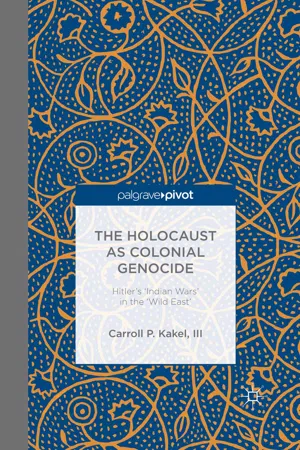
Based on an exploration of both pre-Nazi and Nazi theory and practice, Pete Kakel challenges the dominant narrative of the murder of European Jewry, illuminating the Holocaust's decidedly imperial-colonial origins, context, and content in a book of interest to students, teachers, and lay readers, as well as specialist and non-specialist scholars.
Information
1
Pre-Nazi Discourse: Racial Imperialism
Abstract: This chapter looks at pre-Nazi late nineteenth- and early twentieth-century expansionist ideas which informed and shaped Hitler’s understanding of Lebensraum imperialism, an ideology focused on gaining new ‘living space’ for an expanding population, on colonizing that ‘space’ with settlers, and on ruthlessly thrusting aside the indigenous inhabitants. It examines the expansionist ideas of the American historian Frederick Jackson Turner (and his ‘frontier thesis’), the German geographer Friedrich Ratzel (and his notion of Lebensraum), and the German geopolitical theorist Karl Haushofer (and his geopolitical theories). It shows how the Turner–Ratzel transatlantic dialogue confirmed a shared genealogy between the classic American ‘frontier thesis’ and later German ideas of Lebensraum and how these Lebensraum imperialist ideas were transmitted to Nazi Party Leader Adolf Hitler.
Kakel, Carroll P. III. The Holocaust as Colonial Genocide: Hitler’s ‘Indian Wars’ in the ‘Wild East’. Basingstoke: Palgrave Macmillan, 2013. DOI: 10.1057/9781137391698.
Politics is the art of carrying out a people’s struggle for survival – for its earthly existence. Foreign policy is the art of securing for a people the necessary quantity and quality of Lebensraum. Domestic policy is the art of preserving the commitment of strength – in terms of the people’s racial quality and numbers – necessary to do this.
Adolf Hitler (1928)1
Introduction: Lebensraum racial imperialism
During the years 1890–1914, there were two main Wilhelmine ideologies of German imperialism: Weltpolitik (world politics) and Lebensraum (living space).2 German expansionists used the term ‘Weltpolitik’ to evoke their demand for a colonial and commercial empire to be built largely on German sea power and on overseas colonies. Alongside Weltpolitik grew Lebensraum ideas of contiguous land-based expansion (supported by the army) in east-central and eastern Europe, taking territory from ‘inferior’ Slavs and gaining much-needed ‘living space’ for the German nation. By 1914, Lebensraum imperialism was firmly planted in German political culture.
The new twentieth century, these German expansionists argued, should be a ‘German century’. Rapid population growth, they claimed, had left Germany a ‘people without space’ (Volk ohne Raum). Furthermore, as a great and expanding power, they noted, Germany needed and deserved an empire, and its own ‘place in the sun’. In their view, Germany would attain greatness and its rightful place in the world only through expansion and conquest, based on its claimed racial and cultural ‘superiority’. These nationalist, imperialist and racist ideas were quickly taken up by nationalist pressure groups in Wilhelmine Germany (1871–1918). One of these groups, the Pan-German League (Alldeutscher Verband) became the most important organization in the construction of the Lebensraum imperialist ideology.
The Pan-German League considered Lebensraum as its central programmatic element. Inspired by radical and social Darwinist ideas, the League aimed to mobilize all those of the German ‘race’ in Europe with a Germany ‘cleansed’ of internal ‘enemies’ (including socialists and Jews). It advocated dictatorship and the conquest of new Lebensraum at the expense of Slavs in ‘the East’; it opposed international finance capitalism (with its supposed Jewish influence); and it sought to revoke the Reich citizenship of all Jews. According to the Pan-Germanists, the individual ‘settler-farmer’ was the ideal foundation upon which to build a ‘new’ German national character. In their view, the settlement experience would transform the farmer’s innate spirit of independence into an ethics of self-reliance and ethnic superiority – all modelled on the contemporary experience of the ‘American frontier’.3
That many late nineteenth- and early-twentieth century German expansionists – supporters of both Weltpolitik and Lebensraum – looked to the United States as the best available model for a German imperial-colonial project was due, in no small measure, to the work, ideas and influence of the American historian Frederick Jackson Turner.
Frederick Jackson Turner: father of the ‘frontier thesis’
In 1893, at the World’s Columbian Exposition in Chicago (a celebration of the 400th anniversary of the European ‘discovery’ of the Americas), a young historian from a backwater college, Frederick Jackson Turner (1861–1932), delivered a paper before an audience of some 200 historians. Little noted at the time, Turner’s essay – titled ‘The Significance of the Frontier in American History’ – would become the ‘single most influential piece of writing in the history of American history’.4
In his 1893 lecture on the ‘frontier thesis’ of American history, Turner used the phrase ‘the colonization of the Great West’ to describe the Early American process of conquest, expansion, displacement of the Indians and ‘settlement’ of the entire North American continent.5 According to the Turnerian ‘frontier thesis’, American history had been ‘in a large degree the history of the colonization of the Great West’, achieved by the ‘advance of American settlement westward’ and marked by the ‘the advance of the pioneer into the wastes of the [North American] continent’. American expansion occurred, Turner noted, along ‘a continually advancing frontier line’. At the same time, he observed, the ‘frontier’ was ‘the outer edge of the wave [of settlement] – the meeting point between savagery and civilization’ (where the Indians, a barrier to expansion and settlement, had to be ‘pushed back’). The ‘frontier’, he claimed, was also the ‘line of most rapid and effective Americanization’, the crucible of the American character. The ‘closing’ of the ‘frontier’ in 1890, Turner concluded, marked the ‘closing’ of the ‘first period of American history’.6
In an 1896 essay – called ‘The Problem of the West’ – Turner wrote that ‘[f]or nearly three centuries the dominant fact in American life has been expansion’. When the expansionist flood reached the Pacific coast, and with the ‘closing’ of the ‘frontier’, American ‘energies of expansion’ had slowed to a crawl, Turner lamented; the ‘frontier opportunities are gone’. The ‘task of filling up the vacant spaces of the continent’, he observed, had been completed, ‘the free lands are gone, the continent is crossed’, and the nation ‘is now thrown back upon itself’. ‘Agitation’ and ‘discontent’ were growing over this ‘Western problem’. But, Turner happily noted, popular demands for a ‘vigorous foreign policy’; for an ‘interoceanic canal’ linking the Atlantic and the Pacific; for a revival of American sea power; and for expanded ‘American influence to outlying islands on adjoining countries’ were all signs that American expansion would continue.7 In the near future, he had no doubt, there would be ‘new American frontiers’.
Throughout Europe, Turner’s essay became known to a wide range of scholars in different academic disciplines. One of the first scholars to express admiration for Turner and Turnerian ideas was the German geographer, Friedrich Ratzel. In a review written in 1985, Ratzel called Turner’s essay on the ‘frontier thesis’ a ‘very important work’ and an ‘instructive example of a review of the state and its geographic origins’.8 So impressed was Ratzel that he incorporated much of it into an article for an 1897 issue of Deutsche Zeitschrift für Geschichtswissenschaft (The German Journal of the History of Science).9 Turner’s first contact with Ratzel’s work came in 1895 or early 1896. For his part, Turner grew to admire Ratzel’s books. He was especially delighted, Turner’s leading biographer notes, with Ratzel’s chapter on ‘Space as a Factor in the United States’ in Ratzel’s 1882/1891 two-volume work Anthropogeographie (Human Geography).10 Turner denied having read Ratzel’s works before preparing his now famous 1893 essay on the ‘frontier thesis’. In his 1896 paper on ‘The West as a Field of Historical Study’, however, Turner quoted extensively from Ratzel’s chapter on ‘Space as a Factor in the United States’.11
In Turner’s view, the ‘frontier’ was not a ‘place’ but rather a ‘process’, a recurring process of ‘frontier settlement’ that moved across the continent in stages, a series of sequential ‘frontiers’, of ‘transitory’ ‘Wests’. According to Turner, then, there were ‘multiple frontiers’ and ‘multiple Wests’. Beginning with the Atlantic coastal settlements, ‘the West’ as a ‘process’ spread across the entire continent. American Indians (or, as he called them, the ‘native races’) were invisible in his writings, having ‘disappeared’ as...
Table of contents
- Cover
- Title
- Introduction: Explaining the Holocaust
- 1 Pre-Nazi Discourse: Racial Imperialism
- 2 Pre-Nazi Praxis: Imperial-Colonial Models
- 3 Nazi Discourse: Colonial Fantasies of Space and Race
- 4 Nazi Praxis: Colonial War and Genocide
- Conclusion: Accounting for the Holocaust
- Bibliography
- Index
Trusted by 375,005 students
Access to over 1.5 million titles for a fair monthly price.
Study more efficiently using our study tools.
Frequently asked questions
Yes, you can cancel anytime from the Subscription tab in your account settings on the Perlego website. Your subscription will stay active until the end of your current billing period. Learn how to cancel your subscription
No, books cannot be downloaded as external files, such as PDFs, for use outside of Perlego. However, you can download books within the Perlego app for offline reading on mobile or tablet. Learn how to download books offline
Perlego offers two plans: Essential and Complete
- Essential is ideal for learners and professionals who enjoy exploring a wide range of subjects. Access the Essential Library with 800,000+ trusted titles and best-sellers across business, personal growth, and the humanities. Includes unlimited reading time and Standard Read Aloud voice.
- Complete: Perfect for advanced learners and researchers needing full, unrestricted access. Unlock 1.5M+ books across hundreds of subjects, including academic and specialized titles. The Complete Plan also includes advanced features like Premium Read Aloud and Research Assistant.
We are an online textbook subscription service, where you can get access to an entire online library for less than the price of a single book per month. With over 1.5 million books across 990+ topics, we’ve got you covered! Learn about our mission
Look out for the read-aloud symbol on your next book to see if you can listen to it. The read-aloud tool reads text aloud for you, highlighting the text as it is being read. You can pause it, speed it up and slow it down. Learn more about Read Aloud
Yes! You can use the Perlego app on both iOS and Android devices to read anytime, anywhere — even offline. Perfect for commutes or when you’re on the go.
Please note we cannot support devices running on iOS 13 and Android 7 or earlier. Learn more about using the app
Please note we cannot support devices running on iOS 13 and Android 7 or earlier. Learn more about using the app
Yes, you can access The Holocaust as Colonial Genocide by C. Kakel in PDF and/or ePUB format, as well as other popular books in History & European History. We have over 1.5 million books available in our catalogue for you to explore.