- English
- ePUB (mobile friendly)
- Available on iOS & Android
eBook - ePub
About this book
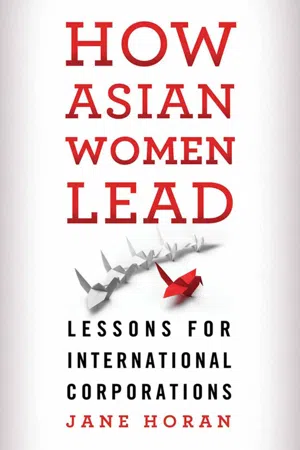
How Asian Women Lead provides a vastly different picture than Western-focused leadership literature, highlighting obstacles Asian women face reaching the top, and looking beneath the corporate surface to show cultural and family perspectives.
Information
C H A P T E R 1
A Road Map for the Book
This chapter provides the groundwork for the book, and gives reasons for the study. The prologue provides a snapshot of my experiences as head of organizational development in multinational organizations. I have seen this story—talented individuals falling off the leadership ladder—many times and have often pondered why this happens. After years in the corporate world, I returned to graduate school to obtain a doctorate in leadership education. Three serendipitous events spurred me to pursue this path of study and use the mechanism of narrative inquiry or what is more commonly known as storytelling.
The first event was my reading of a captivating research paper on multicultural narrative inquiry by JoAnn Phillion (2002). Her story and imaginative writing intrigued me. I found this use of narrative provided a powerful method to learn about multicultural environments. Second was a paper on ethical leadership and finding connections to women and transformational leadership (Eagly 2007; Ciulla 2004). The third event was the chance meeting with Ms. Lim, a Malaysian Chinese businesswoman and mother of three teenage boys. Ms. Lim was born into a prominent family and attended prestigious boarding schools; she was never the best student and only aspired to become a flight attendant. She now runs a successful global hedge fund. Hedge funds are among the more demanding areas of investment banking, and only a few women are at the helm of such funds. Ms. Lim’s story, coupled with my experiences in developing and facilitating leadership inside organizations, aroused my curiosity. I wanted to understand how women—particularly Asian women—navigated the road to leadership. These events sparked my interest in cross-cultural narrative and my desire to learn about leadership from women in an Asian context.
In this study, I use narrative to explore the complexities of life and leadership experiences of four women in Asia, each immersed in the intricacies of culture, particularly within an organization. Asia, with over 3.3 billion people, provides enormous growth opportunities and will continue to be at the top of the population charts for the foreseeable future. Digging into the demographics, we find highly educated women now entering the workforce in droves and organizations struggling to maintain diverse and inclusive leadership (Hewlett 2007). The demographic and economic shifts in Asia predict positive developments for the region while simultaneously presenting demands on organizations and leadership. As headlines continue to highlight the dearth of women in leadership positions, the research on women leaders (specifically Asian women) remains sparse. Accordingly, this cross-cultural narrative inquiry provides a new perspective for both organizations and for qualitative research.
Interestingly, women enter the workforce at the same rate as men, but their numbers noticeably diminish as they move up the organization (Aguirre and Sabbagh 2010; Coffman et al. 2010; Barsh et al. 2012). There are many reasons for this: demands of work and family, vagaries in talent selection, organizational politics (Barsh and Yee 2011; Hewlett 2007), to name a few. The focus of my research is to gain insight into leadership from the experience of women in academia and nonprofits and from women entrepreneurs and businesswomen. Understandably, there are many ways to gather data. Since this research explores the human side of leadership and organizational life, narrative is well suited to this study. I use the terms narrative, narrative inquiry, and stories throughout this book. Stories provide suitable conditions for understanding and expressing the human experience of events, choices, and leadership (Polkinghorne 1995). From this perspective, I examine four women’s leadership experiences in Asia.
A single theory should not hold authority over another, and while there is much quantitative research on leadership, this study uses words rather than numbers as data; stories provide a different perspective on leadership and culture. From a postmodernist perspective, stories evolve, as do interpretations. This study looked at multiple perspectives, including my own, in order to guide the interpretive process. The fluid nature of narrative allows interpretation to evolve, holding back from a definite view. Stories regenerate with each reading, and each time are interpreted through different prisms and perspectives.
In the process of doing this research, I reconsidered my Western thought process and my deeply held beliefs about Asian culture, both during interviews and in my subsequent writing. This presented opportunities, conflicting emotions, and learning. At times I connected with my participants, and at other times I was left baffled, unable to make any meaningful connection. From my first interview I struggled with the meaning of words and the participant’s response. This may sound amusing but is true. Simple words used every day offer new ways to understand culture and organizational systems. My challenges often came from holding on to a particular meaning, relying on the same ideals and structure by which I was in fact also challenging the participant (Derrida 1978). Conducting cross-cultural interviews unearthed mistaken beliefs and exposed misinterpretations inherent in both Western and Eastern cultures.
Struggle can both educate and elucidate. In writing about leadership and culture, there are no absolute truths, but rather different ways to examine assumptions about truths. Similarly, as will be discussed in chapter 8, there are few definite definitions of leadership; the prevailing definitions reflect a Western perspective. Leadership—like science—should not be considered unilaterally or from a dominant cultural perspective. The complexity and diversity of global business and society distort our view and certainly should challenge a universal understanding of leadership. I do not intend to offer vague solutions or uncover truths about leadership and demonstrate specific steps to get to the top. Instead, I focus on and explore values, influences, and experiences from a combined perspective on how these women experienced leadership. This research is collaborative, based on the journey of women at multiple junctions of life. I am an integral part of this story traveling alongside my participants. This qualitative method explores the past, sometimes from a historical perspective, sometimes from a current perspective, sometimes from a cultural one, all to gain insights and create meaning based on multicultural views. In the end, this book highlights various viewpoints for understanding an underrepresented community of leaders.
Cross-Cultural Storytelling
Narrative allows multiple interpretations for many people. These stories provide lessons of experience and serendipitous moments of realization on the road to leadership. A story is never straightforward, and a challenge immediately exists. Context, situations, and the fluid nature of stories can unnerve, be endlessly creative, or be perpetually interpreted (Denzin and Lincoln 2005). Learning takes place through a reflexive process. Reflexivity looks both internally and externally for answers. A story presents itself one way, but going back and reading it again provides another angle, multiple interpretations and ways to tell a story. Some of these stories start with the interview sequence, others begin from a different angle, and all blend culture and historical elements. Each story presents a window into the participant’s self, leadership, and culture providing a representation of life for the reader’s interpretation.
As previously mentioned, the decision to use cross-cultural narrative began with my interest in JoAnn Phillion’s (2002) research on narrative multiculturalism. However, my exposure to qualitative research and using stories began at university with Erving Goffman’s book The Presentation of Self in Everyday Life (1959), which laid the groundwork for narrative performance. Unlike Phillion, I entered this research without a prepared script. Phillion carried “scripts of expectation” into the Bay Street school, stating “the truths of the script were what I personally and professionally believed in and tried to practice” (2002, 268). In my research, I deliberately did not have a script but unconsciously carried baggage of cultural knowledge and mental frameworks into this narrative. I also uncovered bias, a gut reaction to a story or thought that prevented me from accepting a new perspective. This experience provided much learning and profound insights on what happens inside organizations for women. In chapter 7, bias is explored in more detail with links to culture, gender, and invisible barriers for women in organizations.
My background in cross-cultural development should have eliminated such bias, but I had to remind myself (constantly) to look at the corporate world and these women through a very different lens. I left the United States over 25 years ago to study Chinese language, history, and culture in Changsha, Hunan Province, in China. Under the leadership of Deng Xiao Ping, China was then a very different country from today. In 1985 summer indicated tomatoes or watermelons and few other varieties of food. I taught English to graduate student engineers at one of the large mining and metallurgy universities. The university resembled a small city with 100,000 or more residents living within the walled enclave. My fellow students wore Mao suits, studied the Little Red Book on Saturday afternoons, and few spoke English. I later moved to Hong Kong and was employed by a Shanghainese family-run company; subsequently, I worked in multinational organizations across Asia for over two decades. Through these experiences and my own personal development, I became sensitive to Asian cultural values and was made painfully aware of the increasing demands on women at work. Using cross-cultural narrative inquiry to engage and collaborate with my participants provided insights into culture and undoubtedly more questions.
Leadership Research and Storytelling
Stories have been used as a research method in education and leadership for years (Clandinin and Connelly 1990; Ciulla 2004; Helgesen 1995; Brown and Rhodes 2005; Howard 2010). As I was writing these stories, a thought or picture of a past event would fleetingly enter my mind, and I carefully tried to capture these thoughts. Taking a step back, I recognized similar events with my participants—events or moments in time when decisions were made to shift, change, transform, or step into leadership. More important, these short-lived moments provided valuable learning about leadership and self, but only through reflection. Recognizing these events—moments of realization—during the interview process, I started to see similar events appearing in each story. These events were not tragic—indeed, many are delightful (the offer of a new position or business opportunity)—but often linked with pain or emotional upheaval. Reading these stories, readers will find many such turning points in each.
Stories are performance art. Sitting in a trendy Hong Kong café or a wood-paneled Singapore office, pictures unfolded in my mind while listening. Many times I thought I had seen this movie before. I was aware that bias entered my thoughts. Returning to my notes provided a new perspective to make sense of the scenes unfolding. The words now carried a different meaning. Looking back, I have questioned and doubted the interview process, wondering if the stories represent my participants’ voices. But how do we accurately represent a voice and grab a memory? As the story retreats, it floats between center stage and back stage.
Moments of Realization Defined
During interviews and story writing, moments of realization precipitated periods of reflexive analysis of the process of narrative inquiry and my unchecked bias (Finlay 2006). These pivotal moments became apparent as I was writing the stories and seeking my participants’ reflections. One participant responded, “You know me better than I know myself.”
These moments of realization, either spontaneous or over time, defined a time when participants realized the need to change course, when there was not a choice, and when leadership was thrust upon them. These moments were critical junctures for me with my participants and within the stories. Listening to their stories, I experienced many of these moments and remembered my time in the corporate world, on the other side of talent meetings, observing and advising leaders.
There were many occasions when I was headed in one research direction but forced to take a step back, and in doing so, I learned something new. The word “failure” provided significant learning from a personal and organizational perspective. In chapter 9 the misinterpretation of words is discussed in greater detail together with its impact on leadership and organizations. The setback with words (specifically the word “failure”) forced a review of these stories and leadership. As I was doing so, these serendipitous moments of realization emerged. These epiphanies happened suddenly when a thought, statement, or story triggered a memory. Or they came slowly when a belief was accepted, challenged, or disregarded. Such reflexive moments illustrate the tremendous importance of noticing a specific response in order to make a predictive action (Etherington 2004).
In chapter 2 through 5, such moments are highlighted in each story. Throughout this study, I lived within my participants’ world and experienced episodes of discontinuity with narrative inquiry and multicultural environments. In chapter 9 multicultural mishaps are discussed in more detail, exploring definitions of culture and identity and their impact on organizations. Some of this confusion stems from using a Western concept of leadership and accepting cultural stereotypes. Using reflexivity in this study helped me assign meaning to popular myths surrounding leadership. Instead of seeking truth or generalized perspectives, the stories are intended to build awareness and cultivate interest in future leadership in a global context.
Participants in This Study
The women in my research discuss family, spirituality, and personal attitudes toward leadership. Their families play an integral role, weaving an interesting dynamic throughout. Setbacks abound—either losing a parent early in life or rejecting a parent in adulthood and reuniting with parents in midlife—and these women attribute their success to family support and to integrating work and personal life.
I am fortunate to have lived in Asia and developed an extended network in business, academia, and nonprofits. I am also a member of many women’s networks and have held two board positions for nonprofit organizations. Embarking on this study, I reached out to this extended network, provided an overview of my research, and asked for introductions to women in leadership positions. I was not seeking to interview CEOs or managing directors but was more interested in one or two levels below. I wanted someone who was on a path of leadership, leading a function, department, or nonprofit, and I planned to broaden the scope of this discovery beyond the business community.
My only criteria were diversity and time. I wanted diversity in culture and experiences—participants had to be willing to spend a year or more of many interviews and story iterations. I received a few responses from prominent business leaders and many from European and American women with extensive experience and impressive credentials in Asia. I decided against both, as business leaders could not afford the time and I was focused on stories of Asian women. I soon started the interview process of over 30 women in the region. The interviews and research required time and commitment, and I was honored that my participants chose to be part of this journey with me.
I have not worked with or for any of them; none are colleagues. But I was introduced to each one and decided to invite them to take part in my research. I intended to write stories across the countries in Asia but received wise advice that this might not be feasible. I started with six stories and whittled this number down to four. I wanted to maintain diversity of cultures, experience, profession, seniority levels, and industry. The four women I selected represented “success,” and could identify and articulate the foundation of their success. Yet, theirs is not success in a conspicuous sense of achievement—financial, for example, accompanied by fame and fortune. In fact, reframing success to honor their cultures, these women believe their achievements are the result of having been offered opportunities, having had a commitment to learning, and having taken the time for self-reflection. From my vantage point and in my words, these women are “successful in more ways than one.”
In keeping with the narrative form, I had a broad set of questions I intended to ask, but I also maintained flexibility to allow each individual story to flow. I used my plan as a guide, not a strict format. When participants asked me to send the questionnaire in advance, I realized I needed to provide an overview of narrative, how the process works, and a road map of the journey. I was aware of the cultural aspects and saw that this guide was important because some participants required an overview before our first meeting in order to prepare. In addition, the guide aided in building rapport and trust. The overview outlined the process and broad areas to be discussed; it highlighted confidentiality, disguising names or industry, and other connections. My intention was to engage in a general dialogue to understand various experiences relating to leadership and life. Mindful of the ethical aspects of this study, the overview provided a general guideline without being too prescriptive (Josselson 2007).
To conduct the interviews I used a digital tape rec...
Table of contents
- Cover
- Title
- 1 A Road Map for the Book
- 2 Akiko Ito’s Story: Life Is a Game
- 3 Faria Ali’s Story: Live Well, Love Well
- 4 Judy Lee’s Story: Out of Asia and into Africa
- 5 Sara Chin’s Story: The Accidental Leader
- 6 A Corporate Fable
- 7 Unconscious Bias Uncovered
- 8 Leadership Review
- 9 Multicultural Mishaps
- 10 Conclusion: A Roadmap for the Future— What Do We Know?
- References
- Index
Trusted by 375,005 students
Access to over 1.5 million titles for a fair monthly price.
Study more efficiently using our study tools.
Frequently asked questions
Yes, you can cancel anytime from the Subscription tab in your account settings on the Perlego website. Your subscription will stay active until the end of your current billing period. Learn how to cancel your subscription
No, books cannot be downloaded as external files, such as PDFs, for use outside of Perlego. However, you can download books within the Perlego app for offline reading on mobile or tablet. Learn how to download books offline
Perlego offers two plans: Essential and Complete
- Essential is ideal for learners and professionals who enjoy exploring a wide range of subjects. Access the Essential Library with 800,000+ trusted titles and best-sellers across business, personal growth, and the humanities. Includes unlimited reading time and Standard Read Aloud voice.
- Complete: Perfect for advanced learners and researchers needing full, unrestricted access. Unlock 1.5M+ books across hundreds of subjects, including academic and specialized titles. The Complete Plan also includes advanced features like Premium Read Aloud and Research Assistant.
We are an online textbook subscription service, where you can get access to an entire online library for less than the price of a single book per month. With over 1.5 million books across 990+ topics, we’ve got you covered! Learn about our mission
Look out for the read-aloud symbol on your next book to see if you can listen to it. The read-aloud tool reads text aloud for you, highlighting the text as it is being read. You can pause it, speed it up and slow it down. Learn more about Read Aloud
Yes! You can use the Perlego app on both iOS and Android devices to read anytime, anywhere — even offline. Perfect for commutes or when you’re on the go.
Please note we cannot support devices running on iOS 13 and Android 7 or earlier. Learn more about using the app
Please note we cannot support devices running on iOS 13 and Android 7 or earlier. Learn more about using the app
Yes, you can access How Asian Women Lead by J. Horan in PDF and/or ePUB format, as well as other popular books in Business & Business Ethics. We have over 1.5 million books available in our catalogue for you to explore.