
- English
- ePUB (mobile friendly)
- Available on iOS & Android
eBook - ePub
Exploring Listening Strategy Instruction through Action Research
About this book
Listening in a second language is challenge for students and teachers alike. This book provides a personal account of an action research intervention involving listening strategy instruction that investigated the viability of this innovative pedagogy in the Japanese university context.
Information
Part I
Addressing a Gap in Second Language Listening Instruction
1
Personal and Professional Foundations of a Listening Strategy Intervention
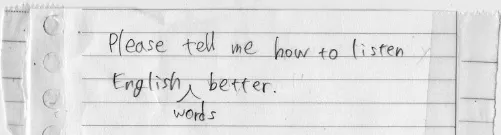
Figure 1.1 Student note
The note in Figure 1.1 was anonymous but the message was clear. ‘Please tell me how to listen English words better.’ In the spring of 2009, I was working as a lecturer at Sakura University (a pseudonym), a private university in southern Japan. Teaching a class focused on developing listening skills, I was in my first year at this institution. Near the end of my first semester, I asked students to write comments about the course and how it could be improved. The student note pictured in Figure 1.1 above really made an impact on me and prompted me to reflect on the supposed ‘teaching’ of listening I was doing.
Throughout the listening course, I had been troubled by the repetitive classroom practices in which students listened to audio or watched video texts, and answered discrete-item comprehension questions, after which I shared the correct answers. Then we simply repeated the same procedure with a new text the next day. After a time, I came to realize that I was doing very little ‘teaching.’ Instead, I was continually evaluating students’ existing listening ability, but was not providing much scaffolded guidance that would help them become competent listeners. This situation led to feelings of dismay and frustration, as I realized I was being an ineffective listening teacher who was hardly teaching students ‘how to listen English words better.’ I imagine many language teachers have shared similar feelings.
When I approached other language teachers at this school to ask for suggestions, many admitted that they did not have any innovative ideas for listening instruction and were satisfied to conduct the course in its current fashion. That is, a predictable pattern centering on multiple choice questions was the accepted status quo. Some kind of intervention was needed to address student desires about listening and to challenge the status quo of conventional pedagogy, and an idea for conducting action research in my classroom was born.
This situation motivated me to consult literature on second language (L2) listening and related instruction in search of some solutions. I was encouraged to read about various different pedagogical options, but the notion of strategy instruction for listening enticed me most as it had several connections to my core beliefs as a teacher. These beliefs included support for process-oriented (rather than product-based) instruction, that language teachers have innate abilities which they can use to guide learners, and that students enter language courses with the intention of gaining L2 skills and strategies that are transferable beyond the classroom.
Through my reading and personal reflection, I became inspired to make an attempt to improve L2 listening instruction at this university by adopting and investigating a listening strategy instruction program. Although the literature discussed various theories of listening, models for strategy instruction, and strategy taxonomies, it was more challenging to find practical recommendations for a coherent and systematic methodology. Thus, I decided to coordinate an action research intervention using listening strategy instruction. I identified this area as one in need of greater attention in my local context as well as one that could potentially reverberate through the broader L2 teaching and learning community, and it became the motivation for this project.
1.1 L2 listening: important but neglected
It is widely accepted that listening skills are of vital importance to the communicative process. In fact, research shows that a considerable amount of the time adults spend communicating involves listening (45%), a percentage that dominates time spent engaged in the other three skills: writing (9%); reading (16%); and speaking (30%) (Feyten, 1991; Nunan, 1998; Flowerdew & Miller, 2005). Listening becomes even more important in Western academic settings, where ‘close to 90% of class time in high school and college is spent listening to discussion and lectures’ (Taylor, 1964, as cited in Oxford, 1993). Such observations suggest that listening is often a more valuable and more frequently-used skill than speaking. Moreover, the importance attributed to listening continues to increase in international testing, business, and communication (Richards & Burns, 2012). Given these observations, it is surprising that the crucial and complex act of listening is typically taken for granted in many language classrooms.
Listening is an inconspicuous skill and in-depth understanding of it remains elusive (Field, 2008). Although it is a major human attribute, listening is rarely consciously acknowledged due to its ephemeral, covert nature (Buck, 2001; Field, 2008; Vandergrift, 2010). In fact, frequently the only time many people acknowledge their capacity to listen is when they are unable to hear something (Anderson & Lynch, 1988; Lynch & Mendelsohn, 2002). Therefore, it is unsurprising that in L2 classrooms, listening is often given less attention than the other macro-skills. Listening has been dubbed the ‘Cinderella skill’ (Mendelsohn, 1994), the ‘forgotten skill’ (Burley-Allen, 1995), and an ‘overlooked dimension’ of L2 acquisition (Feyten, 1991). It is often neglected or overlooked during social interaction and in classroom learning in general, as well as in L2 classrooms specifically (Nunan, 1998; Flowerdew & Miller, 2005; Field, 2008; Nation & Newton, 2009).
Outside the classroom context, in general oral communication, the speaker rather than the listener is usually the center of attention. This situation is likely to be reflected in L2 classrooms, where speaking as well as reading and writing often take priority over listening. In addition to problems with assessing listening ability, another dilemma language teachers face is a lack of a well-recognized methodology for teaching L2 listening. Of the four main language skills, reading, writing, and speaking have traditionally enjoyed more attention from language teaching methodologists; however, clear and accepted methods, models, and directions for the teaching of L2 listening are far from abundant.
Although often taken for granted, listening is typically the first language skill to develop in first language (L1) users and serves as a gateway to other skills. In an L2 situation, it provides a valuable source of input for acquisition of the language, as well as content. While it is generally recognized as one of the four main language skills, listening is often the most challenging for language teachers to address in their classrooms and is frequently identified by L2 learners as the most difficult skill (for example, Field, 2008; Renandya & Farrell, 2011). Due to a lack of pedagogical knowledge and options for L2 listening instruction, many teachers may rely on the status quo of ‘listen, answer, check’ sequences like the one in the opening anecdote, which do little to help L2 students learn ‘how to’ listen in their new language. Instructors may be unfamiliar with a range of activities that effectively develop the necessary sub-skills and strategies to lead to competent listening (Nemtchinova, 2013). Many teacher education courses neglect to explore listening at the theoretical level, and they typically underprepare new teachers in terms of the practical approaches, techniques, and activities that they can apply in their classrooms (Graham et al., 2011). Further, teachers who turn to textbook teacher manuals for help may find little support for listening (Field, 2012a).
1.2 Putting theory into practice: a focus on listening strategy instruction
The purpose of the project described in this book is to contribute to the development of improved pedagogy associated with aural understanding through listening strategy instruction (LSI). It was started to address shortcomings in my own teaching context and has evolved into an illustration of what is possible for other language teachers who seek to extend themselves, their students, and their curricula to tackle the complicated situation surrounding how to teach L2 listening. It is my hope that readers will come away from the book with ideas, possibilities, and a sample blueprint for informed, systematic, and contextually appropriate listening instruction.
As highlighted by the opening anecdote, I was disenchanted by the lack of pedagogic options for L2 listening instruction. As a language teacher, I believed that listening was a crucial skill for my students and was likely to be the most useful for them. However, I also felt my own teaching of listening, as well as that described in the literature and by other colleagues, was in need of enhancement. I empathized with my L2 learners as well, for I realized I was putting pressure on them in listening classes by constantly testing their present listening ability, yet I was neglecting to help them develop their aural abilities through a systematic, consistent, and pedagogically sound methodology. This notion was crystallized in the student’s comment about being taught ‘how to’ listen.
Therefore, the reasons for this LSI project related to my dissatisfaction with listening instruction both in my own local context and with that described in the wider field. Such pedagogy often involves a heavy emphasis on products of listening and gives little, if any, attention to the cognitive processes involved, and I was motivated to investigate a pedagogic alternative, namely LSI. The project was guided by three underlying issues related to student and teacher perspectives, respectively, as well as the pragmatic and practical viability of the LSI.
The first issue related to learner perceptions of the LSI. This was an important question for me because if any pedagogic change is to be viable, learners need to buy in to it. Teachers may have good intentions and grandiose plans, but resistance in the classroom can collapse any ambition. Also, in terms of listening pedagogy specifically, I had suspected that learners too were not convinced that repeatedly answering comprehension questions would actually help improve their listening ability. After all, if the same students consistently answer incorrectly, they are demonstrating that their abilities are not improving, a pattern that certainly leads to lowered motivation. Therefore, although I felt strongly that there must be better approaches to listening pedagogy, I wanted to know if students agreed or if they were satisfied with more traditional approaches.
In a similar way, the second issue relates to teacher perceptions of the LSI intervention. Since teachers are the ones responsible for making decisions before and during L2 classes, their views on this LSI program were valuable in assessing the program in a number of ways, including the theoretical underpinnings, the experiential motivations, the materials development, and the everyday LSI delivery in the classroom. Involving other teachers in the conceptualization and implementation of the LSI was important from a teacher education perspective and shed light on how collaboration and cooperation can stimulate change in language education. In order for the project to extend beyond my immediate teaching context, it was important to elicit opinions from teachers also familiar with the LSI, who offered insights on how to continually refine the instruction over the course of the project.
The third issue I wanted to examine was the myriad factors that affected the LSI program, which included both obstacles that needed to be addressed and assets that contributed to the viability of the program. Given that the LSI intervention described hereafter represents a substantial shift from previous product-oriented listening pedagogy, a number of potential hurdles had to be dealt with. Would it be possible to identify, select, and integrate LSI into everyday classroom instruction? Would administrative resistance quash the initiative at the inception stage? Would colleagues criticize or support the plan? These concerns, along with questions about the present and potential value of LSI for the students in this local context, were topics investigated through the project.
In order to create manageable parameters for this research in terms of practicality and achievability as well as to focus the research in my own local teaching context, the scope of the project was limited to upper intermediate English (UIE) level courses at a private university in southern Japan. It was intended to better understand how the introduction of LSI in this specific setting might make a difference to teaching practices and to the learning outcomes for the students involved. As such, the planning stages, list of strategies, and classroom techniques illustrated here are described and exemplified in ways that other teachers and curriculum planners can adopt in part or in whole for their own working situations.
Given the local nature of the investigation and its direct relationship to understanding more about teaching in my own context, I adopted an action research (AR) framework, which consisted of iterative stages of planning, action, observation, and reflection. This approach seemed relevant, both because of my interest in investigating my own practice and because recent literature has also included calls for AR on types of listening pedagogy (for example, Macaro, 2001; Goh, 2005, 2008). Therefore, this research was not based solely on my personal interest in the topic, but also incorporated wider directions in the field related to L2 listening pedagogy. In order to recognize the various groups that were affected and influenced by this exploratory research, a qualitative AR perspective was adopted. This stance allowed a range of participants (for example, students, teachers, and me as the teacher-researcher) to experience and interpret the LSI intervention, and allowed data to be collected via several instruments: questionnaires; interviews; class observations; pre/post tests; and a research journal.
The LSI intervention took place over the course of three consecutive semesters. During that time, I taught four classes using LSI, and a co-teacher taught two other classes using the same LSI material. The LSI consisted of specific listening strategies selected for incorporation into UIE courses. Strategies were selected based on my reading of the literature, on me and my colleagues’ teaching experiences in Japan, and our collective understanding of both the needs of our students and the UIE course objectives. The strategies were integrated with the existing listening materials for the UIE course and were organized into a 15-week semester. Each week’s instruction centered on a different strategy and operated according to a pedagogic cycle, which was developed specifically for this LSI and consisted of the following stages: introduction/awareness raising; practice; review; and extension.
1.3 An extended and contextualized LSI investigation
This project aimed to address a gap that exists in the pedagogical literature on listening and strategy instruction by exploring the viability of LSI as a classroom practice. Its focus was to forge a stronger link between the academic literature and the everyday classroom by providing and evaluating a framework for LSI that could inform teachers and teacher educators about this methodology. It also aimed to contribute to the field by recognizing that student perspectives on pedagogy are important in determining what they want and what they expect from their teachers in terms of listening instruction. Finally, this research was intended to contribute to the enhancement of teaching practices in my local context, the classroom lives of students and teachers at the institution, and potentially to the language teaching and learning lives of other teachers and their students as well.
This research distinguishes itself from other previous studies on LSI (for example, Ozeki, 2000; Goh, 2002; Chen, 2005) in several ways. First, the three-semester (1.5 year) duration of this study was markedly longer than other LSI studies, such as Ozeki’s (2000) single-semester project. This extended time period allowed for increased understanding and insights related to the sustainabili...
Table of contents
- Cover
- Title
- Copyright
- Contents
- List of Figures and Tables
- List of Abbreviations
- Conventions for Naming Participants
- Part I Addressing a Gap in Second Language Listening Instruction
- Part II Understanding the Listening Strategy Instruction Intervention
- Part III Positioning the Listening Strategy Instruction Project in the Field
- Appendix 1: Questionnaire Items
- Appendix 2: Student Interview Protocols
- Appendix 3: Teacher Interview Questions
- Appendix 4: Phase Two Observation Comment Sheet Prompts
- Appendix 5: Phase Three Observation Sheet Behaviors Checklist Categories
- Appendix 6: Additional Examples of Classroom Observation Comments
- Appendix 7: Post-Peer Review Questions for Peggy
- References
- Index
Trusted by 375,005 students
Access to over 1.5 million titles for a fair monthly price.
Study more efficiently using our study tools.
Frequently asked questions
Yes, you can cancel anytime from the Subscription tab in your account settings on the Perlego website. Your subscription will stay active until the end of your current billing period. Learn how to cancel your subscription
No, books cannot be downloaded as external files, such as PDFs, for use outside of Perlego. However, you can download books within the Perlego app for offline reading on mobile or tablet. Learn how to download books offline
Perlego offers two plans: Essential and Complete
- Essential is ideal for learners and professionals who enjoy exploring a wide range of subjects. Access the Essential Library with 800,000+ trusted titles and best-sellers across business, personal growth, and the humanities. Includes unlimited reading time and Standard Read Aloud voice.
- Complete: Perfect for advanced learners and researchers needing full, unrestricted access. Unlock 1.5M+ books across hundreds of subjects, including academic and specialized titles. The Complete Plan also includes advanced features like Premium Read Aloud and Research Assistant.
We are an online textbook subscription service, where you can get access to an entire online library for less than the price of a single book per month. With over 1.5 million books across 990+ topics, we’ve got you covered! Learn about our mission
Look out for the read-aloud symbol on your next book to see if you can listen to it. The read-aloud tool reads text aloud for you, highlighting the text as it is being read. You can pause it, speed it up and slow it down. Learn more about Read Aloud
Yes! You can use the Perlego app on both iOS and Android devices to read anytime, anywhere — even offline. Perfect for commutes or when you’re on the go.
Please note we cannot support devices running on iOS 13 and Android 7 or earlier. Learn more about using the app
Please note we cannot support devices running on iOS 13 and Android 7 or earlier. Learn more about using the app
Yes, you can access Exploring Listening Strategy Instruction through Action Research by Joseph Siegel in PDF and/or ePUB format, as well as other popular books in Languages & Linguistics & Teacher Training. We have over 1.5 million books available in our catalogue for you to explore.