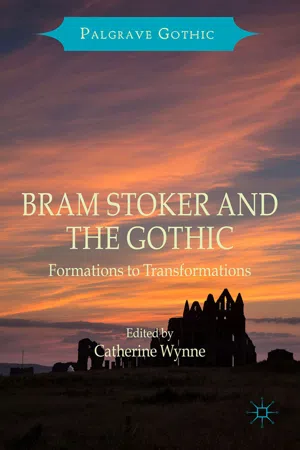
'My revenge is just begun! I spread it over centuries, and time is on my side,' warns Dracula. This statement is descriptive of the Gothic genre. Like the Count, the Gothic encompasses and has manifested itself in many forms. Bram Stoker and the Gothic demonstrates how Dracula marks a key moment in the transformation of the Gothic. Harking back to early Gothic's preoccupation with the supernatural, decayed aristocracy and incarceration in gloomy castles, the novel speaks to its own time, but has also transformed the genre, a revitalization that continues to sustain the Gothic today. This collection explores the formations of the Gothic, the relationship between Stoker's work and some of his Gothic predecessors, such as Poe and Wollstonecraft, presents new readings of Stoker's fiction and probes the influences of his cultural circle, before concluding by examining aspects of Gothic transformation from Daphne du Maurier to Stoker's own 'reincarnation' in fiction and biography. Bram Stoker and the Gothic testifies to Stoker's centrality to the Gothic genre. Like Dracula, Stoker's 'revenge' shows no sign of abating.
- English
- ePUB (mobile friendly)
- Available on iOS & Android
eBook - ePub
About this book
Information
1
On the Origins of the Gothic Novel: From Old Norse to Otranto
A primary vehicle for the literary Gothic in the late eighteenth to early nineteenth centuries was past superstition. The extent to which Old Norse tradition provided the basis for a subspecies of literary horror has been passed over in an expanding critical literature which has not otherwise missed out on cosmopolitan perspectives.
This observation by Robert W. Rix (2011: 1) accurately assesses what may be considered a significant oversight in studies of the Gothic novel. Whilst it is well known that the ethnic meaning of ‘Gothic’ originally referred to invasive, eastern Germanic, pagan tribes of the third to the sixth centuries AD (Sowerby, 2000: 15–26), there remains a disconnect between Gothicism as the legacy of Old Norse literature and the use of the term ‘Gothic’ to mean a category of fantastical literature. This essay, then, seeks to complement Rix’s study by, in certain areas, adding more detail about the gradual emergence of Old Norse literature as a significant presence on the European literary scene. The initial focus will be on those formations (often malformations) and interpretations of Old Norse literature as it came gradually to light from the sixteenth century onwards, and how the Nordic Revival impacted on what is widely considered to be the first Gothic novel, The Castle of Otranto (1764) by Horace Walpole (1717–97). As will be argued, although Walpole was ambivalent in his opinions on the growing influence of Nordic antiquity in the latter half of the eighteenth century, it is quite clear that it played an important role in stimulating his ‘Gothicised’ imagination, not least due to his close association with the poet Thomas Gray (1716–71), an unabashed enthusiast for the Old North. The essay will conclude with an examination of how, over a hundred years later, this material and all things Viking, along with the attendant glamorisations, had become an accepted and uncontroversial cultural reference point in the novels of Bram Stoker (1847–1912).
The Scandinavian recovery period from the sixteenth to the early eighteenth century
The manuscripts containing myths and legends concerning pagan Scandinavia fall broadly into three areas. The first and most mythologically informative area includes The Poetic Edda, an anonymous collection of over thirty poems, many of which were preserved from oral tradition, and The Prose Edda, a systematised account of Old Norse mythology set down in the early thirteenth century by the Icelander Snorri Sturluson (1178/9–1241). As Iceland had converted to Christianity over two hundred years earlier, Snorri’s edda takes particular care not to offend biblical orthodoxy, so providing a euhemerised introduction which explains the error of Norse paganism in terms of naïve Scandinavians mistaking northward migrating descendants of heroes of the Trojan wars for gods. The second area includes medieval histories, such as Adam of Bremen’s late eleventh-century Gesta Hammaburgensis Ecclesiae Pontificum (Deeds of the Bishops of the Hamburg Church), Saxo Grammaticus’s late twelfth-/early thirteenth-century Gesta Danorum (The History of the Danes) and Snorri Sturluson’s Heimskringla, an early thirteenth-century history of the kings of Norway. Explicit disapprobation of pre-Christian practices is most apparent in the histories by Adam and Saxo. The third and by far the largest area is the Icelandic sagas, which range from the seemingly historical to the wildly imaginative. The sagas also preserved the majority of skaldic poetry, an occasional verse-form using a highly complex metre. Whilst Old Norse manuscripts continued to come to light from the Renaissance onwards, it was the interpretations placed on them and the various medieval histories by patriotic Scandinavian scholars that characterised their early reception history.
Initially, there were three main problems for the Scandinavians in their efforts to reclaim their respective country’s pre-Christian history. Firstly, there was the widespread perception elsewhere in Europe that Scandinavia was a cultural backwater, one where Christianity was late in arriving and where Greco-Roman Classicism had had little impact and, so, had left the European north culturally impoverished. Endorsing this view was Giorgio Vasari (1511–74), whose influential Lives of the Artists (1524) included a ‘philippic against the Gothic style’ which denounced north European medieval architecture as barbaric compared to the Classical Revival of his own time (Pearsall, 2001: 2). Secondly, as was the case with Snorri Sturluson’s edda, any attempt to recover the pagan past needed to be reconciled with biblical history, hence the continued need for euhemerisation. Thirdly, political relations between the Dano-Norwegian coalition, which included Iceland as a Danish colony, and Sweden were very strained. The, perhaps inevitable, consequence of these problems was that interpretations placed upon the Scandinavian past were invariably convoluted and typically determined to belittle their political opponents. Ethnographic insults and counter-insults were aimed across the Baltic inlets throughout the early recovery period.
In sixteenth-century Denmark, two printed editions of Saxo’s Gesta Danorum, one in the original Latin and one in Danish translation, formed the basis of Danish insights into their early ancestors but, for further insight, the Danes needed to look to Iceland and its vast store of medieval manuscripts. The most influential Icelander on future Danish and Icelandic scholars was Arngrímur Jónsson (1568–1648), who referred to Old Norse as ‘Old Gothic’. Arngrímur used Icelandic saga sources to write a now lost history of the Danish kings, and perturbed by the poor reports Iceland had received from visitors, wrote the chauvinistic Brevis commentarius de Islandia (Defence of Iceland) and Crymogæa (On Iceland). Given such efforts by learned Icelanders, the Danes would always be better informed than the Swedes and, as a result, somewhat more sober in the significances they attached to manuscript evidence. Lacking such resources, the Swedes were largely dependent on Adam of Bremen’s unflattering history of their pagan past, which they combined with early Roman histories, notably Tacitus’s first-century, often approving, history of the Germanic tribes, Germania, and Jordanes’s sixth-century history of the Gothic tribes, Getica, which they construed as meaning exclusively Swedish tribes. The main significance of Swedish interpretations of their past lies in the impact they had on Danish scholars, whose responses were typically belligerent and not a little hyperbolised.
Setting the tone for future rivalries with the Danes were the Swedish brothers Johannes Magnus (1488–1544), the last Catholic Archbishop of Uppsala, and Olaus Magnus (1490–1557), who as a consequence of the Lutheran Reformation, inherited his brother’s title in name only. According to Johannes’s posthumously published Historia de omnibus Gothorum Sveonumque regibus (A History of All the Kings of the Goths and the Swedes) of 1554, the Swedish Goths were originally led by the biblical Magog, Noah’s grandson. Fortunately, Magog had taken his tribe to Sweden before the destruction of the Tower of Babel, the upshot being that the Goths spoke the language of God and had therefore succeeded in spreading civilised values across Ancient Greece on through to the birth of Christ. It was these divinely ordained virtues that had enabled the Goths to triumph over the Roman legions, as recounted in Jordanes’s Getica. Moreover, claimed Johannes, the surviving evidence of the ur-language of the Goths is Gothic script, otherwise known as runes, which, on the one hand, he wrongly asserted to be uniquely Swedish, and on the other, implied them to be a common form of manuscript writing. This extraordinary theory was one that Olaus Magnus not only fully endorsed but also used to remind enemies of the Swedes, i.e. the Danes, how unwise it would be ‘to join battle with the elements themselves’ (Johannesson, 1991: 189).
Pursuing a similar, if less excessive, line of what had become known as Gothicism was the Dane Ole Worm (1588–1654). Here again, doubtless in response to Swedish assertions, runes were the issue. For Worm, runes provided not only an insight into Danish origins, character and vocation but also into the origins of language, for, he argued, Danish runes, that is to say all runes, are derived from Hebraic script. With the help of the Icelanders, most notably Magnús Ólafsson (1574–1636), Worm’s RUNIR seu Danica literatura antiquissima … eller literatura runica (Runes or the Most Ancient Danish Literature) of 1636 drew particular attention to ‘Krákumál’, a heroic poem rendered by Worm in both runic script and Latin that became widely translated in Britain in the seventeenth and eighteenth centuries as ‘The Death-Song of Ragnar Lodbrok’. In this, the hero, Ragnar, has been cast defenceless into a Northumbrian snake-pit, where he proudly reflects on his many triumphs as a Viking warrior. ‘Laughing shall I die’, concludes Ragnar, for he is sure of his glorious transportation to Valhalla by Odin’s Valkyries, where, according to Worm’s text, he will drink ale from the skulls of his fallen enemies. However, while the arresting idea of a human skull-cup is one that would become widely quoted by future enthusiasts for ‘runic poetry’, the text provided for Worm by Magnús Ólafsson had misinterpreted the Old Norse phrase or bjúgviðum hausa as signifying a human skull, whereas it actually means ‘from the curved branches of skulls’, a poetic locution for ‘drinking-horns’ (Gordon, 1981: lxix–lxx).
Such solecisms apart, the latter half of the seventeenth century presented even greater opportunities for the Danes to advertise the literary genius and indomitable spirit of their ancestors. The discovery of the manuscripts of The Poetic Edda in Iceland in 1634 and the presentation of them to King Frederick III of Denmark in 1662, led the Danish scholar Bishop Peder Resen (1625–88) to include Danish and Latin translations of the eddic poems ‘Völuspá’ (The Seeress’s Prophecy), a Creation to Ragnarök augury, and ‘Hávamál’ (The Sayings of the High One), an extensive articulation of Odin’s wisdom, alongside Resen’s landmark translation of the whole of The Prose Edda (Faulkes, ed., vol. 2: 1977–79). For Resen, Norse mythology contained ‘certain higher spiritual truths, to be apprehended intuitively’, which recent scholars have perceived as a shift from the ‘pragmatic’ to the ‘metaphysical’ (Malm, 1996; Clunies Ross and Lönnroth, 1999: 7). From here on, reconciling Norse paganism with the bible could be done on a philosophical basis rather than in terms of tortuous arguments concerning the divinely blessed origins of the Goths, not that this stopped such desperate efforts entirely.
The final decades of the seventeenth century marked the high point in antipathies between Danish and Swedish scholars. Setting aside, for now, the highly influential 1672 translation of the Icelandic Hervarar saga ok Heiðreks (The Saga of Hervar and Heidrik) by the Swedish scholar Olaus Verelius (1618–82), which included the much vaunted heroic poem that became known in English circles as ‘The Waking of Angantýr’, it was both national politics and the often deeply personal rivalry between the Dane Thomas Bartholin the Younger (1659–90) and the Swede Olof Rudbeck (1630–1702) that coloured scholarly judgements.
Olof Rudbeck’s four-volume, three-thousand page treatise Atlantica (Swedish: Atland eller Manheim), which he began in 1679 and continued to work on until his death in 1702, was clearly inspired by the theories of Johannes and Olaus Magnus, and, indeed, Ole Worm. Rudbeck argued that Sweden was the cradle of civilisation named by Plato as ‘Atlantis’ and that the Swedish language was inherited from Adam and was, therefore, the forerunner of Hebrew. The logic of this, insisted Rudbeck, is that Greek and Roman mythology had originated in Atlantian Sweden. The proof for Rudbeck is to be found in the eddas, which, in painstaking detail, he interpreted as an allegorical code, one that Plato had cleverly remodeled. So it is, for example, that when Plato refers to elephants, what is actually being signified are Swedish wolves (Malm, 1994: 12).
Thomas Bartholin’s response to Rudbeck was to ignore any distinction between the Swedish and the Danish past and refer to all Scandinavians as Danes. As for Rudbeck’s Atlantica, Bartholin was an unsparing critic, accusing him of ‘having no more purpose in all the heap of his work than to attack the history of the Danes’ and adding, ‘Oh, wretched condition of the History of the Northern Lands, if, indeed, upon the testimony of the Greek poets it shall stand or fall’, which conveniently ignored Bartholin’s own tendency to do likewise when it suited his argument (Bartholin, 1689: 324–6: author’s own translations). Nonetheless, here again, while the Swedes were obliged to resort to extravagant theorising in order to assert their ancestral superiority over their Scandinavian neighbours, the Danes had the benefit of far greater manuscript resources.
As had been the case with Ole Worm, Bartholin was highly dependent on the Icelanders in order to substantiate his views. In Bartholin’s case, it was his highly industrious assistant Árni Magnússon (1633–1730), who collected together and translated thousands of pages of Icelandic manuscripts. Notably, Árni also acquired the entire manuscript collection of his deceased countryman Þormóður Torfason (1636–1719), whose Latin translations of Icelandic sagas concerning Viking settlements across the North Atlantic, including the eastern seaboard of North America, had a major impact on many Catholic-averse North Americans during the nineteenth century (Barnes, 2001). Bartholin’s use of this material was to focus was on Viking machismo and derring-do. His Antiquitatum danicarum de causis contemptae a Danis adhuc gentilibus mortis (Danish Antiquities Concerning the Reasons for the Danes Disdain for Death) of 1689, adduces as much evidence as was then available to highlight the nobility of Danish mentality, which, Bartholin suggests, was directly inherited from the Vikings and their devotions to the Norse gods.
Inevitably, as the title of Bartholin’s study indicates, it was the death-defying Ragnar Lodbrok who epitomised Bartholin’s lionisation of the Danish past. In effect, what Bartholin was ultimately set on validating was the manly virtue of that individual who, through no fault of his own, had not benefited from the revealed faith of Christianity but who nonetheless lived according to the principles of a blame-free precursor to Christian conversion. This rehabilitation of the Scandinavian pagan, mooted in the works of Worm and his Icelandic informants, marked another significant step toward Romanticist interpretations of Norse myth and legend that would come to dominate enthusiasm for the Old North.
Despite the tendency toward patriotically overwrought ‘medievalisms’ from both the Swedes and the Danes, the wealth of manuscript information they collectively gathered together and translated, both into Latin and their native tongues, gave many scholars and literary artists throughout Europe access to the Old Norse legacy. During the early eighteenth century, with theories of a Rudbeckian nature now largely dismissed, less nationalist and better informed studies emerged in both Denmark and Sweden, although euhemerisation continued to be regarded as essential when it came to any discussion of the origins of Norse paganism.
Old Norse reception in England in the seventeenth and early eighteenth centuries
For a number of English scholars during the seventeenth century, knowledge about the pre-Christian Germanic practices, which became available through the publications of Worm and Bartholin particularly, stimulated several studies aiming to shed further light on the Anglo-Saxon past. Even before the Scandinavian material impacted on English antiquarians, William Camden (1561–1623) had perceived the ethnic and religious similarities between Bede’s eighth-century description of pre-conversion Anglo-Saxons and Adam of Bremen’s description of Scandinavian pagans (Quinn and Clunies Ross, 1994: 189–90). Adding to this, in 1605, was Richard Verstegen (c. 1550–1640), an English-born Dutch national whose A Restitution of decayed Intelligence in Antiquities, concerning the most Noble and Renowned English Nation had somewhat censoriously offered as detailed a study as was then possible of ancient Saxon beliefs.
Once vastly more documentary evidence came to light, the term ‘rune’ came under particular scrutiny by Sir Henry Spelman (c.1562–1641), who having corresponded at length with Ole Worm and been sent a copy of his RUNIR, deduced that in Old English the significance of ‘rune’ (rún) was ‘a secret’ or ‘a mystery’, a point that Worm noted in his future studies. Expanding on this was Robert Sheringham (1602–78), who, having read Resen’s translations of the eddas, particularly ‘Hávamál’, commented insightfully on Odin’s mastery of runes and also cited two verses from Worm’s ‘Death-Song of Ragnar Lodbrok’ in Latin, including, of course, the mistranslation made by Magnús Ólafsson. Clearly influenced by Sheringham, Aylett Sammes (c. 1636–c. 1679) in his compendious account of Anglo-Saxon and Old Norse beliefs, the first to be published in English translation, also cites the egregious ‘Death-Song’ verse, the key lines of which he renders, perhaps with deliberate drollery, as, ‘There we shall Tope our bellies full / Of Nappy-Ale in full-brim’d Skull’ (Sammes, 1676: 436; Fell, 1993: 88–9; also Fell, 1996: 29–35). Adding further insight into the ideological significance of Old Norse ...
Table of contents
- Cover
- Title
- Copyright
- Contents
- List of Figures
- Acknowledgements
- Contributors
- Introduction
- 1 On the Origins of the Gothic Novel: From Old Norse to Otranto
- 2 Wollstonecraft’s Wrongs of Woman to Stoker’s Dracula: You’ve Come a Long Way Baby, or Have You?
- 3 Stoker, Poe, and American Gothic in ‘The Squaw’
- 4 Bram Stoker and Gothic Transylvania
- 5 ‘Labours of Their Own’: Property, Blood, and the Szgany in Dracula
- 6 Invasions Real and Imagined: Stoker’s Gothic Narratives
- 7 ‘Gay Motes that People the Sunbeams’: Dust, Death and Degeneration in Dracula
- 8 The Imprint of the Mother: Bram Stoker’s ‘The Squaw’ and The Jewel of Seven Stars
- 9 ‘‘Empire of the Air’: Ireland, Aerial Warfare and Futurist Gothic
- 10 Bram Stoker, Ellen Terry, Pamela Colman Smith and the Art of Devilry
- 11 Beyond ‘Hommy-Beg’: Hall Caine’s Place in Dracula
- 12 The Du Mauriers and Stoker: Gothic Transformations of Whitby and Cornwall
- 13 The Un-Death of the Author: The Fictional Afterlife of Bram Stoker
- 14 Gallants, Ghosts, and Gargoyles: Illustrating the Gothic Tale
- Works Cited
- Index
Trusted by 375,005 students
Access to over 1.5 million titles for a fair monthly price.
Study more efficiently using our study tools.
Frequently asked questions
Yes, you can cancel anytime from the Subscription tab in your account settings on the Perlego website. Your subscription will stay active until the end of your current billing period. Learn how to cancel your subscription
No, books cannot be downloaded as external files, such as PDFs, for use outside of Perlego. However, you can download books within the Perlego app for offline reading on mobile or tablet. Learn how to download books offline
Perlego offers two plans: Essential and Complete
- Essential is ideal for learners and professionals who enjoy exploring a wide range of subjects. Access the Essential Library with 800,000+ trusted titles and best-sellers across business, personal growth, and the humanities. Includes unlimited reading time and Standard Read Aloud voice.
- Complete: Perfect for advanced learners and researchers needing full, unrestricted access. Unlock 1.5M+ books across hundreds of subjects, including academic and specialized titles. The Complete Plan also includes advanced features like Premium Read Aloud and Research Assistant.
We are an online textbook subscription service, where you can get access to an entire online library for less than the price of a single book per month. With over 1.5 million books across 990+ topics, we’ve got you covered! Learn about our mission
Look out for the read-aloud symbol on your next book to see if you can listen to it. The read-aloud tool reads text aloud for you, highlighting the text as it is being read. You can pause it, speed it up and slow it down. Learn more about Read Aloud
Yes! You can use the Perlego app on both iOS and Android devices to read anytime, anywhere — even offline. Perfect for commutes or when you’re on the go.
Please note we cannot support devices running on iOS 13 and Android 7 or earlier. Learn more about using the app
Please note we cannot support devices running on iOS 13 and Android 7 or earlier. Learn more about using the app
Yes, you can access Bram Stoker and the Gothic by Catherine Wynne in PDF and/or ePUB format, as well as other popular books in Social Sciences & Business General. We have over 1.5 million books available in our catalogue for you to explore.