- English
- ePUB (mobile friendly)
- Available on iOS & Android
eBook - ePub
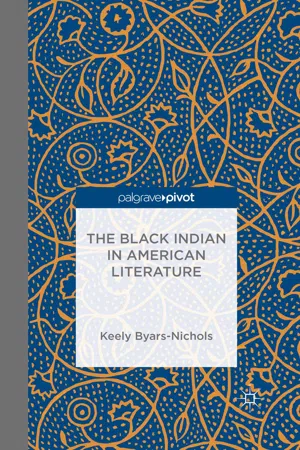
The Black Indian in American Literature
About this book
The first book-length study of the figure of the black Indian in American Literature, this project explores themes of nation, culture, and performativity. Moving from the Post-Independence period to the Contemporary era, Byars-Nichols re-centers a marginalized group challenges stereotypes and conventional ways of thinking about race and culture.
Information
Topic
LiteraturSubtopic
Nordamerikanische Geschichte1
Assuming the Habit of the Country: John Marrant’s Narrative and Playing Indian
Abstract: African American evangelist John Marrant’s Narrative details his conversion to Christianity, captivity by the Cherokee, and his subsequent spiritual, and cultural transformation. Marrant eventually choose to stay among the Cherokee as missionary, and comes to live, dress, act and talk like a true member of the tribe. His Narrative was one of the most popular captivity narratives in America at the time of publication (1785), but lapsed into obscurity by 1835. His dramatic and dual transformations make this narrative unique among other captivity narratives. At once passing and playing Indian, Marrant challenges eighteenth-century notions of what it means to look and act like an Indian, and what it means to look and act like an African American. The interplay between Native and African American in the character of Marrant in his Narrative also points to the symbolic intermixture that occurs between these two groups in a newly-formed American nation.
Keely Byars-Nichols. The Black Indian in American Literature. New York: Palgrave Macmillan, 2014. DOI: 10.1057/9781137389183.
John Marrant (1755–1791) was an African American evangelist and missionary, who published in his lifetime both his missionary journals and a narrative of his religious conversion and captivity by a tribe of Cherokee.1 Marrant was born into a free black family in New York, and around the age of six the family moved to Georgia—possibly due to the colony’s encouragement of free blacks to move south in order to “help stave off hostile incursions of neighboring Native American tribes” (Potkay and Burr 67, 98).2 The family eventually settled in South Carolina, near Charleston (67). Briefly, A Narrative of the Lord’s Wonderful Dealings with John Marrant, a Black (Now Going to Nova-Scotia) Born in New-York, in North-America (1785) recounts his adolescence, Christian conversion, and incidents of conversion he fostered and witnessed in others. As described in his narrative, Marrant experiences a religious conversion to Christianity, befriends and then is held captive by the Cherokee, converts the tribe to Christianity, then lives among them for two years, proselytizing to Cherokee, Creek, Choctaw, and Chickasaw tribes, before returning to his family in the middle of 1772 (Marrant; Potkay and Burr 67–70). He returns home to his family, spiritually transformed and visually changed, dressed completely in the attire of the Cherokee. He then works as a minister in Charleston, alongside slaves at the Jenkins Plantation (1772–1775), and is impressed by the British army to fight in the Dutch-Anglo War in 1781 (Potkay and Burr 67–70). He travels to London and is ordained by a Methodist evangelical group in 1785, just before his arrival in Nova Scotia (67–70). The events of John Marrant’s life, some described in his Narrative and some pieced together by scholars, paint a compelling image of a character engaged in multicultural and multinational exchanges and relationships, the most interesting and historically unique event being his time spent among the Cherokee. His description of the experience among the Cherokee reflects popular notions about American identity during the eighteenth century. The process through which Marrant comes into contact with the Cherokee and uses the Cherokee language and dress to signify his full conversion demonstrates the power of costume and masking. Through a close reading of the text, I will show how Marrant moves through the Cherokee community he creates in his Narrative, the extent to which he forges a transformed and liberated self/character, and the extent to which he lapses into exoticization and mere passing. In his narrative construction of his own identity, Marrant negotiates, redefines, and often obscures the lines between Native and African American.
Marrant’s religious and conversion experiences reach beyond eighteenth-century American confines of rationality. As stated earlier, he suffered ostracization from family and neighbors after his initial conversion to Christianity, and was rendered unrecognizable by his family after his time spent among the Cherokee (Montgomery 109–110). The descriptions Marrant gives of his conversion are outside the conventional (white) confines of acceptable modes of communion with God and are perhaps more in keeping with African and Native American traditions. In American Lazarus: Religion and the Rise of African-American and Native American Literatures (2003), Joanna Brooks argues that the American evangelical movement, of which Marrant was a part, provided a space for African Americans and Native Americans to “recycle and bind together” indigenous and African religious symbols and practices (10). In his first religious experience, Marrant was “[s]truck to the ground, and lay both speechless and senseless for near half an hour” (78). In Marrant’s Journal, there are similar descriptions of the African, African American, and Native American congregation he later led at Birchtown, Nova Scotia:
Those who were not struck down by the spirit were elevated and invigorated beyond the natural reach of sleep. Marrant frequently reports that worshippers stayed up until four and five in the morning, singing hymns, exclaiming praises, but refusing to return to their homes . . . Marrant’s report from Nova Scotia corroborates others from America and the Caribbean in documenting visions, trances, shouts, and “falling out” as elements of black worship. (111)
Both Marrant’s description of his conversion and the conversions of members of his congregation deal with such profound and dramatic scenes. Marrant’s conversion is so absolute that he at once refuses to continue to play the violin, even upon his sister’s urging. His sister calls him “crazy” and tells all their neighbors as much, “which opened the mouths of all around against [him]” (Marrant 80). Thus he resolves to leave his sister’s house (who was his guardian) for Charleston to see his mother. At his mother’s house, the family begins supper without asking blessing, which Marrant objects to because it offends his so profoundly. He recounts that they then
called me every name but that which was good. The more they persecuted me, the stronger I grow in grace. At length my mother turned against me also, and the neighbors joined her and there was not a friend to assist me, or that I could speak to; this made me earnest with God. (80)
In the face of such adversity and opposition, Marrant grows stronger in his belief and resolve. His self-imposed status as outcast and outsider ultimately leads him to a position of great power and enlightenment in the narrative. In the tradition of the slave, captivity, and conversion narratives, Marrant faces great hardship as a necessary obstacle on his path to self-discovery.3
Finding no fellowship among his family or community, John Marrant recalls that at age 14, one morning
I took up a small pocket bible [sic] and one of Dr. Watt’s hymn books, and passing by them went out without one word spoken by any of us. After spending some time in the fields, I was persuaded to go from home altogether. Accordingly, I went over the fence, about half a mile from our house, which divided the inhabited and cultivated parts of the country from the wilderness . . . [A]bout evening I began to be surrounded by wolves. (81)
After four days without food and only a little water, he devours deer-grass and, declaring it the “best meal” he’d ever had, eats it “like a horse” (81–82). Then, he prays for water and is directed to a puddle of muddy water “some wild pigs had just left” (81–82). Abandoning the “civilized” rules of behavior, Marrant more intimately connects with God’s will and grace and finds that he will be provided for among wolves and other “wild beasts of the forest” better than he is among non-believers (82). Karen Chandler states that such descriptions of this part of Marrant’s journey demonstrate how his narrative “implicitly faults” black southern society for its incapacity to foster his autonomy: “The God Marrant has discovered encourages his spiritual, psychical, and social freedom and empowerment” (29). Also implicitly at fault is southern white society. Even though he was free, he lived in a racist society that often sought to limit his personal and civic freedom; in eighteenth-century South Carolina many free blacks were forced to leave the state (25, 31). Such conditions may also have contributed to Marrant’s decision to leave “civilization” for the wilderness (my quotations; 31).
In the “wilderness” he comes upon an “Indian hunter” (Marrant 82). The hunter, who stood at first behind a tree, “bolted out and put his hands on my breast, which surprised [Marrant] a few moments” (82). The Cherokee man’s ambush of Marrant recalls attacks by Native of whites in more conventional captivity narratives. However, Marrant’s break with tradition is never more evident than here, as the man actually shows himself as a true guardian and teacher for the young black man. Apparently confused by Marrant’s solitary walk in the woods and by overhearing him in conversation with God, the Cherokee man asks Marrant where he is going and to whom he is talking (82). The man is surprised, but views Marrant’s “beliefs neither ‘crazy’ nor ‘mad’ but consistent with [his] own sense of divine immanence” (Montgomery 110). Marrant’s close communion with the divine surprises the Cherokee man, though such connection is in some ways not foreign to Native ideologies.4
Acting as an older guardian and showing himself as a neighbor, the man reveals that he knows Marrant’s family, and offers to take him back home (Marrant 82). When Marrant refuses, he says he can stay with him if he agrees to help with the hunt (82). As an act of cultural and familial adoption, the Cherokee hunter allows the boy to stay with him in the woods for ten weeks, during which time their tasks are “killing deer, and taking off skins by day, which we afterwards hung on trees to dry till they were sent for; the means of defense and security against our nocturnal enemies always took up the evenings” (83). As a team united against newly common enemies of the forests, they
collected a number of large bushes, and placed them nearly in circular form, which united at the extremity, afforded [them] both verdant covering, and a sufficient shelter from the night dews . . . and this was [their] defense from the dreadful animals, whose whining eyes and tremendous roar [they] often saw and heard during the night. (83)
Unlike other captivity narratives like Rowlandson’s or conversion narratives like Equiano’s (upon which Marrant’s tale is modeled), the descriptions of his relationship with this man do not depict a solitary triumph over hardship or a singular recognition of one’s own strength and courage. Rather, Marrant’s descriptions here reflect common strivings—the work of one man and one boy, racially, visually different, but perhaps united by their belief in the power of nature and of divine providence.
One of the most significant steps Marrant takes in his assumption of Cherokee identity is his acquisition of the Cherokee language. In his meeting and travels with the Cherokee hunter, Marrant “emphasizes not the tension between them, but their comradeship and his acculturation to the hunter’s way of life. Marrant conveys his union with the hunter by repeating the words ‘we’ and ‘our,’ thereby departing from a linguistic tendency to stress his singularity” (Chandler 31). And Marrant’s knowledge of his language is an essential part of this union. He describes, “By constant conversation with the hunter, I acquired a fuller knowledge of the Indian tongue: This, together with the sweet communion I enjoyed with God, I have since considered as a preparation for the great trial I was soon after the pass through” (Marrant 83). Celia Naylor-Ojurongbe’s discussion of Works Progress Administration interviews of former slaves of mixed African American and Native American descent proves useful here to examine the two men’s discussion of language. Naylor-Ojurongbe writes, “Ex-slaves’ abilities to communicate in Native languages symbolize an additional dimension of acculturation. Although representing a discernible marker of cultural identity, the use of language is not one limited to communication solely; language also embodies other aspects of culture, namely mores, values, oral history, and tradition” (169). Thus, Marrant uses his knowledge of the Cherokee language to gain knowledge of another culture and thereby trust. In this partnership, Marrant “acquires more control over his situation in the wild” and in his knowledge of the Cherokee language, a skill which will help “to enhance his standing among hostile Cherokees” (Chandler 31–32).
The young John Marrant and the man leave the woods at the end of their hunting season, to return to the Cherokee Nation (Marrant 84). At the entrance of the fortified town, the man assures Marrant that since he was with him, “nobody would interrupt [him]” (84). However, upon meeting the guards of the “Indian fortification” Marrant was “surrounded by about fifty men, and carried to one of their principal chiefs and Judge to be examined by him” (84). When he explained that he came with the hunter, the Judge declared his answer insufficient and sentenced him to death.5
When the judge heard Marrant speaking in Cherokee, he asked where he had learned it and who his Lord Jesus was, but Marrant just continued praying for his life (Marrant 84). At this time, his behavior is dismissed just as it was by his family—as the ramblings of an irrational person. Awaiting his execution in a “dreary and dismal . . . dungeon” he prays and the space becomes his “chapel” where the Lord is with him (84). His planned execution is to be exceptionally cruel. Marrant relays the process:
I was to be stripped naked and laid down on one side by the basket [of turpentine wood, stuck full of small pieces like skewers], and these sharp pegs were to be stuck into me, and then set on fire, and when they had burnt to my body, I was to be turned on the other side, and served in the same manner, and then to be taken by four men and thrown into the flame, which was to finish the execution. (84–85)
Potkay and Burr note that this type of execution is unique to practices of the Iroquois, not Cherokee, and appears throughout captivity narratives (100). We can only assume then that this part of the account is intended to comply with the genre of the captivity narrative, and make his captors seem more savage before their conversion. The dramatic convention works, when out of sheer terror, Marrant begins again to pray aloud:
[T]he Lord impressed a strong desire in [him] to turn to their language, and pray in their tongue . . . which wonderfully affected the people . . . I believe the executioner was savingly converted to God. He rose from his knees and, and embracing me around the middle was unable to speak for about five minutes; the first words he expressed, when he had utterance, were, “No man shall hurt thee till thou hast been to the king.” (Marrant 85)
Thus begins Marrant’s career as preacher to the Native Americans of the southern United States. Among the Cherokee “Marrant transcends the sense of powerlessness that he felt in white society and with his family” (Chandler 33). With this executioner as his first convert, Marrant is taken to the king, to whom he explains that his God made all people and heaven and earth; the king refuses to believe Marrant’s claim (Marrant 86). Marrant explains, “I then pointed to the sun, and asked him who made the sun, and moon, and stars, and preserved them in their regular order; He said there was a man in their town that did it” (86). The king, apparently unimpressed, insists on enforcing the sentence the next day. That night, as Marrant prays in his cell with the king’s daughter and the Cherokee convert,
the Lord appeared most lovely and glorious; the king himself was awakened and the others set at liberty. A great change took place among the people; the kings’ house became God’s house; the soldiers were ordered away, and the poor condemned prisoner had perfect liberty, and was treated like a prince . . . I remained nine weeks in the king’s palace. Praising God day and night . . . I had assumed the habit of the country, and was dressed much like the king, and nothing was too good for me. The king would take off his golden ornaments, his chain and bracelets, like a child, if I objected to them, and lay them aside. Here I learned to speak their tongue in the highest stile [sic]. (87)
Among the Cherokee, Marrant’s God grants him more power than he was ever allowed in his black community (Chandler 32). Marrant uses his knowledge of the language and his deep understanding of a more intimate and visceral communion with God to connect to and convert this Cherokee community to Christianity.
However, as Chandler points out, “Marrant does not simply act as a representative of white colonial culture and attempt to indoctrinate the Cherokees to its standard. He chooses to stay among the Cherokee for several months, presumably benefiting from a spirit of reciprocity that he has not portrayed in his family or the larger colonial society” (34). Marrant next decides to travel, with the companionsh...
Table of contents
- Cover
- Title
- Introduction: Within Our Bosom and on Our Borders: Negotiating Shared Black and Native Histories
- 1 Assuming the Habit of the Country: John Marrants Narrative and Playing Indian
- 2 Domesticated Savagery: Blackness and Indigeneity in Herman Melvilles Moby-Dick and Elizabeth Stoddards Temple House
- 3 On Precarious Footing: William Faulkners Sam Fathers and the Specter of Slavery
- 4 Black Nationalism and Native Separatism Unhinged: Toni Morrisons Song of Solomon
- 5 The First Black Indian: Clinton in Leslie Marmon Silkos Almanac of the Dead
- Conclusion: Toward a Black Indian Poetics and Politics
- References
- Index
Trusted by 375,005 students
Access to over 1.5 million titles for a fair monthly price.
Study more efficiently using our study tools.
Frequently asked questions
Yes, you can cancel anytime from the Subscription tab in your account settings on the Perlego website. Your subscription will stay active until the end of your current billing period. Learn how to cancel your subscription
No, books cannot be downloaded as external files, such as PDFs, for use outside of Perlego. However, you can download books within the Perlego app for offline reading on mobile or tablet. Learn how to download books offline
Perlego offers two plans: Essential and Complete
- Essential is ideal for learners and professionals who enjoy exploring a wide range of subjects. Access the Essential Library with 800,000+ trusted titles and best-sellers across business, personal growth, and the humanities. Includes unlimited reading time and Standard Read Aloud voice.
- Complete: Perfect for advanced learners and researchers needing full, unrestricted access. Unlock 1.5M+ books across hundreds of subjects, including academic and specialized titles. The Complete Plan also includes advanced features like Premium Read Aloud and Research Assistant.
We are an online textbook subscription service, where you can get access to an entire online library for less than the price of a single book per month. With over 1.5 million books across 990+ topics, we’ve got you covered! Learn about our mission
Look out for the read-aloud symbol on your next book to see if you can listen to it. The read-aloud tool reads text aloud for you, highlighting the text as it is being read. You can pause it, speed it up and slow it down. Learn more about Read Aloud
Yes! You can use the Perlego app on both iOS and Android devices to read anytime, anywhere — even offline. Perfect for commutes or when you’re on the go.
Please note we cannot support devices running on iOS 13 and Android 7 or earlier. Learn more about using the app
Please note we cannot support devices running on iOS 13 and Android 7 or earlier. Learn more about using the app
Yes, you can access The Black Indian in American Literature by K. Byars-Nichols in PDF and/or ePUB format, as well as other popular books in Literatur & Nordamerikanische Geschichte. We have over 1.5 million books available in our catalogue for you to explore.