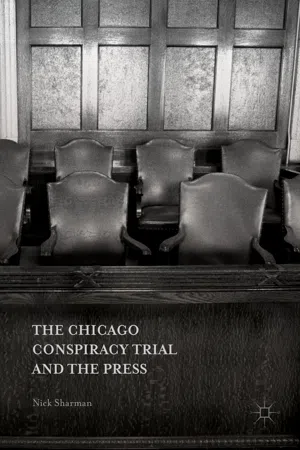
This book analyzes the newspaper coverage of one of America's most famous and dramatic trials–the trial of the "Chicago 8." Covering a five month period from September 1969 to February 1970 the book considers the way eight radical activists including Black Panther leader Bobby Seale, antiwar activists Tom Hayden, David Dellinger, and Rennie Davis, and leading Yippies, Abbie Hoffman and Jerry Rubin are represented in the press. How did the New York Times represent Judge Hoffman's decision to chain and gag Bobby Seale in the courtroom for demanding his right to represent himself? To what extent did the press adequately describe the injustice visited on the defendants in the trial by the presiding Judge, Julius J Hoffman? The author aims to answer these questions and demonstrate the press's reluctance to criticize Judge Hoffman in the case until the evidence of his misconduct of the trial became overwhelming.
- English
- ePUB (mobile friendly)
- Available on iOS & Android
eBook - ePub
The Chicago Conspiracy Trial and the Press
About this book
Information
© The Editor(s) (if applicable) and The Author(s) 2016
Nick SharmanThe Chicago Conspiracy Trial and the Press10.1057/978-1-137-55938-8_11. Introduction
Nick Sharman1
(1)
University of Melbourne, Melbourne, Victoria, Australia
On September 24, 1969, eight men went on trial in the Chicago courtroom of Judge Julius J. Hoffman. The eight men were charged under Title 18 of the Civil Rights Act of 1968, Sections 371, 231 (a) and 2101. The two key charges were that first during the Democratic National Convention held in Chicago in August 1968 they had conspired to come to Chicago for the purpose of inciting a riot. Second, during their time in Chicago they had also committed at least one deliberate act designed to incite a riot among the demonstrators at the convention. Two of the defendants, Lee Weiner and John Froines, were also charged under the act with teaching how to make and use an incendiary device to be used to disrupt the convention.1 Known subsequently as the Chicago conspiracy trial, or colloquially as the trial of the “Chicago 8,” it brought together eight men representing the different strands of the radical movement, which had burgeoned during the 1960s. These defendants included the organizers of some of the main anti-Vietnam war organizations: Tom Hayden, Rennie Davis and David Dellinger, all of whom were leaders in the National Mobilization against the war. They also included two leaders of the Yippies, or Youth International Party, Abbie Hoffman and Jerry Rubin, who sought to bring change to American society by promoting an alternative lifestyle that included the abolition of money, the promotion of art over work, and the legalization of illicit drugs such as marijuana.2 Also included was the leader of the Black Panther Party, Bobby Seale. The Panthers were a militant Black Nationalist organization, which sought the right of blacks to self-determination and control of their community free from what they regarded as the exploitation by white business and civic authority.3 Of the eight, the less-high profile, defendants were John Froines and Lee Weiner, who were both involved in the antiwar movement and had protested at the convention.
The Democratic Convention in Chicago had been a highly charged and conflict-ridden political event. Groups of demonstrators had sought permits to march and sleep in the parks during the convention to protest against the Vietnam War and to express the values of an alternative lifestyle. Chicago authorities denied them permits, and this meant nightly raids by police into the parks to enforce curfews and constant pursuit of protesters, who were said by the police to be demonstrating illegally in Chicago.4 When the dust had settled from the violent clashes, broadcast nightly on national news services throughout the country, the time came to apportion blame for what had happened in Chicago. The Walker Commission set up by the government to inquire into the events in Chicago concluded that most of the violence that occurred was perpetrated on the demonstrators by the police in what the report described as a “police riot.”5
Richard J. Daley, mayor of the city of Chicago, had other ideas about who was responsible for the breakdown of law and order, which had tarnished the image of his city during the Chicago Democratic Convention. In association with the newly appointed Nixon Administration Attorney General, John Mitchell, and US District Attorney for Chicago, Thomas Foran, a grand jury was convened, and the eight defendants were charged under the civil rights statute with conspiring and acting to incite a riot.6
The celebrity status of the movement leaders who made up the bulk of the defendants in the case meant that the trial received significant media coverage throughout the case. This coverage was only heightened by the large number of major incidents that occurred in the trial, including the arrest of four defense lawyers by the judge on the first day of the case and the chaining and gagging of defendant Bobby Seale by Judge Hoffman.
Despite the extensive media coverage and the significance of media reporting in shaping the memory of the case, scant attention has been paid in the scholarly literature to an analysis of the media coverage of the trial. An exception is Juliet Dee’s article, which is the only academic article which significantly analyses the media’s reporting of the case.7 Dee highlights the difficulties that the defendants had in getting their message across through the media, yet her article’s relative brevity and the fact that it discusses a wide range of journals’ reporting on the case means that there is much still to be said on the media coverage of the trial.
There has been a lack of academic attention devoted to the media reporting of trials generally. As Claire Wardle notes, “the ways in which the criminal justice issues are shaped in the media is an important topic, but one that has been under-studied in the field of communication.”8 Wardle goes on to note that there has “been less analysis of newspaper coverage of trial courts” in the literature than even the space devoted to criminal justice issues generally.9 A further limitation, which Wardle notes, is the lack of comparison between the media coverage and the trial record of the case.10
This study thus fills a gap in the literature on the media reporting of criminal proceedings, focusing on the Chicago conspiracy trial. It also seeks to compare, where appropriate, the media coverage of the trial with the substantial trial record that exists as the official version of what occurred in the case.
There is another significant issue in the media reporting of trials, which has drawn attention in the literature. This issue, raised by Fox, Van Sickel and Steiger, and Wardle, is the tendency of media reporting of trials to ignore the substantive legal and other issues raised by controversial and high-profile cases.11 This literature suggests that sensational reporting focusing on personalities and a simplistic framing of issues dominates the media representation of important trials. This study considers the extent to which the media coverage of the Chicago conspiracy trial reported on and acknowledged the substantive questions about the American justice system that the case raised.
Although other newspapers are considered as a point of comparison, the focus of this study is on the New York Times’ coverage of the Chicago conspiracy trial. The New York Times occupies an exalted place in the American media landscape, and in all major surveys of the quality and influence of newspapers, the New York Times tops the rankings.12 As Friel and Falk note, the “self-proclaimed goal of the Times is to provide readers with ‘all the news that’s fit to print.’”13 The paper is also seen as, and aspires to be, “the paper of record,” the voice of what is occurring in society.14 It also has a significant influence in shaping both the media agenda as well as the views of influential people within American society. Friel and Falk critically analyze the New York Times’ coverage of foreign policy and the limitations of this coverage. They state the New York Times
Occupies such an exalted place in the political and moral imagination of influential Americans and others as the most authoritative source of information and guidance on issues of public policy. It is on this basis that the Times has acquired its special status as the newspaper of record [my italics] in the United States, a trusted media source that supposedly is dedicated to truthfulness and objectivity regardless of political consequences.15
Given the significant place which the New York Times occupied in American journalism and the respect granted to its reportage, it is the most appropriate vehicle for an analysis of the way the media represented an event such as the Chicago conspiracy trial involving high-profile, politically active defendants. The book considers the fundamental issue of what the New York Times did when faced with evidence of apparent egregious misbehavior by a judge, which did not fit its worldview, and that of its readership, of the sanctity and authority of the US federal court. Evidence of this judicial malfeasance is amply provided by the trial record and the court of appeal’s subsequent judgment on the jury trial.16 When the judicial system was faced with a challenge to its legitimacy as a result of the conduct of Judge Hoffman in the case, how did the paper respond? The challenge was amplified by the attacks on the authority of major American institutions, which were occurring in the late 1960s, particularly over the question of the legitimacy of American conduct in Vietnam.17 Consistent with the suggestion of Wardle and Fox et al., this study argues that the New York Times did not take the opportunity to explore questions of the broader significance for the judicial system of Judge Hoffman’s conduct of the case.18
This study demonstrates that when faced with significant evidence of judicial misbehavior the New York Times sought to manage what was perceived to be a crisis. In the early phases of the trial the paper’s reporting sought to minimize criticism of the judge’s actions. It did this in part by framing the case in terms of the conflict between the two sides in the trial and suggesting that both were equally blameworthy for the disruption that was occurring. On occasions, such as the judge’s decision to chain and gag the Black Panther leader Bobby Seale, the New York Times justified the judge’s decision to forcefully restrain the Panther leader in terms of the deliberately disruptive conduct of the black defendant and his other coaccused. As the trial progressed, following Seale’s incarceration and his later severing from the case, the New York Times’ coverage of the trial changed. Although the paper was reluctant to give voice to the defendants’ views on the case, except when they were expressed in a humorous way with the evidence of Abbie Hoffman, the paper became more critical of Judge Hoffman’s conduct of the case. This study makes a significant original contribution to the literature on the media coverage of the trial by identifying a turning point in the New York Times’ coverage of the Chicago conspiracy trial. This turning point in the paper’s coverage occurred with the exclusion of Attorney General Ramsey Clark from the witness stand. Clark’s standing as a leading figure in the liberal establishment gave the New York Times license for the first time to criticize openly Judge Hoffman’s rulings in the case. Although for the rest of the trial the New York Times overtly criticized the partiality of Judge Hoffman’s rulings in the case, it continued to blame the defendants equally for the “farce” which the paper believed the trial had become. As a way of legitimizing the operation of the judicial system in the face of the evidence of its partiality displayed in Judge Hoffman’s courtroom, editorially, at the end of the case, the New York Times privileged the role of the higher appeal courts. The paper editorialized that these courts would protect the defendants’ rights and overturn any unjust rulings by Judg...
Table of contents
- Cover
- Frontmatter
- 1. Introduction
- 2. “My Wishes Are That a Lawyer Respect the Court”: Initial Representation of the Trial and the Lawyers’ Arrest
- 3. “The Orderly Administration of Justice”: The Chaining and Gagging of Defendant Bobby Seale
- 4. “The Use of Vile and Insulting Language”: The Voice of White Radicals
- 5. “You Are a Disgrace, Sir, I Say You Are a Disgrace, I Really Say You Are a Disgrace”: The Voice of Antiwar: Rennie Davis
- 6. “The Exclusion of Authority”: Ramsey Clark’s Muted Evidence
- 7. The Summation on the Conclusion of the Chicago Conspiracy Trial
- 8. Conclusion
- Backmatter
Trusted by 375,005 students
Access to over 1.5 million titles for a fair monthly price.
Study more efficiently using our study tools.
Frequently asked questions
Yes, you can cancel anytime from the Subscription tab in your account settings on the Perlego website. Your subscription will stay active until the end of your current billing period. Learn how to cancel your subscription
No, books cannot be downloaded as external files, such as PDFs, for use outside of Perlego. However, you can download books within the Perlego app for offline reading on mobile or tablet. Learn how to download books offline
Perlego offers two plans: Essential and Complete
- Essential is ideal for learners and professionals who enjoy exploring a wide range of subjects. Access the Essential Library with 800,000+ trusted titles and best-sellers across business, personal growth, and the humanities. Includes unlimited reading time and Standard Read Aloud voice.
- Complete: Perfect for advanced learners and researchers needing full, unrestricted access. Unlock 1.5M+ books across hundreds of subjects, including academic and specialized titles. The Complete Plan also includes advanced features like Premium Read Aloud and Research Assistant.
We are an online textbook subscription service, where you can get access to an entire online library for less than the price of a single book per month. With over 1.5 million books across 990+ topics, we’ve got you covered! Learn about our mission
Look out for the read-aloud symbol on your next book to see if you can listen to it. The read-aloud tool reads text aloud for you, highlighting the text as it is being read. You can pause it, speed it up and slow it down. Learn more about Read Aloud
Yes! You can use the Perlego app on both iOS and Android devices to read anytime, anywhere — even offline. Perfect for commutes or when you’re on the go.
Please note we cannot support devices running on iOS 13 and Android 7 or earlier. Learn more about using the app
Please note we cannot support devices running on iOS 13 and Android 7 or earlier. Learn more about using the app
Yes, you can access The Chicago Conspiracy Trial and the Press by Nick Sharman in PDF and/or ePUB format, as well as other popular books in Politics & International Relations & American Government. We have over 1.5 million books available in our catalogue for you to explore.