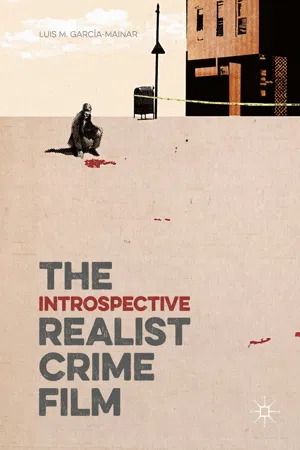
This book explores the formal and thematic conventions of crime film, the contexts in which these have flourished and their links with the social issues of a globalized world. The crime film has traditionally been identified with suspense, a heterogeneous aesthetic and a tacit social mind. However, a good number of the crime films produced since the early 2000s have shifted their focus from action or suspense and towards melodrama in narratives that highlight the social dimension of crime, intensify their realist aesthetics and dwell on subjectivity. With the 1940s wave of Hollywood semi-documentary crime films and 1970s generic revisionism as antecedents, these crime films find inspiration in Hollywood cinema and constitute a transnational trend. With a close look at Steven Soderbergh's Traffic (2000), David Fincher's Zodiac (2007), Jacques Audiard's Un prophète (2009) and Tomas Alfredson's Tinker Tailor Soldier Spy (2011), this book sets out the stylistic and thematic conventions, contexts and cultural significance of a new transnational trend in crime film.
- English
- ePUB (mobile friendly)
- Available on iOS & Android
eBook - ePub
The Introspective Realist Crime Film
About this book
Information
Subtopic
Film & Video© The Editor(s) (if applicable) and The Author(s) 2016
Luis M. García-MainarThe Introspective Realist Crime Film10.1057/978-1-137-49653-9_11. Introduction
Luis M. García-Mainar1
(1)
Facultad de Filosofía y Letras, Universidad de Zaragoza, Zaragoza, Spain
Bill Condon’s Mr. Holmes, a 2015 British and US production, follows the daily life of retired Sherlock Holmes (Ian McKellen), who at 93 lives tormented by his past. He decides to write about his last case, which prompted him to abandon his activity as a detective, although a failing memory does not let him recall the exact details of the case or the reasons for his decision. With the help and company of his housekeeper’s son, Roger (Milo Parker), Holmes eventually manages to remember the case of Ann Kelmot (Hattie Morahan), whose suicide he failed to prevent and for whose death he has unconsciously kept blaming himself. Through these memories and shared time with Roger, Holmes realizes that his life as a detective had taught him to privilege intellect and reason over feelings and affection, and that emotion is more truthful than reason, that it is closer to the mysteries of life than pure logic may ever be. The film, based on Mitch Cullin’s novel A Slight Trick of the Mind (2005), illustrates the turn taken by some crime films in the last decade and a half, as they have chosen to divest crime genres of their quasi-mythical overtones, dwelling instead on realist accounts of everyday lives touched by crime where personal experience and emotion take centre stage. Since the early 2000s a significant number of the Hollywood and international films that have deployed the conventions of the crime film have shifted their focus away from the expected action or suspense and onto the characters’ personal, emotional experience of crime. This book will explore the formal and thematic conventions of this generic trend, the contexts in which it has flourished, and its links with the social issues of a globalized world. These new crime films are more interested than their predecessors in the social dimension of their stories, as they offer detailed accounts of their social contexts and claim authenticity by evoking true events or historical circumstances. They show even more interest in expressing it through the characters’ complex subjectivity, heightened by means of an aesthetic of pathos and realism that combines with recurrent visual and narrative choices. Traditionally, the margins of crime films have contained scenarios of oppression and helpless characters, but these have become the main content of many crime films today. Since these new crime films are defined by their realism and boosted subjectivity I propose that they be called introspective realist crime films.
The social content of the crime film has been noted in many a definition of the genre, its presence argued even in literary antecedents of the Sherlock Holmes type. G. K. Chesterton defined the detective story for its transformation of everyday life into the marvellous realm of adventure, a response to modernity which was perceived as no longer thrilling (Rubin 1999, pp. 14–15). Modernity would also be responsible for the thriller’s two key conventions, a usually male hero and a conspiracy set up against him, which reflected the rise of competitive individualism in the labour market caused by the industrialization of England during the nineteenth century (Palmer 1979, pp. 153–80). In the late 1960s, Ralph Harper understood the thriller as a simulation of existentialism in which the hero faced the chaos and absurdity of the modern world (Rubin 1999, pp. 10–11); Back (1994) would later posit the genre as a symptom of the dissolution of the self, only alleviated by firmly established conventions that in restoring a disrupted equilibrium would manage to reassure the individual. From Robert Warshow’s (1948) classic discussion of the gangster film as enacting the contradiction between the two fundamentally US beliefs of capitalism and democracy (Warshow 2001 [1948]), to Ernest Mandel’s (1984) reading of crime fiction as naturalizing a bourgeois social order, social perspectives on crime culture have stressed its capacity to express the citizens’ ambivalence about the law and the state. More recent assessments of the crime film have continued in this line, viewing the genre as a cultural space for the expression of hostility toward authority while simultaneously promoting systems of social control (Rafter 2006 [2000], pp. 153–4), or as an anachronistic form with the curatorial function of representing both social change and resistance to it (Rubin 1999, p. 266). According to Thomas Leitch (2002, pp. 1–17), the central problem that defines the crime film is its attempt to challenge the status of the law by setting clear-cut positions regarding it—the perpetrator, the victim and the avenger—and then showing their fluid nature, how for example perpetrators become victims in the gangster film or avengers become perpetrators in many police films. The crime film relies on social ambivalence about the law since its cultural pleasure is produced by entertaining ways in which it can be broken.
In broad terms, crime acts as a metaphorical expression of personal initiative, and thus the crime film stands as a narrative that expresses the conflict between personal initiative and social organization by following the lives of the participants in crime: criminals, victims and agents of the law. This cultural significance of crime has persisted not only in those films that openly share the conventions of the genre but generally in those films that use unlawful activity as narrative motif. For example, Woody Allen’s Irrational Man (2015) employs crime to indicate the possibility that intervention in reality may lead the main character, Abe (Joaquin Phoenix), to recover his engagement with reality. A philosophy professor who has lost all interest in life, Abe believes that he would regain it if he managed to prove his capacity to influence a world of rampant injustice. He will then decide to help a woman whose conversation he overhears at a diner by murdering the judge that threatens to take her children into custody. The murder suddenly infuses new life into Abe, who can now enjoy relationships and sex, but also launches him into a spiral of violence that will eventually end with his own death. The film’s choice of crime to propel the narrative illustrates the cultural meaning attributed to crime: it changes life, allows escape from a humdrum existence and disrupts comfortable routine with extraordinary moral dilemmas. Irrational Man exemplifies the pervasiveness of this metaphorical work of crime and thus its cultural relevance.
This brief overview of definitions suggests the variety of terms that studies of both fiction and film have employed in their approaches to the genre. This proliferation of terms is also evident in Film Studies, which has often chosen a narrow focus, be it on the gangster film (Warshow 2001 [1948]; Shadoian 1977; Clarens 1997 [1980]; Munby 1999; Mason 2002; Grieveson et al. 2005; Nochimson 2007), the suspense thriller (Davis 1973; Derry 1988), the detective film (Effron 2011; Nicol 2013) or film noir (Borde and Chaumeton 1996 [1955]; Schrader 1996 [1972]; Spicer 2002, 2007; Luhr 2012). However, some of these studies have traditionally shown a degree of ambiguity around the limits of the chosen genres, when for example both Jack Shadoian’s Dreams and Dead Ends and Carlos Clarens’ Crime Movies included film noir as part of their discussion of the gangster film, or Colin McArthur’s Underworld USA (1972) set out to analyse the, literally, ‘gangster film/thriller’. These cases have shown the difficulty of attempting to delimit crime film genres that constantly cross their established borders to overlap adjacent territories; thus, film noirs are often centred on detectives or gangsters and also qualify as suspense thrillers, a case that reveals the futility of applying rigid notions of genre, as James Naremore’s (2008 [1998]) study of film noir has exemplified. Since the late 1990s, however, a few books have replaced those narrow genres with broader umbrella terms. Martin Rubin (1999) employed the term thriller, although the most popular one has been crime film, adopted by Nicole Rafter (2006 [2000]), Thomas Leitch (2002), Kirsten Moana Thompson (2007), Sarah Casey Benyahia (2012) or Matthew Sorrento (2012). In this book I have also decided to refer to the broad genre as crime film, a label that would include the more specific areas of the genre, although the choice of a broader term does not necessarily result in an open genre: a broader field can also set its own inflexible limits.
This pitfall can only be avoided by using a notion of genre that is sensitive to the complexity of each genre and to the changes experienced by generic conventions and films historically. This has not been the norm in genre theory, which has tended to think of genres as closed groups of films sharing immutable conventions. That was the case of the first studies, which centred on the iconography of genres (Alloway 1963; Buscombe 1995 [1970]), of the aesthetic theories that stressed repetition of common traits (Altman 1984), and of those approaches that defined genres according to narrative mode (Neale 1980). Even those theories that viewed genres as expression of sociocultural issues (Cawelti 1977 [1976]; Schatz 2012 [1977]) or discussed their ideological intention (Wright 2012 [1974]; Altman 1987) assumed that they amounted to closed groups of films distinguished by common conventions that did not experience much change in time. When generic evolution was accepted and explored, it was considered an intrinsic process through which genres transformed themselves following a purely aesthetic logic not influenced by their historical context (Cawelti 2003 [1979]; Neale 2000). These approaches to genre inevitably met the same problem: they were not applicable to all the members of a genre because films tended to exceed the categories that were used to define them, films were not as stable entities as these notions of genre presumed them to be, and often they changed under the influence of their social and historical context. An intrinsic theory that nevertheless managed to change the course of genre studies, Rick Altman’s Film/Genre (1999) conceived genre as process, endlessly changing according to the needs of the industry, critics and spectators who create and transform them discursively (pp. 49–82). Genres do not therefore have clear borders and are not pure, but have always appeared in combination with other genres as part of the industry’s strategy to maximize box-office appeal (Altman 1999, pp. 123–43).
This open, impermanent concept of genre implicitly relies on a flexible perspective of conventions, groups and categories. Jacques Derrida opened the notion of genre by arguing that all texts are by definition generic because they always invoke patterns of legibility that readers should use to make sense of them. There are no genreless texts and, since these patterns are not mutually exclusive, texts contain signs of more than one genre. Furthermore, texts are not free from genres but genres do not limit texts completely. Genres are not stable and fixed groups of texts but constantly changing patterns that provide a series of recognizable elements that texts use as they like. Thus, texts participate in genres rather than belong to them (Derrida 1980). In a similar vein, Ludwig Wittgenstein had conceived categories not as groups but as chains of connections, and he had used the example of games to illustrate it. Board-games, card-games, ball-games, or Olympic games do not necessarily share any characteristic that is common to them all, but nevertheless similarities and relationships among them create complex networks that make us perceive them as members of the same category. He calls these similarities ‘family resemblances’ because they are like those that exist between members of...
Table of contents
- Cover
- Frontmatter
- 1. Introduction
- 2. The Introspective Realist Crime Film
- 3. The Context of the Introspective Realist Crime Film
- 4. Pictorial Realism and Introspection
- 5. A Documentary Aesthetic of Helplessness
- 6. Postcards of Sympathy from the Periphery
- 7. Complex Narrative and Social Melodrama
- 8. Conclusion
- Backmatter
Trusted by 375,005 students
Access to over 1.5 million titles for a fair monthly price.
Study more efficiently using our study tools.
Frequently asked questions
Yes, you can cancel anytime from the Subscription tab in your account settings on the Perlego website. Your subscription will stay active until the end of your current billing period. Learn how to cancel your subscription
No, books cannot be downloaded as external files, such as PDFs, for use outside of Perlego. However, you can download books within the Perlego app for offline reading on mobile or tablet. Learn how to download books offline
Perlego offers two plans: Essential and Complete
- Essential is ideal for learners and professionals who enjoy exploring a wide range of subjects. Access the Essential Library with 800,000+ trusted titles and best-sellers across business, personal growth, and the humanities. Includes unlimited reading time and Standard Read Aloud voice.
- Complete: Perfect for advanced learners and researchers needing full, unrestricted access. Unlock 1.5M+ books across hundreds of subjects, including academic and specialized titles. The Complete Plan also includes advanced features like Premium Read Aloud and Research Assistant.
We are an online textbook subscription service, where you can get access to an entire online library for less than the price of a single book per month. With over 1.5 million books across 990+ topics, we’ve got you covered! Learn about our mission
Look out for the read-aloud symbol on your next book to see if you can listen to it. The read-aloud tool reads text aloud for you, highlighting the text as it is being read. You can pause it, speed it up and slow it down. Learn more about Read Aloud
Yes! You can use the Perlego app on both iOS and Android devices to read anytime, anywhere — even offline. Perfect for commutes or when you’re on the go.
Please note we cannot support devices running on iOS 13 and Android 7 or earlier. Learn more about using the app
Please note we cannot support devices running on iOS 13 and Android 7 or earlier. Learn more about using the app
Yes, you can access The Introspective Realist Crime Film by Luis M. García-Mainar in PDF and/or ePUB format, as well as other popular books in Media & Performing Arts & Film & Video. We have over 1.5 million books available in our catalogue for you to explore.