eBook - ePub
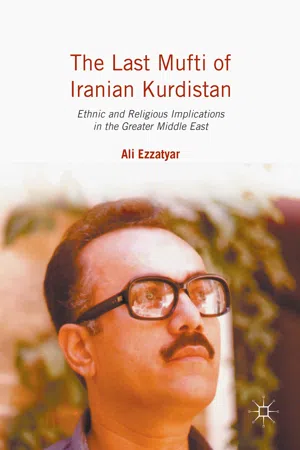
The Last Mufti of Iranian Kurdistan
Ethnic and Religious Implications in the Greater Middle East
- English
- ePUB (mobile friendly)
- Available on iOS & Android
eBook - ePub
The Last Mufti of Iranian Kurdistan
Ethnic and Religious Implications in the Greater Middle East
About this book
Amidst changing notions of religion and identity in the modern Middle East, this book uncovers the hidden story of Ahmad Moftizadeh, the nonviolent religious leader of Iran's Kurds during the Iranian Revolution. The characters of Ayatollah Khomeini and a number of other prominent revolutionaries surface through never before heard first-hand accounts of that era's events. The author further surveys the underlying causes of conflict and extremism today by placing this dramatic biography in the context of a rapidly-evolving region after the First World War. The author's coverage of some of the twentieth century Middle East's most defining events leads him to powerful policy arguments for a region in turmoil.
Information
Part I
© The Author(s) 2016
Ali EzzatyarThe Last Mufti of Iranian Kurdistan10.1057/978-1-137-56324-8_11. Introduction
Ali Ezzatyar1
(1)
Islamabad, Pakistan
Introduction
As this book went to press, the region described as the Middle East was engulfed in flames. And the Kurds were in the midst of their now typical once-a-decade prominence in the Western media. In the 1980s, the Kurds temporarily surfaced in the Western mind as victims of genocide at the hands of Saddam Hussein’s government. In the 1990s, they surfaced as untimely participants in failed uprisings against the Iraqi and Turkish governments. In 2003, they were known the reliable allies in America’s war in Iraq. In each of these cases we learned a bit more about the kurds, but until recently, never a meaningful amount. Now, Kurdish guerrillas are the protagonist in a horror story involving the Islamic State and the potential dissolution of the modern Middle East, with the Syrian and Iraqi nation-states in the throes of war, and virtually all of Kurdistan’s neighbors/home countries in precarious circumstances. While the Kurdish peshmerga are making the news, actively fighting the Islamic State in cities like Kobane and Sinjar, the Kurds are still a secondary actor in the bigger story. Their struggle and their role in the battle of arms and ideas in the Middle East are ancillary to the larger news items of Islamic extremism and American and Russian military involvement in the region.
Despite the relative lack of importance attributed to it by the press, the Kurdish story has an increasingly essential role in all of these larger items. In Turkey, the Kurds are making some progress toward their struggle for recognition, albeit alongside a polarizing Turkish government that is viewed with increased suspicion both at home and abroad. Turkey’s ability to forge a peaceful resolution to the so-called Kurdish Question will go a long way in demonstrating whether Turkey is in fact a model for the Muslim world. At the moment, such notions seem remote. Turkey is renewing a battle with elements of its own Kurdish population domestically as well as with Kurds who are staking out autonomy in Syria, at the world’s expense in its fight against the Islamic State. In Iraq, the Kurdistan Regional Government (KRG) is fully autonomous, having even secured the crown jewel of Kirkuk without fanfare as the Iraqi army withdrew its forces in the summer of 2014 (and further defending it from attacks by the Islamic State at the beginning of 2015). 1 However, there is still no resolution as to what Kurdistan represents in a united Iraq, and this has the potential to unravel nearly three decades of stability there. In Syria, of course, a coalition of Kurds is one of a number of actors fighting for partial control of a now devastated country. Their organization after military success against the Islamic State (with the help of American airstrikes) looks to some like the beginning of a sort of Syrian KRG.
Meanwhile, with almost no coverage in the press, tensions continue to bubble in Iranian Kurdistan. The ongoing assassination and execution of suspected Kurdish militants and sympathizers has exacerbated tensions in the region, and skirmishes with peshmerga forces in Iran (despite the Iranian peshmerga’s participation en masse in the wars across the border) may bring tensions to a boil. 2
While the 40 million or so Kurds are playing a role in virtually all of the region’s most watched conflicts, Kurdistan does not figure prominently in America’s national interest and foreign policy discourse. It should. Regardless of how one views the question of Kurdish self-determination, it is undeniable that the Kurdish question is one that, while integral to every generation of the region’s political development, becomes especially important in this period of turmoil and transition.
The combination of a war-weary American public, the shale oil revolution, and American leadership in the information age that is more focused on domestic political repercussions vis-à-vis foreign policy matters has changed America’s role in the region substantially. America is neither interested in, nor capable of, exerting the influence it once did. 3 This means that each of its allies is increasingly indispensable in helping it influence the tide of events to the extent it seeks to do so. Reliable friends are hard to find, and they have proven to be increasingly difficult to patronize. Iraqi leadership today is arguably closer to Iran than to any other country, despite the considerable American expense and effort there for over a decade. The Egyptian army, one of the largest recipients of US assistance historically, has repeatedly proven itself unswayed by the preferences of Washington. Many other examples of America’s waning influence abound. Countries like Saudi Arabia and Qatar outspend and out-influence America when their existence, and not just their interests, is at stake, and America has had trouble competing in the region of recent with notions of prestige or the threat of economic or military force. 4 It is difficult to counter the idea that not only is the “West” a number of steps behind in reacting to important events in the region, but its actions have often had the continued effect of worsening things, despite its intentions.
The notion growing out of some policy circles in Washington, that America’s preoccupation with the region will be less pronounced going forward due to its increased energy self-sufficiency, is misguided. While it is true that America’s shale oil breakthrough changes fundamental calculations with regard to its energy policy, these advancements by no means immunize it from the region’s instability or make the region less relevant. Even minor blips or disruptions in Iraqi or Saudi oil production can cause massive disruptions to financial markets, for starters.
Most importantly, however, where America’s focus can ebb to some degree as a result of lower energy dependence, the balance of such focus will have to be applied to non-economic factors in the region. The Islamic State of Iraq and the Levant’s (ISIL’s) rise was delegitimized by the Obama administration and the international press as a fluke event owing to the disunity of Iraq, the weakness of the Iraqi army, and the Syrian civil war. Regardless of where the blame lies for the Islamic State’s ascendance, America has failed to recognize the monumental event that its existence represents: For the first time, a non-ethnic Muslim country is born and lives on, with no other clear ideological core than the Islamic fundamentalist extremism that the West has fought so hard to eliminate. So radical that even al-Qaeda has disavowed its messianic ideological construction, this state is attracting young Muslims from the entire world to partake in its project. Erasing ISIL’s nebulous borders through military intervention will not change the gravity of this foregone reality. The West is losing an important war of ideas against Islamic extremism, and its traditional contingency planning in the Middle East is going nowhere.
Complicating matters intensely is the fact that America is off-balance in its desire to destroy the Islamic State, while at the same time supporting and placating Turkey, an important North Atlantic Treaty Organization (NATO) ally and neighbor to the conflict. With respect to battling the Islamic State, President Obama and other US policymakers have insisted that the bulk of this work needs to be done by Muslims in the region. This is the correct instinct. Besides Shia militias aligned with Iran and ultimately uninterested in battling ISIL in the core of IS territory, the only indigenous group that has shown the willingness and facility to target the Islamic State is the Kurds. Meanwhile, Turkey’s main fear is the ascent of those same Kurds and the precedent that this may set for Turkey’s own sizeable Kurdish population. So while the USA has developed a close relationship with Kurdish militias, and has encouraged and supported their war effort, the current Turkish government has made the weakening of those same Kurdish militias its primary national security priority.
For Western policymakers, it is not as simple as throwing more weight behind the Kurds to do the world’s bidding. Even if the Kurds were to be further empowered, their participation in wars outside of the boundaries of “Kurdistan” could actually aggravate matters. The region’s turmoil and the rise of the Islamic State have also reinforced the idea among many Kurds that independence is not only necessary, but increasingly urgent. This adds yet another layer of complexity to supporting them. For America’s foreign policy calculation in the region, this is just one of many intricate factors, each with potential for catastrophe.
So as the Iraqi, Syrian, Yemeni, Egyptian, Libyan (and the list goes on) nations undergo turmoil, transition, and change, several key questions arise. Who will they perceive as allies? Is the anti-Americanism in these places irreversible? What will a permanent Islamic State mean for the broader region and its actors, stretching out to China? What will be the legacy of the Islamic State in the minds of marginalized Muslims for the next 100 years in places like Pakistan and Malaysia, even if the Islamic State is destroyed? Where can America salvage some influence and, at the very least, ensure the safety of its citizens? These will be the defining foreign policy questions of the next decades. In this text, we examine why Kurdistan is essential to addressing all of them.
Notes
- 1.Young, Jeffrey. “Kurdish Peshmerga Force Secures Kirkuk, Its Oil.” VOA. Accessed December 21, 2014.
- 2.“Iranian Kurdish Parties Accuse Tehran of Mass Assassinations.” Rudaw, December 13, 2014. Accessed December 21, 2014. http://rudaw.net/english/middleeast/iran/13122014.
- 3.See generally: Ezzatyar, Ali. “The Case for Kurdistan.” The National Interest, 2014.
- 4.Nordland, Rod. “Saudi Arabia Promises to Aid Egypt’s Regime.” The New York Times, August 21, 2013.
© The Author(s) 2016
Ali EzzatyarThe Last Mufti of Iranian Kurdistan10.1057/978-1-137-56324-8_22. Sunni, Shia, and Kurd: A Brief History of Islamism in Kurdistan
Ali Ezzatyar1
(1)
Islamabad, Pakistan
The tumultuous events that gave rise to modern Kurdish identity generate two important questions. Both relate to “Islamism” in Kurdistan, Islamism being a group’s reference to Islam for political purposes. First, what type of a relationship has the Kurdish population maintained historically vis-à-vis political Islam in Iranian Kurdistan (and Kurdistan generally), and how does this relate to the sentiment of Kurdish nationalism in that same population? Second, given Islam and Islamism’s role in Kurdistan, what type of conclusions can we draw between these sentiments and the development and rise of Islamism in the populations and governments of the sovereign (Turkey, Iran, Iraq, and Syria)?
The history of Islamism in Kurdistan reveals important trends that are valuable in analyzing ongoing events in the broader region today. As we will see, prior to and during the development of pan-Kurdish nationalist ideas and institutions, Islamic identity with a uniquely Kurdish coloring was a vehicle of sorts for unity in Kurdistan. This was primarily a reactive and irredentist process, mostly during the period leading up to and after the collapse of the Ottoman empire. It is on the heels of this environment that our biographical examination takes pace, and thus this warrants further examination.
***
Today’s typical American timeline on Iran tends to commence at the Islamic revolution in 1979. Given that, it is easy to see Iran as a Shia religious monolith, with most other political currents in the country being anti-establishment non-religious ones. Iran is, of course, much more complex politically and religiously. Its religious demography today is the product of much historical change. Zoroastrianism was the first dominant religion of any contiguous “Persian” or “Iranian” region before Iran became primarily Sunni Muslim after the conquest of Islam. Many of Iran’s well-known historical poets and scientists, such as Omar Khayyam and Ibn Sina, were Sunni Muslims. It was not until the Safavid dynasty took control of Iran, nearly a thousand years after Islam was born, that a majority of Iran’s population became Shia. 1 This was mostly the result of forced conversion, a practice which did not fully succeed in reaching the rebellious and far-off Kurdish populations, who remain mostly Sunni today.
The Kurdish population in Iran has maintained a conflictual relationship with Iran’s rulers for centuries. Toward the end of the nineteenth century, Kurdish tribes were forcibly settled and their vestiges of self-government, in the form of semi-autonomous tribal principalities, were undermined by successive “central governments.” Kurds, for their part, never missed an opportunity to claw back lands and control from the central government when the central government’s rule was weaker, usually under a combination of tribal and religious leadership. The role of Islam in this complex array of cultural and ideological identities is a unique one by regional standards. 2
Islam in Kurdistan: To What End?
As a result of its lack of proximity to historic Islamic centers of learning, the heavy influence of mystic and sufi orders, as well as certain elements of Kurdish culture and tradition, the role of Islam in Kurdistan differs significantly from Islam’s role in the rest of the Middle East as well as most of the Muslim world. In Kurdish society today, many Kurds identify as Muslim while at the same time, counterintuitively, disowning any brotherhood or commonalities with their Arab, Persian, or Turkish neighbors. Many seldom attend the mosque and ignore standa...
Table of contents
- Cover
- Frontmatter
- 1. Part I
- 2. Part II
- 3. Part III
- Backmatter
Trusted by 375,005 students
Access to over 1.5 million titles for a fair monthly price.
Study more efficiently using our study tools.
Frequently asked questions
Yes, you can cancel anytime from the Subscription tab in your account settings on the Perlego website. Your subscription will stay active until the end of your current billing period. Learn how to cancel your subscription
No, books cannot be downloaded as external files, such as PDFs, for use outside of Perlego. However, you can download books within the Perlego app for offline reading on mobile or tablet. Learn how to download books offline
Perlego offers two plans: Essential and Complete
- Essential is ideal for learners and professionals who enjoy exploring a wide range of subjects. Access the Essential Library with 800,000+ trusted titles and best-sellers across business, personal growth, and the humanities. Includes unlimited reading time and Standard Read Aloud voice.
- Complete: Perfect for advanced learners and researchers needing full, unrestricted access. Unlock 1.5M+ books across hundreds of subjects, including academic and specialized titles. The Complete Plan also includes advanced features like Premium Read Aloud and Research Assistant.
We are an online textbook subscription service, where you can get access to an entire online library for less than the price of a single book per month. With over 1.5 million books across 990+ topics, we’ve got you covered! Learn about our mission
Look out for the read-aloud symbol on your next book to see if you can listen to it. The read-aloud tool reads text aloud for you, highlighting the text as it is being read. You can pause it, speed it up and slow it down. Learn more about Read Aloud
Yes! You can use the Perlego app on both iOS and Android devices to read anytime, anywhere — even offline. Perfect for commutes or when you’re on the go.
Please note we cannot support devices running on iOS 13 and Android 7 or earlier. Learn more about using the app
Please note we cannot support devices running on iOS 13 and Android 7 or earlier. Learn more about using the app
Yes, you can access The Last Mufti of Iranian Kurdistan by Ali Ezzatyar in PDF and/or ePUB format, as well as other popular books in Politics & International Relations & Middle Eastern History. We have over 1.5 million books available in our catalogue for you to explore.