The concentrations camps that existed in the colonised world at the turn of the 20th Century are a vivid reminder of the atrocities committed by imperial powers on indigenous populations. This study explores British, American and Spanish camp cultures, analysing debates over their legitimacy and current discussions on retributive justice.
eBook - ePub
Restorative Justice, Humanitarian Rhetorics, and Public Memories of Colonial Camp Cultures
- English
- ePUB (mobile friendly)
- Available on iOS & Android
eBook - ePub
Restorative Justice, Humanitarian Rhetorics, and Public Memories of Colonial Camp Cultures
About this book
Information
1
The Biopolitical Usage of Colonial Camp Systems between 1896 and 1908 and the Quest for Restorative Justice
[T]he camp is the most absolute biopolitical space that has ever been realized—a space in which power confronts nothing other than pure biological life without mediation.1
Michel Foucault, Security, Territory, Population
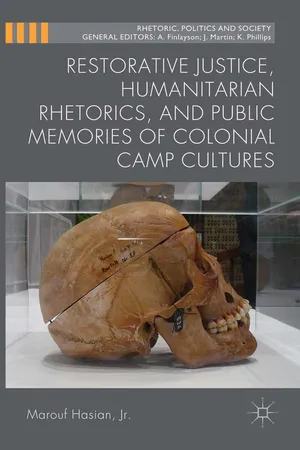
In 2004, a minister from Germany visited Namibia and personally apologized for the colonial-era violence that killed at least 60,000 Herero people who survived the Battle of Waterberg and who were then rounded up and placed in German prisoner of war camps. Seven years later, German medical institutions repatriated Herero and Nama skulls that had been transported from Africa to Germany for anthropological studies in race science. All this happened because today’s Namibia have to deal with some of the imperial and colonial legacies that were bequeathed by those who once lived in a place called German South-West Africa (GSWA).
As Reinhart Kó´ssler explains, the “postcolonial relationships and related intercultural communication” between Namibia and Germany have been marked by “entangled” histories and politics wherein the “negotiation of the past” has meant that diverse groups have advanced “competing claims” regarding the possession of “some truth” regarding what happened in German South-West Africa.2 Some of these exchanges have gotten so heated that conflicting memories of colonial violence have led to the changing of German-named streets and towns in Namibia to help wipe “colonialism off the map.”3 In August of 2013 Patricia Glyn interviewed many of the Khomani bushmen in the Kalahari region and asked them about their remembrances of forgotten camp cultures, and one of them had this to say about the effects of some of these geopolitical changes:
I don’t think a couple of name changes goes far enough, bearing in mind not one of the German concentration camps has so much as a sign and you can still go out in a buggy and find yourself driving over the bones of those who died. There is absolutely no evidence of what really happened there. I don't think the Namibian government is doing one-eighth of what it should to honour the dead. 4
For some, the thanatopolitical5 presence of those old bones of contention from forgotten camps were reminders that too many were willing for forget or forgive.
Glyn’s interviewees need not worry, because a growing number of experts and lay persons have expressed an interest in reviving memories of what happened in the German concentration camps in GSWA during the early 1900s. We live in an era where many national and international communities write and argue about the need for restorative justice, acknowledgment of forgotten colonial misdeeds, apologies for colonial camp abuses, and reparations.6 During the early 1990s, stories about colonial violence in German South-West Africa were resurrected in new calls for colonial redress, and increased public pressure is now being brought to bear as 21st-century governments hear complaints about amnesiac practices. Academic libraries that already had rows of books on various facets of the World War II Holocaust are now having to find room for the public cataloguing of books that now cover the horrors of “colonial genocides.”
The Herero of Namibia are just one among the ethnic groups that refuse to forget about what happened in some of the German concentration camps that were organized in GSWA between 1904 and 1908. Since at least 2001, Herero communities have tried to use American courts and other venues to obtain legal redress for the descendants of those who died or suffered in German colonial camps.7 These efforts may be a harbinger of things to come as other colonial powers are invited to master their own entangled pasts.
For many observers who reflect on the remembrances and amnesias that swirl around what is now called the forgotten Herero “holocaust,”8 what is happening in Namibia is symptomatic of a growing, transglobal phenomenon, where world audiences join movements that advocate the delivery of equitable compensation to former colonies for the abuses that their populations suffered during American, Belgian, British, French, Dutch, Italian, Japanese, Portuguese, or Spanish colonial periods. Many cosmopolitan citizens who grew up reading textbooks about their own “model” colonies now have to watch as journalists and students today write about recovered “lost” colonial archives, famines,9 forgotten massacres, imperial labor abuses, or problematic colonial camp systems. Law firms that specialize in seeking civil redress for aggrieved plaintiffs are hiring historians and others who specialize in “commonwealth,” colonial or imperial research so that they can put together the briefs that make out a prima facie case against some of these former colonial powers. As I will argue throughout this book, documenting the horrors of colonial camps is often considered to be one of the focal points for these types of investigations.
This, obviously, is not the first time that motivated human beings have spent time gathering evidence so that they could accuse some colonizers of having been involved in reprehensive behavior. A British author of the famous Blue Book had this to say after he stitched together a text that was filled with photographs, official administrative records, and testimonials of what purportedly happed in GSWA between 1904 and 1908:
After [General Lothar] von Trotha had left and surrenders were once more possible, the Germans decided to use their prisoners (men and women) as labourers on the harbor works at Lüderitzbucht and Swakopmund, and also on railway construction. . . Probably 60 percent. [sic] of the natives who surrendered after von Trotha left perished this way. True indeed the cold and raw climate of the two port coasts contributed greatly to this huge death-toll. But for this the Germans who placed these naked remnants of starving humanity on the barren islets of Lüderitzbucht and on the moisture-oozing shores of Swakopmund must take the fullest blame and submit to the condemnation of all persons with even an elemental feeling of humanity toward the native races.10
The British South African Blue Book—written decades after these events took place—was a politicized text used to make sure the Germans would never regain their colonial empire after World War I.
The Blue Book was not just a chronicle of German misdeeds during the early 1900s—it also contained a host of rhetorical fragments that would haunt those who sought to forget about the annihilation of the Herero and Nama. During the 1920s, when Afrikaners wanted to join hands with other whites in South Africa and let bygones be bygones, they asked the British to remove from circulation all copies of the Blue Book that had allegedly libeled the German nation. For many, this signaled the substitution of one public memory for another, the prioritizing of racial harmony through the forgetting of the loss of tens of thousands of lives of Herero and Nama. What some 20th-century humanitarians and rival imperialists called an “atrocity” was recontextualized as a propagandizing instrument that was produced by the same generation that signed the Treaty of Versailles.
The British Blue Book is obviously just one of many colonial texts that can be salvaged, dusted off, and deployed again as today’s (post)colonial generations debate about the beneficence or poverty of particular colonial or imperial ventures. Archival and testimonial research is now being gathered for use in public and legal forums where aggrieved parties are demanding that former colonial powers openly acknowledge, apologize, or pay for their past misdeeds. For example, during summer 2013, some 5,000 survivors of British prison camps that were established during the 1950s colonial “emergency” years in Kenya won an out-of-court settlement that compensated former Mau Mau victims who had been castrated, beaten, or tortured during British counter-insurgency operations.11 Their legal victory had been aided immeasurably by the factual materials that came from the books of authors such as Carolyn Elkins and David Anderson; British Foreign Secretary, William Hague, may have given voice to wishful thinking when he argued that this particular “process of reconciliation” would not open the floodgates for other colonial-era claims from other former British colonies.12 As I write these words, former camp detainees, or descendants of those who experienced the ravages of colonial violence in places such as Palestine, Cyprus, and the Caribbean islands, are all starting to marshal together their own arguments that will once again place the spotlight on what I call colonial camp cultures.
Many interdisciplinary memory scholars have pointed out that both our rhetorical histories and our public memories of past misdeeds are often partial, selective, and motivated, and the purpose of this book is to provide readers with a critical genealogical approach that studies the arguments that have been deployed by both defenders and critics of these colonial camp cultures. I compare the synchronic and diachronic arguments that were used by several generations or advocates who debated about several key colonial camp cultures, and I wish to show the repetitive nature of many of these claims. As Richard Reid argued in early 2014, there seems to be a “direct genealogical link” between our generation’s notions of rights, well-being, and development and the older “benign paternalism” that was at the “heart of the imperial mission” a century ago, and all of these tales invite us to think about colonial “horror, hubris, and humanity.”13
Colonial violence during this period was so horrific—where witnesses wrote about the use of artillery, Maxim guns, the burning of entire villages, the shooting on sight of some indigenous peoples, and so forth—that even otherwise objectionable colonial camps could be characterized as places of “refuge.” Devin Pendas explains that many of the colonizers argued that the Hague Conventions conceptualized “military atrocity as essentially a civil law violation” that did not involve any criminal penal sanctions,14 and the military leaders who supervised the first colonial “concentration” camps often claimed that these were temporary facilities that were used to protect the detainees. When these temporary facilities became more permanent—what Italian philosopher Giorgio Agamben would call a legalized state of exception15—then critics learned about the losses of hundreds, thousands, and sometimes even tens of thousands of lives, and the camps were used in humanitarian critiques of colonial violence or imperialism itself.
Although many colonial camp cultures warrant attention, in this particular book I have chosen to focus on some of the ones that have the most rhetoricity—meaning that ones that have captured the attention of international presses during several historical points in time. The four case studies that I cover in this book—reviewing colonial camp systems in Cuba, South Africa, German South-West Africa, and the Philippines—have also become selected because memories of these cases have become ensnared in some of today’s complex memory wars as arguers debate about the politics of regret or monetary compensation for aggrieved parties.
As I write about these four camp systems, I will sometimes cover some of the legal aspects of these camp systems, but most of the time I will be providing readers with a more perspectival, rhetorical study of how both defenders and critics of these camps talked and wrote about these facilities.16 In other words, I want to show readers some of the persuasive and strategic dimensions of these colonial camp controversies, and I want to explain how some of this colonial violence may have been “forgotten” as defenders of empire won key arguments and patrolled key archives.
Throughout this book I will build on the insights of writers such as Gorgio Agamben, Judith Butler,17 Michel Foucault, and other theorists who have written about the importance of biopolitical and thanatopolitical rhetorics, and I will constantly underscore the importance of reflecting on the contested nature of our colonial histories and memories.18 An argumentative approach—that studies that ways that arguers build “cases” and compose arguments for the purpose of persuasion—reminds us that we need to be circumspect when we hear that any particular historical account, from either the colonized or the colonizer, is providing us with some preferred, “objective,” or accurate rendition of “what happened” in the camps. A critical genealogical approach views the colonial archives and historical records as repositories that have been filled by motivated social agents who wanted future readers to take for granted select ways of thinking about colonial beneficence or depravity.
This comparative way of thinking about colonial texts and images assumes that elite histories...
Table of contents
- Cover
- Title
- Copyright
- Contents
- List of Illustrations
- Acknowledgments
- 1 The Biopolitical Usage of Colonial Camp Systems between 1896 and 1908 and the Quest for Restorative Justice
- 2 General Valeriano Weyler, the Spanish “Reconcentración Policy,” and American Calls for Military Intervention into Cuba
- 3 The “Faded Flowers” and the Concentration Camps of the Anglo–Boer War
- 4 The German Konzentrationslager and the Debates about the Annihilation of the Herero, 1905–1908
- 5 American “Concentration” Camp Debates and Selective Remembrances of the Philippine–American War
- 6 (Post)colonial Presents and International Humanitarian Futures: Remembering the Age of the Colonial Camps
- Notes
- Bibliography
- Index
Trusted by 375,005 students
Access to over 1.5 million titles for a fair monthly price.
Study more efficiently using our study tools.
Frequently asked questions
Yes, you can cancel anytime from the Subscription tab in your account settings on the Perlego website. Your subscription will stay active until the end of your current billing period. Learn how to cancel your subscription
No, books cannot be downloaded as external files, such as PDFs, for use outside of Perlego. However, you can download books within the Perlego app for offline reading on mobile or tablet. Learn how to download books offline
Perlego offers two plans: Essential and Complete
- Essential is ideal for learners and professionals who enjoy exploring a wide range of subjects. Access the Essential Library with 800,000+ trusted titles and best-sellers across business, personal growth, and the humanities. Includes unlimited reading time and Standard Read Aloud voice.
- Complete: Perfect for advanced learners and researchers needing full, unrestricted access. Unlock 1.5M+ books across hundreds of subjects, including academic and specialized titles. The Complete Plan also includes advanced features like Premium Read Aloud and Research Assistant.
We are an online textbook subscription service, where you can get access to an entire online library for less than the price of a single book per month. With over 1.5 million books across 990+ topics, we’ve got you covered! Learn about our mission
Look out for the read-aloud symbol on your next book to see if you can listen to it. The read-aloud tool reads text aloud for you, highlighting the text as it is being read. You can pause it, speed it up and slow it down. Learn more about Read Aloud
Yes! You can use the Perlego app on both iOS and Android devices to read anytime, anywhere — even offline. Perfect for commutes or when you’re on the go.
Please note we cannot support devices running on iOS 13 and Android 7 or earlier. Learn more about using the app
Please note we cannot support devices running on iOS 13 and Android 7 or earlier. Learn more about using the app
Yes, you can access Restorative Justice, Humanitarian Rhetorics, and Public Memories of Colonial Camp Cultures by Kenneth A. Loparo,Marouf Hasian, Jr. in PDF and/or ePUB format, as well as other popular books in Politics & International Relations & World History. We have over 1.5 million books available in our catalogue for you to explore.