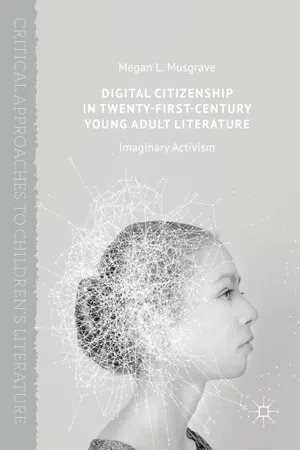
eBook - ePub
Digital Citizenship in Twenty-First-Century Young Adult Literature
Imaginary Activism
- English
- ePUB (mobile friendly)
- Available on iOS & Android
eBook - ePub
Digital Citizenship in Twenty-First-Century Young Adult Literature
Imaginary Activism
About this book
This book is a study of the evolving relationships between literature, cyberspace, and young adults in the twenty-first century. Megan L. Musgrave explores the ways that young adult fiction is becoming a platform for a public conversation about the great benefits and terrible risks of our increasing dependence upon technology in public and private life. Drawing from theories of digital citizenship and posthuman theory, Digital Citizenship in Twenty-First Century Young Adult Literature considers how the imaginary forms of activism depicted in literature can prompt young people to shape their identities and choices as citizens in a digital culture
Information
© The Author(s) 2016
Megan L. MusgraveDigital Citizenship in Twenty-First-Century Young Adult LiteratureCritical Approaches to Children's Literature10.1057/978-1-137-58173-0_11. Cyborg Bodies in Illness and Disability Narratives
Megan L. Musgrave1
(1)
English Department, Indiana University – Purdue University at Indianapolis Indianapolis, Indianapolis, Indiana, USA
A consideration of technology and its impact on young adults as individuals and digital citizens logically begins with the most private space: the body. Perhaps the most frequently articulated anxiety concerning human interventions with technology is the fear that technology will invade, and eventually overwhelm, the human body. The posthuman alteration and merging of biological bodies with machines is a frequent theme in speculative fiction, which often reflects a deep cultural anxiety that the merging of organic and mechanical matter leads to a loss of humanity.
Anderson captures this anxiety perfectly in Feed, imagining a future society in which the human body itself becomes the delivery system for digital connection, and the implanted technology becomes inextricably linked to the human organism. If the feed malfunctions, the biological body malfunctions as well. Titus lacks any sense of the value of authentic or organic experience and as such typifies fears of the posthuman merging of technological and biological function. The feed guides him and his peers to become effective consumers, bombarding their consciousness with minute-by-minute fashion trend updates, advertisements, and other distractions from their work for School™—a corporatized institution designed not to cultivate skills in languages, sciences, or critical thinking, but to teach young consumers how to make better use of their feeds. Violet, on the other hand, resists the feed and its intent to craft consumer drones. Because Violet is the poor daughter of a linguistics professor (an antiquated and undervalued profession in Feedworld), she has an outdated feed but a sharp anti-consumerist, analytical worldview that sets her apart from Titus and his peers. In a brilliant satire of a typical, frustrating series of phone conversations with real-world help desk representatives, Violet’s requests for fixes and upgrades to her malfunctioning feed are denied. Rather than earning her autonomy, her resistance against FeedCorp earns her a slow degeneration into malfunction and death. Feed suggests that the endless cycle of material culture is unstoppable, that the posthuman merging of biological and non-biological components occur at the expense of human individuality, and that attempts at civil disobedience are futile in the face of corporate and technological power.
In other words, disturbing the digital universe can prompt the most frightening outcome: the extermination of the human body. The fear of the biological self succumbing to technological advancements similarly guides much twenty-first-century YA speculative fiction, as demonstrated by the cyborg bodies depicted in Scott Westerfeld’s Uglies series (2005–2012), Mary E. Pearson’s Jenna Fox Chronicles (2008–2013), Robin Wasserman’s Skinned trilogy (2008–2010), Kevin Brooks’s iBoy (2011), and Kat Zhang’s Hybrid Chronicles (2012–2014), to name just a few. Applebaum argues that texts like these provide young people with
Violet’s failure to mount an effective resistance against the feed, and her neurological decline into paralysis and death, makes a connection between fearsome technology and illness narrative that supports Applebaum’s thesis concerning the negative connotation of technology in recent YA science fiction. But by contrast, a variety of contemporary realistic texts consider posthuman interactions between technology and the body in more nuanced ways.an excess of cautionary tales that not only demonise technology but also ignore its creative potential and dismiss its significant role in repairing past damage associated with its misuse, [and] can result in their internalising technophobic attitudes. A child reader absorbing these messages may be ill-prepared for growing up in an increasingly technologised age, crippled by a perpetuated fear of the technology she is bound to use. (2010: 158)
The texts I discuss in this chapter elucidate a growing contrast between speculative and realistic fiction, supporting Hayles’s suggestion that although “some current versions of the posthuman point toward the anti-human and the apocalyptic, we can craft others that will be conducive to the long-range survival of humans and of the other life-forms, biological and artificial, with whom we share the planet and ourselves” (1999: 291). Some such provocative “other versions” are appearing in realistic YA fiction, specifically in illness and disability narratives. A discussion of the complex intersection of young adult bodies with non-organic components as a response to illness and disability is the focus of this chapter.
Recognizing the differences between illness and disability and the challenges they depict, 1 I group the two together here due to the ways in which a variety of recent texts consider technological enhancements to the ill and/or disabled body as a component of a broader consideration of digital citizenship. These narratives present interesting interpretations of Nayar’s consideration of the posthuman body and “the ways in which the machine and the organic body and the human and other life forms are now more or less seamlessly articulated, mutually dependent and co-evolving” (2014: 8), and thus offer a more inclusive, and therefore more ethical understanding of life. The fact that these texts raise awareness about illness and disability narratives and the channels they open up for considerations of posthuman identity positions them as subactivist texts. As Bakardjieva explains, subactivism is “categorically submerged and subjective,” and involves
Narratives that represent the struggles of ill and disabled individuals to reconcile their private, bodily struggles with their public subjectivity function as examples of subactivism due to the ways they position readers to contemplate their own subject positions as members of disabled or non-disabled groups. By co-opting sympathetic or empathetic responses in readers, this body of literature presents the most personal, “submerged” examples of on the spectrum of behaviors that constitute imaginary activism—even when those examples are largely presented via awareness-raising, which is a viable form of political engagement.small-scale, often individual decisions and actions that have either a political or ethical frame of reference (or both) and remain submerged in everyday life … It is not about political power in the strict sense, but about personal empowerment seen as the power of the subject to be the person that they want to be in accordance with his or her reflexively chosen moral and political standards … It is that essential bedrock against which individual citizens’ capacity for participation in subpolitics or in the formal political institutions of the public world is shaped and nurtured. (2009: 96)
To this end, rather than signaling the end of humanity, as cautionary dystopias like Feed suggest, a deep consideration of the posthuman elements at work in illness and disability narratives “signals instead the end of a certain conception of the human, a conception that may have applied, at best, to that fraction of humanity who had the wealth, power, and leisure to conceptualize themselves as autonomous beings exercising their will through individual agency and choice” (Hayles 1999: 286). As for those individuals who do not enjoy such privilege, Donna Haraway proposes a different approach to self-conception in her seminal deconstructive essay “Cyborg Manifesto,” arguing that
Feminist perspectives on the imperialist outlook of traditional scientific practices coincide effectively with central concerns of children’s and YA literature, whose subjects share a history of disenfranchisement and marginalization in common with women, racial minorities, and the lower classes. Haraway argues, “For us, in imagination and in other practice, machines can be prosthetic devices, intimate components, friendly selves. We don’t need organic holism to give impermeable wholeness, the total woman and her feminist variants (mutants?) … The machine is us, our processes, an aspect of our embodiment” (2000: 314–315). Like other disenfranchised groups, children and young adults have never been included in a humanist vision in which “conscious agency is the essence of human identity” (Hayles 1999: 288). Rather, Hayles argues that in the posthuman view, “conscious agency has never been ‘in control’. In fact, the very illusion of control bespeaks a fundamental ignorance about the nature of the emergent processes through which consciousness, the organism, and the environment are constituted” (1999: 288). Hayles’s discussion of such emergent processes bears a striking resemblance to critical discussions of the emergence of adolescent identity, which tends to be characterized as turbulent, chaotic, and uncontrollable (Flanagan 2014: 72; Cart 2010: 3–4; Elman 2014: 2). The dominant cultural view remains that to be a teenager “is to be besieged by raging hormones while at the mercy of an incomplete brain. Such figurations of the teenager offer up adolescent bodies as perennially volatile and unstable bodies to be managed” (Elman 2014: 3). It therefore seems appropriate that some of the most interesting recent investigations of similarly unstable posthuman possibilities, and their power to forge new connections between private struggles and public understanding of disability, are occurring via YA fiction.taking responsibility for the social relations of science and technology means refusing an anti-science metaphysics, a demonology of technology, and so means embracing the skillful task of reconstructing the boundaries of daily life, in partial connection with others, in communication with all of our parts … Cyborg imagery can suggest a way out of the maze of dualisms in which we have explained our bodies and our tools to ourselves. (2000: 316)
Illness and Disability Narratives in the History of YA Literature
In The Fault In Our Stars, Hazel Grace Lancaster declares that in spite of featuring a central character with cancer, her favorite book is “not a cancer book, because cancer books suck” (Green 2012: 48). This comment epitomizes changing attitudes toward illness and disability narratives in the twenty-first century. In order to make sense of how a character like Hazel arrives at such a cynical outlook on cancer stories, it first helps to establish the significance of illness narratives as a mainstay of the YA genre. Illness narratives have comprised a significant portion of children’s literature since before it was recognized as a genre; in the nineteenth century, the likes of Charles’s Dickens’s Tiny Tim, Louisa May Alcott’s Beth March, and Susan Coolidge’s Katy Carr paved the way for the likes of Lurlene McDaniel’s Dawn Rochelle to define “sick lit” by the late twentieth century. Notions of illness and disability evolved alongside social constructions of adolescence in the late twentieth century, so it is helpful to consider the ways in which narratives of chronic conditions—illness and disability, childhood and adolescence—reflect changing notions of citizenship in the digital era.
One of the classic cultural linkages made between adolescent struggle and illness or disability is the assumption that each involves suffering, as Julie Elman points out in Chronic Youth:
Moreover, narratives depicting struggle are perceived to produce better citizens, and such “suffering and sadness” has been the special provenance of YA illness and disability narratives since their development as a genre in the 1970s and 1980s. This development occurred at an interesting time in the growth of YA literature as a marketing genre that was only beginning to build toward the economic power it wields in the twenty-first century. The idea of youth culture as “dangerous” spread during World War II, when many youths were increasingly unsupervised (Cart 2010: 18), and grew in the 1950s “as post–World War II prosperity put money into the kids’ own pockets, money that had previously gone to support the entire family” (Cart 2010: 11). Young adults embraced rock and roll, television, comic books, and such iconic films as Marlon Brando’s The Wild One (1954) and James Dean’s Rebel Without a Cause (1955) in their embrace of an anarchic sense of resistance against authority. As a growing youth culture produced a generation of young consumers, adult gatekeepers sought out realistic novels to suit didactic purposes. 2 YA literature soon came to serve a socializing purpose; as Trites argues, “the YA novel teaches adolescents how to exist within the (capitalistically bound) institutions that necessarily define teenagers’ existence” (2000: 19). Hence, the problem novel evolved as an adult reaction against the perceived rebellion of youth culture. With it came a new category of youth pop culture, largely defined by the problem novels, illness narratives, and educational after-school television programming that Elman has termed “rehabilitative edutainment” (2014: 4). Moreover, as adult fears of the apathetic young citizen grew,The normative cultural understanding of adolescence as an affective stage defined by the universal human experience of deep suffering and sadness—and likewise the construction of sadness as somehow more “authentic”—has been crucial to the interweaving of engaged citizenship, participatory democracy, and emotional instruction as national values. (Elman 2014: 123)
Ironically, the literature that seemed to fit the bill for “healthy literature” was the illness narrative—pejoratively dubbed “sick-lit” to mirror the heteronormative romance genre, “chick-lit.” When Hazel declares that “cancer books suck,” she is almost certainly alluding to the overly sentimental and melodramatic sick-lit written by the likes of Jean Ferris and Lurlene McDaniel beginning in the 1980s. Having authored more than 70 YA novels, McDaniel in particular is largely responsible for the popularity of novels that blend the didacticism of the problem novel with the melodrama of the Harlequin romance (Elman 2014: 100). There are exceptional early illness and disability narratives for teens, including Judy Blume’s Deenie (1973), Cynthia Voigt’s Izzy, Willy-Nilly (1986), and Marjorie Kellogg’s Tell Me That You Love Me, Junie Moon (1968), a favorite book of one of the contemporary protagonists I discuss in this chapter. 3 That said, sick-lit has not generally been celebrated for its literary quality; as it became a dominant subgenre of realistic YA fiction, “many children’s literature scholars, advocates, and literary critics celebrated the problem novel’s turn toward frankness even as they lamented its dreadful aesthetics” (Elman 2014: 104). Literary quality, it seems, was sacrificed in deference to “the cultural value of literary relics as medicinal for developing citizens,” a trend that reflected “shifting economic expectations, the expansion of mass media, and a notion of participatory citizenship in a post-1968 public sphere that had been changed inexorably by progressive social movements” (Elman 2014: 117).[l]iberal and conservative arguments about the merits or perils of literary realism manifested two shared beliefs about healthy popular culture’s transformative power and its significance to the disciplines of citizenship. First, reading problem novels would (and perhaps even should) incite emotional upheaval, such as sadness or fear, in its readers. Second, emotional realism was a necessary growth experience for teenagers, who were conjured as problematically emotive—either emotionally excessive or apathetic—and thus in need of the emotional instruction that healthy literature might provide. (2014: 121)
In tandem with the mobilization of the rhetoric of disability and rehabilitation after passage of the Americans with Disabilities Act in 1990, experts in parenting books and news media described teenagers as “disabled” by their unfinished brains and configured coming-of-age as a rehabilitative journey that would culminate in “stable” adulthood and ensure national health (Elman 2014: 132). As Elman argues, “Although ‘teen’ and ‘disability’ may at first seem like unrelated categories, both have been understood as abnormal (and undesirable) bodily states and as problematic sexual sites in different but intimately related ways” (2014: 14). In language strikingly similar to the language describing adolescent bodies and identities, Rosemarie Garland Thomson notes that disability has historically been constructed as “the embodiment of corporeal insufficiency and deviance, the physically disabled body becomes a repository for social anxieties about such troubling concerns as vulnerability, control, and identity” (1997: 6). A key reason why both adolescence and disability are repositories for such social anxieties is that the majority of people will experience both, living through adolescence in order to reach adulthood, and living with disabilities as a result of reaching old age. Michael Bérubé argues that “disability is perhaps the most unstable designation of them all” (1998: xi), specifically because most people will experience disability in their lifetimes due to the illnesses and impairments that accompany the human condition.
Perhaps this is why the language of “overcoming” is so prominent in YA literature generally, and in disability literature in particular. Novels in these genres are often structured to empower their characters to move beyond their limitations—whether imposed by adolesc...
Table of contents
- Cover
- Frontmatter
- 1. Cyborg Bodies in Illness and Disability Narratives
- 2. Cyborg Minds at Play in Participatory Cultures, or, Going Public in Private
- 3. Gamer Guys: Playing with Civic Responsibility in Ludic Fiction
- 4. Gamer Girls: Going Online in the Age of Misogynist Terrorism
- 5. Imaginary Activism
- 6. Conclusion
- Backmatter
Trusted by 375,005 students
Access to over 1.5 million titles for a fair monthly price.
Study more efficiently using our study tools.
Frequently asked questions
Yes, you can cancel anytime from the Subscription tab in your account settings on the Perlego website. Your subscription will stay active until the end of your current billing period. Learn how to cancel your subscription
No, books cannot be downloaded as external files, such as PDFs, for use outside of Perlego. However, you can download books within the Perlego app for offline reading on mobile or tablet. Learn how to download books offline
Perlego offers two plans: Essential and Complete
- Essential is ideal for learners and professionals who enjoy exploring a wide range of subjects. Access the Essential Library with 800,000+ trusted titles and best-sellers across business, personal growth, and the humanities. Includes unlimited reading time and Standard Read Aloud voice.
- Complete: Perfect for advanced learners and researchers needing full, unrestricted access. Unlock 1.5M+ books across hundreds of subjects, including academic and specialized titles. The Complete Plan also includes advanced features like Premium Read Aloud and Research Assistant.
We are an online textbook subscription service, where you can get access to an entire online library for less than the price of a single book per month. With over 1.5 million books across 990+ topics, we’ve got you covered! Learn about our mission
Look out for the read-aloud symbol on your next book to see if you can listen to it. The read-aloud tool reads text aloud for you, highlighting the text as it is being read. You can pause it, speed it up and slow it down. Learn more about Read Aloud
Yes! You can use the Perlego app on both iOS and Android devices to read anytime, anywhere — even offline. Perfect for commutes or when you’re on the go.
Please note we cannot support devices running on iOS 13 and Android 7 or earlier. Learn more about using the app
Please note we cannot support devices running on iOS 13 and Android 7 or earlier. Learn more about using the app
Yes, you can access Digital Citizenship in Twenty-First-Century Young Adult Literature by Megan L. Musgrave in PDF and/or ePUB format, as well as other popular books in Languages & Linguistics & Linguistics. We have over 1.5 million books available in our catalogue for you to explore.