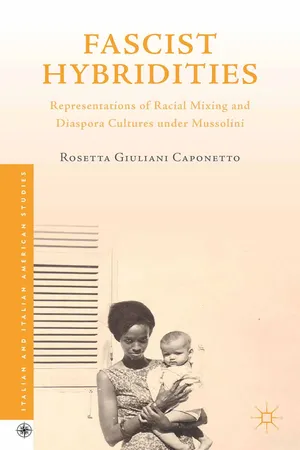
Under Italian Fascism, African-Italian mulattoes and white Italians living in Egypt posed a particular threat to the pursuit of a homogenous national identity. This book examines novels and films of the period, showing that their attempts at stigmatization were self-undermining, forcing audiences to reassess their collective identity.
eBook - ePub
Fascist Hybridities
Representations of Racial Mixing and Diaspora Cultures under Mussolini
- English
- ePUB (mobile friendly)
- Available on iOS & Android
eBook - ePub
Fascist Hybridities
Representations of Racial Mixing and Diaspora Cultures under Mussolini
About this book
Information
Topic
HistoriaSubtopic
Historia africana1
Art of Darkness: The Aestheticization of Black People in Fascist Colonial Novels*
Black Venuses and Meticci1 in the Italian Colonial Context
Propaganda about race and racial identity in Italy is most commonly discussed in the context of the Fascist regime’s 1938 race laws, which asserted the superiority of the Italian race on the basis of biological differences between Italians and the black colonial subjects and Jewish minorities living on Italian territory. In reality, racial propaganda appeared much earlier. As early as the 1880s, indigenous black women began to appear in illustrated pamphlets depicting Italy’s exploration of Africa, and the extensive photographs, drawings, and written accounts of African women indicate that colonialism had found a powerful instrument for capturing the Italian imagination through depictions of African females as dark, large-breasted black Venuses. Beyond increasing sales and promoting territorial conquests, the eroticization of native women as nude or semi-nude black Venuses emphasized a desire to be subjugated. As Sandra Ponzanesi has suggested in her analysis of the relationship between race and gender as well as politics and colonialism, native women were shown as possessing a sexual allure and willingness to be conquered that was not permitted for European women, or that European women were seen to have lost (166).
Literature likewise became invested in shaping relationships between whites and blacks as early as 1896, the year of publication of Emilio Salgari’s novel, I drammi della schiavitù, set aboard slave ships headed to America. Salgari, one of Italy’s most prolific and widely read authors of action and adventure novels during the period of the Italian colonial campaign, wrote numerous novels and hundreds of short stories, fifteen of which were set in Africa and almost all of which feature dangerous or mysterious settings. As a popular writer of mass literature, Salgari has often been viewed by scholars, such as Margherita Botto, as “thriving parasitically on topoi rooted” in Italy’s collective unconscious (86). In fact, Salgari’s literary career, spanning the period between 1884 and his 1911 suicide, coincides with several significant events in Italy’s early colonial period, including the landing at Massawa in 1885 after the acquisition of the Bay of Assab, and the onset of the 1911 Italo-Turkish war. With its focus on the African slave trade, I drammi della schiavitù, published in the period following Italy’s exploration travels in Africa and its consolidation of colonial possessions in Eritrea, was historically relevant, as it was published less than a decade following the 1889 Congress of Vienna’s formal condemnation of the African slave trade in Europe.
Even while lacking explicit references to the events related to Italian colonialism, I drammi della schiavitù incorporates issues of a larger topical interest in the colonial discourse, predicts a spectrum of mixed races, and attempts to subtly influence the reader’s opinion. Salgari’s novel focuses on the beautiful biracial character Seghira, who falls in love with the ship’s captain, Alvaez, a fundamentally honest man if not for his profession as a slave trafficker. Before the rise of Fascism, depictions of sexual conquest and sexual exploits with native women were common and provided a less explicit means of alluding to the colonial enterprise and promoting domination in the new territories. Yet, in Salgari’s novel, the entire crew of the slave ship is distracted by the presence of the beautiful mixed-race slave, and any possibility for a lasting relationship between Seghira and Alvaez is preempted when he is murdered by the jealous Second Captain. Alvaez’s death prevents Seghira from ascending the racial and social scale. Rather than permit her union with the white character, Alvaez, Salgari has Seghira marry the African King, Niombo, who was captured by Alvaez but agreed to aid Seghira in avenging the captain’s death. The novel’s cover emphasizes this resolution by depicting Seghira with Niombo rather than with Alvaez.
Thirty years before the 1938 race laws and the 1940 law that denied citizenship to Italian biracial offspring, the novel’s representation of a mixed-race character provides a blueprint for later writers affiliated with the Fascist regime, and anticipates ethical and political themes that became pertinent during the height of the Italian colonial period. The character of Seghira becomes a precursor of meticcio characters in Italian colonial literature and film. This chapter will provide a historical, legal, racial, and cross-cultural perspective of the meticcio from the early Italian colonial period through the Fascist propaganda literature of the 1930s, before the 1940 law barring citizenship to biracial children. Drawing on the theoretical concept of mimicry discussed by Homi Bhabha in The Location of Culture, this chapter analyzes the narrative devices used in Fascist colonial novels to discourage interracial unions. One of the main problems faced by the Fascist regime was how to define the biracial offspring and the place of this mixed-race group in Italian society, given that these subjects were born to one Italian and one African parent. Interracial unions forced the Italian government to define the social and legal status of biracial progeny whose mixed identity complicated the desire to establish Italy’s racial supremacy over black colonial subjects.
The reality that mixed-race individuals challenged notions of racial purity, and destabilized the assumptions that would form the grounds of the 1938 race laws, led to the attempt to control the public perception of colonial meticci through fiction. In the Fascist propagandist repertoire, historical meticci appear rarely, since making them visible would have raised the problem of their classification. Instead, other hybrid figures are carefully constructed to make only oblique references to colonial meticci. In popular novels affiliated with Mussolini’s regime, the skin color of the native protagonists is often lightened, or the historical hybridity of the meticci replaced with constructed hybrid characters. One example is the askari, the native soldier whose status as ‘almost’ Italian allows him in certain circumstances to pass, socially if not physically, as white. Another example of hybrid character is the passer, the black passing for white. Black characters are disciplined, becoming ‘lighter’ when refined or polite, when adopting a white military uniform, or when their dark skin is revealed to only be the result of sunburn or genetic defect. At the base of these narrative strategies lies a will to control. Where in reality colonial meticci complicated the racial hierarchy with their intermediate positions, it was hoped nonetheless that they could be controlled through fiction.
With the advent of Fascism, the role of the black woman was given a new political scope and, as it became politically necessary to discourage interracial relationships in the 1930s, depictions and perceptions of the black Venus changed radically without disappearing. Representations of the black female’s exotic appeal and willingness to be dominated, previously used to attract Italian men to the colonial enterprise, were replaced by depictions of her supposedly inferior racial status intended to provoke disgust and repulsion. Even comic representations revealed the view that black women, as potential procreators of a mixed-race progeny, threatened to irremediably dilute the Italian racial fabric. Enrico De Seta’s famous series of commercial posters and comics, collected by Adolfo Mignemi in his Immagine coordinata per un impero, transformed the African woman into a caricature, occasionally depriving her of human characteristics and equating her with consumer products such as cattle.
In other cases, the black female’s sexual appeal was exploited to reinforce the gender roles tailored by Fascism, as illustrated by Barbara Sòrgoni’s volume Parole e corpi. As a guardian of racial purity, the Italian woman was called to join her spouse in Africa to oppose the native woman’s charm with submissive and obedient behavior and ensure his faithfulness (Sòrgoni 1998, 230–233). This is true of Guido Brignone’s 1938 Fascist propagandist film, Sotto la croce del sud, which focuses on a young engineer, Paolo, whose eventual success in overcoming his attraction toward a female meticcio character is intended to exemplify a capacity for self-control and discipline that prevented male Italians from yielding to women of inferior racial status. Brignone adopts the common practice of substituting the image of the black Venus with lighter skinned meticcio characters, whose erotic appeal was justified by their greater resemblance to white Europeans. Sotto la croce del sud also provides a good example of how black and meticcio characters were used to provide a negative contrast to the Italian characters, as evident in the editing of one of the most crucial scenes in the film, in which the image of naked Abyssinian women performing a fertility rite is contrasted with scenes of colonial family life in which Italian settlers are seated at the table attended by their wives.
Although a few scholars have focused on the tradition of skin color lightening in Italian Fascist cinema,2 Giorgio Bertellini’s study on the westernization of the popular character of Maciste discusses one of the earliest and most outstanding examples. Maciste first appears as a black slave in the 1914 film Cabiria, and goes on to become the protagonist of a series of films between 1914 and 1930 that gradually eliminate his African characteristics and move him into an increasingly European appearance (Bertellini 2003, 256). Already in 1916, in the film Maciste alpino, the character is portrayed as a member of the Italian alpine troops (Bertellini 2003, 260). The practice of lightening skin color continues in later Fascist propagandist films, such as Augusto Genina’s 1936 film, Lo squadrone bianco, the title of which refers to the indigenous askari (Arabic for “soldier”) who fought on behalf of the Italian colony during the African campaigns. Cecilia Boggio explains in her “Black Shirts/Black Skins” that, in the film, the askaris are referred to as the “white squadron” because of their white uniforms, which were usually paired with red or leather accessories, such as the typical cylindrical tarbush hat. As the film concludes with the white squadron’s victory in battle against a group of Libyan rebels, the askaris are represented through the typically Fascist image of orderly followers (Boggio 2003, 284).
The phenomenon of lightening skin color or suppressing non-European traits was by no means unique to the Italian context. In Italy, the process of recognizing the social and political status of mixed-race individuals and of accepting their position in a positive light followed a different historical path with respect to Latin and North America. Yet, a comparison with the situation in the Americas, where cultural representations of mixed-race individuals played a significant role in the anti-colonial nationalist movement in the Caribbean and in the abolitionist movement in the United States, can help to clarify the specific function that black and meticcio characters acquired in Italian film and literature. Suzanne Bost’s Mulattas and Mestizas provides an invaluable analysis of how and why the question of racial identity was more complex in the Spanish-speaking American colonies than in North America’s rigid white master/black slave binary. Socially and economically, segregation was impossible. Europeans relied on natives for labor, business, and communication with Caribbean locals and, unlike in North America, “the small European population on the islands was insufficient to establish a separate, independent white culture” (Bost 2003, 91).
Interracial unions, according to Bost, were always part of the Spanish colonial project. Since the earliest stages of colonization, intermarriage between Spanish men and native women was supported by the Church and viewed by Spain as a means of facilitating the Hispanization of the natives and promoting domestic stability in the colonies (Bost 2003, 27). Michael Meyer and William Sherman’s volume on the conquest of Mexico, The Course of Mexican History, illustrates how marriage with women from noble native families provided Spaniards with jurisdiction over a given number of native laborers through the legal system of the encomienda (209). Given the long history of intermarriage within the context of Spanish colonizers, interracial unions were considerably more common in the Hispanic Caribbean than in the British Caribbean or in North America (Bost 2003, 99). In discussing representations of blackness in Latin American literature, Richard Jackson highlights in The Black Image that intermarriage was viewed as a means of gradual racial purification in the Spanish Caribbean. It was expected that the natural inferiority of the indigenous populations would gradually be filtered out as the superior and more dominant white traits were passed on to new generations (Jackson 1976, 3–4). Although intermarriage or racial intermixing was to some degree considered an acceptable practice, the underlying discourse was no more or less positive than in the North American context, since in both instances European racial purity remained the ultimate goal (Jackson 1976, 3–4).
Racial hierarchies dominated Caribbean history as well, and European origins remained synonymous with racial superiority. Skin color alone did not, however, determine social standing since so many inhabitants of nineteenth-century Cuba and Puerto Rico were descendants of interracial unions (Bost 2003, 29). The impossibility of using skin color as a basis for classification created a caste system rather than a racial binary and other elements, such as religion, education, fluency in Spanish, lifestyle, and behavior, were associated with race (Bost 2003, 29). Spain’s colonies had a system of meticulous racial classification that paid close attention to cultural components and the percentage of indigenous and African blood. Terms such as terzerón, cuarterón, octoroon identified points on a scale ranging from blackness to whiteness.
Eventually, in Spanish colonial literature and history, the mixed-race individual, whether classified as mestizo or mulatto, became a symbol of national resistance, an ethnic and cultural medley opposed to notions of limpieza de sangre and European colonialism. Biracial women appear as important figures in nineteenth-century Cuban novels about slavery. Claudette Williams, in her extensive research on racial identity in Spanish Caribbean literature, looks closely at novels of this period and cites, as examples, Bosmeniel’s novel, Petrona y Rosalía (1838), and Villaverde’s Cecilia Valdés (1839), as having contributed to the development of the negrismo literary movement that flourished in Cuba and Puerto Rico (11). Even among writers in the Caribbean, however, attitudes were split. Some writers of the French Caribbean, such as Aimé Césaire, “rejected the European heritage and promoted black cultural autonomy” (Williams 2000, 14). This position was to some degree against the ethnic crossing between different groups, since it associated mixed-race individuals with the bourgeois ideology of the white colonizers (Williams 2000, 14). On the other hand, writers of the Spanish Caribbean saw mixed-race individuals as a symbol of a new, harmonious national identity based on an African-European synthesis (Williams 2000, 14).
The North American scenario was completely different, as racial prejudice operated according to a binary system, thus anyone with the so-called “one-drop of black blood,” regardless of the shade of his/her skin color, was considered black. In Neither Black nor White yet Both Werner Sollors defines biracial offspring as a “living challenge” in a civil structure based upon birth and lineage (241). For those who had left Europe because of persecution and oppression, the mixed-race individual was reminiscent of the failed good intentions to establish a civil structure in the new continent that would respect the freedom of man regardless of his lineage (Sollors 1997, 241). This explains to some extent why the adoption of the generic term mulatto was originally rejected, because it would have implied recognizing the existence of miscegenation and providing official status to individuals born out of taboo relationships (Sollors 1997, 7–9; 16–24). Mixed-race progeny was finally acknowledged by the United States Census in 1850 and for nearly a century ...
Table of contents
- Cover
- Title
- Introduction Race to the End. Meticci and Levantines in Literary and Cinematic Representations of Colonial Experience in Africa
- 1 Art of Darkness: The Aestheticization of Black People in Fascist Colonial Novels
- 2 The Dissident Literature of Enrico Pea and Fausta Cialente
- 3 Fade to White: Cinematic Representations of Italian Whiteness
- 4 Levantines and Biracial Offspring in Postwar Italy
- Conclusion
- Notes
- Index
Trusted by 375,005 students
Access to over 1.5 million titles for a fair monthly price.
Study more efficiently using our study tools.
Frequently asked questions
Yes, you can cancel anytime from the Subscription tab in your account settings on the Perlego website. Your subscription will stay active until the end of your current billing period. Learn how to cancel your subscription
No, books cannot be downloaded as external files, such as PDFs, for use outside of Perlego. However, you can download books within the Perlego app for offline reading on mobile or tablet. Learn how to download books offline
Perlego offers two plans: Essential and Complete
- Essential is ideal for learners and professionals who enjoy exploring a wide range of subjects. Access the Essential Library with 800,000+ trusted titles and best-sellers across business, personal growth, and the humanities. Includes unlimited reading time and Standard Read Aloud voice.
- Complete: Perfect for advanced learners and researchers needing full, unrestricted access. Unlock 1.5M+ books across hundreds of subjects, including academic and specialized titles. The Complete Plan also includes advanced features like Premium Read Aloud and Research Assistant.
We are an online textbook subscription service, where you can get access to an entire online library for less than the price of a single book per month. With over 1.5 million books across 990+ topics, we’ve got you covered! Learn about our mission
Look out for the read-aloud symbol on your next book to see if you can listen to it. The read-aloud tool reads text aloud for you, highlighting the text as it is being read. You can pause it, speed it up and slow it down. Learn more about Read Aloud
Yes! You can use the Perlego app on both iOS and Android devices to read anytime, anywhere — even offline. Perfect for commutes or when you’re on the go.
Please note we cannot support devices running on iOS 13 and Android 7 or earlier. Learn more about using the app
Please note we cannot support devices running on iOS 13 and Android 7 or earlier. Learn more about using the app
Yes, you can access Fascist Hybridities by Kenneth A. Loparo,Rosetta Giuliani Caponetto in PDF and/or ePUB format, as well as other popular books in Historia & Historia africana. We have over 1.5 million books available in our catalogue for you to explore.