- English
- ePUB (mobile friendly)
- Available on iOS & Android
eBook - ePub
About this book
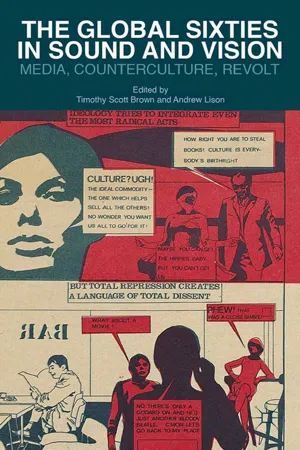
Despite the explosion of interest in the "global 1968," the arts in this period - both popular and avant-garde forms - have too often been neglected. This interdisciplinary volume brings together scholars in history, cultural studies, musicology and other areas to explore the symbiosis of the sonic and the visual in the counterculture of the 1960s.
Information
CHAPTER 1
A Red Noise: Pop and Politics in Post-1968 France
Jonathyne Briggs
In 1971, a group of French students from the École des Travaux Publics organized a rock concert at the Palais des Sports in Paris, featuring Soft Machine, Yes, Gong, and Iron Butterfly. An audience of nearly 5,000 young people was in attendance, and many of them had broken through the doors to secure the free access to the stadium promised by organizers. During Gong’s set, young listeners destroyed seats as they drummed along with the band and requisitioned the concession areas in a strange replay of the occupation of the Sorbonne in May of 1968, when students occupied the campus buildings in the Latin Quarter (subsequently destroying seats in numerous classrooms there). Throughout the concert, members of the audience interrupted the music by taking the stage on several occasions, requisitioning the microphone to assert the political importance of pop music. Soon after, the contents of the concession stands rained down from the rafters, showering the audience with ice cream bars, cocoa powder, and fruit juice. By midnight, the stadium’s power was cut, sending concertgoers to the exits as the remainder of the show was cancelled. The French riot police, the Compagnie Républicaine de Securité [CRS], had entered the area outside of the Palais to restore order and subsequently a melee broke out between members of the audience and police.1 In his review of the event, Rock & Folk journalist Philippe Parginaux questioned the assumed connection between pop music and politics and the depth of young people’s political motivations in France after 1968. While skeptical, especially in light of the debacle at the Palais des Sports, Parginaux nevertheless remained hopeful about the ability of pop music to motivate young people into organizing in a viable manner that would bring about social and political change.2
The relationship between pop music, which in France encompasses the range of subgenres of rock and pop, and politics was never quite clear in France during the 1960s.3 While pop musicians in other countries openly, if at times superficially, embraced political causes during this period, in France they remained more associated with leisure and entertainment.4 Perhaps the most telling sign of this difference was the relative absence of pop music during the Events of May 1968, when French students and young workers took to the streets to protest against the French government, society, and whatever else they saw as blocking their path. In other national contexts, musicians were often supportive of student demonstrators and protest movements, but in France, prominent pop musicians had little positive to say about the Events.5 Nevertheless, many in the counterculture of the early 1970s saw a natural alliance between the ideas of pop music and the desire to transform French society. Pop music was considered a vehicle for articulating a new France as an expression of cultural utopianism that veered away from the direct and confrontational politics of May. Rather than directly overthrowing the political order, many pop musicians wanted to change the social order through the creation of new types of popular culture. Eric Drott’s recent work on French cultural politics after 1968 underscores the importance of pop music as a cultural locus for rearticulating political activity in the wake of the Events.6 Several pop groups integrated the utopianism of pop music with the political engagement associated with groupuscules, small activist organizations that had populated the streets during May and claimed its heritage thereafter. Their efforts reveal how pop musicians, in this case progressive rock bands, carried on the 1968 ideal by connecting various forms of social protest to pop music as a method of overturning the traditional political and social order through a combination of cultural and political activism.
The Progressive Sound of May
The Events of May in France have received a great deal of attention, both from its participants, the soixante-huitards, and from scholars. Many interpretations of the Events focus on the cultural transformation that emerged from the street battles across France that led to a broader acceptance of more Americanized forms of consumer capitalism that had been evident in France since the middle of the century.7 The actions of cultural activists in the 1970s who capitalized on libertarian and Marxist attitudes expressed during May reveal the creation of a counterculture in France that carried on the cultural challenges of May. However, the difference in these attitudes divided the counterculture into different spheres representing broad trends rather than specific blocs. Those of the counterculture interested in the politics of lifestyle choices symbolized a larger European trend of the Freak Left. The Freak Left is understood as in opposition to the reorganized left in the post-1968 period, the New Left, which was more explicit in its political aims.8 The New Left took the political ideals of the groupuscules, especially that of worker self-production and the importance of direct political action, and in turn rejected the cultural challenges posed by the Freak Left as mere distractions from the real revolution.9 By sending students to organize workers into Maoist- and Trotskyist-inspired groupuscules, the New Left sought to continue the revolution in a more effective and direct manner that would create a class alliance between middle-class students and working-class laborers.
Members of the Freak Left, however, had similar intentions in their use of popular culture to unify different classes. In the late 1960s, a new subgenre, progressive rock, developed out of psychedelia, the hallucinogenic music of the hippie movement. Psychedelia combined the blues structure of rock music, the microtonality of Eastern music and the noise of electronic instrumentation and reflected the growing interest in new modes of consciousness, a combination exemplified in the work of the Beatles, Jimi Hendrix, and Cream.10 Progressive rock built upon the musical pretentions of psychedelia by adding new influences such as modernist composition and musique concrète. An international phenomenon, progressive rock manifested many of the same ideas that defined Western counterculture during the early 1970s: musical exploration as a pathway to mental liberation and the necessary conflation of high and low culture to undermine hierarchical notions of cultural difference and create a truly democratic form of popular culture.
The utopian aspiration of class reconciliation, which had been a central aspect of the Marxist-inspired rhetoric in the streets of Paris, manifested itself in progressive rock through its integration of “serious” compositional and popular musical forms. The juxtaposition of classical instrumentation—such as woodwinds and strings—with electric instruments, including early versions of the synthesizer, is a defining characteristic of progressive rock.11 According to one supporter’s assessment, it was to be “a new classical music,”12 and in the French counterculture, the combination of the more radical elements of rock and jazz with the legitimacy and seriousness of classical music lent the genre cultural significance and validity. Such a mélange spoke to the aspirations of class leveling manifest in the counterculture after 1968, albeit without the more overt political rhetoric associated with the Events of 1968. For music historian Edward Macan, progressive rock, at least in Britain, exemplified a turn toward spiritual transformation as a method for changing society, and many groups in France—Magma, Catharsis, Gong, Martin Circus, and Triangle, to name but a few—stressed this ideal within their music.13 Through its narrative and musical complexity, progressive rock suggested a less contentious form of cultural critique. For its proponents, May 1968 was best represented by the cultural challenge that was present in the Odeon Theatre during the occupation of the Latin Quarter and not the street battles between students and police. Progressive rock in France was also deeply influenced by the sound of free jazz and the political implications of its aesthetics due to its associations with the civil rights movement in the United States.14 In France, the synthesis of jazz, perceived as a more highbrow cultural form, with popular genres reinforced the power of cultural challenge in rock music during the post-1968 period.15
The Noise of Revolution
Several progressive rock groups developed a complex aesthetic combination of free jazz, blues-based rock, and modernist musical techniques. The compositions of Magma, Catharsis, and Gong exemplify this combination of sounds and approaches and reveal the tendencies of countercultural musicians to employ particular musical motifs as a form of cultural critique. Perhaps the most commercially successful of these groups, Magma, led by drummer Christian Vander, recorded several albums of material that blended the modernist tradition of the symphonic works of Igor Stravinsky, the choral arrangements of Carl Orff, and the improvisational spirit of John Coltrane. Magma’s early albums, sprawling hour-long affairs, dealt with themes of alienation and Armageddon within extended musical pieces with the lyrics sung in Kobaïan, a language invented by Vander. Powered by Vander’s drumming, Magma’s sound collapsed all of these influences together within the context of a style dubbed “Zeuhl” or cosmic music. Over the course of its initial three albums, Magma dealt with themes of mod...
Table of contents
- Cover
- Title
- Introduction The Global Sixties in Sound and Vision: Media Counterculture, Revolt
- Chapter 1 A Red Noise: Pop and Politics in Post-1968 France
- Chapter 2 Mapping Tropicália
- Chapter 3 Magical Mystery Tours: Godard and Antonioni in America
- Chapter 4 Turning Inwards: The Politics of Privacy in the New American Cinema
- Chapter 5 Utopia and Dystopia in Science Fiction Films around 1968
- Chapter 6 “Musical & Magical Counterpoint”: Language, Sound, and Image in Wallace Berman’s Aleph, 1956–1966
- Chapter 7 Guitar Smashing: Gustav Metzger, the Idea of Auto-destructive Works of Art, and Its Influence on Rock Music
- Chapter 8 “The Revolution Is Over—and We Have Won!”: Alfred Hilsberg, West German Punk, and the Sixties
- Chapter 9 The Sun and Moon Have Come Together: The Fourth Way, the Counterculture, and Capitol Records
- Chapter 10 “A Weapon in Our Struggle for Liberation”: Black Arts, Black Power, and the 1969 Pan-African Cultural Festival
- Chapter 11 The Revolution Will Not Be Televised, But It Will Be Recorded: Soul, Funk, and the Black Urban Experience, 1968–1979
- Chapter 12 Jukebox Modernism: The Transatlantic Sight and Sound of Peter Blake’s Got a Girl (1960–1961)
- Chapter 13 Uninteresting Pictures: Art and Technocracy, 1968
- Chapter 14 1968 and the Future of Information
- Notes on Contributors
- Index
Trusted by 375,005 students
Access to over 1.5 million titles for a fair monthly price.
Study more efficiently using our study tools.
Frequently asked questions
Yes, you can cancel anytime from the Subscription tab in your account settings on the Perlego website. Your subscription will stay active until the end of your current billing period. Learn how to cancel your subscription
No, books cannot be downloaded as external files, such as PDFs, for use outside of Perlego. However, you can download books within the Perlego app for offline reading on mobile or tablet. Learn how to download books offline
Perlego offers two plans: Essential and Complete
- Essential is ideal for learners and professionals who enjoy exploring a wide range of subjects. Access the Essential Library with 800,000+ trusted titles and best-sellers across business, personal growth, and the humanities. Includes unlimited reading time and Standard Read Aloud voice.
- Complete: Perfect for advanced learners and researchers needing full, unrestricted access. Unlock 1.5M+ books across hundreds of subjects, including academic and specialized titles. The Complete Plan also includes advanced features like Premium Read Aloud and Research Assistant.
We are an online textbook subscription service, where you can get access to an entire online library for less than the price of a single book per month. With over 1.5 million books across 990+ topics, we’ve got you covered! Learn about our mission
Look out for the read-aloud symbol on your next book to see if you can listen to it. The read-aloud tool reads text aloud for you, highlighting the text as it is being read. You can pause it, speed it up and slow it down. Learn more about Read Aloud
Yes! You can use the Perlego app on both iOS and Android devices to read anytime, anywhere — even offline. Perfect for commutes or when you’re on the go.
Please note we cannot support devices running on iOS 13 and Android 7 or earlier. Learn more about using the app
Please note we cannot support devices running on iOS 13 and Android 7 or earlier. Learn more about using the app
Yes, you can access The Global Sixties in Sound and Vision by T. Brown, A. Lison, T. Brown,A. Lison in PDF and/or ePUB format, as well as other popular books in History & Art General. We have over 1.5 million books available in our catalogue for you to explore.