The Intellectual and the People in Egyptian Literature and Culture uses the notion of am?ra – the Egyptian concept of collective and connective agency – to explore the relationship between the Egyptian intellectual and 'the people' in contemporary Egyptian literature and culture.
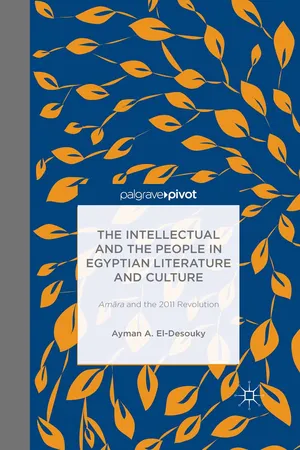
eBook - ePub
The Intellectual and the People in Egyptian Literature and Culture
Am?ra and the 2011 Revolution
- English
- ePUB (mobile friendly)
- Available on iOS & Android
eBook - ePub
The Intellectual and the People in Egyptian Literature and Culture
Am?ra and the 2011 Revolution
About this book
Information
Part I
The Intellectual and the Quest for Amāra
1
Amāra: Concept, Cultural Practice and Aesthetic
Abstract: El-Desouky explores the aesthetic force of the concept of amāra as a form of cultural practice, with emphasis not so much on its sociological or anthropological provenances but on its revelatory function in literature as a dimension of Egyptian social reality. The chapter offers analyses of literary representations of amāra and how they tend to focus on the image and role of the intellectual and the tension inhering in the mediatory function. The analysis will focus on two encounters in modern Egyptian literature between the intellectual fragmentary speech of truth and the larger social imaginary, and on the absence of the pivoting tally that is dramatized in these encounters. An example from the public life of intellectuals will also be offered.
El-Desouky, Ayman A. The Intellectual and the People in Egyptian Literature and Culture: Amāra and the 2011 Revolution. Basingstoke: Palgrave Macmillan, 2014. DOI: 10.1057/9781137392442.0006.
In my assessment, the stories of Yusuf Idris, and more generally his art, constitute an engaged attempt at figuring out the amāra and possessing it. That is, his is the attempt to recognize and master the law that enables the Egyptian people finally to claim the historical chair, the burden of which they have endured for ever so long, and to have the last word at the end.
Mahmoud Amin Al-‘Alim (1994, p.106)
Perhaps it is worth quoting Said once more on the question of literary representations of the intellectual: ‘It is in modern public life seen as a novel or drama and not as business or as the raw material for a sociological monograph that we can most readily see and understand how it is that intellectuals are representative, not just of some subterranean or large social movement, but of a quite peculiar, even abrasive style of life and social performance that is uniquely theirs’ (1994, p.14). Two key and relevant insights are articulated here. The first one has to do with the narrative construction of social reality. The second insight is a more indirect one. Said’s aside regarding the representation of ‘some subterranean or large social movement’ here hints at the history of intellectual attempts at representing the common people or the masses, always as social movement or as mobilized activity, always politicized, though, we might add here, not yet political or exercising their own power.1 I shall address the questions of collective agency and manifestations of the law to which al-‘Alim refers above in Chapter 3 and 4.
My aim here is to offer an analysis of two of the key encounters in modern Egyptian literature between the intellectual fragmentary speech of truth and the larger social imaginary and the absence of the pivoting tally that is dramatized in these encounters. First I shall introduce amāra as a form of cultural practice, with emphasis not so much on its sociological or anthropological provenances (there are no studies in either discipline as of yet). Emphasis will be on its revelatory function in literature as a dimension of Egyptian social reality. And then I shall explore the literary representation of amāra and how it tends to focus on the image and role of the intellectual, revealing their lines of possibility, and with that the tension inhering in the mediatory function. The question is fundamentally one of voice and of communication. Voice is formed out of encounter. The encounter is with the envisioned addressee/recipient in the dialogic context of the creative act or situation of speech. Said already implies this situation of encounter, which determines the efficacy of voice, when he speaks of the ever readiness for risk. The persistent identifiability of voice (for example, that it must be Sartre or Russell and no one else) is rooted in the rhythm of risk, the alertness to what is at stake, which triggers the intellectual’s vision as a personal impulse and a response to the situation. In narrative, the intellectual’s possibility of voice is imaged in the dramatization of the figure precisely in the moment of encounter, in the tension between representation and intervention.
It is precisely at this point of the encounter, when intellectual speech turns to those whose truth is being articulated, seeking direct communication, that amāra is called for. Something is revealed to be more at stake than even the courage to take risks, something perhaps beyond politicizing, historicizing or the sociological, something that has to do fundamentally with the very nature and act of communication. The aesthetic dimensions of social reality, collective modes of expression, popular cultural practices, and the resources of language and of cultural memory begin to acquire an unsettling sense of immediacy and of urgency. Remaining with the example of Sartre, a double irony is revealed in the language with which he, and de Beauvoir, sought to engage with Nasser in the name of a perceived common cause of liberation, decolonization and justice for the people. According to Haykal’s records of the meeting (19 March 1967), Sartre pleaded the cause of the Egyptian communist party (famous for its acronym, hadito), which has just been disbanded, in the name of the European left, disbelieving that such a party could have disbanded itself (as was declared by its members). Nasser responded: ‘What European Left are you talking about? Is it that of the French socialists, the very same ones who were complicit in the tripartite aggression on us in 1956, with the British occupation and with Israel?’ (Al-Qa’id, 2013, p. 355). (In fact, Nasser had also had to suffer Eden’s Oxonian Arabic, when he visited at the height of the crisis, which Eden sought to exercise as a token of good will.) The same stance regarding the position of truth happened also with de Beauvoir’s interrogations of Nasser on the status of Egyptian women in the name of Islam, which he easily defended (ibid., p. 353).2 This example is not offered by way of defending Nasser’s attack on the communists (which according to him was also out of fear of having localized Soviet agendas, or so the explanation goes). This is to stress the disparities in language, which also reveal disparities in knowledge of the local, and Egyptian intellectuals themselves were often all too aware of such disparities, beginning with the liberal agendas of the 1920s and 1930s. It is also to stress the fact that the question is not one of ‘insider’ and ‘outsider’ knowledge. Most Egyptian and Arab intellectuals hailed from the very same rural or urban poor milieu that would witness the breakdown in communication, and which they dramatized in their novels, such as Abel Rahman al-Sharqawi’s Al-fallah (‘The Peasant’), to mention but one famous example, when an illiterate peasant woman pleads with the ‘peasant intellectual’ (al-fallah al-muthaqqaf) Abdel Maqsud to speak ‘in words we can understand’ (Idris, 1992, p. 211).
Amāra as a cultural practice is specifically Egyptian, both in the use of the term and in the manner in which it is deployed in particular social situations. The terms amāra and amār have their roots in classical Arabic, originally denoting a pile of stones set up in a waterless desert to signal the right direction to those who may have lost their way (according to al-Fayrūzābādī’s lexicon, al-Qāmus al-muḥīṭ and Edward Lane’s Arabic-English Lexicon). Amāra has also evolved into denoting signs, marks, signposts or elevated ground and has come to indicate an appointed time – lexical metaphors rather appropriate for the resonant revolutionary acts that we were to witness in Tahrir, and behind which there is the longer stretches of the creative forms of popular imagination.3 It is historically significant, though, that the same root, A/Hamza-M-R, also offers a whole range of derivatives, among others, that denotes power and ruling, with the difference hinging on the short vowel that follows the initial hamza. If the short vowel ‘i’ is inserted following the initial hamza, we have the range of imara, or princedom, rule, regime, or amir, prince, ruler over a sizable group or domain. But if we insert the short vowel ‘a’ after the hamza we have the range of amār and amāra as I have defined them here. The terms amār and amāra are no longer as current in contemporary standard usage, and the currency and popularity the term amāra has in Egyptian colloquial Arabic is unique among other Arabic dialects.
The specific usages current in Egyptian Arabic have been noted by El-Said Badawi and Martin Hinds in their Dictionary of Egyptian Arabic, defining it as sign or indication or as evidence of good faith, an example of which is given from everyday mundane practice: ‘give me an amāra so that your home helper will let me into your flat’. This example of a social amāra captures the potential range of the forms of amāra as either particular signs or details and information only the participants are privy to, or as a narrative of an incident known only to them. The visual forms of recognition are encapsulated in the stock phrase ‘on his face are the amārāt of ...’ (‘ala wishshu amārāt ...). The narrative offered in the exchanges, emphasizing a shared identity or a common bond, usually begins with the stock phrase: ‘by the amāra of ...’, which traverses social boundaries. Amāra forms, verbal, visual and gestural, thus encompass the social imaginary of identity, involving the force of cultural memory, popular practices, the subconscious of traditions, the cumulative force of historical experience, transactions of the everyday, the social spheres of religious practices, the horizontal leaps of faith (vs. vertical metaphysical).
As I shall explain in Chapter 4, the import of this unspoken phrase was transmuted into the lexical and syntactic patterns of the slogans and the visual iconicity of the signs, street art and performances on Tahrir Square, and beyond. Unspoken but extending into the dimensions of social reality, invisibly as in the suggested extension of a gesture, amāra constructions offered the forms in which the verbal as well as visual resonances that seemingly individual and disparate singular acts have struck with the collective Egyptian imaginary. The agency of socially cementing modes of speech and of action lies in the production of these amāra forms, and as a specifically Egyptian concept and practice of connective agency it is at the heart of what Caroline Rooney has also been investigating under an ‘ethic of solidarity’ (2011).
Analysing two significant moments of encounter, two acts of intervention in modern Egyptian literature, can help us draw a typology for the intellectual’s image of voice, the signature and act of intervention. The first is that of the young urban intellectual in the early story by Mahmoud Tahir Lashin, ‘Hadith al-qarya’ (‘Village Small Talk’, published circa 1929) in his encounter with simple Egyptian peasants and his ardent desire to speak their own truth to them. The second is a symbolic encounter rendered in an allegorical short story by Yusuf Idris, ‘Hammal al-karasi’ (‘The Chair Carrier’, written in 1968). The story by Lashin prefigures the dilemmas of the later generation of realist and committed writers in the 1950’s. Idris’ story offers itself as an allegory of the intellectual’s crisis, a crisis of voice par excellence, which is symbolized by the bewildered narrator’s inability to produce the amāra, or ‘token of intervention’ – to render the term loosely for the time being – for the miraculously surviving Ancient Egyptian.
In both accounts the moment of encounter is intense and demystifying, as the act of intervention leads to a radical experience of self-encounter. No final solution is offered, but the moving dramatization of the crisis of voice reveals a strong sense of urgency in its trail. To look for the amāra that would effect historical intervention is, on the writerly side, to look for the possibilities of voice, to devise new narrative strategies for self-placement in mirrored metonymic (historical) or metaphoric (mythical and existential) universes. While this mode of writing has eventually led to more experimental (especially in post-1967 literature) forms of literary practice, it has continued somehow secure in its sense of relevance and urgency, pointing more and more to the gap left by the receding master nationalist and ideological projects. The political imagination that is portrayed in the literature is also at work in the public life of intellectuals. A third moment of encounter is offered from the public life of intellectuals in the 1990s, involving the figures of Nasr Hamid Abu Zayd and Muhammad ‘Imara.
The figure of the intellectual as national pathology
In modern Egyptian literature, the national imaginary of the people began to take literary shape in the form of an aesthetic of urgency in the first two decades of the twentieth century. The most famous examples from this early literary history are: Mahmoud Taher Haqqi’s The Maiden of Denshaway (1906), Muhammad Husayn Haykal’s Zainab (1914/1916; also his short stories, some of which take place in Ancient Egypt, and critical studies on national literature), Tawfiq al-Hakim’s The Return of the Spirit (1919; prefaced with an epigraph culled from the Ancient Egyptian Book of the Dead). These works, long since canonized in literary history, happen to represent not only some of the first experiments in the novel form, but also offering some of the first treatments of the national collective. The 1906 incident in the village of Denshaway in Lower Egypt and the ensuing public trials, the 1919 Revolution, with women and all factions of the Egyptian society out on the streets, and the popularly followed court case in 1926 over the treasuries of Tutankhamen, all these incidents would rally the consciousness of the nation. The systematic investigation of the relation between literature and the national imaginary was perhaps best illustrated in the programmatic vision of Mahmoud Taher Lahsin and the New School4, where in the 1920s we see for the first time the aesthetic dimension emerging as an agent in social reality comparable to the historical, the political, the religious and the economic (Hafez, 1993). The drive for an ‘adab qasasi qawmi’ (‘national narrative art’), the realism of themes, styles and social typologies of characters all serve the exhilarating discovery of the power of art, seen in the intervention of the artist through the power of articulation and dramatization in narrative. A similar tendency in poetry would take almost two decades to begin to emerge (in the 1940s, with Louis Awad and the Iraqi school of free verse, Nazik al-Mala’ika, Badr Shakir al-Sayyab and Abdel Wahab al-Bayyati).
In 1925, the group decided to establish a literary and critical review to promote their vision for the role of literature and in particular the short story, to which they gave the significant tile of Al-Fajr, Sahifat al-Hadm wa al-Bina’ (‘The Dawn: A Journal for Destruction and Building’) (Hafez, 1993, pp. 217–19). The weekly Al-Fajr had a committed vision, social and political, offering anatomies of social life through the thematic treatment of social issues and what they called ‘ideal types’. Hafez explains how as an avant-garde paper Al-Fajr:
established new criteria in dealing with literature not as something incidental to political and ideological writing, but as a significant independent activity. This enriched both creative literature and criticism. These new criteria also underlined the relationship between literary work and the other media of artistic expression. The emphasis shifted from the political relevance of the work to its artistic form, without sacrificing its social or edifying role, and a new concept of regional literature was created which was not confined by the limitations of ‘local colour’, but was capable of portraying the human aspects of mature Egyptian characters and scenes. The new criteria also affirmed the role of selectivity in representation, stressed the power of imagination, and the subtlety of the sophisticated relationship between art and reality. (1993, p. 218)
It was in the works of Lashin, Hafez further argues, that such a vision achieved its mature expression (1993, p. 218). Lashin was the only member of the group to publish two collections, Sukhriyyat al-nayy (‘The Mocking Flute’, 1926) and Yuhka anna (‘Once Upon a Time’, 1929/1930). ‘The central aim of his work,’ Hafez notes, ‘appears to be a literary survey of social life in Egypt in order to integrate the short story into the country’s social and cultural consciousness and indirectly expose its social problems and defects’ (1993, p. 219). In these two collections, Lashin does indeed offer a whole range of urban, mostly middle and lower cla...
Table of contents
- Cover
- Title
- Introduction: Intellectuals, Representation, Connective Agency
- Part I The Intellectual and the Quest for Amra
- Part II The People and the Amra of Connective Agency
- Postscript: Ih.n al-mas.riyyn and al-shab: The Untranslatabilities of Conceptual Languages
- Bibliography
- Index
Trusted by 375,005 students
Access to over 1.5 million titles for a fair monthly price.
Study more efficiently using our study tools.
Frequently asked questions
Yes, you can cancel anytime from the Subscription tab in your account settings on the Perlego website. Your subscription will stay active until the end of your current billing period. Learn how to cancel your subscription
No, books cannot be downloaded as external files, such as PDFs, for use outside of Perlego. However, you can download books within the Perlego app for offline reading on mobile or tablet. Learn how to download books offline
Perlego offers two plans: Essential and Complete
- Essential is ideal for learners and professionals who enjoy exploring a wide range of subjects. Access the Essential Library with 800,000+ trusted titles and best-sellers across business, personal growth, and the humanities. Includes unlimited reading time and Standard Read Aloud voice.
- Complete: Perfect for advanced learners and researchers needing full, unrestricted access. Unlock 1.5M+ books across hundreds of subjects, including academic and specialized titles. The Complete Plan also includes advanced features like Premium Read Aloud and Research Assistant.
We are an online textbook subscription service, where you can get access to an entire online library for less than the price of a single book per month. With over 1.5 million books across 990+ topics, we’ve got you covered! Learn about our mission
Look out for the read-aloud symbol on your next book to see if you can listen to it. The read-aloud tool reads text aloud for you, highlighting the text as it is being read. You can pause it, speed it up and slow it down. Learn more about Read Aloud
Yes! You can use the Perlego app on both iOS and Android devices to read anytime, anywhere — even offline. Perfect for commutes or when you’re on the go.
Please note we cannot support devices running on iOS 13 and Android 7 or earlier. Learn more about using the app
Please note we cannot support devices running on iOS 13 and Android 7 or earlier. Learn more about using the app
Yes, you can access The Intellectual and the People in Egyptian Literature and Culture by Kenneth A. Loparo,Ayman A. El-Desouky in PDF and/or ePUB format, as well as other popular books in Politics & International Relations & African Literary Criticism. We have over 1.5 million books available in our catalogue for you to explore.