This book examines Israel's relationship and political decision-making process towards the Occupied Territories from the aftermath of the Six Day War to the Labour Party's electoral defeat in 1977.
The period represents the first decade of Israel's occupation of the Occupied Territories and the last decade in which the Labour Party was Israel's most dominant political force.
Arguing that the successive Israeli governments headed by the Labour Party lacked a strategic policy towards the Occupied Territories to address the country's objectives and needs, this book demonstrates the detrimental effect this had on Israel, on the Middle East in general, and on the Palestinian people in particular.
In addressing key aspects of decision making pathologies, this book raises issues which remain important features of Israeli politics today and an analysis relevant for political decision making worldwide.
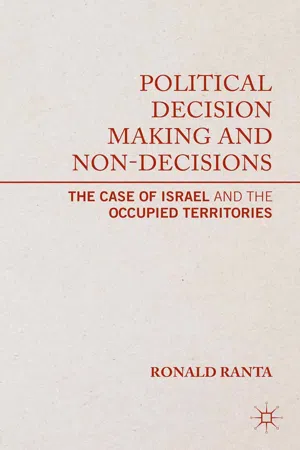
eBook - ePub
Political Decision Making and Non-Decisions
The Case of Israel and the Occupied Territories
- English
- ePUB (mobile friendly)
- Available on iOS & Android
eBook - ePub
About this book
Information
1
Early Days
The war
In his memoirs, Defence Minister Moshe Dayan criticised the conduct of the government and the army in the period leading up to and during the war. He accused Prime Minister Levi Eshkol of mismanaging the country and of being over-reliant on the US. Dayan claimed that the government under Eshkol did not complement the army’s operational plans with coherent strategic objectives. According to Dayan, the war was the least planned and the worst prepared in Israel’s history. Reactions to the day-to-day events determined the direction of the war, though he acknowledged that the army was successful at exploiting the chances that came its way.1
On 1 June 1967, Dayan took his place as Israel’s new defence minister, replacing Eshkol.2 This followed a week of intense political manoeuvring within both the coalition and the opposition parties. It came about as a result of Eshkol’s perceived paralysis in the face of an unfolding crisis – one that started with Egyptian President Gamal ‘Abdel Nasser’s decision to move troops into the demilitarised Sinai Peninsula and close the Straits of Tiran. After a particularly embarrassing incident, in which Eshkol seemed to stutter and stumble during a live radio broadcast that was meant to reassure the nation, public confidence in him evaporated. Demands for his removal from office were made by members of the opposition, the press, the army and even his own Mapai Party members.3 Threats to dissolve the ruling coalition were made by several parties, in particular Mapai’s coalition partner the National Religious Party (NRP). They demanded the formation of a national unity government that would include Rafi and Gahal, and the removal of Eshkol from the Defence Ministry, which, incidentally, was also one of the preconditions set by both Rafi and Gahal. Dayan was the opposition’s preferred candidate.4
Former chief-of-staff and the architect of Israel’s successful conquest of the Sinai Peninsula during the Suez crisis, Dayan, with his many years of military service during the pre- and post-state period, cut a very different figure from Eshkol. With his famous eye-patch5 and war hero status, kibbutz born and bred Dayan represented the new resourceful and confident native Jew (Tzabar). In contrast, 72-year-old Prime Minister Eshkol represented a different generation. Eshkol immigrated to Palestine in 1914 from Russia, and was a life-long bureaucrat and politician famous for his organisational skills and for establishing Israel’s national water company. His supporters considered him a cautious and calculated operator who enjoyed colouring his sentences with Yiddish sayings. His detractors pictured him as hesitant and indecisive; a popular joke told of his secretary asking him whether he wanted coffee or tea, to which he replied ‘half and half’.
Contrary to popular perception, the formation of the national unity government and the inclusion of Dayan as defence minister did not hasten the decision to go to war. This decision came as a result of the inability of the US administration, headed by President Lyndon Johnson, to put forward a constructive solution to the diplomatic impasse that had been reached. Despite the army’s top brass clamouring for action, and existential fears for the country expressed by the press, Eshkol tried to avoid war. He, as well as most of the ministers, believed that the army would win the war, but feared large casualty numbers and an international backlash if Israel went ahead without America’s approval. The final decision came on 3 June 1967, during Meir Amit’s (Head of Mossad) mission to Washington, where he received what was understood to be a ‘yellow light’ for operations against Egypt.6
Israel’s war plan, in response to the Egyptian troop build-up, was clear from the outset. It called for a pre-emptive air strike to neutralise the Egyptian air force followed by a three-pronged armoured thrust into Sinai, sweeping through the Egyptian stationary defensive set-up, and advancing towards the Suez Canal.7 The Israeli war planners had their sights set firmly on the Egyptian front; Israeli Defence Force (IDF) units on the borders with Jordan and Syria were ordered to remain in defensive positions. This was done despite warnings from AMAN (the IDF’s intelligence unit) that Jordan and Syria might be tempted to ‘bite the bullet’ and join the war.8 As a precautionary measure, the Israeli government sent a message to King Hussein not to interfere with the war, promising in return to honour Jordan’s territorial integrity.9
Having examined the plans, Dayan requested that several changes be made. He wanted the IDF to surround the Gaza Strip but not enter it. Dayan felt that conquering the Gaza Strip would be unwise, referring to the Gaza Strip as a ‘nest of wasps’ bristling with problems.10 Dayan also felt that the army needed to take Sharm el-Sheikh and secure the Straits of Tiran, arguing that the war was fought over the right of passage through the straits. Furthermore, fearing a war on several fronts, he warned the army generals not to get Israel entangled in a war over the West Bank or Jerusalem. The first digression from the plan occurred early on the first day of fighting (5 June 1967). Major-General Yeshayahu Gavish, head of Israel’s Southern Command, sent an urgent request to Chief-of-Staff Yitzhak Rabin for permission to send troops to occupy the Gaza Strip. Gavish complained that Israeli troops were coming under fire from Egyptian and Palestinian forces in the Strip. Knowing Dayan’s predisposition towards Gaza, Chief-of-Staff Yitzhak Rabin decided to approve Gavish’s request without consulting him.11
Encouraged by misleading early reports from Nasser of Egyptian military success against Israel, Syria and Jordan decided to join the war. King Hussein, normally a very cautious and calculated political operator ordered Jordanian air force and artillery units to attack Israeli targets in and around West Jerusalem, reaching as far as the outskirts of Tel Aviv, while Syrian artillery shelled northern Israel. However, by the time their forces entered the war the Egyptian army was ‘on the ropes’; its air force had been eliminated in a series of pre-emptive air strikes, while its ground forces were rolled back by the rapidly advancing Israeli armoured thrust.12 Dayan’s fears of a multiple-front war became a reality. Yet, despite the attacks, he called for restraint and warned against diverting troops to the new fronts before the army was allowed to conclude its operations against Egypt. Additionally, the Israeli government tried to invalidate one of the newly created fronts by sending King Hussein a message, imploring him to cease all hostilities; by his own admission, Hussein refused.13
As the situation on the Egyptian front and the scale of Egypt’s impending defeat became clearer, the voices calling on the IDF to divert attention to the Jordanian front grew louder. In a cabinet meeting, Employment Minister Yigal Allon and Minister without Portfolio Menahem Begin (leader of the Gahal Party) declared that this was a historic opportunity for Israel; they urged the government to order the immediate conquest of East Jerusalem and the West Bank.14 Eshkol appeared to side with the duo, but demanded time to consider the diplomatic repercussions of such an act.15 Several ministers were against the conquest of East Jerusalem, including Foreign Minister Abba Eban, and the NRP Ministers Haim-Moshe Shapira (Interior) and Zerach Warhaftig (Religion). Shapira and Education Minister Zalman Aran suggested that the government consider handing over the city, once it had been occupied, to international jurisdiction.16 Shapira would later claim he meant for international jurisdiction to be applied only to the holy places. Eshkol commented that even if Israel took over the West Bank and East Jerusalem, it would have to withdraw from these areas in the end.17
During the second day of the fighting, the government convened to discuss its options, with ministers voting for the conquest of the Samaria (northern West Bank) mountain range, stretching from Jerusalem to Jenin,18 and for the army to seize the city of Hebron, as well as to surround the Old City of Jerusalem. A government vote on whether to storm the Old City ended in a draw.19 During the meeting, Amit inquired whether Israel would seek to annex the West Bank and wanted to know more about the diplomatic state of affairs the government would have to face should the worst come to the worst. According to Amit, the lack of strategic planning was characteristic of the Eshkol government, during and after the war.20 At the same time, realising the extent to which the situation had deteriorated, King Hussein implored the US and British governments to intervene on his behalf and impose a ceasefire, citing his fear for the survival of his Hashemite kingdom.21 Eshkol offered Hussein a way out, but demanded that the king agree to immediate peace talks; a generous proposition, but one to which Hussein could not agree.22 From the king’s perspective he was between a rock and a hard place. If he ordered his army to stop fighting, and the Arab side lost the war, he would be blamed for the defeat. If the Arab side won and his army stopped fighting, there is every indication that the victorious armies would have continued towards Jordan to liberate it from his rule.
After agreeing to postpone the conquest of the Old City, the ministers deliberated over the Syrian front. Dayan argued against opening another front; he warned against antagonising Syria’s Soviet patrons. According to Dayan, the Syrian army had not advanced into Israel and its artillery attacks on northern Israel were manageable and did not pose an imminent threat. On this issue, Dayan became increasingly isolated. The majority of ministers were in favour of dealing with the Syrians ‘once and for all’, as were Rabin and Major-General David ‘Daddo’ El‘azar, head of the Northern Command, but all agreed to leave the final decision to Dayan and Eshkol.23
One of the main concerns expressed by ministers was of a possible international condemnation – a fear which increased with every new territory conquered, but one which eventually turned out to be totally misplaced. The US administration was starting to accept that some territories would remain in Israel’s possession. During the first days of fighting, Walt Rostow (the National Security Advisor) wrote to President Johnson suggesting that the US should act, upon the cessation of violence, to find a permanent solution to the Middle East problem, adding that the US should not allow for a return to the pre-war borders.24 The US position was further clarified when Walworth Barbour (US ambassador to Israel), while conveying King Hussein’s urgent request for a ceasefire to Eshkol, did not seek an Israeli commitment on the West Bank. In Barbour’s view it was too late.25
In the early hours of the morning, on 7 June, Eshkol was informed that the UN Security Council had agreed to a general ceasefire that would come into effect at 22.00 later that night. Eshkol immediately called Dayan, ordering him to send the army into the Old City of Jerusalem and complete the conquest of the West Bank. At a ministerial-level meeting later that morning, Dayan announced that orders had been given to storm the Old City.26 Despite a Jordanian acceptance of the UN-brokered ceasefire, fighting in and around the city continued throughout the morning. Israeli officials claimed that as long as the ceasefire was not agreed to by Egypt and Syria, the fighting would go on. Around late afternoon, news that the IDF had managed to seize the Old City of Jerusalem prompted a mad rush of government ministers to the site. Dayan, initially sceptical about the need to conquer the Old City, and wanting to avoid what he called ‘all that Vatican’, was the first on the scene. In full military attire and accompanied by Head of the Central Command Major-General Uzi Narkiss and Rabin, he was the first minister photographed entering the Old City, stealing the limelight from Eshkol in the process. According to Dayan, Israel had returned to its holiest places ‘returned in order never to be separated from them again’.27 By night time the majority of the West Bank was in Israeli hands. Eshkol commented that ‘these were historic days for Israel and for the Jewish people’.28 He expressed his views regarding the territories several times that day, professing a deep desire to keep the Gaza Strip as part of Israel, referring to it as ‘a lily with many thorns’, while examining the possibility of relocating its population.29
On 8 June, the daily broadsheet Ha‘aretz asked the government, in its editorial, to complete the task and conquer the Golan Heights. Goaded on by the press, the entire leadership appeared to be in frenzy for further conquests. Allon claimed that he did n...
Table of contents
- Cover
- Title
- Copyright
- Contents
- Acknowledgements
- Abbreviations
- Maps
- Introduction
- 1 Early Days
- 2 The ‘Wall-to-Wall’ Coalition
- 3 ‘I don’t know, I am looking for someone who does!’
- 4 The Best Man in the Government
- 5 Golda’s Kitchenette
- 6 The Grand Debate
- 7 Hand Picked
- 8 Submission to Gush Emunim
- Conclusion
- Epilogue
- Notes
- Bibliography
- Index
Trusted by 375,005 students
Access to over 1.5 million titles for a fair monthly price.
Study more efficiently using our study tools.
Frequently asked questions
Yes, you can cancel anytime from the Subscription tab in your account settings on the Perlego website. Your subscription will stay active until the end of your current billing period. Learn how to cancel your subscription
No, books cannot be downloaded as external files, such as PDFs, for use outside of Perlego. However, you can download books within the Perlego app for offline reading on mobile or tablet. Learn how to download books offline
Perlego offers two plans: Essential and Complete
- Essential is ideal for learners and professionals who enjoy exploring a wide range of subjects. Access the Essential Library with 800,000+ trusted titles and best-sellers across business, personal growth, and the humanities. Includes unlimited reading time and Standard Read Aloud voice.
- Complete: Perfect for advanced learners and researchers needing full, unrestricted access. Unlock 1.5M+ books across hundreds of subjects, including academic and specialized titles. The Complete Plan also includes advanced features like Premium Read Aloud and Research Assistant.
We are an online textbook subscription service, where you can get access to an entire online library for less than the price of a single book per month. With over 1.5 million books across 990+ topics, we’ve got you covered! Learn about our mission
Look out for the read-aloud symbol on your next book to see if you can listen to it. The read-aloud tool reads text aloud for you, highlighting the text as it is being read. You can pause it, speed it up and slow it down. Learn more about Read Aloud
Yes! You can use the Perlego app on both iOS and Android devices to read anytime, anywhere — even offline. Perfect for commutes or when you’re on the go.
Please note we cannot support devices running on iOS 13 and Android 7 or earlier. Learn more about using the app
Please note we cannot support devices running on iOS 13 and Android 7 or earlier. Learn more about using the app
Yes, you can access Political Decision Making and Non-Decisions by R. Ranta in PDF and/or ePUB format, as well as other popular books in Politics & International Relations & Middle Eastern History. We have over 1.5 million books available in our catalogue for you to explore.