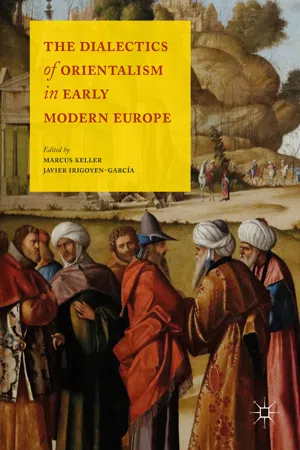
Uniting twelve original studies by scholars of early modern history, literature, and the arts, this collection is the first that foregrounds the dialectical quality of early modern Orientalism by taking a broad interdisciplinary perspective. Dialectics of Orientalism demonstrates how texts and images of the sixteenth and seventeenth century from across Europe and the New World are better understood as part of a dynamic and transformative orientalist discourse rather than a manifestation of the supposed dichotomy between the 'East' and the 'West.' The volume's central claim is that early modern orientalist discourses are fundamentally open, self-critical, and creative. Analyzing a varied corpus-from German and Dutch travelogues to Spanish humanist treaties, French essays, Flemish paintings, and English diaries-this collection thus breathes fresh air into the critique of Orientalism and provides productive new perspectives for the study of east-west and indeed globalized exchanges in the early modern world.
eBook - ePub
The Dialectics of Orientalism in Early Modern Europe
- English
- ePUB (mobile friendly)
- Available on iOS & Android
eBook - ePub
The Dialectics of Orientalism in Early Modern Europe
About this book
Information
Orientalist Epistemologies
© The Author(s) 2018
Marcus Keller and Javier Irigoyen-García (eds.)The Dialectics of Orientalism in Early Modern Europehttps://doi.org/10.1057/978-1-137-46236-7_2A Captive Library Between Morocco and Spain
Oumelbanine Zhiri1
(1)
University of California, San Diego, USA
Oumelbanine Zhiri
Professor of French and Comparative Literature at the University of California, San Diego. She specializes in early modern culture, including travel literature and geography, comparative studies in European, North African and Middle Eastern cultures, and the history of Orientalism. She has published books and articles on Leo Africanus, François Rabelais, and Arab-European cultural interactions. In her current research, she is interested in mapping the development of European early modern Oriental studies in a transcultural context, as a circulation of objects, manuscripts, knowledge, and people across civilizations.
In early modern Europe, the academic field of Oriental studies developed considerably as part of a broader interest for Antiquity and history, and, during the first half of the seventeenth century, was in the process of establishing its enduring institutional bases. A growing number of scholars were deeply engaged in the study of the cultures and languages of the East; Hebrew, Arabic , and related languages were taught in some universities; publishers were offering readers dictionaries, grammar books, and classical texts. This vast enterprise depended essentially on the ability to obtain manuscripts in the languages of the Orient. Scholars eagerly sought to collect documents from the East that would allow them to further their studies, which was not an easy task. Europeans who were interested in the Orient would attempt to create exchange networks that included travelers and missionaries in Eastern countries, as well as local scholars, to be able to acquire manuscripts. In this way, public and private collectors were working diligently to augment the Oriental holdings in European libraries.
However, many manuscripts from the East found their way to Europe in a much less peaceful manner. The development of Oriental studies in early modern Europe is inseparable from the circumstances of “cold war” 1 that prevailed in the unstable border zone between Christendom and Islam, particularly in the Mediterranean. 2 A considerable number of texts ended up in European collections as spoils of war or as the result of piracy. 3
The most important and prestigious of those bounties was deposited at the library of the Spanish royal palace of El Escorial in 1614. Its story is recorded in many archival documents; some of them have been published, and in all likelihood, more are still awaiting discovery. This information allows us to better map out the geographies of Oriental studies in early modern Europe. On one hand, it helps present a more nuanced view of the field’s development in various regions of Europe; on the other hand, it leads us to consider the multiple routes through which persons and objects circulated between the Orient and the Occident. The acquisition of manuscripts and other artifacts in the Ottoman Empire and the Eastern Mediterranean have been particularly scrutinized. 4 Yet scholars rarely consider Morocco as a point of origin, even though a large part of the Escorial Arabic library originated there. Indeed, Morocco belongs to an area that has been described as an “archetypal Mediterranean frontier,” 5 a region where Islam and Christendom had interacted and even mingled for centuries. After the end of the Reconquista in 1492, this boundary became increasingly rigid, but the contact between the shores did not come to an end, although it took new forms. Morocco , as the immediate neighbor of imperial Spain, and often its victim, inevitably became involved in European politics, and the sultans energetically pursued diplomatic relations with the competitors of Spain , such as England, France, and the United Provinces. The peaceful or more violent interactions allowed for cultural exchanges and impacted the development of European Oriental studies, as the account of the Arabic fund in the Escorial reveals.
A Royal Library on the Ocean
The collection deposited at the Escorial in 1614 first belonged to the Moroccan sultan Mulay Zaydân of the Sa‘dî dynasty (r. 1603–1627) who had inherited the bulk of it from his powerful and learned father, Ahmad al-Mansûr. When the latter died in 1603, the power of Zaydân was unsteady, and for many years he remained fiercely contested by several contenders. 6 In 1612, the agitator Abû Mahallî forced Zaydân to flee his capital Marrakesh and to retreat to Safi on the Atlantic coast. The sultan took with him his valuables, such as luxurious jewelry and clothes, as well as his beloved library , and hired Jean-Philipe Castelane to put his treasure in a safe place. Castelane was a privateer from Marseilles who was also the representative of the French monarchy in Morocco , and had just signed a treaty of alliance with Zaydân in the name of the king of France, as is confirmed by a letter dated February 13, 1612, written by the sultan and addressed to his agent Samuel Pallache. 7 On June 14, 1612, Castelane’s ship, the Notre-Dame de la Garde, left Safi and on the same day arrived at Agadir, another Atlantic port, where Zaydân’s property was to be discharged. However, on the night of June 22, possibly because of a disagreement over payment, the privateer ordered the ship to sail from Agadir with the cargo still on board. On July 5, it encountered a squadron of Spanish vessels belonging to the fleet of Don Luis Fajardo, admiral of the Spanish Armada. Ship, crew, and cargo were seized by the Spaniards. 8
The matter was first judged by a Cádiz court, and then adjudicated again by the Spanish Council of State. Both declared that the seizure was legal. 9 The consequences of the incident would be far-reaching: for years, the library in particular would be the object of intense diplomatic maneuvering and correspondence between Morocco, Spain , France, and the Netherlands; the Moroccans, with the help of their Dutch allies, would unsuccessfully try to obtain restitution from the French and the Spaniards; and the affair would poison the relationship between Morocco and France. Considering that the French crown was responsible for the theft because it was perpetrated by one of its representatives, Zaydân ordered the arrest of many French subjects residing in his territories, and it took decades for the situation to be finally resolved. 10 The sultan and his successors tried several times to gain the return of the library through ransom or in exchange for Spanish captives held in Morocco, although in vain. Currently, what remains of Mulay Zaydân’s collection is still held at the Escorial.
Moroccan ambassadors, who were sent to Spain to negotiate the liberation of captives or peace treatises, also showed interest in the Escorial’s library and the Arabic books held in Spain, and wrote about them in their travel accounts. 11 For them, and for other Muslim travelers to Spain, the Arabic manuscripts kept in Spain were a painful symbol of the Andalusi paradise lost, that most seemed to barely distinguish between the books left behind in the peninsula after the completion of the Reconquista and the stolen library of Mulay Zaydân.
European Fantasies
In Europe, the booty taken from the sultan became the site of imaginary constructions, as is attested to by the title of a slim volume about the troubles in Morocco, told in verse by Antonio de Vía and published in 1612, the very year of the capture . In its title, the pamphlet mentions the “flight of Mulay Zaydân, and how he loaded his treasure on three ships, among which was a scepter, a golden crown, inestimable diamonds, clothes, and imperial ornaments; his intent was to crown himself Emperor of Marrakesh, and then his fate changed; and how, when disembarking at La Mamora, the general of ships from Dinkerk, there for the service of the King our Lord, seized the ship that contained the treasure, another ship got burned, and the last was defeated and took flight.” 12 The crown and the scepter were not symbols of sovereignty for the Sa‘dî dynasty, although other early texts attest to the belief in the presence of these imaginary objects in the seized bounty. In a letter addressed to minister Puisieux, the French ambassador in Madrid, Vaucelas wrote that according to a witness, “in one crate opened by this Fajardo, there was a scepter and a crown estimated to seventy thousand ecus.” 13 Those rumors made the bounty even more valuable than it really was, both in monetary and symbolic terms. Interestingly, the 1612 pamphlet’s title did not even allude to the library, which became the main issue of contention. The pamphlet’s author and potential readers might have been unaware of how the possession of books could add to the prestige of a ruler, not to mention their scholarly value. 14
Given the state of Oriental studies in Europe in the early seventeenth century, one would think that the presence of the royal library on European soil would have proved to be a boon for the development of th...
Table of contents
- Cover
- Frontmatter
- Introduction: The Dialectics of Early Modern Orientalism
- 1. Orientalist Epistemologies
- 2. Empire and Its Orients
- 3. Orientalism and the Idea of Europe
- 4. Visual Dialectics
- Backmatter
Trusted by 375,005 students
Access to over 1.5 million titles for a fair monthly price.
Study more efficiently using our study tools.
Frequently asked questions
Yes, you can cancel anytime from the Subscription tab in your account settings on the Perlego website. Your subscription will stay active until the end of your current billing period. Learn how to cancel your subscription
No, books cannot be downloaded as external files, such as PDFs, for use outside of Perlego. However, you can download books within the Perlego app for offline reading on mobile or tablet. Learn how to download books offline
Perlego offers two plans: Essential and Complete
- Essential is ideal for learners and professionals who enjoy exploring a wide range of subjects. Access the Essential Library with 800,000+ trusted titles and best-sellers across business, personal growth, and the humanities. Includes unlimited reading time and Standard Read Aloud voice.
- Complete: Perfect for advanced learners and researchers needing full, unrestricted access. Unlock 1.5M+ books across hundreds of subjects, including academic and specialized titles. The Complete Plan also includes advanced features like Premium Read Aloud and Research Assistant.
We are an online textbook subscription service, where you can get access to an entire online library for less than the price of a single book per month. With over 1.5 million books across 990+ topics, we’ve got you covered! Learn about our mission
Look out for the read-aloud symbol on your next book to see if you can listen to it. The read-aloud tool reads text aloud for you, highlighting the text as it is being read. You can pause it, speed it up and slow it down. Learn more about Read Aloud
Yes! You can use the Perlego app on both iOS and Android devices to read anytime, anywhere — even offline. Perfect for commutes or when you’re on the go.
Please note we cannot support devices running on iOS 13 and Android 7 or earlier. Learn more about using the app
Please note we cannot support devices running on iOS 13 and Android 7 or earlier. Learn more about using the app
Yes, you can access The Dialectics of Orientalism in Early Modern Europe by Marcus Keller, Javier Irigoyen-García, Marcus Keller,Javier Irigoyen-García in PDF and/or ePUB format, as well as other popular books in History & European History. We have over 1.5 million books available in our catalogue for you to explore.