eBook - ePub
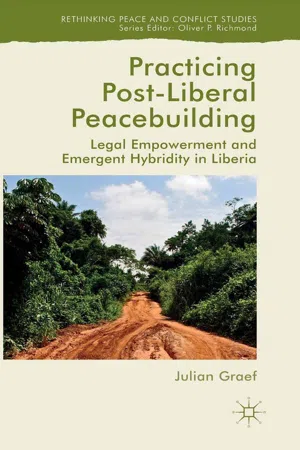
Practicing Post-Liberal Peacebuilding
Legal Empowerment and Emergent Hybridity in Liberia
- English
- ePUB (mobile friendly)
- Available on iOS & Android
eBook - ePub
Practicing Post-Liberal Peacebuilding
Legal Empowerment and Emergent Hybridity in Liberia
About this book
Practicing Post-Liberal Peacebuilding engages with one of the central debates in Peace and Conflict Studies and International Relations. The book's innovation lies in the introduction and application of 'practice theory' to develop a critical methodology for mapping the everyday practices of post-liberal hybridity in Liberia.
Information
Part I
A Practice-Based Theory of Peacebuilding
1
A Genealogy of Hybridity in Peace and Conflict Studies
This chapter traces the emergence of hybridity in the PCS literature. Using a genealogical approach, it maps how the concept of hybridity was translated into PCS and how it was continually re-appropriated by different scholars in order to explain the complex and dynamic processes at play in peacebuilding environments. In the process, the chapter reviews how the transformative properties of hybridity gradually became trapped by the liberal–local distinctions that framed the debate in PCS. However, it also reveals how the recent post-liberal turn in PCS provides opportunities to move the concept of hybridity beyond the liberal–local binary. A post-liberal understanding of hybridity engages with the emerging hybrid processes that are actively displacing and transforming what peace amounts to in the post-liberal world.
This genealogy explores the debate about what hybridity is. In the process, this genealogy unpacks what hybridity means in PCS, uncovers the epistemological boundaries developed to understand the relationship between power and emancipation and then exposes how the meaning of hybridity has been retranslated to cope with the complex process reshaping what the post-liberal world is becoming. Foucault describes a genealogy as ‘a form of history which can account for the constitution of knowledges, discourses, domains of object etc., without having to make reference to a subject which is … transcendental in relation to the field of events’.1 Such an approach exposes regimes of truth to the contingent, emergent politics underlying their perceived stability. Using this approach, this chapter grounds the production of knowledge about hybridity within the PCS debate in order to explore how the concept of hybridity became captured by the very liberal–local distinction which post-liberal hybrid processes unsettle and redefine. This genealogy traces the meaning of hybridity through a series of translations. These translations highlight how the international–local distinction at the heart of hybridity is both preserved and subtly redefined by PCS scholars as they struggle to develop better ways to represent the unstable relationship between exercises of power and emancipatory agency in peacebuilding interventions. Through this process, the genealogy exposes the paradox of hybridity: by their very nature, emergent hybrid processes transcend and transform the theoretical and epistemological shapes designed to explain them. Consequently, explanatory hybridity can function to reproduce and reify the liberal–local binary, potentially obscuring the very emerging hybrid processes actively shaping what peace and peacebuilding amount to in the post-liberal world.
This argument is presented in three sections. The first part engages with how the liberal peace was debated between problem-solving and critical approaches amid the so-called liberal peace ‘crisis’ in the early to mid-2000s.2 The second section reviews how the complex interactions between international peacebuilding and local agency were explained through the concept of hybridity. This section also highlights how explanatory hybridity has reinforced the very distinctions that hybrid processes contest and upset. The final section points to some of the work being undertaken to address the potentially essentializing and reductive effects of explanatory hybridity within the nascent post-liberal paradigm.3
From the liberal peace to the local
Prior to the ascendance of the hybrid paradigm, it was ‘the liberal peace’ that defined theoretical engagement with peacebuilding. The liberal peace emerged in the waning days of the Cold War – specifically from UNTAG, a 1989 peacekeeping mission in Namibia4 which was gradually codified into international peacebuilding and development policy through a number of precedent-setting policy documents.5 The rationale shaping this new peacebuilding paradigm flowed from the understanding that a certain kind of state – a market-based democracy organized under the rule of law – mitigates the kinds of tensions that lead to violent conflict.6 Yet, the drawn-out peacebuilding operations in Bosnia, the transitional administrations in Kosovo and East Timor and the invasions of Afghanistan and Iraq in the early 2000s pointed to a ‘crisis of liberal peacebuilding’.7 The debate between problem solving and critical approaches in PCS emerged in the context of this crisis. According to Newman, problem-solving approaches ‘accept the assumptions that underpin existing policy and focus upon optimum effectiveness and performance’, while a critical approach ‘questions – and if necessary challenges – prevailing discourses or ways of thinking, and the interests they serve’.8 This distinction was taken up in a number of academic publications in the late 2000s as academics grappled with understanding the reasons behind the apparent liberal peace crisis.
In this context, problem-solving scholars proposed greater international control over peacebuilding interventions. Chopra’s notion of ‘peace maintenance’ reflects such an approach. He argued that the UN must act as ‘an outside guarantor of a kind of internal self-determination’9 which should establish ‘a direct relationship with the local people who will eventually, participate in the reconstitution of authority and inherit the newly established institutions’.10 Meanwhile, Kranser’s problem-solving approach proposed international trusteeships and shared sovereignty. Under this vision, ‘international actors would assume control over local functions for an indefinite period of time’.11 Arguing along similar lines, Paris called for institutionalization before liberalization which ‘begins with the premise that democratization and marketization are inherently tumultuous transformations that have the potential to undermine a fragile peace’.12 Based on this rationale, Paris concludes that international peacebuilders must ‘construct the foundations of effective political institutions before the introduction of electoral democracy and market-oriented adjustment policies’.13 The implicit ‘problem’ these examples are attempting to ‘solve’ is the problem of local politics. Consequently, local post-conflict societies must be transformed into liberal civil societies. To this point, Adibe concluded that ‘UN authority must seriously embark on social engineering on a scale large enough and deep enough to ensure [the state’s] acceptance by successive generations of a population’.14
However, there was another response to the liberal peace crisis of the early 2000s. Contrary to the problem-solvers, critical scholars proposed that greater international control was not the solution but the problem. Duffield, for example, observed that the ‘liberal peace is a political project in its own right [the aim of which] is to transform the dysfunctional and war-affected societies that it encounters on its borders into cooperative, representative, and especially, stable entities’.15 Chandler argued that internationally administered democratization in Bosnia had ‘undermined autonomy and self-government on the assumption that external assistance is necessary for building an alternative that will more effectively bridge segmented political divisions’.16 Along with democracy, economic liberalization was also an essential feature of a liberal peace.17 Pugh’s critique of the political economy of peacebuilding maintains that economic liberalization policies are destabilizing and instead argued that local economies should be supported.18 Meanwhile, Richmond’s critique of the liberal peace targeted the deeply embedded Eurocentric cultural assumptions which legitimize such international interventions. According to his line of critique, the liberal peace is ‘sometimes colonial and racist in that it implies the transference of enlightened knowledge to those who lack the capacity and the morality to attain such knowledge themselves’.19 Summarizing the theme of critical scholarship in PCS, Tadjbakhsh notes that it coalesced around the idea that the liberal peace ‘fails to recognize the agency and capacity of local and indigenous institutions and often appears to be impositionary rather than a liberation’.20
Richmond’s critical approach seeks to create some conceptual space for an alternative emancipatory approach to peacebuilding based on local epistemologies of peace.21 PCS’s critical turn to ‘the local’ introduced an alternative to ‘the liberal peace’, one which could be grounded and legitimized through bottom-up, local processes, through a politics which reflected local culture, knowledge and practice as opposed to the top-down internationally led method favored by problem-solving approaches. To this end, Richmond draws on postcolonial scholars such as Spivak, Bhabha and Scott22 to explore expressions of hidden resistance and postcolonial agency: the subtle, often hidden, ways that local politics manifest in the face of domination. As Richmond observes, ‘local agencies, whether resisting aspects of statebuilding or co-opting it, have begun to find ways of claiming ownership of a politics that responds to [local] needs and identity issues, appropriating liberal peacebuilding, ignoring it or modifying it’.23 Arguing along similar lines, Mac Ginty notes that the relationship between local agency and liberal peacebuilding is not necessarily adversarial but also complimentary. His research explores the ‘ways in which internationally supported peace-making interventions can be improved by their inclusion of traditional and indigenous approaches to peace-making’.24 Through this critical line of scholarship, ‘the local’ gradually emerged as the counterpoint to the problem-solving approach and their advocacy of the liberal peace. The critical literature began to cluster around two overlapping and interrelated claims: international peacebuilding represented an exercise in coercive neo-liberal power which limits space for local autonomy; meanwhile, local agency represented an emancipatory expression of resistance against international power, reflecting plurality, local autonomy and local subjectivity.
However, in the midst of the liberal peace crisis, the local was viewed more as a cause of conflict than an alternative foundation for peace.25 In this context, problem-solving scholars responded with skepticism toward ‘the local’ and a defense of the liberal peace. Newman, for example, argued that liberal peace critics tend to overestimate the capacity of the liberal peace to actually transform entire societies. He suggests that some critics of the liberal peace tend to view it as ‘dominated by a single coherent hegemonic agenda’, reducing the agency of liberal peacebuilders to that of instruments of ‘a global conspiracy’.26 Therefore, he concludes that ‘the critical approach to peacebuilding suffers from the analytical weakness of meta-theorizing’.27 Meanwhile, Paris argued that the local is ‘no panacea’, pointing out that ‘if the post-conflict society could organize its own governance arrangements without international assistance, there would have been no need or demand for peacebuilding in the first place’.28 Paris maintains that ‘there appears to be no viable, preferable alternative to some form of liberal peacebuilding’.29 Hence, he concludes that local customs and practices should be incorporated ‘within’ a liberal framework.30
For Paris and Sisk ‘retreating from the post-war statebuilding project would be tantamount to abandoning tens of millions of people to lawlessness, predation, disease and fear’.31 Based on this reasoning, they turned to the task of managing the problems that arise from building a liberal state: the ‘dilemmas analysis approach’.32 This approach aims to acknowledge the contradictions, incoherency and messiness of statebuilding in order to then manage these dilemmas in a way which results in more effective liberal peacebuilding. Following this rationale, Belloni maintains that relying too much on ‘the local’ generates a problematic self-determining ‘dilemma of civil society’ in which people organize not only around democratic and liberal values, but also around values that can be seen as ‘uncivil’.33 He concludes that the risk of a locally rooted and locally situated civil society is too great: ‘the best avenue to favor the emergence and development of a domestic civil society [ … ] is to strengthen the state.’34 Similarly, Donias cautions that local ‘activist civil society organizations may not necessarily be pro-peace, but might just as easily engage in the type of factionalized, zero-sum politics that stand in the way of sustainable peacebuilding’.35
Despite calls from the problem solvers to be cautious of ‘the local’, the need for local ownership, local participation and local empowerment was increasingly understood as essential to the success of international peacebuilding endeavors.36 However, as the local emerged alongside the liberal peace, it was filtered through the academic debate between problem solving and critical scholars. While, problem solvers clustered around the idea that better international peacebuilding techniques were necessary to mitigate the destabilizing impact of local politics, critical scholars concluded that liberal peacebuilding was itself the problem. They argued that for peacebuilding to be locally legitimate and sustainable, international interventions must addresses local context, emphasize local needs and embrace local customs. As a result, the lines of the theoretical debate between problem solving and critical scholarship were projected onto the complex ontological hybrid processes actually unfolding in international peacebuilding environments, producing a liberal–local binary.
Explaining hybridity: Between the liberal peace and the local
With the increasing relevance of local participation to international peacebuilding processes, the academic and policy debates shifted away from the liberal peace and began to emphasize the interactions between international and local entities. However, post-conflict environments are highly dynamic, and the interactions between international and local entities are complex and contingent. In order to make sense of such overwhelming ontological complexity, critical scholars introduced the concept of hybridity to the PCS literature. Hybridity represented a continuation of the postcolonial turn in critical PCS and its accompanying emphasis on how...
Table of contents
- Cover
- Title Page
- Copyright
- Contents
- List of Figures
- Acknowledgments
- Acronyms and Abbreviations
- Introduction
- Part I: A Practice-Based Theory of Peacebuilding
- Part II: Mapping Peacebuilding Practice in Liberia
- Conclusion
- Notes
- Bibliography
- Index
Trusted by 375,005 students
Access to over 1.5 million titles for a fair monthly price.
Study more efficiently using our study tools.
Frequently asked questions
Yes, you can cancel anytime from the Subscription tab in your account settings on the Perlego website. Your subscription will stay active until the end of your current billing period. Learn how to cancel your subscription
No, books cannot be downloaded as external files, such as PDFs, for use outside of Perlego. However, you can download books within the Perlego app for offline reading on mobile or tablet. Learn how to download books offline
Perlego offers two plans: Essential and Complete
- Essential is ideal for learners and professionals who enjoy exploring a wide range of subjects. Access the Essential Library with 800,000+ trusted titles and best-sellers across business, personal growth, and the humanities. Includes unlimited reading time and Standard Read Aloud voice.
- Complete: Perfect for advanced learners and researchers needing full, unrestricted access. Unlock 1.5M+ books across hundreds of subjects, including academic and specialized titles. The Complete Plan also includes advanced features like Premium Read Aloud and Research Assistant.
We are an online textbook subscription service, where you can get access to an entire online library for less than the price of a single book per month. With over 1.5 million books across 990+ topics, we’ve got you covered! Learn about our mission
Look out for the read-aloud symbol on your next book to see if you can listen to it. The read-aloud tool reads text aloud for you, highlighting the text as it is being read. You can pause it, speed it up and slow it down. Learn more about Read Aloud
Yes! You can use the Perlego app on both iOS and Android devices to read anytime, anywhere — even offline. Perfect for commutes or when you’re on the go.
Please note we cannot support devices running on iOS 13 and Android 7 or earlier. Learn more about using the app
Please note we cannot support devices running on iOS 13 and Android 7 or earlier. Learn more about using the app
Yes, you can access Practicing Post-Liberal Peacebuilding by Julian Graef in PDF and/or ePUB format, as well as other popular books in Politics & International Relations & African Politics. We have over 1.5 million books available in our catalogue for you to explore.