- English
- ePUB (mobile friendly)
- Available on iOS & Android
eBook - ePub
About this book
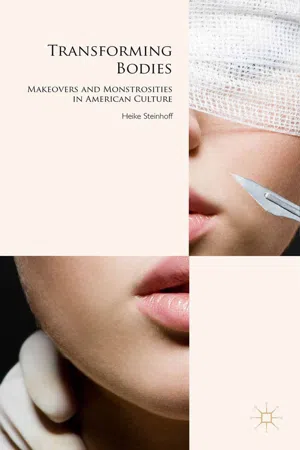
At the turn of the twenty-first century, American media abound with images and narratives of bodily transformations. At the crossroads of American, cultural, literary, media, gender, queer, disability and governmentality studies, the book presents a timely intervention into critical debates on body transformations and contemporary makeover culture.
Information
3
Extreme Makeovers: Transforming Bodies in Popular Culture
Magical-biological metamorphoses
“Mommy picked me up early from school today. She said we were going to the doctor … but it wasn’t my doctor, Dr. Jill. She gives me shots and then I get a lollipop. Today we went to a new doctor for Mommy: Dr. Michael” (1). As the reader learns when turning this first page of Michael Alexander Salzhauer’s illustrated children’s book My Beautiful Mommy, Dr. Michael is not just different from Dr. Jill in that he looks like Arnold Schwarzenegger or Superman but also in terms of his medical specialization. Dr. Michael is a cosmetic surgeon, and My Beautiful Mommy is the first picture book aimed at children whose mothers are undergoing a cosmetic surgical makeover. Written by a board-certified, Florida-based cosmetic surgeon, the book, published in 2008, tells the story of a mother’s plastic surgery, in this case rhinoplasty and a tummy tuck, from a child’s perspective. Drawing on generic conventions from informational children’s literature and fairy tales, My Beautiful Mommy constructs cosmetic surgery as a form of magical-biological transformation.
The book abounds with signifiers and connotations of Disney fairy tales and female beauty pageants:1 At the end, the transformed mother is seated on a pink and sparkling page, dressed in equally pink tank top and pants. She is the – white and middle-class – princess and her makeover appears as a magical and wonderful act, which is at the same time highly gendered as it resorts to conventional and stereotypical signifiers of femininity. Simultaneously, the transformation process from a bandaged, unimpressive mother to a beauty queen is re-framed in biological terms. Comparing the mother’s transformation to that from caterpillar to butterfly, the narrative equates physical transformation via cosmetic surgery with biological metamorphosis and hence presents it as a natural development and a process of maturation or even self-realization (as the bandages come off, the mother’s beauty is revealed). Thus, the book helps to normalize and naturalize the practice of cosmetic surgery at the same time as it provides it with a magical and alluring aura.
My Beautiful Mommy (re)produces a certain discursive interrelation of femininity, class, ethnicity, and beauty, and presents the mother’s makeover as a bonding occasion for mother and female child. Through its color-scheme, narrative structure, illustrations, and metaphors, the book presents cosmetic surgery as a magical yet ‘natural’ and gendered way towards greater happiness, beauty, and well-being. It is in this sense that the book can be read as a product and co-producer of so-called makeover culture, in which transformation, in particular of one’s somatic self, is paramount. When on the very last page, the little girl lies on her mother’s lap and dreams of butterflies – or, given the butterfly’s status as central metaphor in the book, maybe her own future transformation into a beauty queen – her interpellation into a stereotypical gender role and into a culture that cherishes physical self-transformation seems to be almost complete.
My Beautiful Mommy displays a lot of the typical features that characterize the representational politics of popular cultural makeover texts. These politics will be outlined in more detail in the following. As a backdrop for the chapters to come, I will elucidate how and to what effects technologies of gender, sexuality, race, age, and nationality as well as medical and media technologies function to construct hegemonic popular cultural representations of subjectivities in transition. In particular, I will focus on the cosmetic surgical makeover as it takes shape in the American reality television show The Swan. I will discuss the program in the context of popular discourses on cosmetic surgery as well as in the context of other contemporary makeover shows, whether surgical or not, and thus use the program as a starting point to reflect on the strategies and mechanisms that characterize makeover discourses on television in general as well as in other media like women’s magazines. In my analysis I will draw on and bring together the insights of studies by cultural, historical, media, and feminist scholars who have worked on the – surgical or non-surgical, televisual or non-televisual – makeover (e.g. Brenda Weber, Cressida Heyes, Meredith Jones, Susan Bordo, Victoria Pitts-Taylor, and others) or on cosmetic surgery in general (e.g. the historical studies of Elizabeth Haiken and Sander Gilman as well as the feminist studies of Naomi Wolf, Anne Balsamo, Susan Bordo, Virginia L. Blum, Kathryn Pauly Morgan, and Kathy Davis). I will outline those recurring features that characterize the (cosmetic surgical) makeover texts and that, as I will show in this study, are taken up – played with, reversed and reinforced – by those texts that are examined in Chapters 4–6.
In line with most contemporary studies on the makeover I will argue that The Swan, as an exemplary makeover text, represents a powerful narrative of ‘(hyper)normalization,’ in which – in this case female – bodies are transformed in accordance with the dominant cultural norms of beauty, class, race, and gender in a process that is paradoxically framed by a neoliberal and post-feminist rhetoric of (female) empowerment, hard-work, self-improvement, and self-care.2 However, in a reversal of the (dominant) reading of the makeover as a process of ‘beautification,’ I will eventually suggest that the show’s representation of extreme makeovers can also be read as a televisual spectacle of ‘monstrification.’ In this context, I will build upon the works of scholars like Meredith Jones and Brenda Weber, in pointing out that the makeover discourse in general is more complex, also in terms of its representational politics, than the first impression might suggest.
First, I will introduce the concept of makeover culture and, in particular, the cosmetic surgical makeover as the currently most extreme expression of the makeover paradigm, before turning to the genre of reality television and an outline of its characteristics, cultural function, and implications. This lays the groundwork for the ensuing analysis of the surgical reality television program The Swan and other related programs. Interrogating their discursive articulation of somatic transformation, I will elucidate how these programs construct (surgical) makeovers as particularly gendered narratives that (re)produce but to a certain extent also destabilize conventional and essentialist notions of femininity and masculinity. I will suggest that makeover programs can be read as an expression and staging of neoliberal governmentality as they encode the body as a (neoliberal) project and somatic transformations as neoliberal and therapeutic technologies of the self. Fusing the focus on gender and neoliberal structures of governmentality, I will then highlight the interrelation of these two discourses in the specifically post-feminist media discourse that characterizes The Swan. As I will show, the representation of somatic transformations in makeover programs (re)produces not only particular – often hegemonic – discourses about gender, sexuality, race, ethnicity, and class, but also nationality. Hence, before a first preliminary conclusion and my ultimate re-reading of The Swan as a monstrous text, I will elucidate the ways in which The Swan and other makeover programs function as biopedagogical texts that are deeply rooted in American myths and turn somatic transformation into a key feature of contemporary Americanness.
(Surgical) Makeover culture
Makeover culture today can be defined as a culture that is not only characterized by an abundance of (mediated) events of self-transformation but as a culture in which self-transformation has become an imperative. This transformation can come in a number of guises, ranging from changing one’s house, car, or garden, to improving one’s methods of raising the kids or training the dog. A paradigmatic site of self-transformation is the human body. As Brenda Weber points out, in contemporary makeover discourse, rooms, cars, or kids are indeed turned into immediate extensions of the body, presenting a person’s symbolic body whose transformation functions in a similar way to that of the physical body, namely as “a key to unlock the self” (Makeover TV 5).
Physical transformations have, of course, always been a source of fascination and have occurred in various cultures. Bodily metamorphoses and changes, whether marvelous or monstrous, magical or technical and man-made, have been the staple of oral histories, legends, fairy tales, folk tales, literature, and later, of films, television series, computer games, and hypertexts. Moreover, people practice different forms of body modification in different cultures, for different but also for comparable reasons, and they tell different and similar narratives about it. The predominant discourse of physical transformation in contemporary Western popular culture, however, is certainly the change of outward appearance in the name of beautification and self-fulfillment. As Elizabeth A. Ford and Deborah C. Mitchell write in their introduction to The Makeover in Movies,
Cinderella-like tales, dating from an 850 AD Chinese version, show that the spell is neither recent nor located in any single culture […] the pull has never lessened; modern American women are inundated by and obsessed with images of becoming. Our language even provides us with a word for the act of transforming one’s surface appearance: makeover. (1–2)
For a long time the makeover – as the modification of one’s outward appearance – has been a key topic and trope in American women’s magazines, such as Ladies Home Journal (1883 to today), Cosmopolitan (1967 to today), Prevention (1950 to today) or Allure (1991 to today), and women’s and teen movies, such as Now Voyager (1942), Pretty Woman (1990), and The Princess Diaries (2001, adapted from a series of epistolary novels written by Meg Cabot). However, since the turn of the millennium, the makeover that had already been a staple of daytime talk-shows has also become one of the key tropes of prime-time television. In contrast to fictionalized accounts of the makeover in films or makeovers on talk-show programs, the makeover now functions as its own (television) genre (cf. Weber, Makeover TV 19). As Rachel Moseley observed in 2000, there was a true “makeover takeover” on British television. The same development happened in a number of other countries, including the United States. In TV shows like What Not to Wear, The Biggest Loser, Queer Eye for the Straight Guy, Extreme Makeover, or Dr. 90210, somatic selves have since been (trans)formed through dressing differently, losing weight or altering their physical appearance in numerous other ways to become at the same time happier individuals and more ‘normalized’ subjects. This ‘makeover takeover’ coincided with and signaled or reflected a larger cultural trend marked by discourses that put an increasing emphasis on self-transformation, and somatic self-transformation in particular, as a path towards becoming a ‘better,’ ‘healthier,’ more ‘authentic,’ more ‘beautiful,’ and ‘self-fulfilled’ being.
As My Beautiful Mommy and makeover shows like Extreme Makeover and The Swan, indicate, one of the most extreme – and yet increasingly popular and accepted – forms of somatic self-transformation in the contemporary makeover mediascape is cosmetic surgery. In her study of plastic surgery and makeover culture, Meredith Jones even considers cosmetic surgery to be makeover culture’s “quintessential expression” (Skintight 1). Plastic surgery gained popularity and recognition as a branch of medicine and a technique to reconstruct the bodies of victims of war at the beginning of the twentieth century. By the end of the twentieth century, while still applied for reconstructive purposes and then usually referred to as reconstructive surgery, plastic surgery had become increasingly accepted and commodified as cosmetic surgery, a practice to ‘beautify’ the bodies of predominantly female patients or customers.3 Today, cosmetic surgery is an increasingly integral part of beauty and consumer culture. Though it is still predominantly practiced by specific groups of people,4 cosmetic surgery is no longer only the domain of the ‘rich’ and the ‘famous,’ and it provides one of the most ‘invasive’ ways to alter the somatic self. While in 1997 about 1.6 million surgical and non-surgical5 cosmetic procedures were performed in the United States, 16 years later, in 2013, the numbers totaled more than 10 million (The American Society for Aesthetic Plastic Surgery). In 2013, Americans spent more than 12 billion dollars on cosmetic procedures.
In his book Making the Cut Anthony Elliott argues that three main factors have driven the rise of cosmetic surgery culture: the influence of celebrity culture and a related focus on appearance, contemporary consumer culture and its emphasis on buying a ‘better self’ and ‘successful life,’ and the ‘new’ global economy that demands flexibility and adaptability, thus further fostering the ‘reinvention craze.’ Elliot’s factors can also be considered as the driving forces of makeover culture in general. As the epitome of this culture, the cosmetic surgical makeover presents a unique intersection of medicine, art, and consumerism (cf. Haiken 12) and expresses in a heightened form the increasing medicalization of society and the simultaneous commodification of medicine and the body in contemporary American culture. Cosmetic surgery culture is a paradigmatic site in which ‘extreme bodies’ are stigmatized, normalized, and adored.
In the process of their apparent ‘normalization’ and ‘democratization,’ surgical makeovers have occurred both in cautionary tales and typical celebratory makeover stories. In her study of the representation of cosmetic surgery in popular women’s magazines from 1968 to 1998, Louise Woodstock has found that there is a growing acceptance of cosmetic surgery; however, when it is mentioned in passing, cosmetic surgery is also associated with vanity, violence, and deception (421). This is evident in television documentaries on plastic surgery as well as fictional series, examined in Chapter 5. In films, plastic surgery has predominantly occurred in the horror and gangster film genre, where it often functions to conceal a character’s identity or expose the horror of a culture of vanity (cf. Mueller). In advertisements, self-help journals, women’s magazines and reality television, however, cosmetic surgery has been firmly integrated into a makeover discourse that presents it as just another technology of beautification and, more importantly, self-(re)creation. As Woodstock observes in her magazine analysis, whereas in the 60s and 70s cosmetic surgery still had an overtly negative connotation,6 in the 80s and 90s female cosmetic surgery patients “were framed as successful, empowered women, as opposed to their insecure, weak predecessors, who take the best possible care of themselves,” and cosmetic surgery became “a beauty technique much like others: facials, exercise, diet, etc.” (437). As will be illustrated in this Chapter, the latter is true for its depiction in reality makeover programs as well.
Most recently, as My Beautiful Mommy testifies, surgical makeovers have entered children’s literature. The apparent need to explain to young children what has happened to their mother when she returns from her latest surgery indicates the increasing cultural availability and use of plastic surgery in general and such trends as the “Mommy Makeover,” which is the name given to a number of plastic surgery procedures that help women ‘regain’ their ‘pre-pregnancy bodies,’ in particular. As will be shown, the representational features and ideological mechanisms that were pointed out in the introductory analysis of this children’s book, which represents cosmetic surgery as a specifically gendered magical...
Table of contents
- Cover
- Title
- Copyright
- Contents
- Figures
- Acknowledgments
- Before
- Transformations
- After
- Works Cited
- Index
Trusted by 375,005 students
Access to over 1.5 million titles for a fair monthly price.
Study more efficiently using our study tools.
Frequently asked questions
Yes, you can cancel anytime from the Subscription tab in your account settings on the Perlego website. Your subscription will stay active until the end of your current billing period. Learn how to cancel your subscription
No, books cannot be downloaded as external files, such as PDFs, for use outside of Perlego. However, you can download books within the Perlego app for offline reading on mobile or tablet. Learn how to download books offline
Perlego offers two plans: Essential and Complete
- Essential is ideal for learners and professionals who enjoy exploring a wide range of subjects. Access the Essential Library with 800,000+ trusted titles and best-sellers across business, personal growth, and the humanities. Includes unlimited reading time and Standard Read Aloud voice.
- Complete: Perfect for advanced learners and researchers needing full, unrestricted access. Unlock 1.5M+ books across hundreds of subjects, including academic and specialized titles. The Complete Plan also includes advanced features like Premium Read Aloud and Research Assistant.
We are an online textbook subscription service, where you can get access to an entire online library for less than the price of a single book per month. With over 1.5 million books across 990+ topics, we’ve got you covered! Learn about our mission
Look out for the read-aloud symbol on your next book to see if you can listen to it. The read-aloud tool reads text aloud for you, highlighting the text as it is being read. You can pause it, speed it up and slow it down. Learn more about Read Aloud
Yes! You can use the Perlego app on both iOS and Android devices to read anytime, anywhere — even offline. Perfect for commutes or when you’re on the go.
Please note we cannot support devices running on iOS 13 and Android 7 or earlier. Learn more about using the app
Please note we cannot support devices running on iOS 13 and Android 7 or earlier. Learn more about using the app
Yes, you can access Transforming Bodies by H. Steinhoff in PDF and/or ePUB format, as well as other popular books in Social Sciences & Cultural & Social Anthropology. We have over 1.5 million books available in our catalogue for you to explore.