eBook - ePub
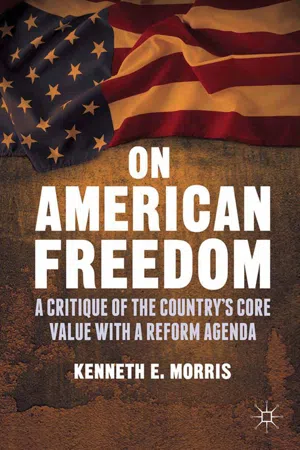
On American Freedom
A Critique of the Country’s Core Value with a Reform Agenda
- English
- ePUB (mobile friendly)
- Available on iOS & Android
eBook - ePub
About this book
Although freedom is America's core value, few Americans have a clear idea of what it means or - worse - enjoy much freedom in any of its conventional meanings. Drawing from republican tradition, the book critiques the contemporary American value of freedom as it appears in politics, the economy, and culture.
Information
CHAPTER 1
Introduction: The Puzzle of Freedom
On the first anniversary of Al-Qaeda’s 2001 attacks on the World Trade Center and the Pentagon, the New York Times gave over a portion of its op-ed page (short for “opposite the editorial page”) to President George W. Bush.1 Although under normal circumstances the Times would not have provided a platform for an incumbent politician, much less one it often opposed editorially, this was not a normal circumstance. America as a whole felt savagely attacked by terrorists, and commemorating the anniversary of the tragedy was simply not a partisan event. On the assumption that President Bush would speak for all Americans on that somber day, the Times also rose above partisanship and published his piece. There was no “Democratic response”—or any need for one.
President Bush’s article therefore provides a rare glimpse into America’s consensus values on the cusp of a century that otherwise seems destined to be dominated by partisan feuding—and the article doesn’t disappoint. Titled “Securing Freedom’s Triumph,” Bush leaves no doubt about what America’s consensual value is: Freedom. In addition to the word’s usage in the headline, the article mentions “free” or “freedom” no less than 18 times, and the rough synonym “liberty” once.2 The theme is obviously freedom, and just as obviously this is a value Americans overwhelmingly affirm.
Yet, while a consensus affirmation of the American value of freedom must understandably be expressed in generalities, President Bush’s article is vaguer than might be expected. His nineteen mentions of freedom and liberty invest these key terms with over a half dozen different meanings. Predictably for a Republican president, Bush’s most frequent usage of “freedom” ties it to markets. By “freedom” Bush usually means “free markets” (although how market freedom bears on the terrorist attacks is a link he doesn’t explain). However, Bush writes of freedom in other ways too. He affirms that freedom includes commitments to human rights, human dignity, democracy, the rule of law, the elimination of poverty, the fight against AIDS, free speech, and respect for women. Whereas proponents of free markets may argue that all these other meanings of freedom flow from market freedom, this is not an argument that President Bush makes. At one juncture, he even juxtaposes “economic freedom” with “social and political freedom,” a contrast that shows he believes there are at least two distinct broad categories of freedom, only one of which involves markets. In all, while the president’s piece is a grand celebration of freedom, it leaves this all-encompassing value remarkably vague.
Anyone acquainted with the history of presidential rhetoric may find little that is surprising in Bush’s diffuse description of freedom. After recalling that in another time of crisis, President Franklin Delano Roosevelt injected two new meanings into the historic American understanding of freedom—freedom from want and freedom from fear—the conjecture arises that President Bush was intentionally manipulating this core American value in order to pave the rhetorical way for initiatives he would soon advance. Subsequent Bush administration initiatives lend plausibility to this conjecture. In what the White House soon called the president’s “freedom agenda,” foreign policy, including foreign military intervention, took center stage.3 Indeed, the Bush administration initially named the invasion of Iraq “Operation Iraqi Freedom.” Although the name was later changed to “Operation New Dawn,” the military campaign in Afghanistan continuously bore the moniker, “Operation Enduring Freedom.” The language of freedom in these contexts, though, would appear to be primarily rhetorical. The invasion of Iraq, for example, killed between 110 thousand and over a million Iraqis (no one knows the exact count), most of whom were civilians.4 Whether the presumably enhanced freedoms of the surviving Iraqis as well as those of future generations of Iraqis will outweigh the deaths of the other Iraqis is a utilitarian calculation and a future projection that is difficult to make. Suppose though that the war in Iraq will result in a justifiable net increase in Iraqi freedom. It is much tougher to maintain that war in Iraq also augmented American freedom. At a cost of over 36 thousand US soldiers dead or wounded and more than $3 trillion, an awful lot of augmented freedom needs to waft over to American shores from a liberated Iraq to justify this war by its enhancement of specifically American freedom.5 Then, any enhancement of American freedom has to be balanced against its diminishment as a result of the invasion turning global opinion against the United States, in particular in the Muslim world, which presumably fomented new terrorists.6 Moreover, any enhancement of American freedom has to be balanced against the infringements on freedoms that President Bush’s “freedom agenda” indirectly included. Suspected terrorists (a vague term that permits considerable leeway in its application and has included US citizens) were subjected to kidnapping and arbitrary incarceration, forced to endure ritual humiliations as well as torture, often denied the right to a trial to determine their guilt or innocence, and sometimes killed outright. Government authorities were also allowed to eavesdrop on citizens’ telephone conversations and to read their emails without having to obtain court approval first, while travelers navigating airports ended up having to walk a gauntlet of security. Yet, President Bush persistently insisted, for example in a June 28, 2005, speech at Fort Bragg, North Carolina, that US soldiers were “defending our freedom” too.7
Whether President Bush’s invoking of freedom was intentionally duplicitous or reflective of genuine if apparently muddled convictions—and there doesn’t seem to be any reason to doubt the president’s personal convictions—the question is frankly how he was able to get away with it. Unlike Roosevelt’s “Four Freedoms Speech,” which although popular with many was severely criticized by opponents, Bush’s fuzzy “freedom agenda” elicited no oppositional response on the grounds of the versions of freedom it promoted. As the years wore on, it attracted a lot of criticism, but most of it focused on policy specifics, not the value of freedom. In fact, after President Barack Obama took office, he was criticized by Fred Haitt of the Washington Post for departing from Bush’s “freedom agenda.” Haitt accused Obama of lacking “passion” and giving only “half-hearted” support for freedom, owing to his valuing “international law and alliances more than the promotion of freedom.”8 Whereas Haitt’s criticism of Obama’s foreign policy may or may not have merit, the striking feature about it is his assumption that Bush’s agenda advanced freedom while Obama’s agenda did not. On the basis of what meaning of freedom was this criticism made?
The obvious inference to be drawn from this kind of imprecision is that freedom—America’s core value—is remarkably elastic. To some extent, of course, it long has been so. Eric Foner traced freedom’s meanings over the course of US history and found a distinct evolution of the value.9 Nevertheless, the situation today would seem to transcend merely evolving meanings of freedom and to have reached the postmodern point in which freedom possesses a collage of meanings, with power rather than reason or morality determining the salient ones.10 Indeed, beneath the welter of freedom’s myriad meanings may reside only a circular, self-referential core value, invoking little more than itself. Freedom may mean whatever powerful Americans want to say it means, simply because America is the “land of the free.” In this vein, it is hard not to be reminded of Lee Greenwood’s now-classic song, “God Bless the USA,“ which thanks God for being an American because “at least I know I’m free.” The song supplies no content to the value of freedom, in fact strips it of all content, yet celebrates freedom as the supreme American value.
* * *
While appreciating its insights, this book rejects the cynicism of full-bore postmodernism. Although the American value of freedom clearly contains a multitude of potential meanings and power often determines which ones become salient, the guiding hypothesis here is that there is more order and coherence to the contemporary American idea of freedom than is implied by the metaphor of a collage from which the powerful extract their preferred meanings at will. One of the objectives of this book is to discern this order and coherence in the American meanings of freedom in order to show what Americans really mean, at least in general, when they speak of freedom.
However, another guiding assumption of this book, consistent with postmodernism, is that the meanings of freedom have become so varied, superficial, and subjective that what is called freedom often isn’t, and in fact what is called freedom is sometimes its inverse. From this it follows that powerful have fertile ground to reshape the value for their own ends. The second objective of this book is therefore to critique extant American ideas of freedom and to show how they can be self-consciously recast as a sturdier value that not only resists manipulation and misuse but also directs and sometimes constrains the powerful.
Each of these objectives includes a number of potential pitfalls. The descriptive objective raises methodological concerns. Scholars are, to some extent, correctly accustomed to focused, linear analyses of ideas and events in which changes over time are explained by antecedent factors of the kind that Aristotle called efficient causes. The descriptive approach, however, proceeds differently. It is less interested in identifying the causal sequences that have produced a given result than it is with describing a structure or gestalt that is itself causal, regardless of how or why it arose. This descriptive approach remains attentive to causality, although cause is understood in the sense of Aristotle’s formal as opposed to efficient cause. The descriptive approach can be frustrating to those accustomed to a more linear analysis, and to some extent can fairly be criticized by them in terms of which they are familiar, but it needs to be appreciated that both the aim and therefore the methods of the descriptive approach are different. When the aim is descriptive, the method amounts to heaping the available descriptors on top of one another without special concern about the causal sequences that produced them.
Of course, the pitfall of the critical objective is that it departs from the supposedly “value neutral” approach that most scholars are trained to prefer, and veers toward a more “value advocacy” approach. This is not the place to rehash stale graduate school debates over these two approaches; suffice it to say that the “value advocacy” orientation is explicitly stated as also will be those values themselves in a moment. Besides this, the book is organized to prevent undue overlap between the descriptive and critical objectives. The three chapters that follow are primarily descriptive. They show how the value of freedom is now manifesting itself in politics, the economy, and the culture, respectively. The presentations are critical, but to a large extent the criticisms well up from the descriptions themselves rather than having to be imposed upon them. A full-throttle value advocacy argument isn’t really reached until the final chapter.
Nevertheless, values are advocated in this book. The first step is therefore to be clear about what those advocated values are, in this case the preferred value of freedom. Accordingly, the remainder of this chapter sketches the outlines of the preferred form of freedom against which other forms will be criticized and on behalf of which reforms will be proposed. The place to begin this sketch is with a consideration of the range of possible meanings that freedom can have.
The Main Meanings of Freedom
With the possible exception of the hunters-and-gatherers, who subsisted for millennia in small, closely knit bands of like-minded kinsmen and seemed content with conformist lives enmeshed in group life, freedom has as strong a claim to being a universal value as any. There doesn’t appear to be a single instance of a post-primitive society in which the yearning for freedom is unknown. Since the transition from hunting-and-gathering societies to more complex social forms was accompanied by heightened political and economic oppression, the appearance of the value of freedom at this historical juncture suggests that freedom is reaction to oppression.11 From this, although its specific manifestations vary according to time and place, a root universal meaning of freedom immediately comes into focus: freedom as the antithesis of oppression.
In the Western tradition (as well as in some others) freedom is historically understood as the antithesis of slavery, the West’s quintessentially oppressive institution. The liberation motif Westerners inherit from the Old Testament is the release from bondage of the Israelites, while classical Greek thinkers like Aristotle regarded the free citizen as the antithesis of the slave. In his masterful study of freedom leading up to its contemporary American incarnation, Orlando Patterson is even still satisfied to define freedom in juxtaposition to slavery, which given the extent to which slavery was practiced in the New World and how recently it ended is certainly plausible.12 Indeed, Martin Luther King Jr.’s eloquent incantation, “Free at last, free at last, thank God Almighty I’m free at last” recalled the connection between slavery and freedom as recently as 1963.
Of course, oppressions exist in more forms than slavery; some forms of it don’t even originate in society. Some have their locus inside the person, even sometimes inside the person biologically. Thus, a person can claim (or want to claim) freedom from an addiction or a disease, which at least in principle needs to have no societal etiology. Some forms of oppression may originate in the natural world. A person trapped by an avalanche may, for example, hope to be freed from the pinning boulders. Although the meanings of freedom that respond to individual or natural oppressions don’t figure directly into a discussion of an American value of freedom, which is a social, political, and economic value, they underscore the root meaning of freedom as the antithesis of oppression.
* * *
Yet, defining freedom as the antithesis of oppression only provides what Isaiah Berlin famously called the “negative” meaning of freedom.13 It tells us what freedom is not rather than what it is. This negative meaning of freedom has to be supplemented with more “positive” meanings, which tell what freedom is “for,” not merely what freedom is “from.”14 In fact, a purely negative version of freedom is philosophically unsustainable, since it would have to be erected upon a foundation of nihilism. If there are no larger uses to which freedom should be put—no reason humans deserve it—there is no justification for freedom itself. This is a crucial orienting point, and appreciating it will prevent much misunderstanding. Most meanings of freedom include the same negative component, but they can only be justified and distinguished on the basis of their positive meanings, which all philosophies of freedom weave into their core negative meanings to one degree or another.15 When philosophies of freedom purport to be purely negative, they are therefore simply being dishonest (perhaps with themselves), and the task becomes one of revealing their concealed positive components.
In any event, the positive meanings of freedom spring from more basic notions of human nature and the social good (sometimes a metaphysical good too), since in order to have an idea of the good that freedom brings one must have an idea of what things are good for humans and their societies in general. The first stopping point on a brief tour of the main positive meanings of freedom in the Western tradition is then classical Greece, where the Western philosophical tradition was born and there was little confusion about the good to which negative freedom is properly harnessed. For the Greeks, freedom was to be used for what contemporary Americans might call self-improvement. The idea was that human nature is such that people naturally aspire to excellence (one translation of the Greek word “virtue”) in their chosen pursuits, be they archery or philosophy or what have you, so freedom is good because it allows people to fulfill their natural desires to achieve excellence. The Greeks did not believe that freedom put into the service of laziness and vice, or even of too much money-making, is justifiable, because those uses of freedom were not in themselves good. At the same time, the Greeks believed that everyone is what Aristotle called a “political animal,” so to some extent everyone fulfills their freedom by participating in public life. This in turn demands the cultivation of still more virtues—in this case civic virtues—but the notion was that virtuous participation in public life makes people happier. It does so not only because both because life in a good society is happier than one in a troubled society but also because free participation in public life satisfies the imperatives of human nature to be an integral contributing member of the society. Then, since to great extent the society is the grantor and guarantor of freedom—...
Table of contents
- Cover
- Title
- Chapter 1 Introduction: The Puzzle of Freedom
- Chapter 2 From Republics to a National Empire
- Chapter 3 The Return of Feudalism
- Chapter 4 American Stoicism
- Chapter 5 A Place for Freedom
- Notes
Trusted by 375,005 students
Access to over 1.5 million titles for a fair monthly price.
Study more efficiently using our study tools.
Frequently asked questions
Yes, you can cancel anytime from the Subscription tab in your account settings on the Perlego website. Your subscription will stay active until the end of your current billing period. Learn how to cancel your subscription
No, books cannot be downloaded as external files, such as PDFs, for use outside of Perlego. However, you can download books within the Perlego app for offline reading on mobile or tablet. Learn how to download books offline
Perlego offers two plans: Essential and Complete
- Essential is ideal for learners and professionals who enjoy exploring a wide range of subjects. Access the Essential Library with 800,000+ trusted titles and best-sellers across business, personal growth, and the humanities. Includes unlimited reading time and Standard Read Aloud voice.
- Complete: Perfect for advanced learners and researchers needing full, unrestricted access. Unlock 1.5M+ books across hundreds of subjects, including academic and specialized titles. The Complete Plan also includes advanced features like Premium Read Aloud and Research Assistant.
We are an online textbook subscription service, where you can get access to an entire online library for less than the price of a single book per month. With over 1.5 million books across 990+ topics, we’ve got you covered! Learn about our mission
Look out for the read-aloud symbol on your next book to see if you can listen to it. The read-aloud tool reads text aloud for you, highlighting the text as it is being read. You can pause it, speed it up and slow it down. Learn more about Read Aloud
Yes! You can use the Perlego app on both iOS and Android devices to read anytime, anywhere — even offline. Perfect for commutes or when you’re on the go.
Please note we cannot support devices running on iOS 13 and Android 7 or earlier. Learn more about using the app
Please note we cannot support devices running on iOS 13 and Android 7 or earlier. Learn more about using the app
Yes, you can access On American Freedom by K. Morris in PDF and/or ePUB format, as well as other popular books in Politics & International Relations & North American History. We have over 1.5 million books available in our catalogue for you to explore.