- English
- ePUB (mobile friendly)
- Available on iOS & Android
eBook - ePub
About this book
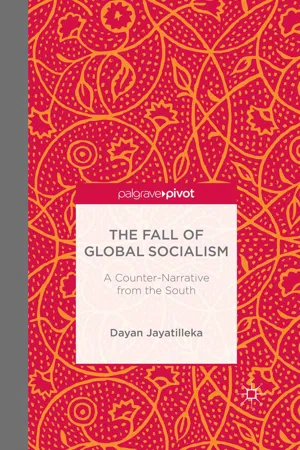
This radical new perspective from the Global South casts a fresh light on a major aspect of contemporary history and in doing so suggests an alternative interpretation of twentieth century revolutions, Socialism, left thinking and radical politics.
Information
1
The Last Revolutions
Abstract: The rise and fall of socialism was characterized by its rapidity. Its spread was rapid, but lasted just under 75 years, from the 1917 October revolution to the 1991 collapse of the USSR.
This chapter argues that Marx’s writings on Ireland mark the beginnings of a paradigm shift, identifying the periphery as the key vector of revolutionary change. It traces a broad consensus between the capitalist and socialist camps that the decisive struggles would be fought in the Third World. It shows that there was a revolutionary upswing which originated in 1968 and crested in 1974–80 encompassing 14 revolutions on 4 continents with its zenith being Vietnam in 1975. The chapter reconstructs that historical moment and what it was held to portend.
Jayatilleka, Dayan. The Fall of Global Socialism: A Counter-Narrative from the South. Basingstoke: Palgrave Macmillan. DOI: 10.1057/9781137395474.0003.
This chapter deals with the historical conjuncture of 1974–80, with specific reference to the year 1975, but located in a longer period dating from 1968.
The rise and fall of socialism is characterized by its rapidity. The entire process took just under 75 years, from the 1917 October Revolution to the 1991 August–December collapse of the USSR. The October Revolution marked an unprecedentedly deep change in that it overturned the dominance of a possessing class without (at least initially) substituting it with the dominance of another or permitting the restoration of the old order. Therefore, it was deemed to have ushered in a new era or even an epoch of history. Its horizontal spread was considerably rapid. Despite this initial depth and spread, the new era did not last out the century of its birth. The phenomenon of rapidity is most dramatically evident in (i) the period of the final surge or wave of revolutions and (ii) the period of the actual fall, that is, from the zenith to the end. The zenith was the victory over the US, the world’s mightiest power, in Vietnam in 1975. This victory was part of a revolutionary upswing, a wave that originated in 1968 and crested in 1974–80, encompassing 14 revolutions on four continents. This chapter hopes to reconstruct that historical moment and what it was held to portend.
Trajectory and timeframe
A striking feature of the socialist experiment is the contrast between the magnitude of its impact and historical claims, on the one hand, and the brevity of its existence, on the other. October 1917 was the first revolution in history to replace a possessing class with a non-possessing one (at least initially) and, therefore, was thought to herald the commencement of a new era or even epoch of history. It was held to signify the beginning of the end of the dominance of the bourgeoisie and the passage of the historical initiative from its hands. ‘The abolition of capitalism and its vestiges and the establishment of the fundamentals of the Communist order comprise the new era of world history that has set in’.1 ‘For the first time in human history, the working people started to build a society without class exploitation and national oppression – a socialist society’.2
By the dawn of the 1960s, the Communist consensus was even more explicit and optimistic. The new era was believed to be unprecedentedly portentous, fraught with dramatic tendencies and possibilities of victory.
Our time whose main content is the transition from capitalism to socialism initiated by the great October Socialist Revolution, is a time of struggle between two opposing social systems, a time of socialist revolutions and national liberation revolutions, a time of the breakdown of imperialism, of the abolition of the colonial system, a time of transition of more peoples to the socialist path, of the triumph of socialism and communism on a world-wide scale. (The Moscow Declaration of the 81 Communist and Workers’ Parties, November–December 1960; author’s italics)3
Given these claims, hopes and prospects, the entire process of the rise and fall of socialism is marked by its rapid velocity. Hardly 75 years separate the October Revolution in Russia (1917) from the collapse of the USSR (1991).
The trajectory of socialism reveals the brevity of the period of time that spans the last peak of anti-systemic struggle and the collapse of socialism in its historic birth place, Russia.
The last peak or high watermark of anti-systemic struggle was the second half of the decade of the 1970s. This was the cresting of a high tide or wave of anti-systemic struggle which dated from 1968. There could, it is said, have been an upswing of revolution for a period of roughly 12 years, commencing with the Tet Offensive in Vietnam in February 1968, erupting in Europe in the student struggles of May 1968 and culminating by 1979–80. Within this period in general, and the peak period in particular, there were two framing episodes: the triumph of Communists in Vietnam in April 1975 and the victory of Sandinista Revolution in Nicaragua in July 1979.
Sixteen years stand between the events in Vietnam and the collapse of the USSR, while 12 years stand between the last victory – the Sandinista triumph – and 1991. The short time span between peak and trough illustrates the rapidity and near-verticality of the fall.
There is a massive historical paradox here. The Third World was acknowledged by both principal protagonists – the US and the more militant currents/agencies of global revolution (the identities of the latter shifted over time) – as the decisive arena of contestation between capitalism and socialism. In precisely this decisive arena, socialism was on the offensive and imperialism on the defensive as late as 1980.
The alternative view concedes that though the Cold War was fought in the Third World, that zone was of marginal rather than decisive importance. For instance, Prof Nancy Mitchell argues that the Cold War ‘was a contest that consisted of shadow-boxing in areas of marginal significance because real war in places that counted – Berlin, Washington and Moscow – was unwinnable’.4 However, this argument only serves to prove the point of the decisive importance of the Third World. It is precisely because the conflict was paralysed in the central theatre due to the nuclear balance that it was the marginal areas and the contestations on the margins that were decisive.
This is confirmed by one of the key figures of the late Cold War period, Zbigniew Brzezinski, who said with reference to Afghanistan, ‘for almost 10 years, Moscow had to carry on a war unsupportable by the government, a conflict that brought about the demoralization and finally the breakup of the Soviet empire’.5
Indeed, though, in retrospect, it is evident that the revolutionary tide was ebbing and there were to be no more victories, there were offensive thrusts in the first half of the 1980s. The ‘correlation of world forces’ was still thought to remain favourable to socialism as late as the 70th anniversary of the October Revolution in 1987.6 In short, in the strategically crucial zone, the Third World, revolutionary change was winning, the status quo was losing – and therefore, that could be said to have been the predominant global trend. Yet a scant decade later, the former had been defeated. The location of major victories indicates the areas of greatest strength and momentum of the anti-systemic struggle. These are also the zones of decisive reversals subsequently suffered by anti-systemic forces.
No study of socialism’s fall or even of the Cold War in general has posed the problem in terms of the paradoxical proximity of the final downswing to the strategic upswing. In 1980 socialism had the initiative. The revolution was winning. In a decade it had lost. How did this happen? When, where and why? How can we account for this turn, this radical inversion?
The centrality of the periphery
The ‘centering of the periphery’, this placing of the periphery at the centre of the discussion, is not a nostalgic ‘global Southernist’ gesture.
Arguably, Karl Marx changed his mind in 1869–70. The change in question took place after the publication of volume 1 of Capital (1867), the only one to be published during his lifetime. The text and context of Marx’s subsequent thoughts are well known, but the full implications have not been thought out ‘at the limit’. Marx’s system, especially in the monumental Capital was one of revolutionary emancipation stemming from the maturing of the inherent contradictions of metropolitan capitalism of which Britain was the stereotypical model. However, it is precisely in relation to this model, Britain, that Marx changes his mind, to the point of inverting his thesis. At the very least, we could say that Marx was of two minds. Or that there were two – or three – Marxes, so to speak. The Althusserian demarcation between the early and mature Marx is very well known. But were there three stages or ‘moments’ of Marxism: the early ‘Hegelian’ Marx, the ‘mature’ Marx of Capital, and Marx after ‘Capital’ – the Marx of the remarks on Ireland and Russia (the latter in reply to Vera Zasulich)?7 Could we speak of a ‘Late Marxism’, not in Fredric Jameson’s meaning of the term8 which refers to Adorno’s Marxism, a Marxism corresponding to the third stage of capitalism, that is, Mandel’s Late Capitalism, but in the sense of a Late or later Marxism on the part of Marx himself? Did Marx rethink Marxism?
He [Marx] considered the solution of the Irish question as the solution of the English, and the English as the solution of the European.9
England cannot be treated simply as a country along with other countries. She must be treated as the metropolis of capital ... . If England is the bulwark of landlordism and European capitalism the only point where one can hit official England really hard is Ireland. In the first place, Ireland is the bulwark of English landlordism. If it fell in Ireland it would fall in England ... English landlordism would not only lose a great source of wealth, but also its greatest moral force i.e. that of representing the domination of England over Ireland ... to encourage the social revolution in England. To this end a great blow must be struck in Ireland. (28 March 1870)10
The prime condition of emancipation here – the overthrow of the English landed oligarch – remains impossible because its position here cannot be stormed so long as it maintains its strongly entrenched outposts in Ireland. But there, once affairs are in the hands of the Irish people itself, once it is made its own legislator and ruler, once it becomes autonomous, the abolition of the landed aristocracy (to a large extent the same persons as the English landlords) will be infinitely easier than here, because in Ireland it is not merely a simple economic question but at the same time a national question, since the landlords there are not, like those in England the traditional dignitaries and representatives of t...
Table of contents
- Cover
- Title
- Introduction
- 1 The Last Revolutions
- 2 The Revolution Self-Destructs
- 3 The Sino-Soviet Conflict
- Conclusion
- Bibliography
- Index
Trusted by 375,005 students
Access to over 1.5 million titles for a fair monthly price.
Study more efficiently using our study tools.
Frequently asked questions
Yes, you can cancel anytime from the Subscription tab in your account settings on the Perlego website. Your subscription will stay active until the end of your current billing period. Learn how to cancel your subscription
No, books cannot be downloaded as external files, such as PDFs, for use outside of Perlego. However, you can download books within the Perlego app for offline reading on mobile or tablet. Learn how to download books offline
Perlego offers two plans: Essential and Complete
- Essential is ideal for learners and professionals who enjoy exploring a wide range of subjects. Access the Essential Library with 800,000+ trusted titles and best-sellers across business, personal growth, and the humanities. Includes unlimited reading time and Standard Read Aloud voice.
- Complete: Perfect for advanced learners and researchers needing full, unrestricted access. Unlock 1.5M+ books across hundreds of subjects, including academic and specialized titles. The Complete Plan also includes advanced features like Premium Read Aloud and Research Assistant.
We are an online textbook subscription service, where you can get access to an entire online library for less than the price of a single book per month. With over 1.5 million books across 990+ topics, we’ve got you covered! Learn about our mission
Look out for the read-aloud symbol on your next book to see if you can listen to it. The read-aloud tool reads text aloud for you, highlighting the text as it is being read. You can pause it, speed it up and slow it down. Learn more about Read Aloud
Yes! You can use the Perlego app on both iOS and Android devices to read anytime, anywhere — even offline. Perfect for commutes or when you’re on the go.
Please note we cannot support devices running on iOS 13 and Android 7 or earlier. Learn more about using the app
Please note we cannot support devices running on iOS 13 and Android 7 or earlier. Learn more about using the app
Yes, you can access The Fall of Global Socialism by D. Jayatilleka in PDF and/or ePUB format, as well as other popular books in Politics & International Relations & European Politics. We have over 1.5 million books available in our catalogue for you to explore.