eBook - ePub
Production Politics and Migrant Labour Regimes
Guest Workers in Asia and the Gulf
- English
- ePUB (mobile friendly)
- Available on iOS & Android
eBook - ePub
Production Politics and Migrant Labour Regimes
Guest Workers in Asia and the Gulf
About this book
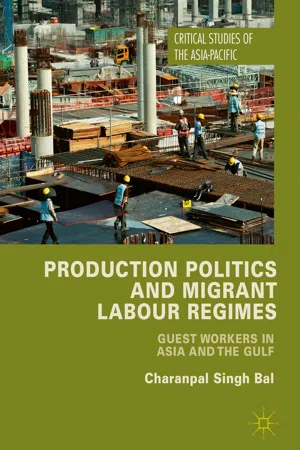
This book emphasizes the importance of production politics, or struggles in the workplace between workers and their employers, for understanding migrant labour regimes in Asia and the Gulf. Drawing from a study of Bangladeshi construction workers in Singapore, as well as on comparative material in the region, Bal shows that migrant labour politics are significantly influenced by the specific form of production politics as well as their variable outcomes. In contrast to contentious politics approaches, this book sheds light on the extent to which migrant labour regimes can be contested by workers and civil society groups and explains the recent rise in migrant labour unrest in the region.
Information
© The Author(s) 2016
Charanpal Singh BalProduction Politics and Migrant Labour RegimesCritical Studies of the Asia-Pacific10.1057/978-1-137-54859-7_11. Production Politics and Migrant Labour Regimes
Charanpal Singh Bal1
(1)
Department of International Relations, BINUS University, Jakarta, Indonesia
Globally, there is an increasing trend towards the use of short-term low-wage temporary migrant workers with limited legal-political entitlements as part of a more general shift towards flexible labour relations (Standing 1997; Bauder 2006; Cohen 2006; Kalleberg and Hewison 2013). This trend is noticeable in Asia and the Middle East where the use of transient migrant labour is an important component in driving industrial development (Young 2006; Deyo 2012, pp. 173–177). Countries such as Hong Kong, South Korea, Singapore, Malaysia, Thailand and the Gulf states bring in large numbers of guest workers from India, Bangladesh, China, Indonesia, the Philippines and Myanmar who, in turn, build homes, roads and offices in the destination countries, ensure that these places remain sanitary and functional and produce commodities which are traded abroad.
Equally noticeable has been the rise of migrant labour unrest in these countries. The increasing economic dependency on guest workers has been accompanied by migrant worker strikes and riots as well as civil society pressure for greater legal protection against exploitation and abuse. This has occurred in spite of structural factors that disempower these workers. In different societies, however, migrant labour politics have taken different forms—from wildcat strikes to rights advocacy—and produced differing outcomes. State responses to manage unrest have been similarly nuanced, ranging from repression to reforms.
The Singapore case proves to be an ideal one to examine such developments in migrant labour politics. By 2006, non-resident employees constituted almost 30 % of the country’s total workforce (Yeoh 2007). Almost 90 % of these were semi- or unskilled migrant workers employed within key industries 1 that are highly dependent on the use of migrant labour to maintain their growth and profitability (Yeoh 2007). At the same time, industrial relations in Singapore are often characterised as being under tight state control—the repression and co-option of trade union movements and the successful enforcement of pro-business labour laws being well known. This allows the People’s Action Party (PAP)-state to discipline labour in the interest of a particular model of economic growth and the preservation of one-party rule (Rodan 1989; Vasil 1989; Deyo 1991; Hing 1997).
However, like elsewhere, contract migrant workers are additionally subject to even stiffer and more coercive regulations governing their employment. In particular, the work permit system severely restricts the occupational mobility of migrant workers and seeks to ensure they do not integrate within Singapore society. Above all, it ensures the deportability of migrant workers, where the right to terminate employment and repatriate migrant workers—even forcibly—lies at the complete discretion of their employers. The vulnerability of contract migrant labour is further compounded by the fact that almost all migrant workers are in debt by the time they arrive in Singapore due to large recruitment fees commanded by labour-hire agents (TWC2 2012a). The ability of migrant workers to agitate for better working conditions is thus greatly compromised by these factors.
In spite of this, in recent years there have been a number of public episodes of migrant worker unrest accompanied by nascent NGO advocacy on behalf of these workers. While the SMRT Corporation bus drivers’ strike of 2012 and the Little India riot of 2013 were the most visible examples, instances of migrant labour unrest had been peppering the city-state since late-2008. In the wake of the Global Financial Crisis (2008–09), shipyard and construction workers of various nationalities gathered outside the Ministry of Manpower (MOM) building to demand unpaid wages as well as to protest their under-deployment and consequent threats of forced repatriation (Reuters 2009; The Straits Times 2009b). Many of these workers had brought their work-related grievances to, and sought assistance from, local migrant worker NGOs who lobbied on their behalf to MOM and called for labour reform (Reuters 2009; The Online Citizen 2009; The Straits Times 2009b).
The response of the state to these episodes of unrest has been somewhat varied. Workers involved in the bus drivers’ strike and the Little India riot were dealt criminal charges and forcefully repatriated by the authorities. Subsequently, however, the state-owned SMRT Corporation upwardly adjusted the pay scale for drivers (inSing 2013) while the government belatedly admitted after the riot that the working and living conditions of migrant workers had left much to be desired (Ministry of Home Affairs 2014, pp. 70–73). During the GFC unrest in 2008/09, MOM had initially refuted NGO calls for concessions and reform and insisted on the immediate repatriation of laid-off workers. The Ministry, however, soon changed their position, and concessions outside the provisions of existing labour laws were soon made to appease affected workers. Following this, Ministry officials and PAP ministers have since attempted to change their public stance towards a few of the salient issues facing migrant workers such as occupational immobility, employer kickbacks for recruitment and the forceful repatriation of migrant workers (Ministry of Manpower 2008, 2011b; Channel NewsAsia 2013), all issues that they had previously ignored. There then followed small-scale, but significant, amendments to the country’s migrant worker laws, such as the criminalisation of employer kickbacks and the institution of ‘no-work-pay’ provisions as well as moves towards possible reform of the Change-Of-Employer (COE) framework (Ministry of Manpower 2012a, b; Channel NewsAsia 2013).
Such episodes of migrant labour unrest and NGO activism calling for reforms of migrant labour regimes reflect similar developments in Asia and the Gulf. From labour-receiving countries like Hong Kong, Malaysia and the Gulf states to labour-sending countries like Indonesia, Sri Lanka and the Philippines, these struggles are occurring in both liberal and illiberal political regimes (Constable 2007; Ford and Piper 2007; Gamburd 2009; Hsia 2009; Lyons 2009; Elias 2010a, b; Buckley 2013). While migrant labour struggles are universal to every locale that sends and receives these types of workers, the precise form of these struggles and their socio-political outcomes vary considerably by context. This book is an attempt to examine the extent to which contract migrant workers, with limited legal-political entitlements, are capable of challenging and reshaping migrant labour regimes. Using the case of temporary Bangladeshi construction workers in Singapore, specific emphasis will be placed on the role of production politics—struggles in the workplace between these workers and their employers—in explaining the nature of challenges facing migrant labour regimes.
Questions on the form and implications of production politics have been well documented within historical and ethnographic accounts of labour and peasant politics (Thompson 1966; Sewell 1980; Burawoy 1985; Scott 1985, 1990; Ong 1987; Metcalfe 1988; Hart 1991; Ibrahim 1998; Koo 2001). Within the labour migration literature, workplace dynamics are generally acknowledged to be the root causes of organised contention but are under-analysed in terms of accounting for their form and implications for labour regime transformation (Pinches 2001; Abdullah 2005; Pun 2005; R. Cohen 2006; Constable 2007; Buckley 2013). The bulk of this literature tends to be concerned with the causes and effects of migration itself (Massey et al. 1993; Athukorala and Manning 1999; de Haas 2005; Dannecker 2009; World Bank 2011). These works are largely focused on the factors (or variables) that cause workers to migrate and the kinds of benefits or losses migration brings to sending and receiving societies.
Political economy scholarship on migrant labour politics, on the other hand, offers a vital contribution in addressing these questions by highlighting the political powerlessness of migrant workers as a defining characteristic of migrant labour regimes (Castles and Kosack 1973; Castells 1975; Burawoy 1976; Zoldberg 1979; Sassen-Koob 1981; Sassen 1988; Arnold and Hewison 2006; Hewison and Young 2006; Munck 2008; Binford 2009). Political powerlessness involves the absence of legal-political rights for migrant workers, ...
Table of contents
- Cover
- Frontmatter
- 1. Production Politics and Migrant Labour Regimes
- 2. The Political Economy of Singapore’s Migrant Labour Regime: State Policies and Contractor Strategies
- 3. Temporary Bangladeshi Labour Emigrants to Singapore
- 4. Constituting Tactical Obedience in the Workplace
- 5. Labour Conflict and the Restoration of Obedience at EW Construction
- 6. Intimidation, Violence and the Compulsions of Desertion
- 7. Production Politics and Migrant Labour Advocacy
- 8. Contesting Migrant Labour Regimes: The State of Migrant Labour Politics in Asia and the Gulf
- 9. Conclusion
- Backmatter
Trusted by 375,005 students
Access to over 1.5 million titles for a fair monthly price.
Study more efficiently using our study tools.
Frequently asked questions
Yes, you can cancel anytime from the Subscription tab in your account settings on the Perlego website. Your subscription will stay active until the end of your current billing period. Learn how to cancel your subscription
No, books cannot be downloaded as external files, such as PDFs, for use outside of Perlego. However, you can download books within the Perlego app for offline reading on mobile or tablet. Learn how to download books offline
Perlego offers two plans: Essential and Complete
- Essential is ideal for learners and professionals who enjoy exploring a wide range of subjects. Access the Essential Library with 800,000+ trusted titles and best-sellers across business, personal growth, and the humanities. Includes unlimited reading time and Standard Read Aloud voice.
- Complete: Perfect for advanced learners and researchers needing full, unrestricted access. Unlock 1.5M+ books across hundreds of subjects, including academic and specialized titles. The Complete Plan also includes advanced features like Premium Read Aloud and Research Assistant.
We are an online textbook subscription service, where you can get access to an entire online library for less than the price of a single book per month. With over 1.5 million books across 990+ topics, we’ve got you covered! Learn about our mission
Look out for the read-aloud symbol on your next book to see if you can listen to it. The read-aloud tool reads text aloud for you, highlighting the text as it is being read. You can pause it, speed it up and slow it down. Learn more about Read Aloud
Yes! You can use the Perlego app on both iOS and Android devices to read anytime, anywhere — even offline. Perfect for commutes or when you’re on the go.
Please note we cannot support devices running on iOS 13 and Android 7 or earlier. Learn more about using the app
Please note we cannot support devices running on iOS 13 and Android 7 or earlier. Learn more about using the app
Yes, you can access Production Politics and Migrant Labour Regimes by Charanpal Singh Bal in PDF and/or ePUB format, as well as other popular books in Politics & International Relations & International Business. We have over 1.5 million books available in our catalogue for you to explore.