- English
- ePUB (mobile friendly)
- Available on iOS & Android
eBook - ePub
About this book
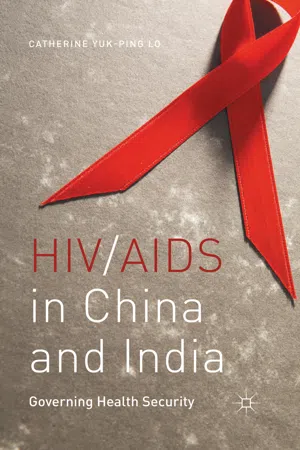
This book compares the policy approaches taken by China and India in dealing with HIV/AIDS, illuminating the challenges they face as they grapple with this intractable disease and identifying best practices for dealing with HIV/AIDS in the developing world and beyond.
Information
Chapter 1

Introduction
On June 6, 1985, at the Peking Union College Hospital in Beijing, an Argentine tourist from the United States died of Human Immunodeficiency Virus/Acquired Immune Deficiency Syndrome (HIV/AIDS).1 It was a death of a foreigner caused by the so-called Western disease. This was the first case of HIV/AIDS to be documented in China. In India, the first reported case of HIV/AIDS death was that of a businessman in Mumbai the following year.2 Indian officials claimed the man was believed to have contracted the disease in Europe or the United States.3 Before the end of the decade this misperception would be shattered as more and more indigenous cases emerged.
In China, the first indigenous HIV/AIDS infections were recorded among 146 injecting drug users (IDUs) in Dehong in Yunnan Province in late 1989,4 while a group of Indian female sex workers (FSWs) was confirmed as HIV-positive in Chennai and Mumbai in late 1986.5 Since the Chinese and Indian governments and societies hold a relatively hostile view on FSWs and IDUs and their associated behaviors, HIV/AIDS was conceived as “a disease of the poor, the illiterate, the prostitutes and the deviants.”6 Thus, FSWs and IDUs living with HIV/AIDS face double stigma in China and India. The disease had not been localized due to the misconception that as long as people were good and virtuous, they had nothing to worry about.
Misperceptions of HIV/AIDS in the early years were not confined to the Chinese and Indian communities. Prior to 1982, the disease was named Gay Related Immunodeficiency Disease (GRID) in the United States, since most HIV/AIDS cases were found among homosexual men in the country. So long as people abstained from a homosexual lifestyle, again, they had nothing to worry about. However, what started as GRID was soon identified among the population irrespective of social, economic, or sexual markers. The multiple syndromes appearing on the host were attributed to the collapse of the human immune system with a low number of white blood cells. Thus, the disease was renamed as AIDS.
In both China and India, such moves into the social mainstream take longer. Both are conservative societies with anticolonized legacies that continue to shape their worldviews. Nonetheless, by the end of the 1980s, China and India came to recognize that HIV/AIDS was not a Western or marginalized population disease. By 1995, an estimated 10,0007 and 1.75 million8 people were infected with HIV/AIDS in China and India, respectively.
Since the beginning of the HIV/AIDS epidemic, more than 60 million people have been infected with the disease globally. The top three largest populations with HIV/AIDS are in South Africa (6.1 million), Nigeria (3.4 million), and India (2.1 million).9 The latest estimate of people living with HIV/AIDS in the world is 35.3 million.10 Of the 35.3 million, 4.78 million people live in Asia.11 Louise Garrett, senior fellow of global health in the Council on Foreign Relations, debated that “the scale and geographical scope of the HIV/AIDS pandemic has only two parallels in recorded history: the 1918 flu pandemic and the Black Death in the fourteenth century.”12 Why is HIV so destructive in the human body?
In the host body, HIV basically attacks and destroys the T cells (a kind of white blood cell) in the human immune system. The infected individual becomes extremely vulnerable to all kinds of bacterial and viral infections due to the depletion of the number of T cells. AIDS thus refers to the multiple syndromes appearing in the infected individual that result in a total collapse of the immune system in the later stages of infection. Apart from its destructive nature, HIV is deemed to be the smartest virus in human history. HIV knows its limits. It cannot reproduce on its own without the host. More importantly, the virus is neither infectious nor can it survive for more than a few hours outside the human body.13 In order to survive and reproduce itself, the virus hides itself inside the host without the host’s awareness and tactically conquers the host’s immune system by integrating itself directly into the DNA of the T cell. Eliminating the virus thus results in the unavoidable destruction of the white blood cells. By replacing the DNA of T cells with the viral ones, HIV makes use of the infected T cells as its virus producing factory to reproduce as many of itself as possible—about 10 billion of its copies daily.14
After knowing all these facts about HIV/AIDS, the next question is how can we understand and deal with the problem? Medical practitioners argue that HIV/AIDS is purely a medical problem that requires medical solutions, for example, the development of antiretroviral (ARV) drugs and vaccines. Sadly, HIV/AIDS is still an incurable disease. There is only one documented case of someone being successfully cured of HIV/AIDS in the world. Timothy Brown, also known as the Berlin patient, was cured of HIV/AIDS after he had a bone marrow transplant that replaced his infected blood with healthy blood from a person who had a rare natural resistance to HIV/AIDS.15 After the Berlin patient, the “Mississippi baby” was once counted as the second successful case.16 However, the four-year-old child relapsed in 2014 despite being “functionally cured” of HIV/AIDS after the doctor gave her an aggressive cocktail therapy, consisting of AZT, Neviripine, and Lamivudine, when she was just 29 hours old.17 It is predicted that the “California baby” could likely become the next successful case of being cured of HIV/AIDS.18 However, these two cases are considered very rare and provide no treatment protocol for the millions of others infected by the disease.
Public health scholars and practitioners argue that HIV/AIDS is a public health problem that requires public health responses: surveillance, testing, condom distribution, methadone maintenance treatment, and needle exchange programs. Perceiving HIV/AIDS as a public health problem, some scholars recommend a further integration of HIV/AIDS-related interventions into the primary health care system. Interviews with respondents working in HIV/AIDS-related non-governmental organizations (NGOs) in Asia indicate a pessimism that HIV/AIDS could be fully resolved in public health systems where the disease is considered to be a stigma.19
Some lawyers and human rights advocates strongly argue that HIV/AIDS is a social and human rights issue. Stigmatization and discrimination of people living with HIV/AIDS are obvious in many Asian countries. The reason is that the general population and even the health workers have an inaccurate understanding of how HIV/AIDS is transmitted. They perceived that causal contacts such as shaking hands and sharing toilets with an infected individual will result in the transmission of the disease. Because of the positive status, infected individuals are barred from working as civil servants and teachers, fired by employers, or refused operations by doctors. In particular societies, the HIV/AIDS stigma is often layered on top of many other stigmas associated with commercial sex workers, homosexual men, IDUs, and their related behaviors such as sex outside marriage and illegal drug injection. Such stigma cannot be fully addressed if we consider HIV/AIDS only as a medical or public health problem. Linking HIV/AIDS and human rights is feasible; however, it may do more harm than good in authoritarian or totalitarian regimes in which human rights are notably sensitive issues.
A different perspective is held by some political leaders and security scholars who robustly debate that HIV/AIDS is a security issue. In the UN Security Council meeting in January 2000, then US vice president Al Gore claimed that HIV/AIDS is a security issue as “it threatens not just individual citizens, but the very institutions that define and defend the character of a society. The disease weakens workforces and saps economic strength. HIV/AIDS strikes at teachers, and denies education to their students. It strikes at the military, and subverts the forces of order and peacekeeping.”20 In July 2000, the UN Security Council passed Resolution 1308 acknowledging the urgent need to address HIV/AIDS, which threatens the stability and security of the nation if left unchecked.21 These events are significant as it was the first time the UN Security Council devoted an entire session to a disease. It was also the first time that the international political authorities framed HIV/AIDS as a global health threat to national and international security rather than solely as a developmental or public health problem. In this sense, HIV/AIDS has been prioritized by the international community. Using the terminology of securitization theory, we can say HIV/AIDS has been “securitized” since 2000.
What is securitization? Securitization here does not refer to the practice in the financial sector. Securitization in International Relations (IR) is a concept that describes the process by which an issue becomes a security issue. Framing HIV/AIDS as a security issue, HIV/AIDS is securitized (prioritized). Emergency measures (redirection of existing resources, new policies or practices) are implemented to address the issue following the security-threat claim.
The Concept of Securitization Theory
Speech has power. Words do not fade. What starts out as a sound, ends in a deed.22
What constitutes a theory? A theory is based on hypotheses and assumptions and is backed by evidence. A theory possesses the predictive power (testability) to explain a phenomenon or a set of phenomena in real-world situations. For example, Darwin’s theory of evolution is a theory because it helps us understand the evolution of animals and plants with the idea of natural selection. Securitization theory is similar. It attempts to explain how an issue becomes a security issue.
Securitization theory is a constructivist theory that originated from the Copenhagen School of security studies in 1998, led by the theorists Barry Buzan, Ole Wæver, and Jaap de Wilde.23 Grounded in constructivist perspectives, the theory outlines the process of defining or framing an issue as a security threat and as a reaction to policy, to block the adverse development of the perceived threat.
How are threats framed in a securitization process? A securitizing actor initiates the process by declaring a particular referent object as an existential threat to security. This threat identification is declaratory in nature (speech acts), and is followed by acceptance of the issue by a target aud...
Table of contents
- Cover
- Title
- 1 Introduction
- 2 Security: A Revised Framework for Analysis
- 3 Health Security and HIV/AIDS
- 4 The Changing Face of Public Health Care Systems in China and India
- 5 Securitizing HIV/AIDS in China
- 6 Audience Acceptance in China: Case Studies in Beijing, Shanghai, and Kunming
- 7 Securitizing HIV/AIDS in India
- 8 Audience Acceptance in India: Case Studies in New Delhi, Mumbai, and Imphal
- 9 Conclusion: Reconsidering HIV/AIDS Securitization
- Notes Conclusion: Reconsidering HIV/AIDS Securitization
- Bibliography Conclusion: Reconsidering HIV/AIDS Securitization
- Index Conclusion: Reconsidering HIV/AIDS Securitization
Trusted by 375,005 students
Access to over 1.5 million titles for a fair monthly price.
Study more efficiently using our study tools.
Frequently asked questions
Yes, you can cancel anytime from the Subscription tab in your account settings on the Perlego website. Your subscription will stay active until the end of your current billing period. Learn how to cancel your subscription
No, books cannot be downloaded as external files, such as PDFs, for use outside of Perlego. However, you can download books within the Perlego app for offline reading on mobile or tablet. Learn how to download books offline
Perlego offers two plans: Essential and Complete
- Essential is ideal for learners and professionals who enjoy exploring a wide range of subjects. Access the Essential Library with 800,000+ trusted titles and best-sellers across business, personal growth, and the humanities. Includes unlimited reading time and Standard Read Aloud voice.
- Complete: Perfect for advanced learners and researchers needing full, unrestricted access. Unlock 1.5M+ books across hundreds of subjects, including academic and specialized titles. The Complete Plan also includes advanced features like Premium Read Aloud and Research Assistant.
We are an online textbook subscription service, where you can get access to an entire online library for less than the price of a single book per month. With over 1.5 million books across 990+ topics, we’ve got you covered! Learn about our mission
Look out for the read-aloud symbol on your next book to see if you can listen to it. The read-aloud tool reads text aloud for you, highlighting the text as it is being read. You can pause it, speed it up and slow it down. Learn more about Read Aloud
Yes! You can use the Perlego app on both iOS and Android devices to read anytime, anywhere — even offline. Perfect for commutes or when you’re on the go.
Please note we cannot support devices running on iOS 13 and Android 7 or earlier. Learn more about using the app
Please note we cannot support devices running on iOS 13 and Android 7 or earlier. Learn more about using the app
Yes, you can access HIV/AIDS in China and India by C. Lo in PDF and/or ePUB format, as well as other popular books in Politics & International Relations & Diseases & Allergies. We have over 1.5 million books available in our catalogue for you to explore.