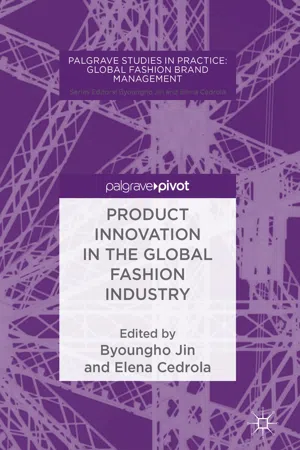
As an initial attempt to understand innovation in fashion, this volume focuses on product innovations, realizing that this industry is truly an innovative sector in which diverse technologies, science, art, and tradition have been merged, synthesized, and utilized to solve the needs and concerns of the end-users. In doing so, this book categorizes product innovation into three levels—materials, style and product development—and aims to present the broader scope of innovation in the global fashion industry with the hope that other sectors can learn from these developments and be inspired.
eBook - ePub
Product Innovation in the Global Fashion Industry
- English
- ePUB (mobile friendly)
- Available on iOS & Android
eBook - ePub
Product Innovation in the Global Fashion Industry
About this book
Information
© The Author(s) 2018
Byoungho Jin and Elena Cedrola (eds.)Product Innovation in the Global Fashion IndustryPalgrave Studies in Practice: Global Fashion Brand Management https://doi.org/10.1057/978-1-137-52349-5_11. Product Innovation: Core to Continued Success
Byoungho Jin1 and Elena Cedrola2
(1)
University of North Carolina at Greensboro, Greensboro, NC, USA
(2)
Department of Economics and Law, University of Macerata, Macerata, Italy
Abstract
Innovation is the development of new products, production processes, business practices or forms of organization. It is key to the creation of competitive advantages in organizations and increasingly at the center of long-term strategy. Innovations can be largely classified in three ways: product innovations, production process innovations and business model innovations. Among these, this volume focuses on product innovations and discusses the comprehensive picture of product innovations occurring in the global fashion industry on three levels—material, style and product development—with examples and references from global fashion brands. Innovations in materials driven largely by technology may not tell the complete story of the industry. The authors alert readers to pay attention to innovations in style, which may provide core competitive advantages for fashion brands and other mature industries where functionality or technology are less critical. This chapter concludes that the global fashion industry is truly the sector where diverse technologies found in many different sectors are merged, synthesized and utilized to address needs and concerns of end-users.
Keywords
InnovationProduct innovationMaterialsStyleProduct developmentInnovation: An Overview
Innovation is the development of new products, production processes , business practices or forms of organization. Innovations can occur within a country or industry and can involve either incremental or radical changes (Sundbo, 1991). It is key to the creation of competitive advantages in organizations (Wagner & Hansen, 2005), serving as a major impetus to economic evolution. The life of an organization, therefore, depends on the extent to which that organization is capable of continuous innovation. Fashion is constantly changing with the continual emergence of new shapes, designs and styles . Yet, in the global fashion industry, the term innovation is not as commonly used as in the technology sector. This chapter aims to break common misconceptions of the fashion industry with examples of innovations occurring in this sector.
The topic of innovation is vastly broad and multidisciplinary. To lay a foundation for the case studies presented in this volume, this chapter begins with a summary of previous studies on innovation in literature, including concepts, types, drivers and inhibitors of innovation . Despite ample research on innovation in general, research that includes innovation as the main topic or as a research variable in the global fashion industry is limited. Thus, innovation studies conducted in various disciplines such as economics, technology management, regional studies, entrepreneurship , marketing and retailing will be reviewed briefly in the next section. Innovations are constantly emerging. What is innovative now will not be as groundbreaking in five years—smartphones, for example, are not presently perceived as innovative as they have been widely available since the mid-2000s. As such, examples given in this chapter were considered innovative at the time of writing.
Definition and Types of Innovations
Innovation is commonly perceived to emerge within technology-related industries. However, the term innovation was broadly defined as early as 1934. Schumpeter (1934) documented five forms of innovation: (1) introduction of a new commodity, (2) introduction of a new method of production, (3) opening of a new market, (4) acquirement of a new source of supply or raw material and (5) restructuring of an organization (e.g., creation of a monopoly, merging, etc.). These five areas include both technological development and organizational creativity . Hence, innovation includes not only technological changes but forms of organizational and behavioral modifications as well (Sundbo, 1991). Accordingly, current literature defines innovation broadly as the “exploitation of new ideas to produce new products, processes, services or business practices” (Pittaway, Robertson, Munir, Denyer, & Neely, 2004). Innovation is often viewed as a process, defined as “a process of developing and implementing a new idea” (Van de Ven & Angle, 1989, p. 12) and “the process of bringing any new problem solving idea into use…it is the generation, acceptance, and implementation of new ideas, processes, products, or services” (p. 20). Literature also implicitly and explicitly views creativity as part of this innovation process. Creativity involves the generation of novel and useful ideas while innovation entails the implementation of creative ideas into new products and production processes (Sarooghi, Libaers, & Burkemper, 2015). These notions of innovation clearly suggest that innovation can occur in any industry, including creative industries such as fashion. Nevertheless, most existing empirical research and case studies have been mainly conducted within the boundaries of technology-related industries such as IT and pharmaceuticals. In those studies, innovation has typically been measured as the introduction of a new product within the previous two years (e.g., De Jong & Vermeulen, 2006; Lederman, 2010) and innovation input is assessed by the ratio of R&D (research and development) to sales. However, non-technology sectors, such as the fashion and retailing industries, introduce many new products within one season with moderate R&D investments. In high fashion in which the designer is centric to a brand’s existence (such as Versace ), unique products and new ideas are introduced each year, if not each season. Innovations, therefore, should be analyzed considering the industry’s innate characteristics. This chapter focuses on innovation in the global fashion industry considering its unique attributes, which are drastically different from the technology sector.
As previously mentioned, innovations can occur in multiple forms—in products, production processes and business models (i.e., De Jong & Vermeulen, 2006). While term usage is slightly varied, this classification of innovation is prevalent throughout literature. Product innovation refers to new product development or improvement (Boer & During, 2001), changes in products or commercialization of new products (Madrid-Guijarro, Garcia, & Van Auken, 2009). Process innovation is defined as improving production or manufacturing processes or acquisition of new equipment (Boer & During, 2001; Madrid-Guijarro et al., 2009). Reduced lead time, lower operational costs and increased flexibility reflect innovations in the production process .
Distinguishing business model innovations from product and process innovations is important. Using the term “business system innovation,” Boer and During (2001) defined it as new and/or improved business and marketing practices, such as e-business and e-commerce. However, most literature in business disciplines define this type of innovation much more broadly, including profit generation in the definition. For example, Teece (2010) defined business model innovation as “how the enterprise creates and delivers value to customers, and then converts payments received to profits” (p. 173). As indicated, business model innovations involve creating and appropriating value by combining revenue models, cost structures, sets of resources or value propositions (Sorescu, Frambach, Singh, Rangaswamy, & Bridges, 2011). Among the three types of innovation, this chapter focuses on product innovations in the global fashion industry.
Drivers and Inhibitors of Innovation
Innovation drivers and inhibitors within an organization have been identified by previous studies. Three orientations—market orientation, learning orientation and entrepreneurial orientation—were found to increase a firm’s level of innovation, which in turn enhances its performance (Hult, Hurley, & Knight, 2004). A customer-centric orientation was suggested to be a potential driver of business model innovations . Emphasis on innovation in general can also lead to business model innovations (Sorescu et al., 2011). In addition, a firm’s learning orientation has significant implications for their innovativeness and competitiveness (Kohli & Jaworski, 1990).
For successful innovations in SMEs, the owner’s ability to recognize opportunities was suggested to be the major driver (Kickul & Gundry, 2002). Further, Kickul and Gundry (2002) foun...
Table of contents
- Cover
- Frontmatter
- 1. Product Innovation: Core to Continued Success
- 2. Stone Island: Product Innovation and Market Positioning as Drivers of Value Creation
- 3. The Geox: The Shoe that Breathes
- 4. Nike: An Innovation Journey
- 5. Repetto, a Paris-Based Craft Enterprise Growing into a Global Brand: Design-Driven Innovation and Meaning Strategy
- Backmatter
Trusted by 375,005 students
Access to over 1.5 million titles for a fair monthly price.
Study more efficiently using our study tools.
Frequently asked questions
Yes, you can cancel anytime from the Subscription tab in your account settings on the Perlego website. Your subscription will stay active until the end of your current billing period. Learn how to cancel your subscription
No, books cannot be downloaded as external files, such as PDFs, for use outside of Perlego. However, you can download books within the Perlego app for offline reading on mobile or tablet. Learn how to download books offline
Perlego offers two plans: Essential and Complete
- Essential is ideal for learners and professionals who enjoy exploring a wide range of subjects. Access the Essential Library with 800,000+ trusted titles and best-sellers across business, personal growth, and the humanities. Includes unlimited reading time and Standard Read Aloud voice.
- Complete: Perfect for advanced learners and researchers needing full, unrestricted access. Unlock 1.5M+ books across hundreds of subjects, including academic and specialized titles. The Complete Plan also includes advanced features like Premium Read Aloud and Research Assistant.
We are an online textbook subscription service, where you can get access to an entire online library for less than the price of a single book per month. With over 1.5 million books across 990+ topics, we’ve got you covered! Learn about our mission
Look out for the read-aloud symbol on your next book to see if you can listen to it. The read-aloud tool reads text aloud for you, highlighting the text as it is being read. You can pause it, speed it up and slow it down. Learn more about Read Aloud
Yes! You can use the Perlego app on both iOS and Android devices to read anytime, anywhere — even offline. Perfect for commutes or when you’re on the go.
Please note we cannot support devices running on iOS 13 and Android 7 or earlier. Learn more about using the app
Please note we cannot support devices running on iOS 13 and Android 7 or earlier. Learn more about using the app
Yes, you can access Product Innovation in the Global Fashion Industry by Byoungho Jin, Elena Cedrola, Byoungho Jin,Elena Cedrola in PDF and/or ePUB format, as well as other popular books in Business & Management. We have over 1.5 million books available in our catalogue for you to explore.