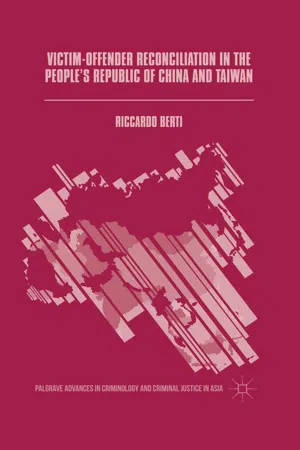
This book examines the conciliatory institutions that operate within criminal law in the People's Republic of China and Taiwan. Despite having the same legal traditions, the two countries have taken very different political and social roads over the past century. Taking these important factors into account, the book compares the conciliatory mechanisms that have emerged in the two countries, particularly focusing on the influence of Confucian tradition in current criminal reconciliation practices. By drawing upon in-depth interviews with multiple experts in the area, the role of tradition in the discipline of modern Xingshi Hejie is explored, alongside an analysis of the reasons that lead victims and offenders to choose this conciliatory procedure. The book offers a fascinating account of this feature of criminal justice in China and Taiwan, and will be of particular interest to scholars interested in comparative approaches to criminology and criminal justice.
eBook - ePub
Victim-Offender Reconciliation in the People's Republic of China and Taiwan
- English
- ePUB (mobile friendly)
- Available on iOS & Android
eBook - ePub
Victim-Offender Reconciliation in the People's Republic of China and Taiwan
About this book
Information
Print ISBN
9781349580064
9781137527530
Subtopic
Criminal Law1
Introductory Profiles
1 Premise
In dealing with criminal law each country of the world has to confront several issues; among these certainly the most common are prison overcrowding, the difficulty in the recovery of debts arising from criminal offenses, and the problems created by the excessive duration of trials. But on closer inspection, these issues could be defined as “practical ones” that are not part of the difficult problems with which criminal lawyers around the world are dealing with nowadays.
What is in front of us is a real crisis in criminal justice; a crisis that emerges especially on the side of rehabilitation, an issue the world pursues through the instrument of criminal proceedings and sanctions that follow. However, the results, as confirmed by many studies,1 are largely contradictory and lacking.
These and other reasons lead scholars to look more often and more carefully to legal solutions adopted in foreign jurisdictions in order to solve, or at least mitigate, these problems. An institution surely interesting in these regards is the so-called Xingshi Hejie, 刑事和解, a criminal procedure active in the Republic of China and in Taiwan. When we say Xingshi Hejie (刑事和解),2 which could be translated as “victim-offender reconciliation” (VOR), we are talking about a conciliatory practice that was only recently implemented in China’s criminal legal system, although it has very ancient roots.
It is founded, basically, on a choice that the person accused of minor criminal offenses makes to enable a conciliatory procedure with the consent of the judge and the prosecutor to obtain a less severe punishment at the end of the judicial process. It is a procedure that allows the victim to receive and promote the offender’s repentance; in fact very often the rules of Xingshi Hejie emphasize a formal apology from the offender to the victim and society, or acts expressing repentance and contrition. These features of Xingshi Hejie lead to its insertion in what are called practices of restorative justice that consist of encouraging the offender to repent for his/her criminal actions, which in turn leads to a meeting.
Including VOR in the list of restorative justice practices is essential to understand how deeply rooted in Chinese history and philosophy these practices are, and therefore how far back in time the beginnings of criminal reconciliation in China go. John Braithwaite, one of the greatest theorists of restorative justice, recognizes the famous Chinese philosopher Confucius as probably the most influential thinker in the field. Braithwaite supports his argument with a significant sentence in Confucius’s Dialogs. Braithwaite says: “One of Confucius’s best-known views is that ‘if the people be led by laws, and uniformity sought to be given punishments by them, they will try to avoid the punishment, but have no sense of shame’ (Confucius 1974, p. 16).3 In opposition to his contemporaries, he was against capital punishment (pp. 92–93, 98). Reciprocity, mutuality, and harmony were central to his ways of seeing.”
2 Purpose of the research
This research is interested in Xingshi Hejie as it is enforced in the legal systems of Mainland China and Taiwan.
With regard to Mainland China, this means examining regulations enacted by the central government. Thus the institutions operating in Macao and Hong Kong, which are two Special Administrative Regions that benefit from strong traits of autonomy are excluded, as are the five Autonomous Regions: Tibet, Inner Mongolia, Guangxi, Ningxia and Xinjiang.
Consideration of the practice in both the People’s Republic of China (PRC) and Taiwan is justified by the fact that it allows observation of the same legal tradition in two realities that have taken very different political and social roads over the past century, thus permitting a more detailed examination of the influence of Confucian tradition in current criminal reconciliation practices.
3 Outline of the elaborate
The Chinese legal tradition
The paper then presents an overview of the Chinese legal tradition with particular attention to the Confucian philosophy and its values. This study aims to understand if and how the age-old legal tradition of China has now been transposed to modern Chinese law, and how much of the modern Xingshi Hejie in both China and Taiwan is influenced by this tradition.
The Xingshi Hejie in Chinese and Taiwanese law
Then we analyze the institution of the VOR in both the continental Chinese reality and the Taiwanese one, considering various aspects, including in particular:
The offenses involved
The Chinese Criminal Code in Article 37 states the possibility of giving up criminal punishment in case of a reconciliation between the victim and the offender, thus simply establishing that it must be a case involving a “minor offense”.
Instead in Taiwan Articles 57 and 59 of the Criminal Code establish a relevant mitigation of the punishment if the accused shows true repentance and if he/she is found forgivable by the court. Taking the cue from this regulation, a judicial recognition has been developed of pre-trial reconciliation between the victim and the offender.4
The procedure:
In June 1989 the PRC proceeded to reform the system of the People’s Committees of Conciliation; substantially, the “People’s Mediation Committees” (PMC) by that time lost their legitimacy to mediate in criminal matters, maintaining their function only for the civil cases. Nonetheless shortly after, some provinces (e.g., Shanghai) reinstated the PMC’s mediating function in minor criminal offenses.
The mediation procedure in the PRC consists of a system for which thecivil process that is established on the basis of an offense for criminal damages can undergo a procedural simplification, and in this case the process ends the penal prosecution with no punishment if the conciliatory solution is satisfactory for the victim and the Procuratorate believes it is acceptable.
Whereas in Taiwan, the process is founded on the chance given to the judge to pursue and support an informal mediation between victim and offender, or to direct the parties to social workers specialized in this kind of reconciliation procedure. Then the judge can consider and take into account the reached agreement in conveying the judgment.5
The pan-Chinese cultural environment
The scene just depicted requires further inquiry into the positive environment where this sort of reconciliation takes place. In Chinese society collectivism plays an important role and is a significant factor in crime control. Thus we then have to examine the phenomena like Guanxi 关系6 and collectivism in order to better understand Chinese reconciliation procedures in criminal matters.
These peculiar traits lead to a major question: whether this reconciliation model constitutes a unicum that we cannot separate from its positive-communitarian environment, and therefore whether or not it is exportable abroad to societies more individual-centered and with no consolidated tradition in restorative justice practices.
Research profiles about victim-offender reconciliation in China and Taiwan
The Xingshi Hejie
The research that I have realized in China and Taiwan has highlighted some issues that deserve further study, in particular, we will talk about the debt that modern Xingshi Hejie has toward the legal tradition of Imperial China, and we will examine how this debt is effective and to which traditional steam it is actually due.
In addition, we will try to highlight the real reasons why the victim and the offender choose the reconciliation process as an alternative to ordinary civil proceedings. Do we face, therefore, a mere commercial-like trade between compensation on one side and reduction of sentence on the other, or on the contrary is it effective in China because of the “culture of forgiveness” preached by the Confucian classics in which the exchange between the offender’s apology and the forgiveness of the victim is much more meaningful than any legal or economic exchange, which can take place only in the background.
Another aspect that deserves attention concerns the future prospects open for the VOR, with particular reference to its compatibility with the principles of the criminal justice system, a relationship that is likely to affect the extent to which these practices have a very burdensome future.
Other models, role of the U.N. and the exportability of the Xingshi Hejie
The issue of mediation in criminal matters, as well as the wider one about restorative justice, have been the subject of increasing academic attention in recent years. Therefore it is suitable to review the most significant examples of these practices in the various states in which these are well established.
The role of the U.N.
Before proceeding to the conclusions, we analyze how the Chinese experience in the field of mediation has emerged clearly at the supranational level. When the U.N. decided to develop the “Basic Principles on the Use of Restorative Justice Program in Criminal Matters” the delegation of the PRC was chosen from among 18 countries appointed to study a model of supranational criminal reconciliation to be proposed as a scheme.
The exportability of the Xingshi Hejie
Although there is a growing interest throughout the world in restorative justice and mediation in criminal matters, we must examine whether the Chinese example can or cannot be profitably exported abroad. In this sense, it is important to point out why this reconciliation mechanism works well and how much its success depends on environmental elements, which are difficult to reproduce in another country. As it results from the research, the Xingshi Hejie seems sustained by Chinese tradition and, to a certain extent, it is able to survive the social transformation that is occurring in China, thanks to the extensive effort in formation made from its authorities.
So what the Chinese experience teaches us is that we must focus on a comprehensive education of all of the parties in criminal justice matters in order to obtain a functional and fruitful restorative justice mechanism.
4 Method note
The examination of an institution belonging to a legal culture that is utterly original and far from that of the writer is certainly suitable for a comparative methodology.
In particular this ...
Table of contents
- Cover
- Title
- 1 Introductory Profiles
- 2 The Chinese Legal Tradition
- 3 The Xingshi Hejie in Chinese and Taiwanese Law
- 4 Research Profiles about Victim-Offender Reconciliation in China and Taiwan
- 5 Other Models, Role of the UN and the Exportability of the Xingshi Hejie
- 6 Conclusions
- Appendix
- Notes
- Index
Trusted by 375,005 students
Access to over 1.5 million titles for a fair monthly price.
Study more efficiently using our study tools.
Frequently asked questions
Yes, you can cancel anytime from the Subscription tab in your account settings on the Perlego website. Your subscription will stay active until the end of your current billing period. Learn how to cancel your subscription
No, books cannot be downloaded as external files, such as PDFs, for use outside of Perlego. However, you can download books within the Perlego app for offline reading on mobile or tablet. Learn how to download books offline
Perlego offers two plans: Essential and Complete
- Essential is ideal for learners and professionals who enjoy exploring a wide range of subjects. Access the Essential Library with 800,000+ trusted titles and best-sellers across business, personal growth, and the humanities. Includes unlimited reading time and Standard Read Aloud voice.
- Complete: Perfect for advanced learners and researchers needing full, unrestricted access. Unlock 1.5M+ books across hundreds of subjects, including academic and specialized titles. The Complete Plan also includes advanced features like Premium Read Aloud and Research Assistant.
We are an online textbook subscription service, where you can get access to an entire online library for less than the price of a single book per month. With over 1.5 million books across 990+ topics, we’ve got you covered! Learn about our mission
Look out for the read-aloud symbol on your next book to see if you can listen to it. The read-aloud tool reads text aloud for you, highlighting the text as it is being read. You can pause it, speed it up and slow it down. Learn more about Read Aloud
Yes! You can use the Perlego app on both iOS and Android devices to read anytime, anywhere — even offline. Perfect for commutes or when you’re on the go.
Please note we cannot support devices running on iOS 13 and Android 7 or earlier. Learn more about using the app
Please note we cannot support devices running on iOS 13 and Android 7 or earlier. Learn more about using the app
Yes, you can access Victim-Offender Reconciliation in the People's Republic of China and Taiwan by Riccardo Berti in PDF and/or ePUB format. We have over 1.5 million books available in our catalogue for you to explore.