- English
- ePUB (mobile friendly)
- Available on iOS & Android
eBook - ePub
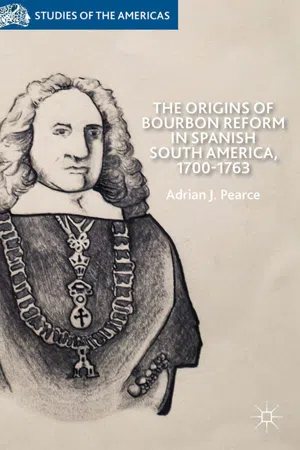
The Origins of Bourbon Reform in Spanish South America, 1700-1763
About this book
Integrating the political and governmental histories of Spain and the American colonies, this book focuses on the political and governmental history of the Viceroyalty of Peru during the 'early Bourbon' period and provides a new interpretation of the period's broader significance within Spanish American history.
Information
Chapter 1
Imperial Hiatus: War in Spain and Crisis in Peru, 1700 to 1720s
Introduction: The War of Succession and Its Implications
Spain’s eighteenth century opened in war. The Bourbon succession was contested by the British, Austrian Habsburgs, Dutch, and lesser powers, in what became the War of the Spanish Succession (1702–13). This war was for the control of Spain and its colonies in Europe and the Americas, and pitted the Allies and their candidate, the Austrian Archduke Charles, against the Bourbon Crowns of France and Spain, in the person of Philip V.1 The war, with all its attendant circumstances, made the following quarter-century a unique period in Spanish history. Large bodies of foreign troops campaigned on Castilian soil for the first time in centuries, and the last before the Napoleonic invasion. The conflict was not only a general European one with a major theatre in the Peninsula, but a Spanish civil war that pitted Castile against the eastern kingdoms of Aragon, Valencia, and Catalonia. Much of the Castilian nobility opposed the new dynasty, and the Catholic Church itself splintered along lines of region or hierarchy. A further distinctive characteristic was the great influence of foreign factions at court, where the French dominated from 1700 to 1709, to be displaced thereafter by Italians. The physical disruption and damage caused by the war, consequent fiscal ruination, and bitter factional strife surrounding Philip V combined to create an extreme political instability that paralyzed government. In the longer run, as we shall see, the war acted as both pretext and catalyst for change, and major reforms were introduced that rationalized and streamlined government and gave it the form it retained until the collapse of the “Ancien Regime.” But these very reforms, at their inception, accentuated the chaos they were designed to eliminate. And all these factors affected not only the Peninsula, but also the administration of the American colonies, such that in America as in Spain, this first quarter-century had a peculiar quality, quite unlike the later periods of Bourbon rule.
The progress of the War of Succession cannot be followed here at length, but given its implications for early Bourbon government, some brief sketch is required.2 For three years, it was fought mainly in Italy and the Netherlands, while Allied attacks on the Peninsula were limited to raids on the coast. In one such raid, the British secured a lasting beachhead at Gibraltar; in another, at Vigo in 1702, the greater part of Spain’s diminutive navy was destroyed, obliging a reliance on the French for maintenance of Spanish trade and communications.3 The war proper came to the Peninsula in 1705–6, with the rapid fall to the Allies of the eastern kingdoms, after which the country was never free of foreign troops until 1713. Within a shifting balance of power and fortunes throughout these years, there were two moments of clear crisis for Philip V and the Bourbon succession. In 1705–6, Spain finally lost control of its historic colonies in the Low Countries and Italy, while in the Peninsula, more than a third of the country lay in the hands of Archduke Charles. Madrid itself was occupied by the Allies, an event that precipitated the defection to the Habsburg cause of part of the high aristocracy.4 There followed a victory at Almansa (April 1707) and a Bourbon recovery; but a second and still greater crisis then occurred in 1708–10, when a harsh winter and severe famine struck both Spain and France.5 Exhaustion and heavy military reverses in Flanders obliged Louis XIV to sue for peace, and he withdrew most French forces from Spain, seemingly abandoning his grandson to inevitable defeat. The Allies advanced once more, and occupied Madrid for a second time, while the Pope recognized Charles as the legitimate king of Spain.
The Crown was saved for Philip V partly by military victory at Villaviciosa in December 1710, and partly by changing international circumstances, which made Charles the Emperor of Austria (and so a less palatable champion to his British and Dutch allies). By the Treaty of Utrecht of 1713, Philip was confirmed in his possession of both Spain and the Indies, though the Spanish Empire in Europe was lost to Austria, while Britain won both Gibraltar and Minorca, as well as commercial privileges in America (discussed further in both this and the following chapters). While Utrecht ended the War of Succession, however, the conflict dragged on in Spain until the conquest of Barcelona in September 1714 and of Mallorca the following year. And even then, peace was fleeting; Spain was at war once more in Italy by 1717, and the War of the Quadruple Alliance in 1719 again saw Galicia and Guipúzcoa invaded by British and French troops.6
The circumstances of this long war—of rampaging armies and a peripatetic court—naturally presented formidable challenges to Spanish government. The government itself fell victim to the fortunes of war: having retaken Madrid in late 1706, Philip purged or reformed the royal councils for their collaboration with Archduke Charles, and dismissed, exiled, or even imprisoned many high officials. Perhaps more critical still was a desperate fiscal crisis, mitigated only in part by the rapid growth of revenues under a French-directed program of reforms.7 And at least as importantly, throughout much of this period, Spain’s royal court was “a focus of constant rivalry and intrigue, as each faction sought for supremacy and drew upon itself the hatred of all others.”8 Much of this factionalism grew out of resentment of the influence of the French in Philip’s early governments. Whether through the offices of the Princesse des Ursins, his personal agent in Madrid, or of a series of French ambassadors, Louis XIV exerted a powerful influence over Spanish affairs, which became all but absolute under Ambassador Michel-Jean Amelot (1705–9), “the unquestioned ruler of Spain.”9 The ascendency of the French excited the hostility of the Spanish, widespread among the people and endemic among the aristocracy. And the latter group found further cause for grievance in the emasculation of the royal councils, which they had dominated under Habsburg rule. As a result, parties were formed, and conspiracies hatched against the regime, in 1705, 1708–9, and (three times) in 1718.10
The outright dominion of the French in Spanish affairs was checked by Louis XIV’s partial withdrawal from Spain in 1709, although in fact, Des Ursins and the financial wizard Jean Orry continued largely to run government until 1714. Already by 1711, the rise of a new faction, that of the Italians, was apparent, riding on the train of Philip’s first wife, María Luisa of Savoy. Italians enjoyed a moment of supremacy after late 1714, when the arrival of Philip’s second wife, Elisabeth Farnese of Parma, provoked yet another wholesale revolution in government. The French and their sympathizers were now banished, to be replaced by a flood of Italians, of whom Julio Alberoni was but the first. A French agent now remarked that “the court of Spain is totally different from what it was ten days ago. It is a completely new court and a completely new system.”11 And, as if this chronic factionalism was not enough, in 1717–18, Philip himself experienced a bout of insanity, the first of similar episodes he would suffer periodically for the rest of his life.12 It is true that around this same time, the entrenchment of the secretarial system in Spain, and the dynamism of the regime led by Alberoni, brought a renewed sense of purpose to peninsular government and a first burst of Bourbon reform in America (discussed in the following chapter). But at the time of Alberoni’s own spectacular fall in December 1719, parts of Spain were once more under foreign occupation. The year 1724 witnessed Philip’s extraordinary abdication and the “lightning reign” of the boy-king, Luis I;13 and this was followed by the administration of the Baron de Ripperdá, a true validazgo as absurd as that of Manuel Godoy in a later period, and only less damaging in that it was so brief (late 1724 to mid-1726).14
Only with the rise to the chief ministry of José Patiño after 1720, then, was Spanish government finally freed from domestic war, foreign influence, and chronic factionalism, to achieve a semblance of real stability. As we shall see, a major step forward was taken with the demotion of the Councils of State and the creation in their place of ministries or secretariats, which concentrated executive authority and increased the efficacy of government. At their inception, however, the secretariats caused considerable confusion; and this was nowhere more apparent than in colonial administration. The Consejo de Indias was an early victim of the War of Succession; disgraced by some of its members’ collaboration with the Austrian pretender during the Allied occupation of Madrid, it suffered a purge and a drastic reduction in membership, from 24 members to 8. In November 1714, the first “Secretariat of State for Indies and Marine” was created, its incumbent the francophile Bernardo Tinajero, and this might have provided an important impetus to the direction of colonial affairs. But the secretariat succumbed to the bureaucratic revolution that followed the arrival of Philip’s second queen, Elisabeth Farnese, in December the same year, and was abolished in April 1715. From this time until its reestablishment in 1721, there was no specific portfolio for the Indies, whose affairs were rather shuffled between secretaries with responsibility for peninsular policy, themselves subject to frequent changes of titular official or fields of competence.15 In point of fact, the Consejo de Indias continued to discuss policy and to prepare decrees much as it had done before, but decrees of January 20 and September 11, 1717, finally stripped it of most of its functions, after which it was restricted to a largely advisory role, retaining direct authority only as the supreme judicial court of appeal and over secular and ecclesiastical patronage.16 When it is further noted that, until the fall of Julio Alberoni in late 1719, the secretaries themselves were largely ciphers, subject to his arbitrary will, it becomes clear that this was a period of extraordinary disorder at the highest level of colonial administration.
In the American colonies themselves, too, the impact of the War of Succession and the accompanying turmoil in government was considerable, though not always in the areas anticipated. The military impact was relatively slight, restricted to Atlantic privateering and to attacks on towns on the Caribbean and Pacific coasts.17 A rising for the Habsburgs in the colonies—much feared, and not unreasonably—failed to materialize.18 The greatest direct impact was commercial, since Spanish trade with Peru virtually dried up altogether during the war.
Nevertheless, the first quarter-century in Peru was marked by a chronic disorder in government that paralleled the situation in Spain and was at least in part a product of it. The last of the Habsburg viceroys, the Conde de la Monclova, died in office in Lima in September 1705; and from this date until the arrival of the Marqués de Castelfuerte in May 1724, the viceroyalty experienced no fewer than eight governing administrations, for an average of one every fewer than 30 months. What was more, three of these administrations were by governing Audiencias rather than viceroys, during a period when the Audiencia of Lima was dominated by creoles. A further three administrations were interim and held by high clergy; only two (those of the Marqués de Castelldosríus in 1707–10 and the Príncipe de Santo Buono in 1716–20) were formal administrations of selected officials dispatched from Spain. In part, this “instability of viceroys” (as the twentieth-century Peruvian historian Rubén Vargas Ugarte called it) was the product simply of misfortune, including the death of incumbents or appointees en route to Peru.19 But the transnational factionalism that prevailed at court during these years also played its part, evident in both the appointment of Castelldosríus (a former ambassador to the French Court, and the personal nominee of Louis XIV) and Santo Buono (an Italian whose wife formed part of Philip V’s closest circle in 1714).20
What was more, none of the earliest Bourbon viceregal administrations in Peru can be considered a success. The Conde de la Monclova, a competent albeit conservative governor, was wearied by almost two decades’ service as viceroy in both New Spain and Peru, and his last years in Lima wasted away in lethargy.21 His successor, the Marqués de Castelldosríus, cut among the most striking viceregal figures of the age, as a cultured man st...
Table of contents
- Cover
- Title
- Introduction The Early Bourbon Period in Spanish South America: An Interpretation
- Chapter 1 Imperial Hiatus: War in Spain and Crisis in Peru, 1700 to 1720s
- Chapter 2 Bourbon Rule and the Origins of Reform in Spain and the Colonies, 1700 to 1719
- Chapter 3 The First Cycle of Reform, 1710s to 1736: Spanish Atlantic Trade
- Chapter 4 The First Cycle of Reform, 1710s to 1736: Government, Treasury, Mining, and the Church
- Chapter 5 Reform Abated, 1736 to 1745
- Chapter 6 Reform Renewed: The Second Cycle, 1745 to 1763
- Chapter 7 Conclusions
- Notes
- Bibliography
- Index
Trusted by 375,005 students
Access to over 1.5 million titles for a fair monthly price.
Study more efficiently using our study tools.
Frequently asked questions
Yes, you can cancel anytime from the Subscription tab in your account settings on the Perlego website. Your subscription will stay active until the end of your current billing period. Learn how to cancel your subscription
No, books cannot be downloaded as external files, such as PDFs, for use outside of Perlego. However, you can download books within the Perlego app for offline reading on mobile or tablet. Learn how to download books offline
Perlego offers two plans: Essential and Complete
- Essential is ideal for learners and professionals who enjoy exploring a wide range of subjects. Access the Essential Library with 800,000+ trusted titles and best-sellers across business, personal growth, and the humanities. Includes unlimited reading time and Standard Read Aloud voice.
- Complete: Perfect for advanced learners and researchers needing full, unrestricted access. Unlock 1.5M+ books across hundreds of subjects, including academic and specialized titles. The Complete Plan also includes advanced features like Premium Read Aloud and Research Assistant.
We are an online textbook subscription service, where you can get access to an entire online library for less than the price of a single book per month. With over 1.5 million books across 990+ topics, we’ve got you covered! Learn about our mission
Look out for the read-aloud symbol on your next book to see if you can listen to it. The read-aloud tool reads text aloud for you, highlighting the text as it is being read. You can pause it, speed it up and slow it down. Learn more about Read Aloud
Yes! You can use the Perlego app on both iOS and Android devices to read anytime, anywhere — even offline. Perfect for commutes or when you’re on the go.
Please note we cannot support devices running on iOS 13 and Android 7 or earlier. Learn more about using the app
Please note we cannot support devices running on iOS 13 and Android 7 or earlier. Learn more about using the app
Yes, you can access The Origins of Bourbon Reform in Spanish South America, 1700-1763 by A. Pearce in PDF and/or ePUB format, as well as other popular books in History & European History. We have over 1.5 million books available in our catalogue for you to explore.