This book explores the behavioral phenomenon that is intended to aid in the benefit of others, known as prosocial behavior. The author combines eight years of quantitative and qualitative research to explain and delineate the antecedents to prosocial leadership and align these findings into an understandable model for prosocial leadership development. This ground-breaking text is the first to combine the elements of prosocial followership, development and altruism as essential components to leadership. It further explores the behaviors, values, and ideas leading to the formation of prosocial leadership within individuals and organizations.
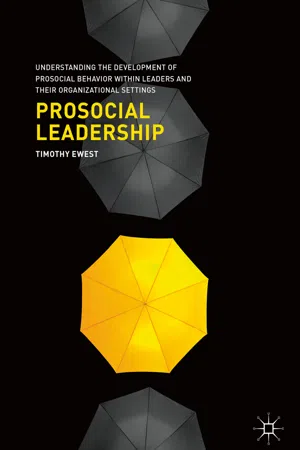
eBook - ePub
Prosocial Leadership
Understanding the Development of Prosocial Behavior within Leaders and their Organizational Settings
- English
- ePUB (mobile friendly)
- Available on iOS & Android
eBook - ePub
Prosocial Leadership
Understanding the Development of Prosocial Behavior within Leaders and their Organizational Settings
About this book
Information
© The Author(s) 2018
Timothy EwestProsocial Leadershiphttps://doi.org/10.1057/978-1-137-57808-2_11. The Need for Prosocial Leaders
Timothy Ewest1
(1)
Houston Baptist University, Houston, USA
Introduction
Who will take responsibility for communities that are being challenged, and even overwhelmed, by environmental, civil, social and economic problems that have resulted in community and ecosystem failure (Palazzo and Scherer 2006)? Today the challenges within many communities have become even more profound given the interconnectedness of local communities to global communities. This interconnectedness of communities has created conditions where negative social or environmental impacts are directly or indirectly felt, or at minimum acknowledged by communities around the world, and where the ability to regulate, control or mitigate these impacts many times exists outside the community.
The interconnectedness of global communities, which has been shaped by global market forces, is supported and expedited by technology, extensive global supply chains, the omnipresence of communications and accessible global transportation—all of which now unify and connect the world. The result is that, when one market fails, workers suffer inhumane treatment or there is a severe environmental impact whose negative effects may be felt directly or indirectly all over the world. There are numerous examples highlighting the interconnectedness of communities by global market forces, such as the global financial crisis of 2008, which sent market shocks around the world, or British Petroleum’s Deep Water Horizon oil spill of 2010, which spilled over 3.19 million barrels of oil in the Gulf of Mexico, resulting in a global loss of confidence in markets and a loss of trust in corporations. The multiplicity of examples illustrating the reality of the systemic connection of communities to global market forces is so replete that arguments to the contrary are baseless.
But not only does the interconnection of global market forces create systemic impact but the present and increasing growth of global economies has resulted in environmental and social impacts on an unprecedented and ever-increasing scale. Environmental challenges alone are becoming insurmountable, even with collective efforts from global communities. While many can hope that technology and innovation will help curb the use of natural resources, innovation can come at a social cost. Innovation often does not seek the common good equitably, favoring developed countries and having negative impacts on people living in close and undeveloped communities (Brown 2010; Ewest 2015; Naldi et al. 2007).
Moreover, Diamond (2005) suggests a sobering reality behind innovations applied through technologies, insofar as they may actually be the cause of existing problems, by asserting the following,
Most of all, advances in technology just increase our ability to do things, which may be either for the better or for worse. All our current problems are unintended negative consequences of our existing technology. The rapid advances in technology during the 20th century have been creating difficult new problems faster than they have been solving old problems, that’s why we’re in the saturation we now find ourselves. (p. 32)
Yet, even if innovation applied to technology can resolve some of the most egregious environmental issues, the Living Planet Report of 2014 suggests that innovation’s dividends may simply be too late, “Humanity’s demand on the planet is more than 50 percent larger than what nature is able to renew, jeopardizing the well-being of humans as well as populations of mammals, birds, reptiles, amphibians and fish. Research would suggest that ‘we are consuming our planet’s resources at an unsustainable rate’” (Monfreda et al. 2004, p. 231).
Social and civil unrest appear to be growing as well, creating both local and global problems. Consider the International Forum for Human Development report which states, “In spite of the complexity and scope of the subject of inequality, and in spite of the difficulties in measuring or simply assessing its dimensions, the forum was able to state with a reasonable degree of certainty that the overall level of inequality in the world had risen since the beginning of the 1980s” (2006, para 3). More recent data proposes that many in the world are experiencing improved human rights, while there is an increasing and disproportionate number of humans who are at extreme risk—the world is becoming deeply divided between those who are at risk, and those for whom there is no risk (Smith 2014). These deep divisions within society have created multiple social problems, including increased human trafficking and a global slave and sex trade (Barner et al. 2014). Even global efforts to address this issue, such as the Millennium Development Goals sponsored by the United Nations (UN), are still emerging and regarded by others as ineffective (Gaiha 2003). While some individuals may have hopes of bringing justice to these realities and closing the gap for those who do not have, the present conditions appear to be fixed in time.
Add to these realities the perspective of Anita Allen as found in her book The New Ethics: A Tour of the 21st-Century Moral Landscape. Allen understands that the current ethical landscape in America is challenged by ethical failure, despite Americans having available multiple moral resources. The fact, she continues, is that most people have an array of novel options to design their daily living, but their insular complacency towards the nation and communities creates natural opposition to these aspirations of justice and citizenship on behalf of the common good (2004, p. xiii). The shared belief in a public common good has acted as a foundation for personal and community ethical behavior (Putnam 1995), but is now in jeopardy within the United States and increasingly throughout the World. Thus, even as solutions are available, the greater question may remain the same, “Who will take individual responsibility and lead global community change?”
To be sure, prosocial leaders can take responsibility to lead others and direct change in their communities, whether local or global. And, while prosocial behaviors can be found as a component of multiple leadership theories, specific attention to the motivations, development and identification of prosocial leaders has largely been unexplored. This book endeavors to explore leadership behaviors, corresponding motivations and the developmental process of leadership that contain empathy and altruism, the two qualities identifying prosocial leadership (Batson 2010). Prosocial leaders are motivated by and respond to the interpersonal value of empathy, and, without regard to punishment or reward, act to bring about the welfare of followers and those they are committed to serve. Yet, prosocial leadership theory and the corresponding prosocial leadership development process should not be understood as a challenge or correction to other leadership theories, specifically ethical leadership theories; instead it is presented as an alternative means to distinguish, identify and note the development of authentic others-directed leaders. More importantly, this book goes beyond the consideration of connecting ethical leadership and prosocial behaviors that act as motivators to leadership behavior, for it also describes the antecedents that lead to the formation of prosocial leadership within individual leaders and describes a prosocial leadership development model.
The book is a result of quantitative and qualitative research conducted over a nine-year period on two groups of individuals in the early stages of pursuing their personal leadership development (nascent leaders). This book also contains research on a third group of mature others-directed prosocial leaders who were active as leaders in social enterprises conducted over a three-year period. The first research project was on a group of nascent leaders, students (n = 163) in a leadership development program, who participated in a quantitative analysis to determine if an established leadership theory’s behaviors, termed transformational leadership (TL) , had a theoretical correlation with prosocial values. This research was published in 2015 (Ewest). This book contains a follow-up exploratory qualitative study using grounded theory methodology with a second group of nascent leaders, students (N = 450/n = 153). This book also contains a second study on a group third of practitioners (N = 27/n = 12) used to test if the prosocial leadership model presented in this book applies to existing leaders within the context of the organization. The methods and findings of both of these research projects will be presented, while referencing numerous leadership research studies.
This book also contributes t...
Table of contents
- Cover
- Frontmatter
- 1. The Need for Prosocial Leaders
- 2. The Challenges Within Ethical Leadership Theories
- 3. What Is Prosocial Behavior’s Connection to Leadership?
- 4. Perspectives on Leadership Development
- 5. The Prosocial Leadership Development Process
- 6. Stage One: Antecedent Awareness and Empathic Concern
- 7. Stage Two: Community and Group Commitment
- 8. Stage Three: Courage and Action
- 9. Stage Four: Reflection and Growth
- 10. Prosocial Leadership Development in Organizational Life
- Backmatter
Trusted by 375,005 students
Access to over 1.5 million titles for a fair monthly price.
Study more efficiently using our study tools.
Frequently asked questions
Yes, you can cancel anytime from the Subscription tab in your account settings on the Perlego website. Your subscription will stay active until the end of your current billing period. Learn how to cancel your subscription
No, books cannot be downloaded as external files, such as PDFs, for use outside of Perlego. However, you can download books within the Perlego app for offline reading on mobile or tablet. Learn how to download books offline
Perlego offers two plans: Essential and Complete
- Essential is ideal for learners and professionals who enjoy exploring a wide range of subjects. Access the Essential Library with 800,000+ trusted titles and best-sellers across business, personal growth, and the humanities. Includes unlimited reading time and Standard Read Aloud voice.
- Complete: Perfect for advanced learners and researchers needing full, unrestricted access. Unlock 1.5M+ books across hundreds of subjects, including academic and specialized titles. The Complete Plan also includes advanced features like Premium Read Aloud and Research Assistant.
We are an online textbook subscription service, where you can get access to an entire online library for less than the price of a single book per month. With over 1.5 million books across 990+ topics, we’ve got you covered! Learn about our mission
Look out for the read-aloud symbol on your next book to see if you can listen to it. The read-aloud tool reads text aloud for you, highlighting the text as it is being read. You can pause it, speed it up and slow it down. Learn more about Read Aloud
Yes! You can use the Perlego app on both iOS and Android devices to read anytime, anywhere — even offline. Perfect for commutes or when you’re on the go.
Please note we cannot support devices running on iOS 13 and Android 7 or earlier. Learn more about using the app
Please note we cannot support devices running on iOS 13 and Android 7 or earlier. Learn more about using the app
Yes, you can access Prosocial Leadership by Timothy Ewest in PDF and/or ePUB format, as well as other popular books in Business & Business Ethics. We have over 1.5 million books available in our catalogue for you to explore.