eBook - ePub
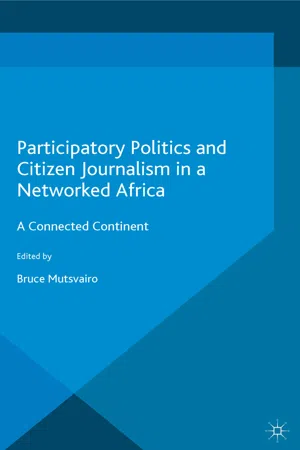
Participatory Politics and Citizen Journalism in a Networked Africa
A Connected Continent
- English
- ePUB (mobile friendly)
- Available on iOS & Android
eBook - ePub
Participatory Politics and Citizen Journalism in a Networked Africa
A Connected Continent
About this book
This book investigates the role of citizen journalism in railroading social and political changes in sub-Saharan Africa. Case studies are drawn from research conducted by leading scholars from the fields of media studies, journalism, anthropology and history, who uniquely probe the real impact of technologies in driving change in Africa.
Information
1
Recapturing Citizen Journalism: Processes and Patterns
In today’s increasingly innovative and globalized world, it is impossible to ignore the dominance of an emerging new form of journalism characterized by rapid reporting, interminable interactivity and ubiquitous multimedia content sharing and customization. Indeed, digital technologies have had a profound effect on the way news content is perceived, produced, shared and analysed. It therefore is by no surprise that the emergence of citizen journalism has not escaped scientific scrutiny (see Allan and Thorsen, 2009; Benkler, 2006). Produced in a matter of seconds, news can be shared instantly across the world, with the supremacy of citizen-inspired content becoming an overriding feature of contemporary news production. The etymology of “citizen journalism” barely needs to be studied anymore as the term is widely used and commonly accepted. But in a world where any computer or mobile phone owner is potentially a news publisher, concerns will be raised about the long-term reliability and expediency of news and content produced by non-professional actors in a technologically deterministic and fast transforming world of journalism. It is against this background that this book uses a case-to-case analysis of citizen journalism practices, based on specific studies from sub-Saharan Africa, with a view of scrutinizing this palpable emerging force – which, thanks to the ubiquity of new media technologies, continues to gather significant momentum in Africa and beyond – and investigating positivistic claims linking technological revolution to democratic changes.
A study by Gulvady (2009) concluded that mainstream media was no longer the only viable source of information available to citizens. While, globally, there is plenty of scientific literature analysing the threats and opportunities citizen journalism pose to the newspaper industry as well as society at large (Deuze et al., 2007; Domingo et al., 2008), very few empirical accounts have focused on the impact of and challenges faced by activists, participants and recipients of alternative media in sub-Sahara Africa (for examples, see Mudhai, 2013; Wasserman, 2010; 2011; Wasserman and Garman 2012) – a central objective of this book. Is citizen journalism offering Africans a first-rate opportunity to tell their stories the way they like? If that is the case, does this help empower citizens and lead them to embrace democratic changes? How have Africans embraced new technologies as a potential tool for participatory political participation?
As the conceptualization of citizen participation has largely been determined by case studies in Western settings, this book provides a geographic counter-narrative, offering African-based perspectives, experiences and responses, potentially demystifying the Western reliance on the cognization of citizen journalism. Not only is the literature analysis based on reflections from studies published between 2000 and 2008, but the leading discipline examinations are, in most cases, dominated by thoughts from the same authors, including Axel Bruns, Stuart Allan and several others. The reliance on these scholars isn’t a problem. However, Africa is a richly varied continent with several differences among its vast cultures. By proposing a wider analysis from different parts of the continent, the book hopes to make a major contribution towards challenging not only Western but also dominant, Anglo-centric notions of citizen journalism in Africa. By zooming in on “alternative” analysis of citizen participation from the continent’s Francophone and Lusophone countries, and building upon scientific interpretations from other case studies, the book, through case-by-case empirical accounts, provides a wider understanding, capturing debates surrounding citizen journalism, which, from the little that is available, has arguably been dominated by scientific reports from “English-speaking Africa”.
It must be noted that, while scholarship on citizen journalism in African settings has been limited, in recent times, attempts have been made to bring the subject to the core (see Mutsvairo et al., 2014; Tufte et al., 2014). Several scholarly accounts have tended to take a broader approach, preferring the thematization of “online” instead of just “citizen” journalism (Mabweazara, 2015; Mabweazara et al., 2013; Mudhai 2013). The broader conceptualization is not just limited to the field of journalism. Most recently, attempts to parade struggles faced by civic participants in online and offline African settings have been examined by Obadare and Willems (2014). Furthermore, research looking into the everyday use of media instruments such as television, radio and the press in African communities is also being developed (Willems and Mano, forthcoming). In another broader approach, Tettey (forthcoming) stresses the significance of media and information literacy, arguing lack of it could severely undermine democratic participation and engagement in African countries. A broader approach is therefore not only key to understanding the immediate role, purpose and problems associated with citizen journalism in sub-Saharan Africa, but helps explain how and why, even with abundant access to technology, political and social reforms have been impeded in the digitally connected continent.
The consequences of the online environment’s ability to instantaneously disseminate news have been widely examined by several scholars (see Deuze, 2003; Matheson, 2004; Osborn, 2001; Thurman, 2007; Volkmer, 2005). Citizen journalism can best be defined by two scene-setting scenarios. First, when a group of people “formerly known as the audience” (Rosen, 2008, p. 163) are involved in producing and sharing content, then citizen journalism is likely at work. Again, when citizens are engaged in an active “process of collecting, reporting, analysing and (distributing) news and information” (Bowman and Willis, 2003, p. 9), they are practising citizen journalism, whose history Schudson (2003) associates with the distribution of political pamphlets in major American cities in the 1700s. For Bruns (2005), citizen journalism occurs when “users of news websites who engage with such sites interchangeably in consumptive and productive modes and often both at the same time” (p. 23).
While it has been referred to as “community journalism”, “networked journalism” (Kelly, 2009, p. 17) or “open-source journalism” (Bentley et al., 2005), it is the “citizen journalism” concordance that has been widely used in scholarly citations. But with the rapid rise of social media, the proliferation of social networks has overshadowed the use of the term “citizen journalism”. As argued in some chapters in this book, it would certainly be misleading to suggest citizen journalism has not only lost its appeal, but also the conceptual relevance that made it attractive to scholars from around the year 2000 onwards. This is because, far from facilitating its societal oblivion, the global social media explosion has actually provided the market for citizen journalism by providing an indispensable platform for technology-savvy citizen journalists to report eyewitness accounts and share stories at remarkable speed. Therefore, the assumption that citizen journalism is “losing out” to social media is somewhat invalid considering citizens have, regardless of their location, benefited through the use of hashtags, retweets and image shares in a powerful citizenry collaboration and engagement that intriguingly rivals reports provided by mainstream media outlets.
While commonly referred to as citizen “journalists”, it is not clear whether such people are indeed journalists. Due to the opinionated nature of content produced by citizens (Nah and Chung, 2009), citizen journalism cannot be considered “journalism”. Keen (2007) propounds that citizen and professional journalists cannot work hand in hand because the former does not leverage ethical issues such as neutrality and objectivity, which form the foundation of the latter’s reporting. Since they do not adhere to accuracy, independence or autonomy, fairness, transparency, professional responsibility and objectivity (Kovach and Rosenstiel, 2001), citizen journalists cannot be classified as “journalists”. Interestingly, a research by Bruns and Highfield (2012) showed concern among traditional journalists that citizen journalism was on course to replace the conventional journalism industry.
Needless to say, the power of citizen journalism in terms of participation cannot be underrated. Time will tell whether its presence will or could ignite political revolutions in sub-Saharan Africa, a recurring question in several case studies in this book. However, in a crisis-ridden continent dominated by dictators, it is no understatement to conclude that the very manifestation of citizen journalism is potentially a revolution in itself. Take Zimbabwe for example. Who would have imagined that citizen-attributed comments attacking President Robert Mugabe would be published by the online edition of the state-owned Herald, a newspaper that prides itself on its long-standing support for the Zimbabwe African National Union–Patriotic Front (ZANU– PF) party? In a country where criticizing the president is considered taboo, the president’s stumble at Harare International Airport in early 2015 will not be remembered because of how the mainstream media the world over reported the incident. Rather, it is the citizen-created comedy memes poking fun at the ageing president and circulating on social media networks that will perhaps linger in many people’s memories. This incident, and several others across Africa, show that times are changing, and indeed, that technology will have a role to play in the way the continent will be governed. The time for the use of traditional letters-to-the-editor, as others have argued, is long gone (McCluskey and Hmielowski, 2011).
Several factors, including decreasing public trust in news and tumbling advertising revenues (Bruns et al., 2007), have contributed to the popularity and eventual tolerability of citizen journalism. While it certainly has its own problems, citizen journalism evidently provides a powerful opposing narrative to traditional journalism. New research has also shown that, with professional journalism fast losing its credibility, citizen journalism has gained momentum (Carr et al., 2014). Brown (2005) draws a clear distinction between citizen and professional journalists, suggesting that while trained journalists are obliged to respect some journalistic principles such as accuracy and fact-checking, citizen journalists do not have specific ethical standards guiding their conduct. With this distinction in mind, one can appreciate why citizen journalism has been subjected to intense scrutiny over ethical concerns. Yet in Africa, and perhaps in several other countries globally, where, due to a number of factors, reliance on traditional media is slowly becoming a thing of the past, citizen journalists are not overly concerned by the ongoing debate on whether they should consider themselves “journalists”. Instead, they see themselves providing an alternative to professional journalism (Mutsvairo and Columbus, 2012): a position which allows them to challenge the conventional settings of mass media.
Conceptualizing citizen journalism
Several scholars have already delved into an array of journalistic challenges posed by the expansion of citizen journalism (Kovacic and Erjavec, 2008; Moyo, 2009; Reich, 2008). Citizen journalists accentuate “first-person, eye witness accounts by participants” (Atton, 2003, p. 267), or “radical media offering social movements’ oxygen” (Downing, 2001, p. 390). But the practice is attributable to newspapers’ “loss of readers, the decline in voting, the national loss of a sense of place, declining civic membership, the rising disgust with politics, and the decay of public discourse” (Merritt and Rosen, 1995). Nip (2006) is adamant there is a clear conceptual distinction between citizen and participatory journalism. Bowman and Willis (2003) see no difference between the two, defining participatory journalism as “the act of a citizen, or group of citizens, playing an active role in the process of collecting, reporting, analyzing and disseminating news and information” (p. 9).
Yet others, like Hermes (2006), are keen to emphasize that the world stands to benefit from a more informed citizenry thanks to the emergence of citizen journalism. A key characteristic of citizen journalism, depending on geographical location, could, as already confirmed by Brown (2005), be the absence of journalistic ethics. That means, for instance, that news can be instantaneously produced and distributed, with no facts checked or verified. While some bloggers may willingly verify some of the news they publish, fact-checking is not a prerequisite for entering the largely self-regulating blogging world. The problem is, when facts are not properly and carefully checked, empowering readers with truthful and accurate information becomes an impracticable task. As noted above, several definitions for citizen journalism have been put forward by researchers in the fields of journalism and sociology. In spite of these variations, it is safe to assume that when an average, non-professional – in most cases unpaid – person voluntarily participates in the process of gathering and sharing news, then he/she can be called a citizen journalist (Carr et al., 2014; Deuze et al., 2007; Lacy et al., 2013).
Without doubt, discussions on whether citizen journalists should possess journalistic integrity have attracted intense debate and, predictably, there is unlikely to be any consensus on this topic. Traditional and online journalism practices can be separated by the reporting element, argues Singer (2005). She is keen to draw a fine line between news reporting and discussions about news that normally frequent the online space. This is despite the fact that, as part of a global trend, traditional media organizations have also launched citizen journalism initiatives. CNN’s iReport is a perfect example. For their part, Kahn and Kellner (2004) are convinced that online activists use new media initiatives, such as blogs, to promote their own agendas and interests, a view that strongly contradicts the demand for “balanced and fair” coverage embedded in traditional ethics of journalism.
Democracy in the digital age: Participatory politics
Wahl-Jorgensen and Hanitzsch (2009, p. xi) stress the importance of media in a democracy by declaring: “We should care about journalism because it’s central to democracy, citizenship, and everyday life, and we should care about journalism studies because it helps us understand this key social institution.” The power of the media is sometimes overrated, however. Can media alone, or access to it, instigate political change? Some have pointed to recent developments in North Africa to support the school of thought that media can indeed foster change. In sub-Saharan Africa, it could be argued that citizen journalists, and new media technologies in general, certainly help advance the democratic participation of citizens. However, it could ...
Table of contents
- Cover
- Title Page
- Copyright
- Contents
- List of Tables and Figures
- Foreword by Stuart Allan
- Notes on Contributors
- 1. Recapturing Citizen Journalism: Processes and Patterns
- Part I: Recapturing Production Practices
- Part II: Prospects, Promises and Pitfalls
- Part III: Perceptions and Critiques
- Index
Trusted by 375,005 students
Access to over 1.5 million titles for a fair monthly price.
Study more efficiently using our study tools.
Frequently asked questions
Yes, you can cancel anytime from the Subscription tab in your account settings on the Perlego website. Your subscription will stay active until the end of your current billing period. Learn how to cancel your subscription
No, books cannot be downloaded as external files, such as PDFs, for use outside of Perlego. However, you can download books within the Perlego app for offline reading on mobile or tablet. Learn how to download books offline
Perlego offers two plans: Essential and Complete
- Essential is ideal for learners and professionals who enjoy exploring a wide range of subjects. Access the Essential Library with 800,000+ trusted titles and best-sellers across business, personal growth, and the humanities. Includes unlimited reading time and Standard Read Aloud voice.
- Complete: Perfect for advanced learners and researchers needing full, unrestricted access. Unlock 1.5M+ books across hundreds of subjects, including academic and specialized titles. The Complete Plan also includes advanced features like Premium Read Aloud and Research Assistant.
We are an online textbook subscription service, where you can get access to an entire online library for less than the price of a single book per month. With over 1.5 million books across 990+ topics, we’ve got you covered! Learn about our mission
Look out for the read-aloud symbol on your next book to see if you can listen to it. The read-aloud tool reads text aloud for you, highlighting the text as it is being read. You can pause it, speed it up and slow it down. Learn more about Read Aloud
Yes! You can use the Perlego app on both iOS and Android devices to read anytime, anywhere — even offline. Perfect for commutes or when you’re on the go.
Please note we cannot support devices running on iOS 13 and Android 7 or earlier. Learn more about using the app
Please note we cannot support devices running on iOS 13 and Android 7 or earlier. Learn more about using the app
Yes, you can access Participatory Politics and Citizen Journalism in a Networked Africa by Bruce Mutsvairo in PDF and/or ePUB format, as well as other popular books in Social Sciences & Journalism. We have over 1.5 million books available in our catalogue for you to explore.