- English
- ePUB (mobile friendly)
- Available on iOS & Android
eBook - ePub
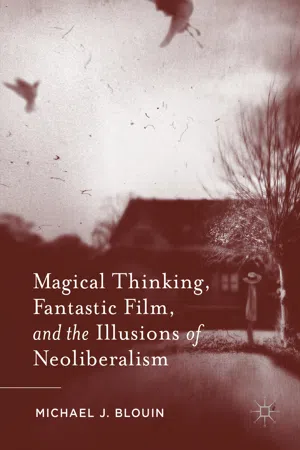
Magical Thinking, Fantastic Film, and the Illusions of Neoliberalism
About this book
This book analyzes how contemporary popular films with fantastic themes, including Candyman, Frozen, The Cabin in the Woods, and The Incredible Burt Wonderstone, cultivate neoliberal subjectivities. These films promise dramatic change, but they too often deliver more of the same. Although proponents maintain the illusion that the militant enforcement of free-market economics will resolve racism, climate change, and imperialism, their magical thinking actually fuels the crises.Magical Thinking, Fantastic Film, and the Illusions of Neoliberalism explores the ways in which the visual economies of Hollywood fantasy compliment this particular political economy.
Information
© The Editor(s) (if applicable) and The Author(s) 2016
Michael J. BlouinMagical Thinking, Fantastic Film, and the Illusions of Neoliberalism10.1057/978-1-137-53164-3_11. Introduction: Neoliberal Fantasies
Michael J. Blouin1
(1)
Humanities Program, Milligan College, Tennessee, USA
A sensation of progress prevails where precious little has been achieved. The election of Barack Obama in 2008 heralded feelings that the country would finally awaken from a rather troubled sleep. Campaign slogans, including “Yes We Can” and “Change We Can Believe In,” left the impression that life in the USA was about to start anew. There was a sense that the financial meltdown that preceded Obama’s inauguration, though deeply painful, might now augur a better, wiser tomorrow. Grave issues could at last be addressed: racism would cease to exist; climate change would be reversed; the USA would mend global ties frayed from the unilateral actions undertaken by the Bush administration; and power would at last be redistributed from the wealthy few to the masses. Riding a wave of good feelings, years of poor decision-making would disappear with the wave of a hand. 1
Nearing the close of Obama’s second term at the time of this writing, the grim reality of the situation grows ever clearer. The well of good feelings has largely dried up. While the Obama administration made some headway, notably concerning health care and the environment, these moves were not substantive enough. The Affordable Care Act (2010) makes only incremental steps in the right direction. Obama’s veto of the development of the Keystone Pipeline (2015) serves as an important symbolic gesture—but a massive amount of difficult work remains to be done to decrease emissions and address consumer habits. Moreover, Obama stands at the forefront of a Trans-Pacific Trade Agreement (TPP) that enhances the sovereignty of enormous corporations while significantly diminishing the capacity for ordinary citizens to stand up for greater economic equality or counteract damage to ecosystems. 2 Overall, the pervasive logic that change is something to believe in—and not to work for—undergirds the neoliberal legacy of the Obama administration.
In retrospect, Obama’s touted pragmatism, billed as a sort of anti-ideology ideology, refurbishes a central principle that characterizes neoliberal thought. Measured predominantly by profit, efficiency trumps ethical concern. 3 The impression of progress continues to alleviate responsibility and distract individuals from the pressing dilemmas that they face. Karl Marx once noted, “From the fact that capital posits every such limit as a barrier and hence gets ideally beyond it, it does not by any means follow that it has really overcome it, and, since every such barrier contradicts its character, its production moves in contradictions which are constantly overcome but just as constantly posited” (Marx Grundrisse, 53). Communal fantasies like the ones promulgated by mainstream Hollywood fulfill a need for progressive action. Meanwhile, pressing difficulties go relatively untouched.
This book attends to the ways in which contemporary films, particularly films that employ fantastic themes, “grease the wheels” of the neoliberal apparatus. Slavoj Žižek writes, “People not only have to ‘realize their old (emancipatory, etc.) dreams’; rather, they have to reinvent their very modes of dreaming” (Žižek Organs, 24). Each chapter examines issues of paramount significance: wars in the Middle East, racism, climate change, globalization, and biopolitics. The films under analysis magically resolve these predicaments while encouraging spectators to feel as though they can enact meaningful reforms through their affective labor. In actuality, this labor more often perpetuates the crises in question.
The Evolution of Neoliberalism
To comprehend the entrenchment of these machinations, it is first necessary to define the term “neoliberalism.” This book contends that a neoliberal techne allows fantastic plots to mesmerize via false promises of social transformation. Yet Rachel S. Turner acknowledges, “Neo-liberalism is a term that has come to be used with a lack of precision in contemporary political debates. What it stands for and what it explains is both confused and confusing” (Turner, 2). The concept of neoliberalism has undergone a number of transformations throughout the twentieth century. Following the initial groundwork constructed during the Walter Lippmann Colloquium in 1938, a group of economists—including F.A. Hayek—gathered in Switzerland to form the Mont Pelerin Society in 1947. The goal of this society was to combat a range of perceived social ills. To do so, they bundled distinct categories—fascism, totalitarianism, the New Deal, communism, and so forth—under the convenient (though woefully inadequate) umbrella term “collectivist.” Notably, figures like Hayek were fleeing from Nazi-controlled Germany. They responded to a unique instance of egregious overreach with appeals to ideas they attributed to classical liberalism: personal liberty, the value of private property, and the potential of unfettered capitalism. In truth, they were creating something quite different.
In the years following 1947, to contain the spread of communism abroad, neoliberal thinkers shaped an underground apparatus with which to transform the regimes of truth that (they alleged) had turned “antiliberal.” Academic circles played a role in determining the parameters of this movement, including the Manchester School, the Chicago School of Economics, ordo-liberalism, and the University of Virginia Public Choice School. Hayek and his colleagues, anticipating in part the sociological work later undertaken by theorist Michel Foucault, understood that the academy serves as a nodal point for infusing the population with a nascent set of values. These nodal points would feed the media landscape with ready-made pundits, provide a venue for gathering financial support, and legitimize an art of governance through the articulation of both the inquiry as well as the methodology with which the inquiry can be addressed.
Subsequently, the second wave of neoliberalism orchestrated the rapid outgrowth of think tanks, including the Hoover Institution, Heritage Foundation, and Cato Institute. Prominent businessmen like William F. Buckley, Jr., founder of the National Review, seized the opportunity to endorse this movement and spread its talking points far and wide. The Heritage Foundation, for its part, initiated the “briefcase test.” To collude with members of congress, proponents of neoliberalism would need to express their ideals with such simplicity and concision that they could fit easily into a government official’s briefcase for digestion on the train ride home (Jones, 163). Though still considered a fringe movement by the mid-twentieth century, neoliberal boosters carefully crafted ideals in the easy-to-swallow terms of Us versus Them, individual freedom versus collectivist enslavement, and common sense versus the corrupt erudition of “Washington elites.” 4
Neoliberalism only emerged as a full-throated movement in the late 1970s after a period of stagflation (stagnant growth accompanied by inflation). The so-called Washington Consensus took shape to respond to this crisis, with President Ronald Reagan at the helm. British Prime Minister Margaret Thatcher trumpeted these ideals on the other side of the Atlantic. Keynesian economics was widely derided in favor of radical privatization. 5 Bastions of neoliberalism sought to reconcile traditional conservatives, and their established resistance to hasty social change, to a techne that would not hesitate to displace traditional values in the name of greater profit. 6 Neoliberal cheerleaders artfully facilitated this reconciliation through the appropriation of the legacies of Adam Smith and David Hume. Daniel Jones calls this move “a rhetorical strategy as much as a belief in the heritage itself” (101). Smith, after all, would never go so far as to dismantle the State in the manner espoused by these think tanks. He would never trust “the rabble” to be free. His theories, moreover, depend upon a sense of moral cultivation explicitly at odds with the self-interest that drives the marketplace imagined by Hayek and Milton Friedman. 7
Nevertheless, the construction of an imaginary tradition—endearing in its elementariness—achieved an outcome with which we still grapple today. We blur imprecise terms like conservative and liberal, liberalism and democracy. It is increasingly difficult to distinguish the agendas of the two dominant political parties in the USA. The race to dismantle any sign of “collectivism” consumes groups operating on the Right as well as the Left. Government budgets are slashed in education and welfare. President Bill Clinton and the New Democrats reverse welfare policy while the repeal of the Glass–Steagall Act (1999) allows high-risk traders to utilize the bank deposits of unwitting consumers. The triumph of neoliberalism has been swift and overwhelming.
But neoliberal ideals, it must be acknowledged, are hardly monolithic. Despite proclamations of a long and storied legacy, neoliberal thought differs from the ideals of classical liberalism in a number of important ways. Most significantly, neoliberalism depends upon a well-endowed State to establish and maintain the conditions for its existence. 8 Cultural formulations remain heterogeneous (corporatism in Germany, for instance, shapes neoliberal policy in a distinctive fashion). And there are key divisions among those figures espousing neoliberalism—How should neoliberals treat the persistent formation of monopolies? What is the proper role of businesspeople in government (and vice versa)? 9
Neoliberalism does, however, rely upon a set of common assumptions (outlined by sociologist Colin Crouch). First, for neoliberal principles to function, we must assume that the barrier for entry into the market, as well as the barrier for exit, remains low. But the growth of enormous firms renders it increasingly difficult for smaller competitors to enter into the fray. As we have seen in the recent string of corporate bailouts following the 2008 meltdown, certain prominent entities are “too big to fail.” Second, we must assume that for the market to be as “free” as advertised, individuals retain equal access to knowledge about how the market is working on a minute-by-minute basis. Yet only wealthy elites can afford to compensate a talented team dedicated to this arduous task. 10 Third, we must assume that for competition to be genuinely self-regulating, government and economics remain completely separate from one another. 11 This separation has never materialized. 12 Politicians proudly tout their business ties and covet the donations of wealthy businesspeople; forms of tenderpreneurship proliferate. Finally, there are externalities for which neoliberal thought cannot readily account: positive (unanticipated pleasures outside of the so-called profit motive), network (privileged access and geographical positioning), and negative (the impact upon the environment by economic activity). Neoliberal mouthpieces disguise these prevailing assumptions with what is perceived by a subset of the populace to be a refreshingly rudimentary breakdown of the social machinery. Fantasy clouds a much darker reality.
The Janus Faces of Neoliberalism
This book considers how the vaunting of personal freedom holds at bay many reasoned considerations of the power structures perpetuating current crises. This ideology of avoidance is considered at length by Pierre Bourdieu:
(Neoliberal) doxa is conservative but presents itself as progressive; it seeks the restoration of the past order in some of its most archaic aspects (especially as regards economic relations), yet it passes regressions, reversals, and surrenders off as forward-looking reforms or revolutions leading to a whole new age of abundance and liberty (as with the language of the so-called new economy and the celebratory discourse around ‘network firms’ and the Internet). (Bourdieu Firing Back, 22 emphasis mine)
A push for smaller government preludes a restoration of the decidedly unromantic age of industrial maltreatment in nineteenth-century Britain and the USA. This restoration is, in truth, a steep regression. Advocates ignore the inconvenient reality that classical liberalism in Britain was ultimately undone not by the hubris of its overzealous politicians, or by the imposition of foreign ideas, but by its own vices—“the internal and external dynamics of industrialization” (Tribe, 74). The sins of politicians did not cause a fundamental shift in economics; the sins of economic abuse caused a necessary change in political alignment. Neoliberal acrobatics aim to reverse this causal relationship in the minds of the people.
Supporters of neoliberalism still contend that to “liberate” certain individuals—or, more accurately, corporate entities—from the constraints of social obligation is to magically empower everyone else. The reduction of public funding for the National Public Radio or Public Broadcasting Service, for instance, is thought in some quarters to be a necessary antecedent to better flows of information (rather than an increased stranglehold over media content by a shrinking number of corporate interests). 13 Insistently, there are apparently no challenges that cannot be solved by the panaceas put forth by neoliberalism. War, racism, climate change, imperial exploitation, imbalance between the financial sector and the subject—through the art of magical thinking, neoliberal policy claims to be capable of solving each plight in turn.
Contemporaries of neoliberal framers immediately exposed the Janus face of these perceived panaceas. Herman Finer detects in nascent neoliberalism a push to dismantle the democratic tradition in favor of a far more biased, and ruthless, referee: economic jockeying for supremacy. According to Hayek’s worldview, widespread antigovernment sentiment will usher in a new governing structure that establishes a playing field populated by economic elites without genuine opposition. In this sense, those entities already in possession of wealth and power manage to evade economic jockeying (an activity for which they purportedly lust) by forcing the middle and lower classes to do this demeaning work in their place. 14
Despite hollow proclamations of “increased liberty,” in Hayek’s tomorrow there is no need for a democratic process to elevate alternative methods for organizing human affairs: “What is to be done about these (socialist and cooperative producers), by a state which plans only for competition? Is there to be a Sedition Law making it an offense to speak publicly with the effect of seducing others from observance of the principles of Hayek’s bill of rights?” (Finer, 85). Neoliberals convince citizens that their chains of bondage are being loosened as economic agents clandestinely abscond with control citizens once held to determine their joint future democratically. 15 “Why should (Hayek) imagine that millions of individuals running a democracy should be more arbitrary than millions running the economic system on the principle of ‘individualism’?” (37). Fred Block and Margaret Somers later add: “The hegemony of a self-regulating economy free of government ‘meddling’ is, in the end, an assertion that the preferences of voters in democratic politics must be ignored when they conflict with the logic of a self-correcting market economy” (Block and Somers, 41).
Wendy Brown explores this decamping in her analysis of Citizens United v. Federal Election Commission (2010). The Supreme Court decision transforms free speech into yet another form of capital. 16 Overlooking essential distinctions between these two concepts, the action disguises power differentials (distinctions between the speech acts of a homeless woman and rhetoric cra...
Table of contents
- Cover
- Frontmatter
- 1. Introduction: Neoliberal Fantasies
- 2. (Neo)liberalism and the Banal Apocalypse
- 3. Cinematic Enchantment and the Magic of the Market
- 4. Candyman and Neoliberal Racism
- 5. Climate Change and the “Greenwashing” of Hollywood Fantasies
- 6. American Horror, Global Commons, and The Cabin in the Woods
- 7. Biopolitics and Movies About Magic
- 8. CODA: The Hunger Games, The Watchmen, and The Confused Critic
- Backmatter
Trusted by 375,005 students
Access to over 1.5 million titles for a fair monthly price.
Study more efficiently using our study tools.
Frequently asked questions
Yes, you can cancel anytime from the Subscription tab in your account settings on the Perlego website. Your subscription will stay active until the end of your current billing period. Learn how to cancel your subscription
No, books cannot be downloaded as external files, such as PDFs, for use outside of Perlego. However, you can download books within the Perlego app for offline reading on mobile or tablet. Learn how to download books offline
Perlego offers two plans: Essential and Complete
- Essential is ideal for learners and professionals who enjoy exploring a wide range of subjects. Access the Essential Library with 800,000+ trusted titles and best-sellers across business, personal growth, and the humanities. Includes unlimited reading time and Standard Read Aloud voice.
- Complete: Perfect for advanced learners and researchers needing full, unrestricted access. Unlock 1.5M+ books across hundreds of subjects, including academic and specialized titles. The Complete Plan also includes advanced features like Premium Read Aloud and Research Assistant.
We are an online textbook subscription service, where you can get access to an entire online library for less than the price of a single book per month. With over 1.5 million books across 990+ topics, we’ve got you covered! Learn about our mission
Look out for the read-aloud symbol on your next book to see if you can listen to it. The read-aloud tool reads text aloud for you, highlighting the text as it is being read. You can pause it, speed it up and slow it down. Learn more about Read Aloud
Yes! You can use the Perlego app on both iOS and Android devices to read anytime, anywhere — even offline. Perfect for commutes or when you’re on the go.
Please note we cannot support devices running on iOS 13 and Android 7 or earlier. Learn more about using the app
Please note we cannot support devices running on iOS 13 and Android 7 or earlier. Learn more about using the app
Yes, you can access Magical Thinking, Fantastic Film, and the Illusions of Neoliberalism by Michael J. Blouin in PDF and/or ePUB format, as well as other popular books in Social Sciences & Art General. We have over 1.5 million books available in our catalogue for you to explore.