- English
- ePUB (mobile friendly)
- Available on iOS & Android
eBook - ePub
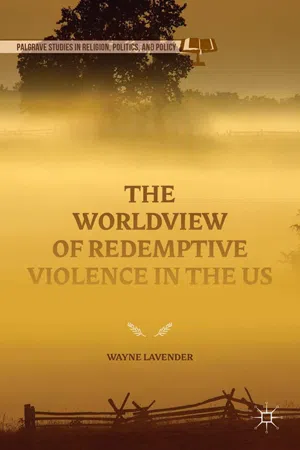
The Worldview of Redemptive Violence in the US
About this book
Through US military history, Lavender directly confronts the dominant US viewpoint of redemptive violence, the concept that a nation can use its military to improve the human condition. Alternatives are presented in order to encourage the current recessive worldview that supports conflict resolution, cooperation, collaboration and peaceful efforts.
Information
1
Was Ist Eine Weltanschauung, aka What Is a Worldview?
Who we listen to determines what we hear.
Where we stand determines what we see.
What we do determines who we are.
—Robert McAfee Brown
Heraclitus vs. von Mises: A Clash of Worldviews
It was Heraclites, the pre-Socratic Greek philosopher, who once wrote, “War is the father and king of all things” (Robinson 1968:93). The full meaning and context for his thoughts are unknown because most of Heraclites’s writings were lost in antiquity. What we do have of his theory comes to us through isolated sentences and paragraphs now nestled within other ancient Greek philosophical works. These related sentences from Heraclites have also survived the ages:
The life of the cosmos is motion and change, and it is war that stirs the posset, war that brings about the perishing of sea that earth may live, and the other transformations of fire . . . It has, in fact, assumed the titles of Zeus, fountainhead of all justice. War, too, is justice. (Robinson 1968:93)
Is war truly “the father and king of all things?” Does the making of war lead to justice? These are, in essence, the questions that lie at the heart of this book. Ludwig von Mises, an economist living approximately 2,500 years after Heraclites, would answer these questions with a clear “No,” adding:
It starts from the premise that not war, but peace, is the father of all things. What alone enables mankind to advance and distinguished man from the animals is social cooperation. [Italics added] It is labor alone that is productive: it creates wealth and therewith lays the outward foundations for the inward flowering of man. War only destroys: it cannot create. War, carnage, destruction, and devastation we have in common with the predatory beasts of the jungle; constructive labor is our distinctively human characteristic. (Von Mises 1978:24)
Heraclitus and von Mises offer conflicting worldviews. Heraclitus stresses the value and role of war in human relationships and development, while von Mises posits that peace and social cooperation are the means through which humanity advances. Simply put, these differing worldviews can be described as understanding the world through the lens of competition, contest, conflict, and war, on the one hand (Heraclitus), or cooperation, collaboration, coordination, and peace, on the other (von Mises).
What Is a Worldview?
A worldview is a cognitive map, a mental landscape, or a conceptual framework in which humans understand the world. Emmanuel Kant coined the term in 1792 when, writing in German, he used the term Weltanschauung: Welt, German for “World” and Anschauung for “view” or “outlook” (Kant 1952:111 – 112). The word migrated into the English language and was first used by academics such as William James and Jane Martineau (Naugle 2002:64). Today, the compound word “Worldview” is commonly used. “Usually the term is applied to a philosophy affecting the practical (as opposed to purely theoretical) attitudes and beliefs of its adherents” (Flew 1982). We may speak of a “liberal worldview” as opposed to a “conservative worldview,” a “Christian worldview” foiled against a “Muslim worldview,” an “American worldview” verses a “Chinese worldview,” and so forth. A worldview provides the existential means through which human beings interpret life and how to live and find meaning in our complex world. Every person has a worldview, even if she or he does not know what a worldview is.
In 2008, Katie Couric queried the then vice presidential candidate Sarah Palin about her worldview:
And when it comes to establishing your worldview, I was curious, what newspapers and magazines did you regularly read before you were tapped for this—to stay informed and to understand the world?
The question was posed to better understand the building blocks of Governor Palin’s worldview. The newspapers and magazines we read help define and reinforce our worldview, as Katie Couric implied, as do the television shows and movies we watch, the books we read, the places we worship, and the stories that we remember and tell. Persons who watch Fox News, enjoy Rush Limbaugh, and read the Weekly Standard are more likely to have a conservative worldview, per se, because these are understood as conservative media outlets. Likewise, folks who watch MSNBC, enjoy Jon Stewart, and read the New York Times are likely to be progressive because these media outlets are considered by most to be more progressive. What we watch, whom we listen to, and what we read shape who we are. Further, we tend to read, watch, and listen to authors and speakers whose worldviews align with our own—thus creating a reinforcement of our beliefs and perspectives on multiple levels.
Worldview provides the context, the structure, and the mental roadmap through which individuals and communities navigate the world around them. Worldviews are constructed and formed through a series of building blocks that include collective memory, history, symbols, religion, and legends and myths. Worldview can be understood as the meaning-making, identity-making, self-perception mechanism that helps individuals and communities define themselves and their place in the world. Worldviews define an individual’s or a group’s cultural norms and mores by providing answers to the most basic and existential of human questions, such as:

The answers that have been developed and passed on, generation to generation, told around campfires by the elders, shamans, spiritual leaders, and teachers, often in a story form, provided their audience with an identity; these answers gave communities and individuals meaning and purpose; the answers gave and continue to give humans the means to understand the world in which they were born and the ability to live “meaningful” lives within this world.
But the answers given to these life questions differed from one community to another, one region to another. Early Native American answers to these important questions differed from those in Central and South America, as they differed from those generated in Europe, the Middle East, Africa, and Asia. Differences in collective memories, history, symbols, religion, and legends and myths developed, thus creating distinct worldviews.
The Relationship between Culture and Worldview
The word “culture” itself is derived from the Latin cultura, literally, “cultivation.” It implies that a culture is rooted to its soil. A plant grows in soil, drawing its life from the chemical elements found in that particular location. Soil composition determines what is grown and varies from location to location. Specific regions throughout the world grow and market specific, regional foods. French wine growers market subtle differences found in their soil and climate, something known as terroir. Terroir is generally translated as “a sense of place” from which an item derives, and is italicized to indicate its French origin. Cuba is known for its cigars, Vermont for its maple syrup, Florida for its oranges, Napa Valley for its wine, Georgia for its peaches and Vidalia onions that must, by law, be grown within a 17-county area centered on and around Vidalia, Georgia. The different tastes and qualities of these foods are acquired via the microclimate in which they are found, which includes topography, precipitation, temperature, soil composition, and the soil microbes themselves (Kingsolver 2007:81).
Similarly, different regions develop distinct cultures. Like foods grown in certain regions that take on the distinctive taste and character of that location, different regions around the world produce different cultures and worldviews. The worldview of a particular region reflects the culture from which it is derived, just as culture reveals the worldview of the society in which it is nested. This, in turn, creates a feedback loop wherein each can be understood as reinforcing the other, as seen in Figure 1.1.

FIGURE 1.1 Worldview and culture feedback loop
The US worldview reflects the US culture in the same way that the US culture mirrors the US worldview. This holds true for other cultures as well that reflect their worldview, whether it is England, Italy, Saudi Arabia, Russia, China, or Brazil (or any given nation).
To highlight this perspective, consider this: it is possible to imagine, for instance, an alternative universe in which Mikhail Gorbachev (1931 – ) was born in the United States and Ronald Regan (1911–2004) was born in Russia, and then came of age in the Soviet Union after the revolution of 1917. With all due respect, it is possible, even likely, that their politics, philosophies, policies, and mental landscape—their worldviews—would have been radically different had they been raised in these reverse settings. Had Mr. Gorbachev been born in Tampico, Illinois—the birthplace of Ronald Reagan—we can easily understand how he might have grown up as a strong supporter of Adam Smith and capitalism and the United States: likewise, had Mr. Reagan been born in Stavropol, Russia—the birthplace of Mikhail Gorbachev—we could project his rise in the Communist Party of the Soviet Union as a strict defender of Marxist-Leninism and communism.
In the same way, we can imagine what would have happened to Karol Józef Wojtyła (Pope John Paul II) had he been born in Saudi Arabia to Muslim parents: the obvious implication is that he would have been raised as a Muslim and perhaps would have chosen as his vocation that of a Mullah. Consider Thich Nhat Hanh (the great Buddhist monk and respected Zen master), who, within this alternative universe, could have been born and raised within a Roman Catholic family in Boston—is it so far a stretch to see him maturing into a Christian mystic? The culture in which we are born, simply stated, contributes to shaping and molding our worldview that in turn determines how we perceive and then act in the world around us.
These illustrations support the words I heard spoken often by Robert McAfee Brown, one of my professors in the 1980s: “Who we listen to determines what we hear. Where we stand determines what we see. What we do determines who we are.” These words make common sense: they are obviously true on the literal level (a person can only hear whoever is speaking to them, you can only see the world from where you are standing, and we are indeed what we do), and are also profoundly true on a deeper level. Human beings are products of the environment in which they are raised—and thus reflect their culture and worldview in multiple ways.
We can see the process of worldview making at work through another example: It is said that an average 6-year-old asks 250 questions per day. (As a parent, I think that number might be conservative.) Children, like adults, ask questions because they are curious...
Table of contents
- Cover
- Title
- Introduction
- 1 Was Ist Eine Weltanschauung, aka What Is a Worldview?
- 2 The Worldview Discovered in Marble, Granite, Bronze, Steel, and Concrete
- 3 The Comingling of US History with US Military History
- 4 The Stars and Stripes in Church: Confusion over Sacred and Profane
- 5 Post-Constantinian Christianity in the United States
- 6 George Washington and the Apple Tree: Legends and Myths in the United States
- 7 Seeing the Water Wherein We Reside and Understanding Its Consequences
- 8 The US Can (and Must) Change Its Worldview!
- References
- Index
Trusted by 375,005 students
Access to over 1.5 million titles for a fair monthly price.
Study more efficiently using our study tools.
Frequently asked questions
Yes, you can cancel anytime from the Subscription tab in your account settings on the Perlego website. Your subscription will stay active until the end of your current billing period. Learn how to cancel your subscription
No, books cannot be downloaded as external files, such as PDFs, for use outside of Perlego. However, you can download books within the Perlego app for offline reading on mobile or tablet. Learn how to download books offline
Perlego offers two plans: Essential and Complete
- Essential is ideal for learners and professionals who enjoy exploring a wide range of subjects. Access the Essential Library with 800,000+ trusted titles and best-sellers across business, personal growth, and the humanities. Includes unlimited reading time and Standard Read Aloud voice.
- Complete: Perfect for advanced learners and researchers needing full, unrestricted access. Unlock 1.5M+ books across hundreds of subjects, including academic and specialized titles. The Complete Plan also includes advanced features like Premium Read Aloud and Research Assistant.
We are an online textbook subscription service, where you can get access to an entire online library for less than the price of a single book per month. With over 1.5 million books across 990+ topics, we’ve got you covered! Learn about our mission
Look out for the read-aloud symbol on your next book to see if you can listen to it. The read-aloud tool reads text aloud for you, highlighting the text as it is being read. You can pause it, speed it up and slow it down. Learn more about Read Aloud
Yes! You can use the Perlego app on both iOS and Android devices to read anytime, anywhere — even offline. Perfect for commutes or when you’re on the go.
Please note we cannot support devices running on iOS 13 and Android 7 or earlier. Learn more about using the app
Please note we cannot support devices running on iOS 13 and Android 7 or earlier. Learn more about using the app
Yes, you can access The Worldview of Redemptive Violence in the US by Wayne Lavender in PDF and/or ePUB format, as well as other popular books in Politique et relations internationales & Droit international. We have over 1.5 million books available in our catalogue for you to explore.