Based on a constructivist approach, this book offers a comparative analysis into the causes of nationalist populist politics in each of the five Nordic independent nation states. Behind the social liberal façade of the economically successful, welfare-orientated Nordic states, right-wing populism has found support in the region. Such parties emerged first in Denmark and Norway in the 1970s, before becoming prominent in Sweden and Finland after the turn of the millennium and in Iceland in the wake of the financial crisis of 2008, when populist parties surged throughout the Nordics. The author traces these Nationalist trails of thoughts back to the National Socialistic movements of the 1920s and 1930s (the respective Nordic version Nazi parties) and before, to the birth of the Nordic nation states in the nineteenth century following the failure of integration. Since then, as the book argues, separate nationalisms have grown strong in each of the countries. This study will appeal to students and scholars as well as wider audiences interested in European Politics, Nordic Politics, Nationalism, and Populism.
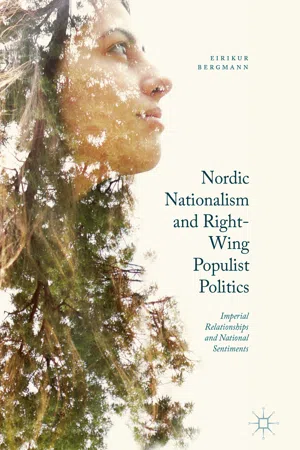
eBook - ePub
Nordic Nationalism and Right-Wing Populist Politics
Imperial Relationships and National Sentiments
- English
- ePUB (mobile friendly)
- Available on iOS & Android
eBook - ePub
Nordic Nationalism and Right-Wing Populist Politics
Imperial Relationships and National Sentiments
About this book
Information
© The Author(s) 2017
Eirikur BergmannNordic Nationalism and Right-Wing Populist Politics10.1057/978-1-137-56703-1_11. Introduction: Nationalizing the North
Eirikur Bergmann1
(1)
Bifrost University, Reykjavik, Iceland
Viewed as model societies of the modern world, the Nordics are most often seen as stable states of solid wealth, high education, wide-scale public welfare, gender equality and benign foreign policies for world peace—crowned by their generous development aids. Cultural exports such as Swedish pop music, Norwegian crime novels, Icelandic mythology literature, Finnish saunas and Danish dramatic TV shows have spread a Nordic vibe around the world—the Nordic Noir, which the world has grown to love. These are countries most often occupying the top end on world lists measuring prosperity, peace and happiness. According to some of these lists, to name just a few examples, Danes are the happiest, Norwegians the richest, Finns the best educated, Iceland the most peaceful and, as The Guardian once put it, Sweden ‘the most successful society the world has ever known’ (Toynbee, 2005).
Beneath the surface, however, lie trends and deeply rooted trails of long-lasting nationalistic ideas, which have, as of yet, been understudied in contemporary literature on the Nordics. Right-wing populism was on the rise in the region already in the 1970s with the establishment of the Progress Parties in Denmark and Norway. Since then, these sorts of politics—perhaps most vividly illustrated in the increasingly troubled race relations in few of the Copenhagen housing projects—have only seen ever-greater support. This is evident, for example, in the sweeping success of the True Finns as well as the Sweden Democrats surging in the new millennium. Unlike many right-wing populist parties elsewhere in Europe, the new Nordic populists did not oppose the redistributive equalitarian Social Democratic state; rather they were redefining the universal Nordic welfare and linking it exclusively to the native populations. In turn, immigrants were seen as a threat to the welfare nation-state they vowed to protect.
When analyzing this sort of politics, trails of thoughts can be traced through to the National Socialist movements of the 1920s and 1930s—the respective Nordic version of Nazi parties. During the Second World War, more than half of the Swedes were pro German (see in Booth, 2014: 300). In the 1980s, gangs of skinheads were roaming around Oslo and Stockholm screaming neo-fascist slogans and waving symbols of ancient Norse mythology while beating up immigrants. Strained religious relations took a comic turn in 2005 when one of Denmark’s most prestigious broadsheets commissioned several cartoonists to mock prophet Mohammed, spurring anger around the Muslim world. The most horrible example of Nordic extreme nationalism in contemporary times was native Anders Behring Breivik’s terrorist attack on Oslo and on Norway’s Labour Party youth movement gathering in the Utøya Island in July 2011, killing 77 of those whom he accused of being responsible for ruining his country’s Nordic heritage by their social democratic multicultural beliefs.
Integrationist strives that led to the unification of, for example, Italy and Germany failed in the Nordic region in the nineteenth century, giving birth to the Nordic system of independent nation-states. To properly understand the finer fabric and inner nature of contemporary Nordic societies, it is necessary to contemplate ongoing undercurrents of Nordic nationalism—which is the aim of this book.
Imperial Relations
Though perhaps subtle in modern-day politics, intra-Nordic relations are still marked by their imperial past. With the break-up of the Kalmar Union in the sixteenth century, Sweden and Denmark once again emerged as rival imperial powers of the region—each dominating its own northern empire. In medieval times, the Nordic kingdoms fluctuated in size, stretching during some periods well beyond the Nordic region of today. The Danish empire reached far into Germany, while Sweden dominated the Baltics and swaths of Russia. Weakened by warfare and black-death plague, resulting in serious agricultural crisis, the two dominating powers merged by the end of the fourteenth century into a constitutional union named after the Kalmar region in southern Sweden. This was rather an arranged marriage of convenience than one entered into because of true love. Already by the second quarter of the sixteenth century, the Kalmar Union was breaking up. Denmark now included the northern German duchies and Norway, as well as the islands in the north-west Atlantic, while Sweden comprised Finland and reached into the Baltics, where Denmark also held territories.
Soon after splitting up, the two powers came at odds, resulting in a prolonged Nordic conflict and developing a deeply strained love–hate relationship still significant when studying the Nordics. Initially, Denmark developed more prosperous economy and built mightier military muscle power while Sweden was gradually gaining strength. Slowly, mostly through successful military expeditions into Russia and Poland in the early seventeenth century, Sweden began to threaten the strong Danish position in the region. During the 30-year wars, Swedish troops, for example, invaded Danish-controlled Holstein from the German side and entered into Jutland in 1643 while at home pressuring the Danes out of Scania, which is southern Sweden today. Denmark though steadily resumed strength in the continued conflict, which in the eighteenth century had calmed into a more stable balance of power in the region (see Griffiths, 2004).
Napoleonic Wars
After prolonged conflict, the two Nordic empires—Sweden in particular but Denmark also to some extent—were suffering costs of war while prosperity and indeed populations were growing faster in their control territories of Norway and Finland. Accompanying greater strength, the peoples of the territories were by the nineteenth century demanding more domestic influence. This was in line with trends of the Enlightenment emphasizing democratic rights of nations, which, for example, were leading up to the French revolution.
In the subsequent Napoleonic Wars, the Nordic power structure was once again significantly reshuffled. When defeating Sweden, Russia acquired Finland, which became a grand duchy of Russia, but with high level of autonomy. After realigning, now alongside Russia and England, Sweden on the other hand won Norway from Denmark. Both territories, Norway and Finland, however enjoyed much greater autonomy in their new imperial homes. Norway was for example awarded with new progressive constitution bringing home significant legislative powers. When removed from Denmark across the border to Sweden, Norway was though stripped from the islands in the north-west Atlantic—Iceland, the Faroe’s and Greenland—which remained left behind within Denmark.
Period of long-awaited peace prevailed in the Nordic region after the end of the Napoleonic wars. The nineteenth century brought streams of nationalistic thought running through Europe and eventually finding way up north, leading many sub-actuated peoples of the two Nordic imperial conglomerates to foster aspirations for self-autonomy. This was a time of nation building, destabilizing many of the old supra-national absolutist monarch empires. On canopy of the European romanticism and liberalism, independence movements were rapidly gaining momentum in Finland, Norway and Iceland.
The Danish supra-national monarch empire was rapidly evaporating. Absolute power of the king was removed by a democratic constitution in Denmark in 1849. Scania had gone back to Sweden, and their German lands of Schleswig and Holstein were soon lost together with many overseas territories. Lastly, Iceland left. With traumatic effects on the Danish political identity, explored further in Chap. 2, the Danish supra-national empire had in short period shrunk to a small nation-state—controlling only the Faroe Island’s and Greenland.
With Finland gone to Russia, Sweden was left with only Norway to rule within its empire. Sweden’s control of Norway was however always limited, which allowed Norway to unilaterally resign from the union in 1905, leaving many Swedes harbouring bitter feelings of betrayal for their new independent neighbour. Imperial times were coming (mostly) to an end in the Nordic region when Finland was able to flee from under Moscow during the Russian revolution, declaring independence in December 1917. Iceland was furthermore able to secure its sovereignty in 1918 and finally ripped loose of formal ties to the Danish king during the Second World War.
This backstory is still significant. Andreas Huyssen’s (2001) claims that a framework for understanding the present is built through remembering past events, where the past event constitutes the source of understanding for complex global interrelations in the present. Importantly, he points out that this involves a successful marketing of these collective memories. The constant and continuous remembrance of the past thus provides a framework and context for an understanding of the present. Anthony Smith (1993) explains how collective memories in relation to a colonial past can even be contradictory and inconsistent.
The nineteenth century also brought large-scale emigration from the Nordics to America. From Sweden alone, more than a million people crossed the Atlantic, a tenth of the population at the time (Martenius, 2014). Almost as many sailed from Norway, and Finland and Denmark lost around half a million each and Iceland even more per capita.
Dual Nationalism
History of the Nordics is not only one of conflict, but rather also one of common community. The nation-statism prevailing since the twentieth century is neither the only form of nationalism in the Nordics. Strong sense of Scandinavianism—later developing into less integrationist Nordism—can also be seen as another sort of nationalism in the Nordic region. Examples can be found at different times. In a lecture in London in 1792, Danish historian Fredrik Sneedorff for example suggested Nordic unity (see in Wetterberg, 2010). In 1810, Danish cultural icon N.F.S. Grundtvig published a pamphlet promoting such Scandinavian unity (Grundtvig, 1810). In the early twentieth century, Icelandic author Gunnar Gunnarsson (1927), Finnish writer Atos Wirtanen (1942) and Swedish politician Anders Örne all printed similar views. In this sense, Nordic nationalism has dual sides: one emphasizing each of the separate Nordic nations, while the other nourishing ideas of common cultural roots and indeed unified common purpose. Thus, to accurately understand intra-Nordic politics, these still ongoing tensions of national separatism and cultural integration need to be considered.
Scandinavianism was spreading in the nineteenth century. In promoting political unity, Scandinavianism emphasizes a shared Nordic past, perhaps most purely found in Nordic mythology and common linguistic roots of the Old Norse. Here, contestations between single Nordic nation and separate Nordic nations are found. However, contrary to similar unification strives leading to, for example, creation of the German and Italian states, Scandinavianism was unsuccessful in pushing through such integration.
Trade and cultural ties were tidily knit throughout the Nordic region already since medieval times. The royal families of the region were even more closely linked by repeated intra-marriage. During the nineteenth century, romantic notions of shared Nordic heritage were increasingly being fostered by youths and intellectuals, for example, both in Danish and Swedish universities. While political Scandinavianism suffered a fatal blow in the wake of the Napoleonic wars giving rise to nation-statism, cultural Nordism still flourished, for example, in Nordic literature nourishing sense of common cultural community.
Close relations between the Nordic nation-states were furthermore institutionalized by many different practical measures. In the late nineteenth century, the Nordics created common cross-border rail links, a postal union and united in a common currency surviving into the First World War. Much of the regions’ research resources were pooled in joint academic endeavours, and even limited legislative and judicial cooperation was initiated. Lots of non-governmental associations were formed, weaving the fabric of Nordic interstate cooperation ever closer (see Wetterberg, 2010).
New Nordic Order
Denmark’s loss of Schleswig-Holstein to Germany in 1848 and 1864 marks the end of the political integrationist Scandinavianism, but gives birth to cultural Nordism based on the Nordic system of nation-states being created in the wake of the Napoleonic wars. The early twentieth century saw dawn of the new system of Nordic nation-states comprising Denmark, Finland, Iceland, Norway and Sweden together with the home-rule territories of Faroe Island and Greenland belonging to Denmark and Åland belonging to Finland.
Though imperial times were generally mostly over, indigenous populations were still being subjugated in the Nordic region. Danish colonizers dominated the small Inuit societies in Greenland, oscillating between civilizing and conservation policies towards people they saw as noble savages. In northern Norway and the Lapland region in Finland and Sweden, the Sami people’s way of life and cultural heritage were similarly being undermined (for more on imperial relations, see Adler-Nissen and Gad (2014).).
Though political Scandinavianism of actively promoting United Nordic States was gone by the twentieth century, the region’s close cultural and indeed political relations were emphasized within tight-knit associations and institutions. Leading up to the First World War, the Nordics jointly declared neutrality, and in December 1914, the three kings of Denmark, Norway and Sweden met in Malmö together with their foreign ministers, marking thaw between Sweden and Norway after a period of friction when Norway had unilaterally left the union with Sweden almost a decade earlier. At the end of First Word War, Nordic Associations were formed in each of the Nordic states in order to promote further intra-regional cooperation. This increased cooperation was however not without its conflicts. The interwar years were for example marked by friction between Norway and Sweden over Svalbard and Norway and Denmark over Greenland.
In the wake of the Great Depression starting in 1929, Nordic leaders were seeking renewed economic cooperation in order to break away with protectionist measures and promoting trade. Further systemic cooperation however only occurred after the Second World War when the Nordic Council was founded in 1952, linking the respective parliaments in close intergovernmental cooperation. A Nordic passport union allowed citizens of the different countries to travel freely throughout the region, and a joint labour market was established including recognition of mutual rights of social insurances.
Ambitious plans for increased economic integration, in what was supposed to be the Nordic Economic Union (NORDEK), being negotiated in the late 1960s, however failed. This would have been a true economic union, similar in nature to the European Economic Community (EEC) of the Rome treaties on the European continent (see Sonne, 2007). Ill fate of NORDEK was the second failure o...
Table of contents
- Cover
- Frontmatter
- 1. Introduction: Nationalizing the North
- 2. Denmark: From Multi-Ethnic and Supra-National Empire to Little Denmark
- 3. Finland: Nation Building While Manoeuvring Through Big Powers Conflicts
- 4. Iceland: Ever-Lasting Independence Struggle
- 5. Norway: From the Poor Periphery to Top of the World
- 6. Sweden: Far Right Sentiments Simmering Underneath the Model Democratic Welfare Society
- 7. Conclusions: Dual Nordic Nationalism
- Backmatter
Trusted by 375,005 students
Access to over 1.5 million titles for a fair monthly price.
Study more efficiently using our study tools.
Frequently asked questions
Yes, you can cancel anytime from the Subscription tab in your account settings on the Perlego website. Your subscription will stay active until the end of your current billing period. Learn how to cancel your subscription
No, books cannot be downloaded as external files, such as PDFs, for use outside of Perlego. However, you can download books within the Perlego app for offline reading on mobile or tablet. Learn how to download books offline
Perlego offers two plans: Essential and Complete
- Essential is ideal for learners and professionals who enjoy exploring a wide range of subjects. Access the Essential Library with 800,000+ trusted titles and best-sellers across business, personal growth, and the humanities. Includes unlimited reading time and Standard Read Aloud voice.
- Complete: Perfect for advanced learners and researchers needing full, unrestricted access. Unlock 1.5M+ books across hundreds of subjects, including academic and specialized titles. The Complete Plan also includes advanced features like Premium Read Aloud and Research Assistant.
We are an online textbook subscription service, where you can get access to an entire online library for less than the price of a single book per month. With over 1.5 million books across 990+ topics, we’ve got you covered! Learn about our mission
Look out for the read-aloud symbol on your next book to see if you can listen to it. The read-aloud tool reads text aloud for you, highlighting the text as it is being read. You can pause it, speed it up and slow it down. Learn more about Read Aloud
Yes! You can use the Perlego app on both iOS and Android devices to read anytime, anywhere — even offline. Perfect for commutes or when you’re on the go.
Please note we cannot support devices running on iOS 13 and Android 7 or earlier. Learn more about using the app
Please note we cannot support devices running on iOS 13 and Android 7 or earlier. Learn more about using the app
Yes, you can access Nordic Nationalism and Right-Wing Populist Politics by Eirikur Bergmann in PDF and/or ePUB format, as well as other popular books in Politics & International Relations & Comparative Politics. We have over 1.5 million books available in our catalogue for you to explore.