eBook - ePub
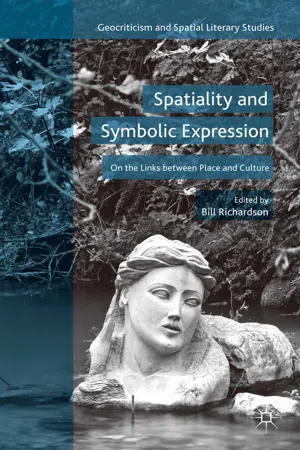
Spatiality and Symbolic Expression
On the Links between Place and Culture
- English
- ePUB (mobile friendly)
- Available on iOS & Android
eBook - ePub
About this book
In this volume, scholars from a wide range of fields within the humanities explore the links between space and place and their relation to cultural expression. This collection shows that a focus on the spatial can help elucidate important facets of symbolic expression and cultural production, whether it be literature, music, dance, films, or art.
Information
CHAPTER 1

SPACE, TIME, AND THE ARTICULATION OF A PLACE IN THE WORLD: THE PHILOSOPHICAL CONTEXT
Felix Ó Murchadha
The question of space is fundamentally a question of orientation: to take up space is to have a location facing toward or away from other places. Space is, in that sense, relative to a place, a location from which and toward which it is. In this directedness toward another place, every location is a place contingent to another. The contingency of place is twofold: the orientation from this place and not another, the priority therefore of this place as the location orientated toward other places, is the result of historically accountable, but specific, reasons; and, second, the place is contingent in the sense of touching upon (con-tingere) another place in relation to which it is. To be in place is to be in this place rather than that place, to be in this time not another possible time, and in consequence to be in a time and a space that is both contingent and inescapable. Such emplacement is a being within articulations of space and time. Again the twofold meaning of this term is helpful: space and time are articulated in place in the sense that the latter appears as separated into joints, as structured according to differences that constitute continuities of space, space as places; second, these joints make up the divisions, the boundaries of space that are marked by names, but also by remembrances and haunting presences of past events and of future hopes and fears. Articulated space, space as lived place, has a temporal structure as growth and decay, and as familiar (habitual) and strange (novel).
This intertwining of time and space marking a place of a self and a place where a self encounters itself as strange, as out of place, is itself an event of production, literally of bringing forth through language and building of a place in which human beings are. But, to describe such a place, it is necessary to understand it in terms of the self in its attempts at self-articulation. The question of space is at once a question of the self for whom space is, but for whom that space is as home or as strange, as set in clear boundaries or as disrupted and obscure, as orientated centrifugally from the self or as a place in which the self dwells only on the periphery. This problematic has been at the core of much of the philosophical accounts of space since Immanuel Kant. While Kant understands space from the place of the transcendental subject, which is both a place and no place in the world, the discussions of space since Kant tend to gradually undermine the basic tenets of his account. What we can see here is a desubjectification, a pluralization, a temporalization, and a displacement of space. In this chapter I wish to trace these developments from Kant to Giorgio Agamben, from commanded space to exilic (dis-)place.
FORM OF SPACE
For Kant there is only one space. The oneness of space is, however, ensured by the experience of a subject. The subject experiences the outer world through the a priori form of space. Space is not an empirical concept, because, if it were, the subject would be able to represent space as an object. In fact what I perceive are objects, and to perceive them at all is to perceive them already in spatial relations—as outside of myself, as near or far. Such spatial relations, for Kant, are not themselves perceived but rather make possible external perception. As he puts it, “[T]he representation of space cannot be obtained through experience from the relations of outer appearance. On the contrary, this outer experience is itself possible at all only through that representation.”1
As an a priori intuition, space is necessary for all access to external reality. While I can think a world in which nothing existed, I cannot think a world without space. Space is not a discursive concept; it is not produced through generalization of experienced relations, but rather is a pure intuition.
Furthermore, for Kant there is only one space and “if we speak of diverse spaces, we mean thereby only parts of one and the same unique space.”2 Understood in this way, space is a purely geometric concept, a concept of the dimension of extended objects. The certainty of geometry derives from its roots in the a priori structure of spatial intuition, which is pure of the contingency of empirical representation.
It is, nevertheless, the case that we can only speak of space from the standpoint of a human being.3 More specifically, space is conditional on the form of sensibility of human beings. The fundamental premise of critical philosophy, namely, that the condition of possibility of the object of perception is the condition of possibility of the perception of the object, entails here that space is constitutive of things in their appearance to a perceiving subject, but not of things in themselves. In this sense, space is both ideal and real: ideal with respect to things in themselves, but real with respect to things as appearances. For something to appear to me as an object of perception is for that thing to appear as spatial. So while, for example, the color, taste, and so on, of such objects are relative to the sense organs of the perceiving subject, the objects cannot be as appearing objects except as really spatial, that is, as really appearing in spatial relations of proximity and distance, of inner and outer.4
The specificality of space, that which makes a space this space rather than that, is a matter of the perceiving subject, not of the objects making up that space. Orientation in space is a matter of the subject’s orientation, such that spatial indicators—in front, behind, above, below, to the right, and to the left—all refer to the subject, indeed to the sense of orientation (Gefühl) of an embodied subject. Kant terms this a “sense” or “feeling” because the differences of left and right are not to be found in external intuition.5 Orientation in space requires both objective reference (e.g., to the sun) and a subjective basis of distinction in order to tell the difference between north and south or east and west. Without this capacity an astronomer would not be able to tell the difference in the night sky if by some miracle the direction of the stars was changed but their order remained the same.6
The subjectivity of spatial orientation does not affect the objective reality of space itself. This is so because subjective orientation occurs within space, and space is irreducible to the relations between objects. As such, space is fundamentally an empty concept; space is that in which objects are, but which can be thought independently of any objects. What characterizes this space is its infinity, as there is no other space outside it, and its existence all at once (zugleich). Fundamental to the intuition of space is that whatever I perceive exists simultaneously with all other things in this one space. As such space is not alone fundamental to external perception, prior to any objects of that perception, but is also characterized by a particular temporal relation, namely, as existing simultaneously, at the same time.
As is well known, Kant illustrates this simultaneity with the example of perceiving a house, as opposed to a boat sailing up a river7: in the case of the house, the simultaneity is shown by the fact that the order of my perceptions is indifferent: I can perceive the hall first, and then the kitchen, and then the bedroom, or I can go in the opposite direction; the boat sailing up the river, on the other hand, imposes on me a particular order of perceptions: I perceive it first at one stage and then at another of its journey. These are two temporal experiences, in one case, of an object in motion, in the other, of a stationary object that can be circumambulated. The event quality of the boat journey imposes on me a temporal order, an order of succession in my perceptions, which spatial experience does not. Nevertheless, the experience of simultaneity depends on a possible action, that of reversing the order of perception. The possibility of such a reversal of perception depends not on the inner sense of those experiences—which in terms of my temporal consciousness allow no such reversal—but rather on the continual existence of the formerly perceived objects. In other words, simultaneity understood in terms of appearance depends on the succession of experiences. Such succession, however, does not so much disclose the causal relation of succession as the dynamic community of causal interrelation that lies at the roots of our understanding of space. To quote Kant:
[W]e cannot empirically change our position (perceive this change), unless the existence of matter throughout the whole of space rendered possible the perception of the positions we occupy; and that this perception can prove the contemporaneous existence of these places only through their reciprocal influence, and thereby also the co-existence of even the most remote objects.8
The issue that arises for us here is this: if space is purely a formal intuition, then how do we explain the difference in spatial positions? For Kant this is to be understood in terms of a community of reciprocal causation, but such reciprocal causation does not so much explain different positions in space as the relation of my position to the infinity of coexisting spatial positions. Furthermore, how does coexisting space relate to temporal succession? The successive nature of causal relations, such that even if cause and effect occur at the same time the relation of cause to effect is one of before to after, allows us to understand temporal relations in space, but not how space can itself be temporally constituted.
HISTORICAL SPACE
If, following Kant, we say that there is one space, we can think this empirically only if we think an infinite community of reciprocal causation. But such a community is thinkable only from the center, from a center of experience from which place objects coexist in relations of greater or lesser distance from one another. Such a center is that of a subject who lives in a world with other subjects. While existing in a world together, such subjects, nonetheless, represent multiple centers of experience, multiple centers of orientation through spatial sense or feeling.
It is already necessary to think such a plurality of spatial centers if we are to understand movement. This is Georg W. F. Hegel’s insight (but in essence it is already present in Aristotle): movement is not originally movement in one place, because for movement to happen, each place is becoming the next place. Movement is the simultaneity of departure and arrival, the crossing of thresholds.9 To think movement in this way is already to move beyond any purely formal account of space and time. In the Encyclopaedia, Hegel makes clear that there can be no motion without matter or matter without motion, but matter itself cannot be understood independently of space and time. Against Kant’s formalized account of the latter, Hegel explicitly rejects the matter/form schema underlying Kant’s analysis. For Hegel the separation of space and time as two forms of intuition is an abstraction from the basic characteristic of nature, which he terms “being-outside-of-itself (Aussersichsein).”10 Such “being-outside-of-itself” understood positively is space, understood negatively is time. In turn, these abstract moments when considered concretely are matter, when considered in their self-relation are movement. In other words, if we are to understand space and time as natural kinds correctly, we need to understand them relative to material bodies. Space and time are only with respect to material bodies in their exteriorizing being and in their movement. As such it is misleading to speak of the emerging and passing of things as occurring in time and in space, as if time and space were empty containers in which material things come to be and go out of being. It is rather the case that “time itself is this becoming, this coming-to-be and passing away.”11 Time is manifest in the material body itself, in its present, past, and future. Time is the now of the material thing, which is in a continual process of becoming past through its always emerging future. This now is also the here of the material body, and the unity of the here and now Hegel terms “place (Ort).”12
As this account suggests, place is nothing static, but is rather movement as the “vanishing and self-regeneration of space in time and of time in space.”13 It is on the basis of such an account of place that Hegel can overcome Zeno’s paradox. Famously Zeno argued that an arrow in flight would not move. He states that in any one (durationless) instant of ...
Table of contents
- Cover
- Title Page
- Copyright
- Contents
- List of Figures
- Series Editor’s Preface
- Acknowledgments
- Introduction: The “Spatio-Cultural Dimension”: Overview and a Proposed Framework
- 1. Space, Time, and the Articulation of a Place in the World: The Philosophical Context
- 2. Symbol, Situatedness, and the Individuality of Literary Space
- 3. Bridging Gaps; Building Bridges: Figures of Speech, Symbolic Expression, and Pedagogy
- 4. Spatiality, Place, and Displacement in Two Gaelic Songs
- 5. Lips in Language and Space: Imaginary Places in James Dawson’s Australian Aborigines (1881)
- 6. The Space of Language and the Place of Literature
- 7. Dreaming Well-being into Being: Dualities of Virtual-Actual Communities
- 8. Between a Rock and No Place: Ursula Meier’s Home (2008)
- 9. Op Weg naar Broxeele: The Production of Shared Spaces
- 10. The Politics of Space: Poetical Dwelling and the Occupation of Poetry
- Conclusion: Mapping, Not the Map
- Notes on Contributors
- Index
Trusted by 375,005 students
Access to over 1.5 million titles for a fair monthly price.
Study more efficiently using our study tools.
Frequently asked questions
Yes, you can cancel anytime from the Subscription tab in your account settings on the Perlego website. Your subscription will stay active until the end of your current billing period. Learn how to cancel your subscription
No, books cannot be downloaded as external files, such as PDFs, for use outside of Perlego. However, you can download books within the Perlego app for offline reading on mobile or tablet. Learn how to download books offline
Perlego offers two plans: Essential and Complete
- Essential is ideal for learners and professionals who enjoy exploring a wide range of subjects. Access the Essential Library with 800,000+ trusted titles and best-sellers across business, personal growth, and the humanities. Includes unlimited reading time and Standard Read Aloud voice.
- Complete: Perfect for advanced learners and researchers needing full, unrestricted access. Unlock 1.5M+ books across hundreds of subjects, including academic and specialized titles. The Complete Plan also includes advanced features like Premium Read Aloud and Research Assistant.
We are an online textbook subscription service, where you can get access to an entire online library for less than the price of a single book per month. With over 1.5 million books across 990+ topics, we’ve got you covered! Learn about our mission
Look out for the read-aloud symbol on your next book to see if you can listen to it. The read-aloud tool reads text aloud for you, highlighting the text as it is being read. You can pause it, speed it up and slow it down. Learn more about Read Aloud
Yes! You can use the Perlego app on both iOS and Android devices to read anytime, anywhere — even offline. Perfect for commutes or when you’re on the go.
Please note we cannot support devices running on iOS 13 and Android 7 or earlier. Learn more about using the app
Please note we cannot support devices running on iOS 13 and Android 7 or earlier. Learn more about using the app
Yes, you can access Spatiality and Symbolic Expression by Bill Richardson in PDF and/or ePUB format, as well as other popular books in Literature & Art General. We have over 1.5 million books available in our catalogue for you to explore.