eBook - ePub
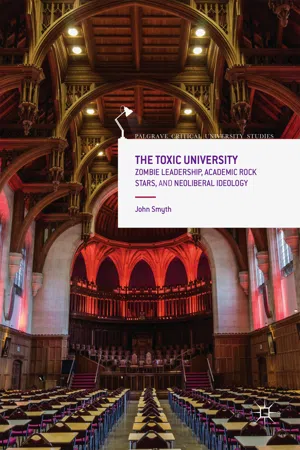
The Toxic University
Zombie Leadership, Academic Rock Stars and Neoliberal Ideology
- English
- ePUB (mobile friendly)
- Available on iOS & Android
eBook - ePub
About this book
This book considers the detrimental changes that have occurred to the institution of the university, as a result of the withdrawal of state funding and the imposition of neoliberal market reforms on higher education. It argues that universities have lost their way, and are currently drowning in an impenetrable mush of economic babble, spurious spin-offs of zombie economics, management-speak and militaristic-corporate jargon. John Smyth provides a trenchant and excoriating analysis of how universities have enveloped themselves in synthetic and meaningless marketing hype, and explains what this has done to academic work and the culture of universities – specifically, how it has degraded higher education and exacerbated social inequalities among both staff and students. Finally, the book explores how we might commence a reclamation. It should be essential reading for students and researchers in the fields of education and sociology, and anyone interested in the current state of universitymanagement.
Information
Topic
EducationSubtopic
Education Administration© The Author(s) 2017
John SmythThe Toxic UniversityPalgrave Critical University Studieshttps://doi.org/10.1057/978-1-137-54968-6_11. Introduction: ‘Getting an Academic Life’
John Smyth1
(1)
School of Education and Professional Development, University of Huddersfield, Huddersfield, UK
What Is This Book About?
I can cut to the essence of what this book is about through retelling an anecdote. In the opening pages of his book Surviving identity, McLaughlin (2012) talks about growing up in Scotland in the 1970s and of it not being uncommon in the streets of cities and towns to see ‘eccentric looking men wearing sandwich-boards proclaiming that “the end is nigh”’ (p. 1). We have all seen them, and they are usually railing against all manner of sinful practices and urging us to ‘buy’ into their particular religious views in order to be ‘saved’. As McLauglin says, we generally ignore these people, treat them as being harmless, regard them as having some sort of mental problem, and go on with our business.
McLaughlin’s point is that while we have no difficulty in dismissing the sandwich-board proclaimers as being somewhat deranged and alarmist, we are much more reticent to dismiss a whole range of not dissimilar contemporary practices that are underpinned by fear and the same ‘survivalist’ mentality. McLaughlin’s claim is that these days we are continually assailed by political claims that unless we follow certain policy trajectories and ideologies presented to us, and construct our lives accordingly in particular ways, we will be doomed! In other words, if we want to be ‘survivors’, to use McLaughlin’s terminology, then we will have to construct ourselves along the lines of a certain kind of identity.
The fear-inducing industry is possibly the most powerful, potent, pervasive, and profound force shaping all aspects of our contemporary lives, as Furedi (1997, 2004, 2005) has shown—and this extends considerably beyond the obvious threat of terrorism. What we are being told by our political and policy elites is that we are under threat at a number of levels—collectively as a society, there is the constant spectre of economic oblivion by our smarter international economic competitors; at the level of our social institutions, universities as a particular example, face certain obliteration unless we continually strive to be in the top echelons of the ‘academic rankings of world universities’; and, individually, academics within universities will perish unless they operate and comport themselves according to a particular set of narrowly conceived rules, in order to survive and insulate themselves from a precarious and fiercely competitive academic world.
What this book is seeking to do is to puncture some of these deeply entrenched and emotional myths as they pertain to the kind of academic identity that is being constructed in/by the contemporary university, and the way academic work is being shaped. It pursues two basic questions:
- Why have academics been so compliant in acquiescing to the construction of universities as marketplaces?
- When universities are conceived in econometric terms, what is the effect, and what kind of consequences flow?
The elephant in the room question, after we strip away all of the marketing hype universities construct around themselves is:
- Have universities become toxic places in which to work?
Why Am I Writing This Book, and in This Particular Way?
It is not always the case that in academic writing we stop and ask ourselves the question—why am I writing this, especially in the present times when universities are continually reminding us to ‘publish or perish’. It is almost a no-brainer! However, this is hardly a justification for writing a book like this one, especially where there are already hundreds of books that describe the carnage being done to universities around the world. The fact that I am writing this at all is all the more remarkable, given that I am no longer in a remunerated university position. I am what is euphemistically called an ‘independent scholar’, made ‘surplus to requirements’, and who is not driven by the mantra of the performativity agenda.
The explanation of why this book has come into existence at all resides, in my case, in looking back over more than 40 years as a university academic, in light of the most recent marketized turn (Rule 1998) that has brought with it a particularly viscous and unsavoury ensemble of unwarranted intrusions into universities that are having all kinds of pathological effects. So what, you may ask? That’s life, and life has changed in all kinds of ways, so just move on! It is not so simple.
If I can put a more precise finger on my animating motive, and there has to be one in taking on such a mammoth task in ‘retirement’, then it has to be to try and cast some light on what I am calling ‘getting an academic life’, and the obstacles and impediments. As a number of scholars have indicated before me, there is something mystical, even magical, about how one gets an academic life—most of it occurring out of sight, invisible to the eye, and at best what we get to see, are the products at the end, and only passing glimpses of the process. I will not be venturing into that space, because it has already been done—for a superb collection of examples on the ‘hidden’ from view nature of academic work, see the edited collection Academic working lives by Gornall et al. (2015).
When massive and possibly irreversible damage is inflicted upon a social institution with little or no opposition, then this ought to be a cause for alarm. When the work of that institution is poorly understood, or mischievously misrepresented in the wider public imagination, then this ought to add urgency to the angst. When that institution happens to be the last remaining place in which social critique and criticism is incubated, nurtured, fostered, encouraged, and supported, then our indignation ought to be almost in hyper-drive. Well, that is the situation in contemporary universities today, and most of what is occurring is largely invisible, and is being covered up or shrouded with a logic that is simply laughable. Put as directly as I can state it, what is happening to universities is placing our societies in a parlous and possibly terminal state.
If we are to unmask what is going on within and to universities, then we need to look forensically at the forces at work and the pathological and dysfunctional effects that are placing academic lives in such jeopardy—hence my somewhat provocative-sounding title ‘the toxic university’.
One of the most succinct explanations of what is animating me in writing this book was put by Lucal (2015)—echoing arguably the most significant sociologist ever, Charles Wright Mills (1971 [1959]) in his The sociological imagination —when she said:
…neoliberalism is a critical public issue influencing apparently private troubles of college [university] students and teachers. (p. 3)
I could not have put it any better myself. To briefly unpick the distinction Lucal is making, just so we do not miss its significance, Mills (1971 [1959]) argued that the purpose of sociology as a perspective, is to go beyond what are presented as ‘personal troubles’ (p. 14)—which he argued reside ‘inside’ individuals and their lives—to looking instead at the ‘public issues’ (p. 15) that constitute the social, economic, and political forces that are really responsible for, and that lie at the heart of these ‘troubles’.
As I have argued elsewhere (Smyth et al. 2014) , Mills was scathing of the academy—his peers—for the way in which they had retreated from the real world into what he labelled ‘the lazy safety of specialization’ (p. 28) within the academy, often doing work that spoke to only a handful of people. What he was referring to, over half a century ago, was the way universities were forcing scholars (and they were complicit in this), into ‘keeping problems isolated within narrow disciplinary sites’ (Smyth et al. 2014, p. 6), with the effect that their unwillingness to ‘take up the challenge[s] that now confront them’, meant that academics were able to ‘further abdicate the intellectual and political tasks of social analysis’ (Mills 1971, p. 29).
My title to this chapter of ‘getting an academic life’ could quite easily be misinterpreted. It could be seen as an opening for the provision of a recipe into how to get a sinecure—a cushy, nice, clean, well-paid, and not too demanding job, with lots of holidays—which is the way academic work is constructed in the wider public imagination. Nothing could be further from my intent. The ‘real’ academic is the complete reverse of its public caricature!
What I am pitching towards in this book is the polar opposite of the popular view. The line I take is that ‘getting an academic life’ means being prepared to experience considerable discomfort, to focus on issues that are not the subject of close critical scrutiny, and taking on powerful and entrenched views that have a lot to lose through being exposed, even when doing so is likely to jeopardize one’s livelihood. Getting an academic life m...
Table of contents
- Cover
- Front Matter
- 1. Introduction: ‘Getting an Academic Life’
- 2. Neoliberalism: An Alien Interloper in Higher Education
- 3. Why the ‘Toxic’ University? A Case of Two Very Different Academics
- 4. Why Zombie Leadership?
- 5. Cultivation of the ‘Rock Star’ Academic Researcher?
- 6. The University as an Instrument of ‘Class’
- 7. The ‘Cancer Stage of Capitalism’ in Universities
- 8. Enough Is Enough…of This Failed Experiment of ‘Killing the Host’
- 9. Get off My Bus! The Reversal of What We Have Been Doing in Universities
- Back Matter
Trusted by 375,005 students
Access to over 1.5 million titles for a fair monthly price.
Study more efficiently using our study tools.
Frequently asked questions
Yes, you can cancel anytime from the Subscription tab in your account settings on the Perlego website. Your subscription will stay active until the end of your current billing period. Learn how to cancel your subscription
No, books cannot be downloaded as external files, such as PDFs, for use outside of Perlego. However, you can download books within the Perlego app for offline reading on mobile or tablet. Learn how to download books offline
Perlego offers two plans: Essential and Complete
- Essential is ideal for learners and professionals who enjoy exploring a wide range of subjects. Access the Essential Library with 800,000+ trusted titles and best-sellers across business, personal growth, and the humanities. Includes unlimited reading time and Standard Read Aloud voice.
- Complete: Perfect for advanced learners and researchers needing full, unrestricted access. Unlock 1.5M+ books across hundreds of subjects, including academic and specialized titles. The Complete Plan also includes advanced features like Premium Read Aloud and Research Assistant.
We are an online textbook subscription service, where you can get access to an entire online library for less than the price of a single book per month. With over 1.5 million books across 990+ topics, we’ve got you covered! Learn about our mission
Look out for the read-aloud symbol on your next book to see if you can listen to it. The read-aloud tool reads text aloud for you, highlighting the text as it is being read. You can pause it, speed it up and slow it down. Learn more about Read Aloud
Yes! You can use the Perlego app on both iOS and Android devices to read anytime, anywhere — even offline. Perfect for commutes or when you’re on the go.
Please note we cannot support devices running on iOS 13 and Android 7 or earlier. Learn more about using the app
Please note we cannot support devices running on iOS 13 and Android 7 or earlier. Learn more about using the app
Yes, you can access The Toxic University by John Smyth in PDF and/or ePUB format, as well as other popular books in Education & Education Administration. We have over 1.5 million books available in our catalogue for you to explore.