- English
- ePUB (mobile friendly)
- Available on iOS & Android
eBook - ePub
About this book
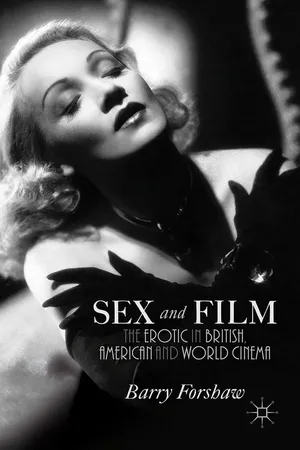
Sex and Film is a frank, comprehensive analysis of the cinema's love affair with the erotic. Forshaw's lively study moves from the sexual abandon of the 1930s to filmmakers' circumvention of censorship, the demolition of taboos by arthouse directors and pornographic films, and an examination of how explicit imagery invaded modern mainstream cinema.
Information
Subtopic
Art General1
The 1930s: From Mae West to the Legion of Decency
The smart, witty and frank sex comedies of the impudent 1930s – notably the ‘bad girls’ cycle of the day – are as fondly celebrated today as when they originally delighted audiences. Crackling with untrammelled sexual energy, their freedom to treat such subjects as prostitution was later prohibited, abruptly ended by the introduction of the Hays Code under its folksy but steely progenitor, Will Hays, the voice of the church. The Code’s draconian restrictions brought about a new age of enforced innocence for the cinema, which was to last for two decades. But the Hay’s Code was not the only opponent of freedom in the cinema, as we shall see. The British establishment, uneasy with the frankness of films, had no ideological arguments with the Code’s strictures.
An early sortie in the sex war had been the notorious Ekstase, which sported the skinny-dipping, youthful Hedy Lamarr making love in a cottage during a rainstorm and showing the clear effects of orgasm. This Czechoslovak film (directed by Gustav Machaty in 1933) is generally considered to be the first time in which sexual intercourse was shown, although with no details of genital contact, and it was seized by the US customs in 1935 and prosecuted for obscenity. As well as being the first major film to depict the sex act and to show female pubic hair, it became the first to initiate the use of customs laws to stop a film entering the US. The film was also an example of a director seeking to enhance the erotic experience of the viewer by utilising other elements such as nature, with couples making love in sylvan settings, although any sense that there is a kind of pantheistic communication with nature as part of the sex act is rarely attempted after Ekstase.
Sex in film would prove to be a battlefield, and America would be where the real conflicts would take place. However, one woman encapsulated a free-and-easy attitude to sex – and powerful religious organisations knew that she had to be dealt with.
Come up and see me sometime
To modern eyes, Mae West suggests a broad, camp parody of the femme fatale, with her massively exaggerated drawl, jutting false eyelashes (now firmly back in favour in various regions of the UK), skin-tight dresses and, above all, her pronounced hips – the latter, in fact, were padded; West was always a construct, and she was fully aware of this. But, in West’s case, the vision of carnality coded for 1930s and 1940s audiences is straightforward: what we see is what we get. West is essentially saying: ‘Don’t take this slyly ravenous man-eater seriously – I don’t.’ And while it is not surprising that Mae West is something of a favourite today among gay audiences with her awareness of and enthusiastic celebration of camp (something she virtually invented), the reasons for her following among feminist viewers are also easy to discern. The standard male prerogative of the movies – the sexual advance that overcomes initial feminine resistance – is turned on its head: it is West who makes the running when it comes to getting her conquests into bed, and her frank physical appraisal of her possible paramours is also specifically masculine. It is particularly fun to see her seducing a young Cary Grant in Lowell Sherman’s She Done Him Wrong (1933), given that the urbane male actor will, from this film onwards, generally be the instigator in scenes of seduction.
Modern viewpoints
West’s attitude to sex itself in her films is a surprisingly modern one in an era in which sexual repression was the order of the day. The actress’s mastery of the double entendre and her knowing self-caricature initially served her well for the stage and films, and there is no question that she enjoyed something of an auteur status, being largely responsible for the screenplays of many of the films she worked on – and frequently voicing dissatisfaction with the contributions of others. After the exuberant stage show Diamond Lil in 1928, which established her take-no-prisoners sexual persona, more commercial success was to follow in the 1930s. But the days when she could indulge in risqué material – which was what she had specialised in – were numbered. Having spotted the potential star quality (not to mention the good looks) of a very young Cary Grant doing physical exercises when an unknown in Hollywood, she inaugurated his career by using him as the detective in Salvation Army disguise in She Done Him Wrong, which was the title chosen for the film version of Diamond Lil. Although entertaining, their scenes together are rather difficult to watch in some respects: she is already a touch too mature, and Grant already has the sophisticated lineaments of his later screen image; in truth, there is no real sexual chemistry between the two – particularly given that the most important aspect of their scenes together is the delivery by West of the killer wisecrack.
West carefully stage-managed her appearances in films – especially her first scenes. The initial shots of her in She Done Him Wrong show her brandishing a parasol and effortlessly attracting the attention of both men and women, prompting such comments as: ‘A fine woman!’ – to which the reply is: ‘One of the finest women that ever walked the streets.’ Similarly, in I’m No Angel (directed by Wesley Ruggles in 1933), she is seen displaying her ample charms outside a showman’s tent, striding, hand on hip, in front of a group of ogling men and making the wry comment to them: ‘Penny for your thoughts?’ Hilarious though this is – particularly in West’s dry delivery – it is also a good example of how West was learning to circumvent censorship restrictions; there is nothing in the line that can be identified as censorable, but, despite that, every savvy viewer of the film knows exactly what thoughts she is referring to. The same film also contains two of her most justifiably famous lines. She asks a further question of her male audience after saucily adjusting her gown: ‘Am I making myself clear, boys?’ This is followed by her quietly amused verdict on her observers: ‘Suckers!’ In fact, although we know she is talking about the unsophisticated audience enthralled by her appeal, we too are the ‘suckers’, reeled in by West and loving every minute of being seduced by her.
To be frank, the individual outings of Mae West are things of shreds and patches, compromised by the necessity for them to be star vehicles for their leading lady with the other characters rarely assuming an importance that matches the name above the title. There is no question of any of her films being a fully integrated comic masterpiece such as Billy Wilder’s Some Like It Hot, with the various comic elements held in balance against each other. But such a balance was not what Mae West’s audiences sought from her work, and the films must be viewed in context. There is a certain honesty in the fact that her roles often demonstrate that sex and Mammon can go hand in hand without any particular problems: West’s characters frequently find their use of sex appeal lucrative. In one scene, she is addressing a group of discarded lovers who are recriminating her for her broken promises, and she simply asks whether they feel they have had reasonable value for their money – it is perfectly clear that we are not expected to see her as being venal in discussing this utterly uncomplicated trading of sex for money.
The curtain descends
West’s reign as the queen of the sex comedy lasted only three or four years into the 1930s. It was sadly inevitable that a woman who traded in an unabashed approach to the erotic would become the target of the morality police, and the Motion Picture Production Code, devised in order to whip a debauched Hollywood into line, was brought to bear on her films. For some time, West was immune to their sorties, not least because her films were so financially successful, and she was granted a little leeway in that she was a home-grown temptress, not one of the more dangerous foreign sirens such as Greta Garbo or Marlene Dietrich. She Done Him Wrong had largely escaped censorship attention, although some sequences involving white slavery had been removed nervously. But, in April 1934, a powerful collaboration between the Roman Catholic Church and laymen similarly concerned with what they saw as the moral decay of America formed the Legion of Decency. The organisation’s Orwellian name may be discredited today, but the Legion wielded considerable power in its heyday and had Hollywood on the ropes. One of the group’s first targets was the ‘depraved’ film output of the actress Mae West, and the motion picture industry, suffering failing box office receipts, was in no mood to take on a powerful religious organisation. Religion may still be utterly woven into the fabric of American life today, but in the 1930s its decision-influencing power at all levels of society was formidable; it was easier by far to kowtow to the Legion of Decency and remove any risky adult content from Hollywood films. West’s new film in 1934 was originally to be called It Ain’t No Sin, but this title was laundered to become the more anodyne Belle of the Nineties. Audiences were surprised to see a strangely incongruous pietistic element creeping into Mae West’s shamelessly enjoyable and raunchy films, such as a large black choir singing morally uplifting spirituals. But it wasn’t just the fact that Mae West was now ‘doing God’; her unblushing sexual remarks were no longer to be heard in the films, and she was even obliged to make disapproving moralistic comments on precisely the kind of behaviour in which audiences once would have loved to see her indulging. From this period on, the sexual aspect of her films becomes harmless in these de-fanged versions. The line that perhaps most depressingly encapsulates the new attitude being forced on West is the one she has to utter with unconvincing sincerity when speaking to a sardonic girl in a dance hall. West says: ‘Any time you take religion for a joke, the laugh’s on you.’ On hearing this at the time, her audiences must have thought: ‘Mae, what have they done to you?’ It was the kind of hypocritical line that in her earlier films would have been given to the unsympathetic, moralistic characters – precisely the kind of attitude that she herself was there to puncture. The star’s days of box office success were numbered, as there was simply no congruence between the po-faced religiosity and a woman who had made no secret of the fact that she liked sex. West, realising that the jig was up, transferred her earlier screen persona back to the stage, where there were fewer restrictions. There were various attempts by directors to lure her back to the cinema, notably from a filmmaker who made no secret of his admiration for large-breasted, broad-hipped women – Federico Fellini – but a Fellini/West film was not to happen. When she was finally tempted back to the cinema in something like her dotage, the result was one of the great cinematic debacles: Mike Sarne’s Myra Breckinridge, which will be discussed later.
See what the boys in the backroom will have: Marlene Dietrich
Marlene Dietrich was born in Berlin with a variety of possible birth dates posited, 1903 or 1906 being the most likely. Had she conducted her film career only in her native Germany, it still would have been a memorable one, not least for her association with the great German director Josef von Sternberg, her Svengali. The latter, seeing Dietrich’s youthful performance in the theatre after her training with Max Reinhardt, was intrigued (even at this nascent stage) by the very element – a rare one – that was to distinguish her film performances: a certain casual coolness and disdain plus a marked sangfroid. This was a woman well aware of her sexuality but uninterested in indulging it in any overt fashion. She was bemused but accepting of her hold over men – and, shockingly for the 1930s, over women, as illustrated by Dietrich’s famous kiss planted on the lips of a girl, the former dressed in a man’s white tie and tails in von Sternberg’s Morocco (1930).
The Dietrich/von Sternberg association began in Germany with the legendary femme fatale Lola Lola in Der Blaue Engel (The Blue Angel) at the start of the decade, with Dietrich’s nightclub singer bringing about the disgrace and destruction of her besotted older lover played by Emil Jannings. Hollywood, ever alert to promising foreign talent, particularly of the sexually alluring kind, quickly beckoned for the actress (and her director). She began to make films in America, but declined an adaptation of Terence Rattigan’s play The Deep Blue Sea by opining that audiences would not accept her as the kind of woman who would commit suicide over losing her lover. With von Sternberg and other directors, she quickly made a mark with the type of imported European sexuality that was very different from that of indigenous American stars; in Dishonoured (directed by her mentor in 1931), she plays the widow of an officer, a woman who has turned to prostitution until spotted by the head of the Austrian Secret Service, who notes her ability to manipulate men. Her favourite director remained the autocratic von Sternberg, who cast her in The Scarlet Empress (1934) to play Princess Sophia of Germany. The film industry always relished royals with a reputation for having a voracious sexual appetite (notably Catherine the Great), and in this film Dietrich is able to suggest a transformation of character, which was something she was not often called upon to do. As Sophia, she moves from being a virginal young princess into the all-powerful figure who dresses as a soldier and exercises power in rooms full of men – and who is not averse to sexually enslaving her guards in the privacy of her bedroom.
Domesticating the exotic
Above all else, Marlene Dietrich was well aware that the moulding of her enticing cinematic image owed a great deal to Josef von Sternberg, and she was always unstinting in her praise of him. But like the American Mae West, although in a different way, the kind of eroticism she traded in became too combustible for Hollywood. Near the start of her Hollywood career, the industry expressly forbade the representation of prostitution on the screen; in Blonde Venus, directed by von Sternberg in 1932, there is a sleight of hand to suggest that she takes money from men for sexual favours but is not actually ‘on the game’. A certain slack was cut for the actress in her representations of such characters by safely distancing them, setting her films in the past or in some exotic foreign locale. Dietrich was nothing if not a survivor, and her delicious comic turn in the Western Destry Rides Again (for director George Marshall in 1939) brought an extension to her faltering career. The expedient used in this film was to depict Dietrich’s mysterious and exotic sexuality with a more jokey, American flavour. Her foreignness was unavoidable, of course, and was signalled in her character’s name: ‘Frenchy’ – German, French, what did it matter? And setting her against the all-American actor James Stewart – yet to establish the darker aspects of his personality in the Westerns he later made for the director Anthony Mann – worked as a canny tactic to integrate her into something that was more like a conventional Hollywood product. Directors and producers always knew that it was a good idea to give Dietrich a song, despite the fact that she actually couldn’t sing; this makes her later concert career with Burt Bacharach as her musical arranger even more of an achievement. But, as with her acting, Dietrich knew precisely how to parley those things that she could do well into her ‘singing’: the insouciance, the husky suggestive voice. And the song she was given for Destry Rides Again, ‘See what the boys in the backroom will have’ (the answer, of course, being her), became as much a signature song of her American career as ‘Falling in love again’ had been in the days of The Blue Angel. Like most iconic stars, she could rise above the absurdity of the material she was obliged to work with, such as her unconvincing scenes with Charles Boyer in Richard Boleslawski’s The Garden of Allah (1936), while Jacques Feyder’s Knight Without Armour a year later (with Dietrich as a Russian countess whose life is in turmoil because of the Russian Revolution) suggested that the very elements that had made her earlier films so compelling were now only fitfully in evidence. As the years went on, and Dietrich moved into her stately concert platform era, she became not so much a parody of herself as a sort of Madame Tussaud’s wax figure – mature, but still retaining the slim and shapely figure of her youth, with dresses slit to the thigh. Audience responses changed from the erotic admiration accorded to her earlier films to a sort of respect for the fact that this ageing woman still – at a distance – looked much as she had in her twenties and could still mesmerise her public. And the element that had been so much a part of her earlier persona – the casual disdain for the way in which she was received, whether manufactured or not – still finessed her long-lasting appeal.
Erotikon: Greta Garbo
To modern audiences, the name ‘Greta Garbo’ suggests the breathily muttered line ‘I vant to be alone!’, and the actress’s place in the upper firmament of 1930s screen stars is assured. Her legend – and that is not too grandiloquent a term – is inextricably linked with the star’s later reclusive lifestyle, when she translated her film persona’s desire for solitude into something of a personal obsession. She became deeply resentful of the paparazzi photographs that showed a lank-haired, unglamorous, middle-aged woman in dark glasses who was quite some distance from the glowing screen image audiences had of her. Rumours of her flexible sexuality further piqued the interest of those who remembered her. But off-screen observations such as this are less important than what remains on celluloid, and what is most striking about Garbo when her films are looked at today is the immense naturalism of her performances, which stand in considerable contrast to the more studied and artificial playing that was largely the norm in her heyday. This naturalistic approach was apparent even in the Swedish actress’s earliest films directed by Mauritz Stiller, whose boundary-pushing Erotikon from 1920 is fondly remembered. Stiller was undoubtedly something of a Svengali figure for her, and, as well as changing her name from Greta Gustafsson, he married her natural shyness with a subtle but powerful sensuousness. The shyness was apparently evident in early films, in which her directors had to conceal a facial tic that demonstrated Garbo’s lack of ease in front of the camera, but Stiller noted, most significantly, that her fresh appeal would prove to be extremely photogenic. Like Marlene Dietrich, Garbo responded to the inevitable summons from Hollywood, and the American industry accommodated her accent, while she worked on her English, by casting her in a series of exotic and foreign roles. The studios quickly realised that her enigmatic quality was something to be stressed both on and off screen, and that it might profitably be played against the mysterious quality of her film characters. The erotic was present in most of her performances, such as that in Queen Christina (directed by Rouben Mamoulian in 1933). Garbo’s performance as the incognito Swedish queen (travelling abroad disguised as a man) has an almost Strasbergian method-style naturalism.
As with all such films in which a woman masquerades as a man, there is the inevitable unveiling, which happens here when her character is obliged to share a bed in a village inn with the attractive Spanish ambassador (played by John Gilbert). The next mo...
Table of contents
- Cover
- Title
- Copyright
- Contents
- Acknowledgements
- Introduction
- 1 The 1930s: From Mae West to the Legion of Decency
- 2 Getting it Past the Puritans: The 1940s
- 3 The Kinsey Era: The 1950s
- 4 Pushing the Boundaries: Preminger the Rebel
- 5 This Property is Condemned: Tennessee Williams
- 6 Arthouse Cinema in Italy: The New Explicitness
- 7 Sex à la Français
- 8 World Cinema Strategies: Britain and America from the 1960s
- 9 World Cinema Strategies: Europe
- 10 Stretching the Parameters: Bergman and Oshima
- 11 The 1970s: Exploitation Joins the Mainstream
- 12 Vixens and Valleys: Russ Meyer’s Cinema
- 13 British Smut
- 14 The Porn Revolution
- 15 Sex Moves Centre Stage: The 1980s and 1990s
- 16 Anything Goes: The Twenty-first Century
- 17 The End of Sex? The New Puritanism
- 18 Painful Odysseys
- Appendix 1: Selected Films
- Appendix 2: Continental Icons of the Seductive
- Selected Bibliography
- Filmography
- Index
Trusted by 375,005 students
Access to over 1.5 million titles for a fair monthly price.
Study more efficiently using our study tools.
Frequently asked questions
Yes, you can cancel anytime from the Subscription tab in your account settings on the Perlego website. Your subscription will stay active until the end of your current billing period. Learn how to cancel your subscription
No, books cannot be downloaded as external files, such as PDFs, for use outside of Perlego. However, you can download books within the Perlego app for offline reading on mobile or tablet. Learn how to download books offline
Perlego offers two plans: Essential and Complete
- Essential is ideal for learners and professionals who enjoy exploring a wide range of subjects. Access the Essential Library with 800,000+ trusted titles and best-sellers across business, personal growth, and the humanities. Includes unlimited reading time and Standard Read Aloud voice.
- Complete: Perfect for advanced learners and researchers needing full, unrestricted access. Unlock 1.5M+ books across hundreds of subjects, including academic and specialized titles. The Complete Plan also includes advanced features like Premium Read Aloud and Research Assistant.
We are an online textbook subscription service, where you can get access to an entire online library for less than the price of a single book per month. With over 1.5 million books across 990+ topics, we’ve got you covered! Learn about our mission
Look out for the read-aloud symbol on your next book to see if you can listen to it. The read-aloud tool reads text aloud for you, highlighting the text as it is being read. You can pause it, speed it up and slow it down. Learn more about Read Aloud
Yes! You can use the Perlego app on both iOS and Android devices to read anytime, anywhere — even offline. Perfect for commutes or when you’re on the go.
Please note we cannot support devices running on iOS 13 and Android 7 or earlier. Learn more about using the app
Please note we cannot support devices running on iOS 13 and Android 7 or earlier. Learn more about using the app
Yes, you can access Sex and Film by B. Forshaw in PDF and/or ePUB format, as well as other popular books in Media & Performing Arts & Art General. We have over 1.5 million books available in our catalogue for you to explore.